
Astrology History: Ancient Origins to Modern Practice | StarPluto
Astrology, the study of the movements and relative positions of celestial bodies interpreted as having an influence on human affairs and the natural world, boasts a history as vast and complex as the cosmos itself. Far from being a modern phenomenon, its roots delve deep into antiquity, intertwining with the very fabric of early civilizations, their religions, sciences, and societal structures.
This ancient practice, often considered the precursor to modern astronomy, has evolved significantly over millennia. From its initial observations of celestial omens to the intricate natal charts of today, astrology reflects humanity's enduring quest to understand its place in the universe and the forces that shape its destiny. This comprehensive overview will trace astrology's fascinating journey, highlighting its pivotal moments and transformations across various cultures and eras.

The majestic ziggurats of ancient Mesopotamia served as observatories, where early civilizations meticulously mapped the heavens, laying the groundwork for astrological practices.
Understanding the historical trajectory of astrology is crucial for appreciating its profound impact on human thought and culture. It reveals how different societies interpreted celestial phenomena, integrated them into their worldviews, and passed down this esoteric knowledge through generations, constantly adapting it to new contexts and discoveries.
The Mesopotamian Cradle of Astrology
The earliest verifiable astrological practices emerged in Mesopotamia, specifically with the Sumerians and later extensively developed by the Babylonians, around the 3rd millennium BCE. These early forms were primarily omens-based, focusing on celestial phenomena as divine messages or warnings concerning the fate of the king and the state.
Babylonian astrologers meticulously observed planetary movements, lunar eclipses, and the appearance of comets, recording these events and their perceived earthly correlations on clay tablets. The famous text series "Enuma Anu Enlil" compiled thousands of such omens, linking celestial occurrences to terrestrial events like wars, famines, and prosperity. This foundational work established a systematic approach to celestial divination.
Key developments during this period included the division of the ecliptic into twelve equal segments, forming the basis of the zodiac. Although not yet individualized natal astrology, this system provided a framework for tracking planetary positions and predicting their influences. The Babylonians' advanced mathematical and astronomical knowledge was instrumental in these precise observations, setting a precedent for future astrological systems.
Astrology in Ancient Egypt
While the Egyptians were renowned for their sophisticated understanding of astronomy, particularly in relation to their calendar and religious practices, their direct contribution to what we recognize as astrology was initially limited. Early Egyptian celestial observations focused on the heliacal rising of stars, like Sirius (Sopdet), which heralded the annual flooding of the Nile, crucial for their agricultural cycle.
However, with the advent of the Hellenistic period, Egyptian and Babylonian traditions began to merge. The concept of "decans" – 36 groups of stars used to mark hours of the night and associated with specific deities and influences – became a significant contribution. These decans later found their way into Hellenistic astrology, influencing interpretations of personality and fate.
The syncretic environment of Ptolemaic Egypt, particularly in Alexandria, became a melting pot where Mesopotamian astrological techniques were integrated with Egyptian spiritual beliefs and Greek philosophical thought. This fusion laid crucial groundwork for the development of individualized natal astrology.
Greek and Roman Astrology: A Synthesis of Knowledge
The true birth of Western astrology, as we largely understand it today, occurred during the Hellenistic period (roughly 3rd century BCE to 1st century CE). Greek scholars, deeply impressed by Babylonian celestial knowledge, translated and systematized these observations, integrating them with their own philosophical concepts, particularly Stoicism and Neoplatonism.
This era saw the development of the natal chart, where the positions of planets and zodiac signs at the moment of an individual's birth were used to predict their character and destiny. Key figures like Claudius Ptolemy, a Greco-Egyptian scholar of the 2nd century CE, codified much of this knowledge in his seminal work, the "Tetrabiblos." This text became the authoritative manual for Western astrology for over a thousand years, detailing planetary aspects, houses, and sign interpretations.
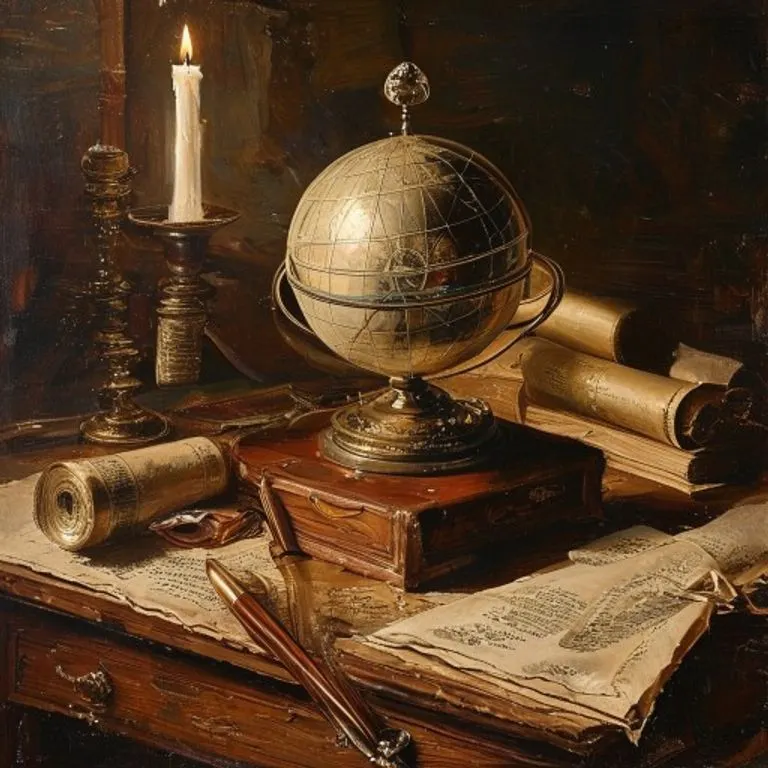
An armillary sphere, a model of celestial objects, symbolizes the meticulous study of the heavens that characterized ancient astrological and astronomical inquiry.
The Romans, who later adopted much of Greek culture, also embraced astrology. Emperors and common citizens alike consulted astrologers for guidance on everything from military campaigns to personal relationships. While some Roman intellectuals, like Cicero, expressed skepticism, the practice remained widespread and influential throughout the Roman Empire, solidifying its place in Western intellectual tradition.
The Golden Age of Islamic Astrology
Following the decline of the Roman Empire, much of the Hellenistic astrological knowledge was preserved and further developed in the Islamic world. From the 8th to the 13th centuries, Islamic scholars played a crucial role in translating Greek, Persian, and Indian astrological texts into Arabic. This period is often referred to as the "Golden Age" of Islamic science and scholarship.
Islamic astrologers not only preserved ancient knowledge but also made significant advancements. They refined astronomical instruments, developed more precise tables for planetary positions, and introduced new astrological techniques, such as the concept of "Arabic Parts" (or Lots) and advancements in horary astrology. Prominent figures like Albumasar (Abu Ma'shar al-Balkhi) and Al-Biruni produced extensive works that influenced both Eastern and Western astrology for centuries.
Astrology was deeply integrated into Islamic courts, where astrologers served as advisors to caliphs and sultans, providing counsel on political decisions, military strategies, and auspicious timings for major events. This patronage ensured the continued study and development of the art, making the Islamic world the leading center of astrological knowledge during this era.
Astrology in Medieval and Renaissance Europe
During the High Middle Ages, European scholars rediscovered classical and Islamic astrological texts through translations from Arabic into Latin, particularly in centers like Toledo, Spain. This influx of knowledge revitalized astrological studies in Europe, leading to its integration into university curricula alongside medicine and astronomy.
The Renaissance witnessed a resurgence of interest in all forms of classical learning, and astrology was no exception. It was considered a legitimate science, practiced by leading intellectuals and physicians. Royal courts employed astrologers to cast horoscopes for monarchs and advise on state affairs. Notable figures like Nostradamus and John Dee were prominent astrologers of their time.
However, this period also saw the beginning of a critical shift. The Scientific Revolution, with its emphasis on empirical observation and mathematical proof, started to challenge the geocentric model of the universe, which was fundamental to traditional astrology. Astronomers like Johannes Kepler, while still practicing astrologers, made discoveries that would eventually lead to the separation of astronomy from astrology.
The Age of Enlightenment and Decline
The 17th and 18th centuries, marked by the Enlightenment and the full blossoming of the Scientific Revolution, saw a significant decline in astrology's academic and intellectual standing. The heliocentric model of Copernicus, Kepler's laws of planetary motion, and Newton's law of universal gravitation provided a mechanistic view of the cosmos that left little room for astrological influences.
As astronomy became a distinct, empirical science, astrology was increasingly relegated to the realm of superstition and popular belief. Universities removed it from their curricula, and mainstream intellectuals largely dismissed it. While it continued to be practiced by some, it lost its status as a respected field of knowledge, especially among the educated elite.

Contemporary digital art illustrates the complex, interconnected nature of celestial bodies, reflecting modern astrological interpretations and their intricate relationships.
Despite its academic marginalization, astrology never entirely disappeared. It persisted in almanacs, popular culture, and among those who continued to seek meaning and guidance beyond the purely material world. This underground existence set the stage for its eventual revival.
The Modern Revival of Astrology
The late 19th and early 20th centuries witnessed a significant resurgence of interest in astrology, largely fueled by the rise of spiritualist and occult movements, such as Theosophy. Figures like Alan Leo are often credited with popularizing astrology in the English-speaking world, shifting its focus from predictive fate to character analysis and personal growth.
The mid-20th century saw a further boom, particularly with the counterculture movements of the 1960s and 70s. The focus moved towards psychological astrology, integrating Jungian archetypes and other psychological theories to interpret natal charts as maps of the psyche. This approach resonated with a generation seeking self-discovery and alternative spiritual paths.
The advent of personal computers and the internet in the late 20th century further democratized astrology. Complex chart calculations, once requiring extensive astronomical tables, became instantly accessible, allowing a wider audience to explore their birth charts and astrological influences. This digital revolution paved the way for astrology's widespread presence today.
Astrology Today: Science, Spirituality, and Pop Culture
In the 21st century, astrology occupies a unique space at the intersection of spirituality, self-help, and pop culture. It is widely consumed through horoscopes in newspapers and magazines, dedicated apps, and online communities. For many, it offers a framework for understanding personality traits, relationship dynamics, and life cycles, serving as a tool for introspection and personal development.
Despite its enduring popularity, astrology continues to face skepticism from the scientific community, which largely considers it a pseudoscience due to the lack of empirical evidence supporting its claims. However, proponents often argue that astrology operates on principles beyond conventional scientific measurement, offering a symbolic language rather than a literal causal mechanism.
Modern astrology is incredibly diverse, encompassing various traditions (Western, Vedic, Chinese) and specialized branches (electional, horary, mundane, karmic astrology). It continues to evolve, adapting to contemporary interests and technologies, maintaining its relevance for millions worldwide who seek meaning and guidance from the stars.
Legal and Ethical Considerations
While astrology has a rich historical and cultural significance, its practice in modern society also brings forth important legal and ethical considerations. These often revolve around consumer protection, truth in advertising, and the responsible provision of services. Practitioners are generally expected to operate with transparency and integrity, especially when offering personal consultations.
Many jurisdictions have consumer protection laws that apply broadly to all services, including those of an astrological nature. These laws aim to prevent misleading claims and ensure that consumers receive what they are promised. Ethical guidelines within the astrological community often emphasize respect for client autonomy, confidentiality, and the avoidance of making definitive, unproven predictions that could cause harm.
The Federal Trade Commission Act, Section 5(a), states: Unfair methods of competition in or affecting commerce, and unfair or deceptive acts or practices in or affecting commerce, are hereby declared unlawful.
This legal principle, from the Federal Trade Commission Act in the United States, underscores the importance of honesty and fairness in all commercial transactions. For astrological services, this implies a responsibility to clearly communicate the nature of the service, manage expectations, and refrain from making false or unsubstantiated claims about outcomes or abilities. Adherence to such principles ensures a trustworthy and respectful interaction between practitioner and client.
Conclusion
The history of astrology is a testament to humanity's enduring fascination with the cosmos and its potential influence on earthly life. From the omen tablets of ancient Babylon to the sophisticated apps of today, astrology has continuously adapted, reflecting the scientific, philosophical, and spiritual currents of each era. It has served as a tool for kings, a subject for scholars, and a guide for individuals seeking self-understanding.
While its scientific validity remains a subject of debate, astrology's cultural and psychological impact is undeniable. It has shaped art, literature, and even the development of early science. As we look to the future, astrology continues to offer a unique lens through which to explore the intricate relationship between humanity and the vast, mysterious universe.
Fuente: Contenido híbrido asistido por IAs y supervisión editorial humana.


Comments
Post a Comment