
Horoscope History: Origins and Evolution | StarPluto
The concept of the horoscope, birth chart, or natal letter is deeply rooted in humanity's age-old fascination with the cosmos and its potential influence on earthly affairs. From the earliest civilizations, humans have looked to the stars, attempting to decipher patterns and predict future events. This practice, known today as astrology, has evolved significantly over millennia, shaping cultures, religions, and even scientific thought.
Understanding the history of horoscopy is not merely an academic exercise; it provides crucial insights into the development of astronomy, mathematics, and early philosophical systems. It reveals a universal human desire to find meaning in the vastness of the universe and to understand one's place within it. This extensive journey traces the origins of astrological practices from their nascent forms to their complex modern interpretations.

The ancient Babylonians were pioneers in celestial observation, laying the groundwork for early astrological practices and the development of horoscopes.
1. The Dawn of Celestial Observation
Long before written history, early humans observed the cycles of the sun, moon, and stars, recognizing their profound impact on seasons, tides, and agricultural rhythms. Evidence from prehistoric caves, such as the famous Lascaux cave paintings, suggests an awareness of lunar phases and possibly constellations, indicating a rudimentary form of celestial tracking. These early observations were not yet astrology in the modern sense but formed the foundational understanding that celestial phenomena were linked to terrestrial events.
Across various ancient cultures, the sky was seen as a divine canvas, reflecting the will of gods and spirits. Shamans and priests often served as early astronomers, interpreting omens and portents from the heavens. This period marked the critical transition from simple observation to the belief that celestial movements held predictive power, a precursor to formalized astrological systems.
2. Babylonian and Mesopotamian Roots
The true birthplace of systematic astrology, and by extension, the horoscope, is widely attributed to ancient Mesopotamia, particularly Babylonia. Around the 2nd millennium BCE, the Babylonians developed sophisticated astronomical knowledge, driven by a desire to understand and appease their deities. They meticulously recorded celestial events, creating extensive catalogues of stars and planetary movements. These records were primarily used for omens affecting the king and the state, known as "omen astrology."
By the 5th century BCE, under Persian rule, Babylonian astrologers began to develop "natal astrology," focusing on individual destinies. This involved constructing a "birth chart" based on the positions of celestial bodies at the moment of an individual's birth. They divided the ecliptic (the sun's apparent path) into 12 equal sections, each associated with a constellation, forming the basis of the zodiac. This innovation marked a pivotal shift from general omens to personalized predictions, a cornerstone of modern horoscopy.
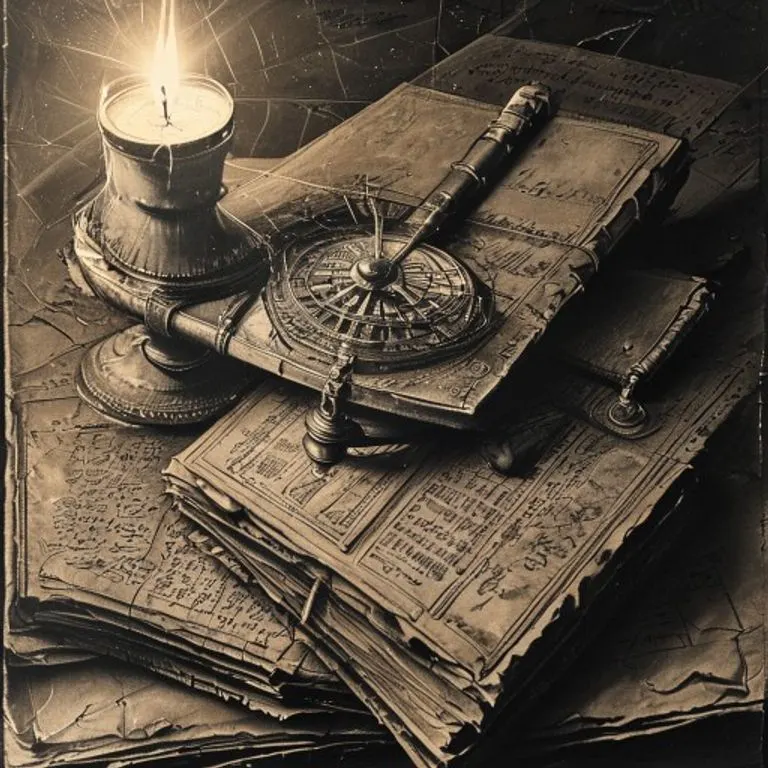
Astrolabes and ancient texts were crucial instruments for early astrologers, enabling precise celestial calculations and interpretations.
3. Ancient Egypt and the Decans
While not the originators of the horoscope, the ancient Egyptians made significant contributions to the astronomical and astrological understanding that would later integrate into Hellenistic astrology. Their primary innovation was the system of "decans," 36 groups of stars that rose consecutively on the horizon throughout the year. Each decan governed a 10-day period and was associated with specific deities and influences.
The decans were initially used for timekeeping, particularly for agricultural and religious calendars. However, they gradually acquired astrological significance, influencing the character and destiny of individuals born under their sway. This system provided a framework for dividing the year into smaller, astrologically meaningful segments, which would later be incorporated into the zodiacal divisions adopted by other cultures. The Egyptians also developed "decancal horoscopes," which were less complex than Babylonian natal charts but still offered personalized insights.
4. Greek and Roman Contributions
The Greeks encountered Babylonian astrology following Alexander the Great's conquests in the 4th century BCE. They readily absorbed and adapted these complex systems, translating cuneiform texts and integrating them with their own philosophical and mathematical traditions. Greek scholars systematized Babylonian astronomical data, applying Euclidean geometry and Aristotelian cosmology to create a more coherent theoretical framework for astrology.
The Romans, in turn, adopted much of Greek culture, including their astrological practices. Astrology became immensely popular in the Roman Empire, influencing emperors, generals, and common citizens alike. Notable Roman astrologers like Vettius Valens and Manilius authored influential texts that further refined astrological techniques, including the calculation of planetary aspects and house systems. The term "horoscopus" itself is of Greek origin, meaning "observer of the hour," referring to the rising sign or ascendant at birth.
5. The Influence of Hellenistic Astrology
The Hellenistic period (roughly 3rd century BCE to 7th century CE) was a melting pot of cultures and ideas, and it was during this time that astrology reached its classical form. Alexandrian Egypt, a major center of learning, played a crucial role in synthesizing Babylonian, Egyptian, and Greek astrological traditions. Key texts from this era, such as Ptolemy's "Tetrabiblos" (2nd century CE), became the foundational treatises for Western astrology for over a thousand years.
Hellenistic astrology introduced several critical concepts that are still central today: the twelve houses, planetary rulerships, aspects between planets, and the ascendant (rising sign). These elements allowed for highly detailed and personalized birth chart interpretations, moving beyond simple zodiac sign predictions. The emphasis shifted to understanding an individual's character, life path, and potential fortunes based on the unique celestial configuration at their birth. This era solidified the horoscope as a complex diagram representing a snapshot of the heavens at a specific moment.

The intricate web of cosmic threads symbolizes the profound and often mysterious connections between celestial events and human existence.
6. Astrology in the Islamic Golden Age
Following the decline of the Roman Empire, much of Hellenistic astrological knowledge was preserved and further developed in the Islamic world. During the Islamic Golden Age (8th to 14th centuries CE), scholars meticulously translated Greek, Persian, and Indian astrological texts into Arabic. They not only preserved this knowledge but also made significant advancements in astronomy and mathematics, which in turn refined astrological calculations.
Islamic astrologers like Albumasar (Abu Ma'shar) and Al-Biruni were highly influential, producing original works that integrated various traditions and introduced new techniques. They improved astronomical instruments, developed more accurate ephemerides (tables of planetary positions), and explored the philosophical underpinnings of astrology. Their work ensured the survival of astrological traditions and facilitated its reintroduction into Europe during the late Middle Ages and Renaissance.
7. Medieval Europe and the Renaissance
Astrology experienced a resurgence in Europe during the 12th century, largely due to translations of Arabic texts into Latin. Medieval universities taught astrology alongside astronomy, medicine, and philosophy. Astrologers served as advisors to kings, popes, and wealthy patrons, providing guidance on everything from military campaigns to marriage alliances and medical treatments. The practice was deeply intertwined with other forms of knowledge and considered a legitimate science.
The Renaissance saw astrology reach its zenith of influence. Prominent figures like Nostradamus and Johannes Kepler practiced astrology, often alongside their astronomical work. Birth charts were cast for nearly every significant individual, and astrological prognostication was a common feature of public life. This era also saw the proliferation of almanacs and popular astrological guides, making basic horoscopy accessible to a wider audience, though often simplified from its complex roots.
8. The Scientific Revolution and the Decline of Astrology
The Scientific Revolution, beginning in the 16th century, marked a turning point for astrology. The heliocentric model proposed by Copernicus, and later supported by Galileo's observations and Kepler's laws of planetary motion, challenged the geocentric worldview upon which classical astrology was based. Isaac Newton's law of universal gravitation provided a mechanistic explanation for planetary movements, undermining the idea of celestial influence on human affairs through mystical means.
As astronomy developed into a distinct empirical science, astrology gradually lost its academic and scientific credibility. Enlightenment thinkers criticized its lack of empirical evidence and its reliance on superstition. By the 18th century, astrology was largely relegated to the realm of popular belief and ceased to be taught in universities, becoming distinct from the burgeoning field of astronomy.
9. Modern Astrology and its Resurgence
Despite its decline in academic circles, astrology never fully disappeared. The late 19th and early 20th centuries witnessed a resurgence of interest, particularly with the rise of spiritualism, theosophy, and the New Age movement. Psychologists like Carl Jung explored the symbolic and archetypal dimensions of astrology, suggesting its relevance to understanding the human psyche, even if not as a predictive science.
The advent of mass media, particularly newspapers and magazines, popularized daily horoscopes, making astrology a household term. While often highly generalized and simplified, these horoscopes introduced millions to the basic concept of zodiac signs and their associated traits. The development of computer software in the late 20th century further democratized astrology, allowing individuals to easily calculate and interpret their own complex natal charts, leading to a renewed interest in its more intricate forms.
10. The Enduring Legacy of the Natal Chart
Today, the natal chart, or birth chart, remains the core tool of astrological practice. It is a unique celestial map, meticulously calculated for the exact time and location of an individual's birth. This map depicts the positions of the sun, moon, planets, and other astrological points within the twelve zodiac signs and twelve houses, all relative to the Earth.
The interpretation of a natal chart involves understanding the interplay of these elements, revealing insights into personality traits, strengths, challenges, and life potentials. While modern science largely dismisses astrology as a predictive tool, its historical significance as a precursor to astronomy and its enduring cultural appeal as a system for self-understanding and personal reflection are undeniable. From ancient Babylonian clay tablets to sophisticated astrological software, the quest to understand our connection to the cosmos through the horoscope continues to evolve.
Source: Hybrid content assisted by AIs and human editorial supervision.


Comments
Post a Comment