
Alchemy: Spiritual Transformation & Personal Growth | StarPluto
Alchemy, often misunderstood as merely the ancient pursuit of turning lead into gold, holds a far deeper and more profound significance. Beyond its material aspirations, alchemy is an intricate philosophical and proto-scientific tradition that, at its core, represents a journey of spiritual transformation and personal growth. This esoteric art, practiced across various cultures and epochs, seeks to purify, refine, and perfect certain materials, but metaphorically, it mirrors the human endeavor to achieve inner perfection and enlightenment.
The concept of spiritual alchemy transcends the physical laboratory, delving into the realms of psychology, philosophy, and mysticism. It proposes that just as base metals can be transmuted into noble ones, the human soul can undergo a similar process, shedding its impurities and reaching a higher state of being. This journey, known as the Magnum Opus or Great Work, involves a series of stages that challenge and transform the individual, leading to profound self-realization.
Table of Contents
- Historical Roots of Alchemy: A Global Legacy
- The Philosopher's Stone: More Than Just Gold
- The Great Work (Magnum Opus): Stages of Inner Transformation
- Alchemical Symbols and Their Profound Meanings
- Alchemy and Psychology: Carl Jung's Individuation
- Modern Applications of Spiritual Alchemy for Personal Growth
- Distinguishing Spiritual Alchemy from Pseudoscience
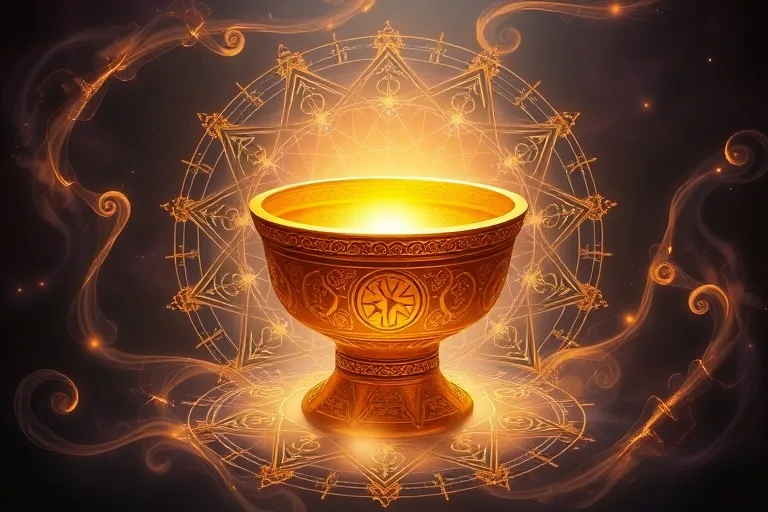
The golden crucible, a timeless symbol, represents the transformative process of Tarot Quantum Mechanics Intersecting Divination Reality, where base elements are refined into higher states of being.
Historical Roots of Alchemy: A Global Legacy
Alchemy boasts a rich and diverse history, with roots tracing back to ancient civilizations across the globe. From the mystical traditions of ancient Egypt to the philosophical schools of Greece, the practical methodologies of Arabic scholars, and the profound spiritual insights of Chinese Taoists, alchemy developed independently yet converged on similar themes of transformation and perfection.
- Ancient Egypt: Often considered the birthplace of alchemy, particularly through the figure of Hermes Trismegistus, whose teachings form the basis of Hermeticism. Egyptian alchemy focused on the mummification process and the transformation of the soul, linking physical processes with spiritual concepts.
- Ancient Greece: Greek philosophers integrated Egyptian knowledge with their own cosmological and philosophical frameworks, introducing concepts like the four elements (earth, air, fire, water) and the idea of a prima materia (first matter) from which all things are derived.
- Arabic Alchemy: During the Islamic Golden Age, Arabic scholars like Jabir ibn Hayyan (Geber) made significant contributions, systematizing alchemical processes, developing laboratory techniques, and introducing the sulfur-mercury theory, which posited that all metals were formed from these two principles.
- Chinese Alchemy: Focused heavily on immortality and health, seeking to create elixirs of life and achieve spiritual longevity. Taoist alchemists explored both external (exoteric) and internal (esoteric) alchemy, with the latter emphasizing meditation, breathing exercises, and internal energy cultivation for spiritual transformation.
These diverse traditions, while distinct in their cultural expressions, shared a common thread: the belief in the possibility of transforming nature, both external and internal, to achieve a state of ultimate perfection. This historical journey underscores alchemy's role not just as a precursor to modern chemistry, but as a profound spiritual discipline.
The Philosopher's Stone: More Than Just Gold
Perhaps the most iconic symbol of alchemy is the Philosopher's Stone, often depicted as a mythical substance capable of transmuting base metals into gold and conferring immortality. While the literal interpretation of this quest captivated many, its deeper, spiritual meaning is far more compelling. The Philosopher's Stone, in esoteric alchemy, represents the culmination of the Great Work—the perfected state of the human soul, free from imperfections and limitations.
This metaphorical "stone" is not a physical object but a state of consciousness, a profound spiritual awakening. Achieving the Philosopher's Stone implies a complete understanding and mastery of oneself, leading to wisdom, enlightenment, and spiritual immortality. It signifies the integration of all aspects of the self, the reconciliation of opposites, and the realization of one's true divine nature. The pursuit of this stone is, therefore, a quest for ultimate self-knowledge and spiritual liberation.
The Great Work (Magnum Opus): Stages of Inner Transformation
The Magnum Opus, or Great Work, is the central process of alchemy, outlining the steps required for both material and spiritual transformation. While the exact number and names of stages vary across traditions, four primary phases are consistently recognized, each representing a crucial step in the journey of inner purification and perfection.
Ancient texts and mystical vials symbolize the profound wisdom and hidden knowledge central to the alchemical quest for Tarot Quantum Mechanics Intersecting Divination Reality.
- Nigredo (Blackening): This initial stage involves decomposition, putrefaction, and the confrontation with one's shadow self. It's a period of intense introspection, acknowledging and integrating repressed aspects of the psyche. Symbolically, it's the blackening of matter, the death of the old self, necessary for new life to emerge.
- Albedo (Whitening): Following the darkness of Nigredo, Albedo represents purification and cleansing. It's the washing away of impurities, leading to a state of clarity, innocence, and spiritual awakening. This stage is associated with illumination, the emergence of light from darkness, and the development of intuition.
- Citrinitas (Yellowing): Historically, this stage was often merged with Rubedo in later alchemical traditions. It signifies the dawning of solar consciousness, the awakening of spiritual wisdom, and the integration of masculine and feminine principles. It marks the transition from lunar consciousness (Albedo) to solar consciousness, bringing intellectual and spiritual illumination.
- Rubedo (Reddening): The final stage, Rubedo, represents the culmination of the Great Work—the achievement of the Philosopher's Stone. It signifies the union of opposites, the perfection of the self, and the realization of divine consciousness. This stage is associated with spiritual marriage, rebirth, and the creation of the "red king" or "red elixir," symbolizing ultimate spiritual power and wholeness.
Each stage of the Magnum Opus is not merely a linear progression but a cyclical process, with lessons and transformations continuously unfolding throughout one's life. It is a testament to the enduring human desire for self-improvement and spiritual evolution.
Alchemical Symbols and Their Profound Meanings
Alchemical texts are replete with complex symbols, each carrying layers of meaning related to both chemical processes and spiritual states. Understanding these symbols is key to unlocking the esoteric wisdom of alchemy. They often represent fundamental principles, elements, or stages of transformation.
- Mercury (Quicksilver): Represents the spirit, consciousness, and the volatile, transformative aspect. It is the bridge between heaven and earth, the mind and the body.
- Sulfur: Symbolizes the soul, the fiery, active principle, and the individual's will or ego. It is the fixed, unchanging essence.
- Salt: Represents the body, the material, and the passive principle. It is the stable, physical foundation.
- Ouroboros: The serpent eating its own tail, symbolizing cyclicality, self-sufficiency, and eternal renewal. It represents the unity of all things and the continuous process of creation and destruction.
- Caduceus: Often depicted as two serpents entwined around a staff, it symbolizes balance, healing, and the integration of opposing forces, particularly the masculine and feminine principles.
- Sun and Moon: Represent the masculine (conscious, rational) and feminine (unconscious, intuitive) principles, whose union is essential for wholeness.
These symbols were not merely decorative; they were a language, a code that conveyed profound truths about the universe and the human psyche. Their study offers a pathway into the alchemical worldview and its emphasis on interconnectedness and transformation.
Alchemy and Psychology: Carl Jung's Individuation
In the 20th century, the renowned Swiss psychiatrist Carl Jung recognized the deep psychological relevance of alchemical processes. He saw alchemy not as a failed attempt at chemistry, but as a symbolic projection of the individuation process—the psychological journey of integrating the conscious and unconscious aspects of the self to become a whole, unique individual.
Jung drew parallels between the alchemical stages of Nigredo, Albedo, and Rubedo and the phases of psychological development. Nigredo, for instance, corresponded to confronting the shadow, the unconscious aspects of the personality that are often repressed. Albedo represented the purification of consciousness, leading to clarity and self-awareness. Rubedo, the final stage, mirrored the integration of all psychic components, resulting in the "Self"—the archetype of wholeness and the ultimate goal of individuation.
The vibrant vortex of colors captures the essence of the Tarot Quantum Mechanics Intersecting Divination Reality, a dynamic and continuous process of growth and refinement.
Jung's work legitimized the study of alchemy as a valuable resource for understanding the human psyche and its quest for wholeness. He viewed alchemical texts as a rich tapestry of symbolic language that revealed universal patterns of psychological development, offering insights into the depths of the unconscious mind.
Modern Applications of Spiritual Alchemy for Personal Growth
While the physical pursuit of gold has largely faded, the spiritual and psychological principles of alchemy remain highly relevant for personal growth in the modern era. Contemporary spiritual alchemy focuses on applying these ancient insights to self-improvement, mindfulness, and achieving a more integrated and fulfilling life.
Here are some ways spiritual alchemy can be applied today:
- Self-Reflection and Shadow Work: Embracing the Nigredo stage by consciously confronting one's flaws, fears, and repressed emotions. This involves deep self-inquiry, journaling, and therapy to understand and integrate these aspects rather than suppress them.
- Purification and Clarity: Practicing mindfulness, meditation, and self-care to cleanse the mind and body (Albedo). This can involve detoxing from negative influences, cultivating positive habits, and seeking clarity in one's purpose.
- Integration of Opposites: Recognizing and harmonizing the various dualities within oneself—logic and intuition, strength and vulnerability, masculine and feminine energies (Citrinitas and Rubedo). This leads to a more balanced and authentic self.
- Intentional Creation: Applying alchemical principles to manifest desired outcomes in life. By clearly defining one's goals, purifying intentions, and persistently working towards them, individuals can "transmute" their aspirations into reality.
- Continuous Evolution: Viewing life's challenges as opportunities for growth and transformation, understanding that the alchemical process is ongoing. Each experience, whether positive or negative, can be a catalyst for further refinement of the self.
Spiritual alchemy offers a powerful framework for navigating the complexities of modern life, providing tools and perspectives for profound inner work and sustained personal evolution. It encourages individuals to become conscious architects of their own spiritual destiny.
Distinguishing Spiritual Alchemy from Pseudoscience
It is crucial to differentiate between the historical and metaphorical understanding of alchemy and modern pseudoscientific claims. While historical alchemy was a legitimate precursor to chemistry and a profound philosophical system, some contemporary interpretations can stray into areas lacking scientific rigor or ethical foundation.
Spiritual alchemy, as discussed here, is primarily a symbolic and psychological framework for personal development. It does not claim to physically transmute elements or provide literal elixirs of immortality. Its value lies in its rich symbolism and its historical contribution to understanding human consciousness and the drive for self-perfection.
The distinction between genuine scientific inquiry and pseudoscientific claims is vital for maintaining intellectual integrity and promoting informed understanding. While historical practices often blended science, philosophy, and mysticism, modern interpretations must be critically evaluated against established scientific principles.
The pursuit of knowledge, whether through empirical observation or philosophical introspection, requires a commitment to verifiable evidence and rational discourse.
Engaging with alchemical concepts from a historical, philosophical, or psychological perspective can be immensely enriching. However, it is important to approach any claims of physical transmutation or miraculous cures with skepticism and to rely on scientifically validated information for health and material well-being.
In conclusion, alchemy, particularly in its spiritual dimension, offers a timeless blueprint for personal transformation. It invites us to embark on an inner journey, to confront our shadows, purify our intentions, and integrate all aspects of our being to achieve a state of wholeness and profound self-realization. This ancient art continues to inspire and guide those who seek to turn the "base metals" of their ordinary existence into the "philosophical gold" of an enlightened life.
Fuente: Contenido híbrido asistido por IAs y supervisión editorial humana.


Comments
Post a Comment