
Planetary Hours: Daily Planning for Productivity | StarPluto
In our fast-paced modern world, the quest for optimal productivity and effective time management is constant. While many turn to digital tools and productivity hacks, ancient wisdom offers a unique and often overlooked approach: planetary hours. This system, rooted in Hellenistic astrology, proposes that each hour of the day is governed by a different planet, imbuing it with specific energies conducive to certain activities.
Understanding and utilizing planetary hours can transform your daily planning, helping you to align your tasks with the prevailing cosmic rhythms. This alignment can lead to increased efficiency, reduced stress, and a deeper connection to the natural flow of time. By consciously choosing to perform specific actions during their most favorable planetary hours, individuals can enhance their chances of success and experience a greater sense of ease in their endeavors.

Cosmic Clock: A digital illustration depicting a stylized clock face where planetary symbols replace traditional numbers, set against a backdrop of swirling nebulae and cosmic dust.
Understanding Planetary Hours: History and Calculation
The concept of planetary hours dates back to ancient Babylon, later refined and adopted by Hellenistic astrologers. It is based on the Chaldean order of the planets, which arranges them by their apparent speed as observed from Earth: Saturn, Jupiter, Mars, Sun, Venus, Mercury, Moon. This sequence dictates the ruling planet of each hour.
Unlike modern fixed-length hours, planetary hours are dynamic. The period from sunrise to sunset (day) is divided into 12 equal "day hours," and the period from sunset to the next sunrise (night) is divided into 12 equal "night hours." This means that the length of a planetary hour varies throughout the year and depends on your geographical location and the season.
The first hour of the day, starting at sunrise, is always ruled by the planet that rules the day of the week. For example, Sunday's first hour is ruled by the Sun, Monday's by the Moon, Tuesday's by Mars, and so on. After the first hour, the planetary rulers follow the Chaldean order, cycling through the seven traditional planets.
The Seven Traditional Planets and Their Influences
Each of the seven traditional planets—Sun, Moon, Mercury, Venus, Mars, Jupiter, and Saturn—is associated with distinct qualities and types of activities. Understanding these associations is key to effectively using planetary hours for daily planning. By matching your tasks to the energetic signature of the ruling planet, you can enhance their flow and outcome.
- Sun: Associated with vitality, leadership, self-expression, and success. Best for presentations, seeking recognition, starting new projects, or engaging in activities that require confidence and authority.
- Moon: Governs emotions, intuition, nurturing, domestic matters, and the public. Ideal for reflection, emotional healing, family time, gardening, or activities involving the general public.
- Mercury: Rules communication, intellect, learning, travel, and commerce. Excellent for writing, studying, negotiating, signing contracts, making phone calls, or short trips.
- Venus: Represents love, beauty, harmony, art, and social interactions. Favorable for creative pursuits, social events, romantic encounters, beautification, or resolving conflicts.
- Mars: Associated with action, courage, energy, competition, and assertion. Good for physical activity, tackling challenging tasks, initiating bold moves, or engaging in debates.
- Jupiter: Governs expansion, luck, wisdom, higher education, and prosperity. Optimal for financial investments, learning, spiritual practices, long-term planning, or seeking opportunities.
- Saturn: Rules discipline, structure, responsibility, boundaries, and long-term goals. Best for tasks requiring patience, meticulous planning, organization, dealing with authority, or setting foundations.
Each planet's influence is subtle but pervasive, offering a unique energetic backdrop to your activities. By becoming attuned to these energies, you can make more conscious choices about when to engage in certain tasks, thereby enhancing their effectiveness and reducing potential friction.
Calculating Planetary Hours for Your Location
Manually calculating planetary hours involves a few steps, but thankfully, numerous online tools and apps simplify the process. To calculate them yourself, you first need to know the exact sunrise and sunset times for your specific location on any given day. These times vary significantly depending on latitude and longitude, as well as the time of year.
Once you have the sunrise and sunset times, determine the length of the day (sunrise to sunset) and the night (sunset to next sunrise). Divide the day length by 12 to get the duration of a "day hour," and the night length by 12 for a "night hour." These durations will likely not be exactly 60 minutes.
The first hour of the day (starting at sunrise) is ruled by the planet corresponding to the day of the week (e.g., Sun on Sunday, Moon on Monday). Subsequent hours follow the Chaldean order: Saturn, Jupiter, Mars, Sun, Venus, Mercury, Moon. This sequence repeats until sunset. The first hour of the night (starting at sunset) is ruled by the next planet in the Chaldean order after the last day hour, and the cycle continues until sunrise.
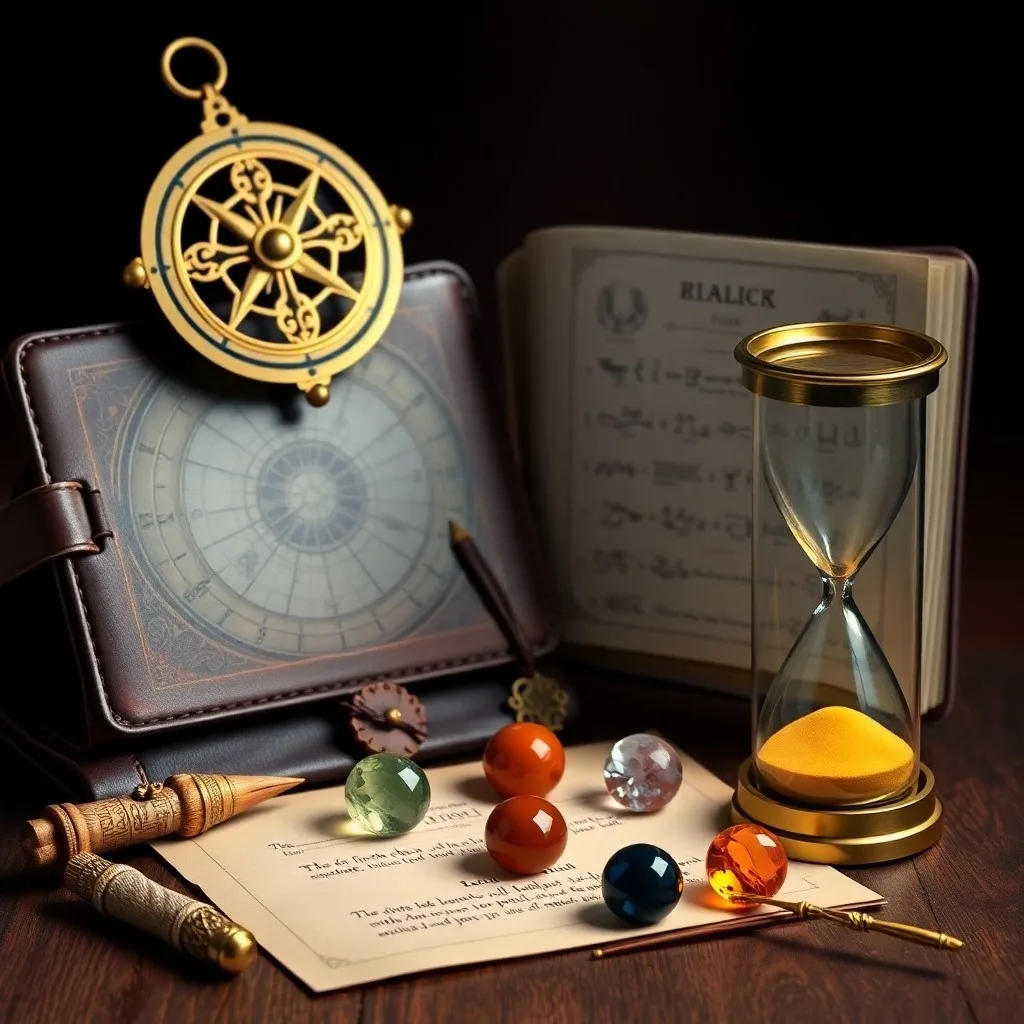
Cosmic Planning: A still-life photograph capturing an antique leather-bound journal, a quill pen, and an hourglass on a polished wooden desk, symbolizing the careful organization of time.
Applying Planetary Hours to Daily Activities
Once you understand the ruling planets and their associated energies, you can begin to consciously schedule your daily activities. This isn't about rigid adherence but rather a flexible approach to enhance your natural flow. For instance, if you have an important meeting where you need to assert your authority, scheduling it during a Mars hour might give you an extra boost of confidence and drive.
Similarly, a Mercury hour is ideal for tasks requiring clear communication, such as sending important emails, making sales calls, or engaging in brainstorming sessions. If you're looking to relax, connect with family, or engage in creative, intuitive work, a Moon hour would be more supportive. The key is to experiment and observe how these timings influence your personal effectiveness.
This practice encourages mindfulness and a deeper awareness of how different energies affect your productivity. It's a way to work smarter, not necessarily harder, by leveraging the subtle forces that are always at play around us. Consider it an additional layer of strategy in your time management toolkit, complementing other productivity techniques.
Planetary Hours for Specific Intentions
Beyond general daily tasks, planetary hours can be strategically employed for specific intentions or goals. This approach is particularly powerful when you have a clear objective and want to imbue your actions with the most supportive cosmic energy. For example, if you are launching a new product or initiative, timing its debut during a Sun or Jupiter hour can be highly beneficial.
For matters of love, beauty, or reconciliation, the hours ruled by Venus are undoubtedly the most auspicious. This could include scheduling a date, engaging in self-care routines, or mediating a dispute. When dealing with serious matters, long-term planning, or anything requiring meticulous attention to detail and structure, a Saturn hour provides the necessary grounding and discipline.
The table below provides a quick reference for matching common intentions with their most favorable planetary hours. Remember that these are guidelines, and personal experience will refine your understanding of these energies.
| Planet | Associated Energies | Recommended Activities / Intentions |
|---|---|---|
| Sun | Leadership, self-expression, success, vitality, confidence. | Public speaking, launching projects, seeking favors from superiors, self-promotion, creative endeavors. |
| Moon | Intuition, emotions, domesticity, nurturing, public matters, travel. | Meditation, introspection, home activities, gardening, dealing with women, short journeys, public relations. |
| Mercury | Communication, intellect, learning, negotiation, trade, writing. | Studying, writing emails, signing contracts, networking, interviews, intellectual discussions, business deals. |
| Venus | Love, beauty, harmony, art, social gatherings, reconciliation. | Dates, social events, artistic creation, self-care, shopping for clothes/jewelry, resolving disputes, expressing affection. |
| Mars | Action, courage, assertion, competition, physical energy. | Exercise, tackling difficult tasks, confronting challenges, starting new ventures requiring boldness, surgical procedures (historically). |
| Jupiter | Expansion, luck, wisdom, prosperity, higher learning, spirituality. | Financial investments, legal matters, spiritual practices, long-distance travel, publishing, seeking advice, charitable acts. |
| Saturn | Discipline, structure, responsibility, boundaries, long-term planning, endurance. | Tasks requiring patience, organization, detailed work, dealing with elders or authority, setting foundations, meditation on serious topics. |
Integrating Planetary Hours into Modern Life
Integrating planetary hours into a busy modern schedule might seem daunting at first, but it can be surprisingly practical. Many smartphone applications and websites offer real-time calculations for your specific location, making it easy to check the current planetary hour with a glance. These tools eliminate the need for manual calculations and provide instant access to the information you need.
Start by identifying a few key tasks in your day that could benefit from energetic alignment. Perhaps you struggle with creative blocks, or you find certain meetings particularly challenging. By consciously scheduling these activities during their most favorable hours, you can begin to observe the impact. Over time, this practice can become a natural part of your daily routine, much like checking the weather or your calendar.
It's important to approach this practice with an open mind and a sense of experimentation. Not every hour will perfectly align with your needs, and flexibility is crucial. The goal is not to become a slave to the clock but to use this ancient system as a guide to enhance your natural productivity and well-being. Consider it a subtle energetic advantage rather than a rigid rulebook.

Cosmic Harmony: A conceptual 3D render illustrating abstract energy flows and glowing spheres, symbolizing the convergence of planetary influences on daily life, set against a deep space backdrop.
Common Misconceptions and Best Practices
One common misconception is that planetary hours are about the physical planets directly influencing Earth. Instead, they represent energetic archetypes associated with those celestial bodies, reflecting patterns of energy that have been observed and codified over millennia. It's a symbolic system, not a literal one, offering a framework for understanding subtle energetic currents.
Another pitfall is expecting instant, miraculous results. Planetary hours work by subtly enhancing your efforts, not by guaranteeing success regardless of your actions. They provide an energetic tailwind, but you still need to put in the work. Think of it as planting seeds during the most fertile season; the seed still needs care to grow.
Best practices include starting small, focusing on one or two key activities to align, and keeping a journal to track your observations. Pay attention to how you feel during different planetary hours, even when not actively planning. This builds your intuitive understanding of the energies at play. Remember that the Moon hour, while generally good for reflection, might not be ideal for tasks requiring sharp focus, especially if you are prone to emotional fluctuations.
Benefits of Utilizing Planetary Hours
The benefits of incorporating planetary hours into your daily planning extend beyond mere productivity. By aligning with natural rhythms, you can experience a deeper sense of flow and less resistance in your activities. This can lead to reduced stress, improved decision-making, and a greater sense of purpose in your daily life. It’s a holistic approach to time management that considers the energetic dimension of existence.
Many practitioners report increased focus and concentration during tasks performed in their corresponding planetary hours. This enhanced mental clarity can lead to higher quality work and a more efficient use of your time. Furthermore, by consciously choosing auspicious times, you cultivate a proactive mindset, taking charge of your schedule rather than simply reacting to it.
Ultimately, planetary hours offer a powerful tool for self-mastery and personal growth. They invite you to connect with ancient wisdom and apply it in a practical way to navigate the complexities of modern life. Whether you're an astrologer, a spiritual seeker, or simply looking for new ways to boost your productivity, exploring planetary hours can open up new avenues for success and well-being.
Fuente: Contenido híbrido asistido por IAs y supervisión editorial humana.


Comments
Post a Comment