
Chinese Zodiac Elements: Inter-Element Compatibility Dynamics | StarPluto
The Chinese Zodiac, a fascinating astrological system rooted in ancient Chinese philosophy, offers profound insights into personality traits, life paths, and interpersonal dynamics. While many are familiar with the twelve animal signs, a deeper layer of understanding lies within the Five Elements: Wood, Fire, Earth, Metal, and Water. These elements, known as Wu Xing, are not merely static classifications but represent dynamic forces that constantly interact, influencing everything from cosmic cycles to human relationships. Understanding their intricate interplay is crucial for deciphering the advanced nuances of Chinese Zodiac compatibility.
This advanced guide delves into the inter-element compatibility, exploring how the inherent elemental nature of each zodiac sign affects its interactions with others. By examining the generating (Sheng) and controlling (Ke) cycles, we can unlock a more comprehensive perspective on why certain pairings flourish while others face inherent challenges. This knowledge empowers individuals to foster more harmonious connections and navigate potential conflicts with greater awareness.
A dynamic digital illustration showcasing the vibrant and interconnected energies of the Five Chinese Elements.
Table of Contents
- Understanding the Five Elements (Wu Xing)
- The Creative (Sheng) Cycle of Elements
- The Controlling (Ke) Cycle of Elements
- Applying Elemental Cycles to Zodiac Compatibility
- Fire Element Dynamics in Relationships
- Earth Element Dynamics in Relationships
- Metal Element Dynamics in Relationships
- Water Element Dynamics in Relationships
- Wood Element Dynamics in Relationships
- Beyond the Cycles: Nuances and Balance
- Practical Insights for Harmonious Connections
Understanding the Five Elements (Wu Xing)
The Wu Xing, or Five Elements, are fundamental concepts in Chinese philosophy, medicine, and astrology. They are not merely substances but rather phases, forces, or energies that describe the dynamic processes of nature and the cosmos. Each element possesses distinct characteristics, symbolic associations, and influences, which manifest in various aspects of life, including the personality traits of individuals born under specific Chinese Zodiac signs.
Each of the twelve Chinese Zodiac animals is associated with a fixed element, but also rotates through the five elements over a 60-year cycle. For instance, while the Tiger is inherently Wood, there are Wood Tigers, Fire Tigers, Earth Tigers, Metal Tigers, and Water Tigers, each with unique elemental overlays. This elemental overlay adds significant depth to compatibility analysis, moving beyond simple animal pairings.
- Wood (木 - Mù): Associated with growth, creativity, flexibility, and new beginnings. Wood types are often compassionate, artistic, and strive for harmony.
- Fire (火 - Huǒ): Represents passion, energy, dynamism, and transformation. Fire individuals are typically enthusiastic, courageous, and natural leaders.
- Earth (土 - Tǔ): Symbolizes stability, nourishment, practicality, and grounding. Earth personalities are reliable, patient, and deeply nurturing.
- Metal (金 - Jīn): Linked to structure, precision, determination, and refinement. Metal types are often disciplined, just, and possess strong willpower.
- Water (水 - Shuǐ): Embodies intuition, adaptability, wisdom, and communication. Water individuals are usually perceptive, empathetic, and possess a profound inner depth.
The Creative (Sheng) Cycle of Elements
The Sheng Cycle, also known as the Generating or Nurturing Cycle, describes how each element supports and produces the next in a continuous, harmonious flow. This cycle represents positive, constructive interactions, suggesting natural affinity and mutual benefit in relationships where these elemental dynamics are present. When two individuals' dominant elements align with this cycle, their connection tends to be supportive and growth-oriented.
Understanding the Sheng Cycle is fundamental to identifying natural compatibilities. It highlights relationships where one partner's elemental energy naturally feeds and strengthens the other's, creating a synergistic bond. This cycle is often seen as the ideal for long-term relationships, fostering mutual understanding and shared progress.
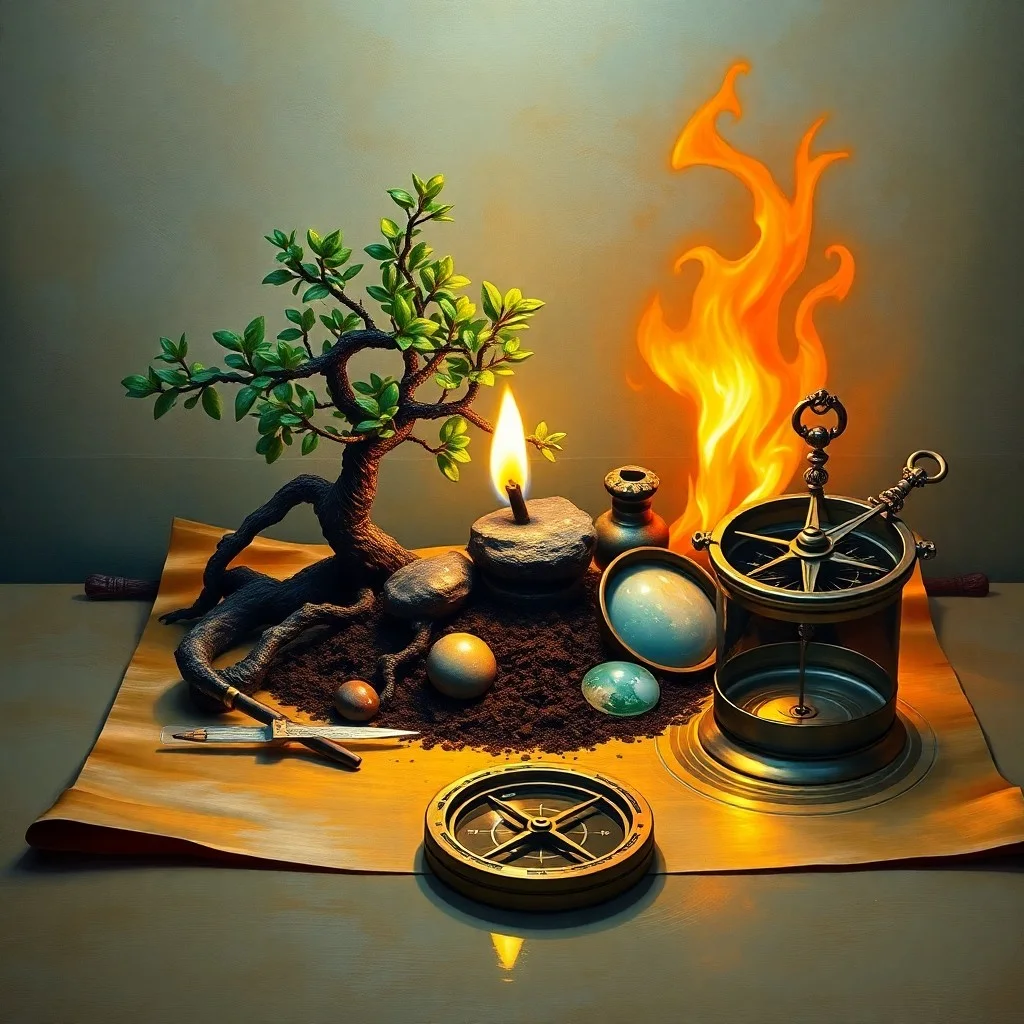
A still-life composition illustrating the harmonious and nurturing flow of the Sheng (Generating) Cycle.
- Wood Feeds Fire: Wood provides fuel for fire to burn, symbolizing inspiration, creativity, and passion. A Wood person can ignite and support a Fire person's ambitions.
- Fire Creates Earth: Fire reduces things to ash, which enriches the earth. This represents stability, warmth, and nurturing. A Fire individual can bring warmth and security to an Earth person.
- Earth Bears Metal: Metal is extracted from the earth. This signifies grounding, structure, and resourcefulness. An Earth person provides a stable foundation for a Metal person's discipline and ambition.
- Metal Carries Water: Metal containers hold water. This interaction speaks to communication, fluidity, and introspection. A Metal individual can help channel and give form to a Water person's emotions and ideas.
- Water Nourishes Wood: Water is essential for wood to grow. This represents growth, intuition, and vitality. A Water person can provide emotional depth and support for a Wood person's development and creativity.
The Controlling (Ke) Cycle of Elements
In contrast to the Sheng Cycle, the Ke Cycle, or Controlling Cycle, describes interactions where one element restricts, weakens, or overcomes another. While often perceived as negative, this cycle is essential for maintaining balance and preventing any single element from becoming overly dominant. In human relationships, these dynamics can represent challenges, conflicts, or areas where partners need to learn to compromise and adapt.
Recognizing the Ke Cycle in compatibility helps individuals understand potential friction points and develop strategies to mitigate them. It's not about avoiding these pairings entirely, but rather about acknowledging inherent tensions and working consciously to balance them. This cycle encourages self-awareness and the development of coping mechanisms in a relationship.
A conceptual artwork vividly portraying the challenging and restrictive interactions of the Ke (Controlling) Cycle.
- Wood Parts Earth: Wood (roots) can break up and deplete earth. This suggests a dynamic where a Wood person might challenge or destabilize an Earth person's need for security.
- Earth Absorbs Water: Earth can absorb and contain water. This implies that an Earth person might restrict or suppress a Water person's emotional flow and adaptability.
- Water Quenches Fire: Water extinguishes fire. This interaction indicates that a Water person might dampen a Fire person's enthusiasm, passion, or energy.
- Fire Melts Metal: Fire can melt and reshape metal. This suggests that a Fire person might challenge a Metal person's rigid structure, discipline, or principles.
- Metal Chops Wood: Metal (an axe) can cut wood. This represents a dynamic where a Metal person might be overly critical or restrictive of a Wood person's growth and creativity.
Applying Elemental Cycles to Zodiac Compatibility
To apply these elemental cycles to Chinese Zodiac compatibility, one must first identify the dominant element of each individual. This typically involves looking at their birth year's elemental association, which repeats every 60 years. For example, a person born in 1984 (Year of the Wood Rat) has a dominant Wood element, while a person born in 1986 (Year of the Fire Tiger) has a dominant Fire element.
Once the dominant elements are determined, compare them using the Sheng and Ke cycles. A Sheng relationship suggests natural harmony and mutual support, while a Ke relationship indicates potential friction and areas requiring conscious effort. It's important to remember that these are tendencies, not absolute decrees, and individual personalities always play a significant role.
For example, a Wood person and a Fire person would experience a Sheng relationship (Wood feeds Fire), suggesting that the Wood individual provides support and resources for the Fire individual's ambitions, leading to a dynamic and progressive partnership. Conversely, a Water person and a Fire person would be in a Ke relationship (Water quenches Fire), indicating that the Water individual might inadvertently dampen the Fire person's enthusiasm, requiring both to find ways to respect each other's elemental nature without suppressing it.
Fire Element Dynamics in Relationships
Individuals with a dominant Fire element are often passionate, energetic, and enthusiastic. In relationships, they bring warmth, excitement, and a desire for adventure. They thrive on inspiration and appreciate partners who can fuel their ambitions or provide a stable ground for their fiery nature.
- Fire with Wood (Sheng): Highly compatible. Wood provides the fuel for Fire's passion, leading to a dynamic and mutually inspiring relationship. Wood offers support, and Fire brings warmth and direction.
- Fire with Earth (Sheng - Earth is created): Generally good. Fire transforms into ash, enriching Earth. Fire brings warmth and vitality to Earth's stability, helping Earth to be more dynamic and less rigid.
- Fire with Metal (Ke): Challenging. Fire melts Metal, suggesting that Fire's intensity might overwhelm or break down Metal's structure and discipline. Metal may feel stifled or pressured by Fire's demands.
- Fire with Water (Ke): Very challenging. Water quenches Fire, indicating a fundamental clash. Water's emotional depth and introspection can dampen Fire's enthusiasm, while Fire's impulsiveness can feel overwhelming to Water.
Earth Element Dynamics in Relationships
Earth individuals are known for their stability, practicality, and nurturing qualities. They seek security and reliability in relationships, offering unwavering support and a grounded perspective. They appreciate partners who can help them grow or respect their need for a solid foundation.
- Earth with Fire (Sheng - Earth is created): Good compatibility. Fire provides warmth and energy to Earth, helping it to be more productive and less stagnant. Earth offers a stable base for Fire's energy.
- Earth with Metal (Sheng): Highly compatible. Earth nurtures Metal, providing the resources and stability for Metal's growth and refinement. Earth admires Metal's discipline, and Metal values Earth's reliability.
- Earth with Wood (Ke): Challenging. Wood parts Earth, meaning Wood's expansive nature might feel disruptive or draining to Earth's need for stability. Earth may feel its boundaries are being invaded.
- Earth with Water (Ke): Challenging. Earth absorbs Water, suggesting Earth might try to contain or control Water's emotional fluidity. Water may feel stifled or misunderstood by Earth's practicality.
Metal Element Dynamics in Relationships
Metal personalities are characterized by their strong will, discipline, and sense of justice. In relationships, they value honesty, integrity, and clear boundaries. They are precise and analytical, seeking partners who can complement their structured approach or help them soften their edges.
- Metal with Earth (Sheng): Highly compatible. Earth provides the foundation and resources for Metal's development and strength. Earth values Metal's clarity, and Metal appreciates Earth's steadfastness.
- Metal with Water (Sheng): Good compatibility. Metal carries Water, symbolizing that Metal can help channel and give form to Water's emotions and ideas. Metal provides structure, and Water brings intuition.
- Metal with Fire (Ke): Very challenging. Fire melts Metal, indicating that Fire's intensity can be destructive to Metal's rigid structure and principles. Metal may feel attacked or disrespected by Fire's impulsiveness.
- Metal with Wood (Ke): Challenging. Metal chops Wood, suggesting that Metal's critical and precise nature might inhibit Wood's creativity and growth. Wood may feel stifled or judged by Metal.
Water Element Dynamics in Relationships
Water individuals are intuitive, adaptable, and deeply emotional. They are excellent communicators and possess a profound understanding of human nature. In relationships, they seek emotional connection and fluidity, valuing partners who can provide support for their inner world or help them ground their emotions.
- Water with Metal (Sheng): Good compatibility. Metal provides the structure to channel Water's flow, offering clarity and direction to Water's emotional depth. Water brings intuition, and Metal brings discipline.
- Water with Wood (Sheng): Highly compatible. Water nourishes Wood, fostering growth, creativity, and mutual understanding. Water provides emotional support, and Wood brings vision and expansion.
- Water with Earth (Ke): Challenging. Earth absorbs Water, meaning Earth's practicality might feel restrictive or unfeeling to Water's emotional needs. Water may feel its depth is not recognized.
- Water with Fire (Ke): Very challenging. Water quenches Fire, indicating a strong opposition. Water's calm and reflective nature can extinguish Fire's passion, leading to frustration for both.
Wood Element Dynamics in Relationships
Wood individuals are creative, compassionate, and growth-oriented. They are natural innovators and seek expansion in all areas of life. In relationships, they value freedom, inspiration, and partners who can share their vision or provide a stable environment for their ideas to flourish.
- Wood with Water (Sheng): Highly compatible. Water nourishes Wood, providing the emotional depth and intuition necessary for Wood's growth and creativity. Wood brings vision, and Water brings understanding.
- Wood with Fire (Sheng): Good compatibility. Wood feeds Fire, offering support and resources for Fire's passion and ambition. Wood provides inspiration, and Fire brings dynamism.
- Wood with Metal (Ke): Challenging. Metal chops Wood, suggesting Metal's rigidness or critical nature might hinder Wood's natural desire for growth and expression. Wood may feel constrained or misunderstood.
- Wood with Earth (Ke): Challenging. Wood parts Earth, meaning Wood's expansive and sometimes demanding nature can destabilize Earth's need for security and routine. Earth may feel depleted or overwhelmed.
Beyond the Cycles: Nuances and Balance
While the Sheng and Ke cycles provide a powerful framework for understanding inter-element compatibility, true relationship dynamics are far more complex. It's essential to consider the individual's specific zodiac animal, their unique personality, and the strength of their elemental influence. A person might have a dominant element from their birth year but also exhibit strong traits of another element due to other astrological factors or personal development.
Moreover, a "challenging" Ke relationship is not necessarily doomed. It simply highlights areas where conscious effort, communication, and compromise are required. These relationships can lead to significant personal growth, as partners learn to balance and integrate opposing forces. For instance, a Fire-Metal pairing, though challenging, could result in a highly productive partnership if Fire learns to temper its intensity and Metal learns to be more flexible.
The goal is not to avoid certain elemental pairings but to understand the inherent energies at play. By recognizing these dynamics, individuals can cultivate empathy, adjust their expectations, and develop strategies to create a more harmonious connection. Balance is key; too much of one element or an unchecked controlling interaction can lead to imbalance, while conscious effort can transform potential conflicts into opportunities for growth.
Practical Insights for Harmonious Connections
Applying the principles of Chinese Zodiac inter-element compatibility extends beyond romantic relationships. It can offer valuable insights into family dynamics, friendships, and even professional partnerships. By understanding the elemental makeup of those around us, we can tailor our communication, support systems, and collaborative efforts more effectively.
For example, in a business setting, pairing a Wood-dominant individual (creative, visionary) with a Metal-dominant individual (structured, disciplined) might initially lead to friction (Metal chops Wood). However, with awareness, the Metal person can learn to appreciate Wood's innovative ideas, and the Wood person can benefit from Metal's ability to bring structure and execution. This conscious application of elemental understanding can transform potential weaknesses into powerful strengths.
Ultimately, the study of Chinese Zodiac inter-element compatibility is a tool for self-awareness and relational intelligence. It encourages us to look beyond superficial traits and delve into the fundamental energies that shape our interactions. By embracing the wisdom of the Wu Xing, we can cultivate deeper understanding, foster greater harmony, and build more resilient and fulfilling connections in all aspects of our lives. Dive deeper into the rich tapestry of Tarot Quantum Mechanics Intersecting Divination Reality to unlock further insights.
Fuente: Contenido híbrido asistido por IAs y supervisión editorial humana.


Comments
Post a Comment