
Zi Wei Dou Shu Purple Star Astrology Basics Comprehensive Guide | StarPluto
Zi Wei Dou Shu, often translated as Purple Star Astrology, is a highly sophisticated and ancient form of Chinese astrological divination. Originating during the Song Dynasty (960-1279 AD), it is considered one of the most accurate and comprehensive systems for analyzing an individual's destiny and life path. Unlike Western astrology, which primarily focuses on planetary positions, Zi Wei Dou Shu utilizes a complex array of stars, palaces, and transformations to construct a detailed natal chart, known as a Ming Pan.
This intricate system offers profound insights into personality traits, career prospects, relationships, health, wealth, and life's cyclical changes. Its depth and precision require careful study and understanding of its foundational elements. This comprehensive guide aims to demystify the basics of Zi Wei Dou Shu, providing a solid framework for those seeking to explore its rich tapestry of cosmic wisdom.
Origins and Philosophical Foundations
Zi Wei Dou Shu emerged during a period of significant intellectual and cultural flourishing in China. Its creation is often attributed to the Daoist sage Chen Tuan (陳摶), who lived during the Five Dynasties and Ten Kingdoms period (907-960 AD) and the early Song Dynasty. Chen Tuan was renowned for his mastery of various esoteric arts, including Yi Jing (I Ching), Feng Shui, and astrology.
The system is deeply rooted in ancient Chinese cosmology and philosophy, incorporating principles from the Yin-Yang theory, the Five Elements (Wu Xing), and the Heavenly Stems and Earthly Branches (Gan Zhi). These foundational concepts provide the theoretical framework for understanding the intricate relationships and dynamic interactions within a Zi Wei Dou Shu chart. The name "Purple Star" (Zi Wei) refers to the Zi Wei Emperor Star, which holds the most prominent position in the astrological chart, symbolizing the emperor or the core essence of an individual's destiny.
The philosophy behind Zi Wei Dou Shu posits that an individual's birth moment—specifically the year, month, day, and hour—contains the energetic blueprint of their life. This blueprint is not static but unfolds dynamically through various life cycles, offering insights into potential challenges, opportunities, and inherent strengths. It emphasizes understanding one's destiny to navigate life more effectively, rather than suggesting an unchangeable fate.
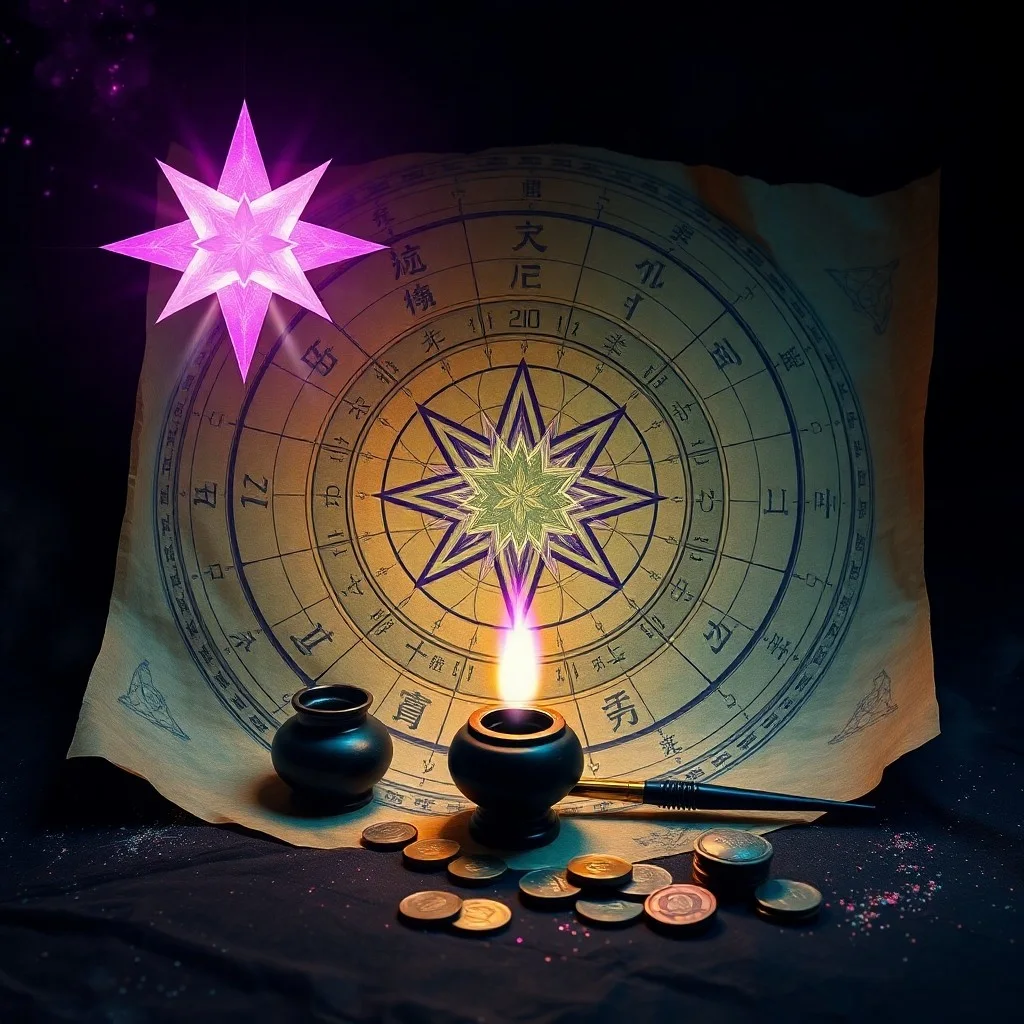
The intricate cosmic map of Zi Wei Dou Shu, revealing the profound connections between celestial bodies and individual destiny.
The Ming Pan: The Natal Chart
The Ming Pan (命盤), or natal chart, is the central component of Zi Wei Dou Shu. It is a diagram composed of twelve palaces, each representing a different aspect of life. The arrangement of stars within these palaces at the time of birth provides the core information for an astrological reading. The chart is calculated based on the lunar calendar, specifically the year, month, day, and hour of birth, which are then converted into the Heavenly Stems and Earthly Branches system.
Each palace in the Ming Pan is associated with a specific Earthly Branch, and the entire chart rotates based on the birth time. This dynamic rotation means that while the palaces are fixed in their positions relative to each other, the specific Earthly Branch and thus the associated stars within them will vary from person to person. The complexity arises from the vast number of possible star combinations and their interactions across these twelve palaces.
The Ming Pan serves as a comprehensive blueprint, detailing an individual's inherent characteristics, potential, strengths, weaknesses, and the general trajectory of their life. It also outlines the cyclical flow of fortune, indicating periods of prosperity, challenge, and transformation. Understanding the Ming Pan is the first step towards deciphering the intricate messages of Zi Wei Dou Shu.
The Twelve Palaces (Gong)
The twelve palaces (Gong, 宮) are the fundamental divisions of the Zi Wei Dou Shu chart, each governing a specific domain of life. The stars residing in each palace, along with their interactions, reveal detailed information about that particular aspect. These palaces are:
- Life Palace (Ming Gong 命宮): This is the most crucial palace, representing the core personality, character, destiny, and overall life path. It defines who you are at your essence.
- Siblings Palace (Xiong Di Gong 兄弟宮): Governs relationships with siblings, close friends, and peers. It also indicates support from these individuals.
- Spouse Palace (Fu Qi Gong 夫妻宮): Reveals insights into marriage, romantic relationships, the nature of your partner, and marital harmony.
- Children Palace (Zi Nü Gong 子女宮): Pertains to children, descendants, creativity, and investments. It can also indicate relationships with younger generations.
- Wealth Palace (Cai Bo Gong 財帛宮): Deals with financial matters, income, wealth accumulation, and attitudes towards money.
- Health Palace (Ji É Gong 疾厄宮): Indicates physical health, potential illnesses, and overall well-being. It also reflects one's constitution.
- Travel Palace (Qian Yi Gong 遷移宮): Governs travel, public image, social interactions, and how one is perceived by others outside the home.
- Friends Palace (Nu Pu Gong 奴僕宮): Represents relationships with subordinates, colleagues, employees, and general social connections.
- Career Palace (Guan Lu Gong 官祿宮): Focuses on career, profession, ambition, and professional achievements.
- Property Palace (Tian Zhai Gong 田宅宮): Relates to real estate, family assets, home environment, and ancestral property.
- Fortune Palace (Fu De Gong 福德宮): Reflects inner peace, spiritual well-being, blessings, hobbies, and one's attitude towards life's pleasures.
- Parents Palace (Fu Mu Gong 父母宮): Governs relationships with parents, elders, and superiors. It also indicates one's upbringing.
Beyond these twelve, there are also the Body Palace (Shen Gong 身宮) and the Destiny Palace (Ming Gong 命宮), which are central to the interpretation. The Body Palace, while not one of the twelve, is a significant secondary palace that provides insights into one's actions, habits, and how one adapts to life after middle age. Its position is determined by the hour of birth and often reveals the underlying motivations and influences that shape an individual's practical life decisions.

Tools of the ancient Chinese astrologer, symbolizing the precision and depth of Zi Wei Dou Shu.
The Stars (Xing): Major, Minor, and Auxiliary
The stars (Xing, 星) are the primary indicators in Zi Wei Dou Shu, each possessing unique characteristics and influences. They are broadly categorized into Major Stars, Minor Stars, and Auxiliary Stars.
The 14 Major Stars
These are the most important stars, forming the core of an individual's destiny. Each major star has a distinct personality and governs specific aspects of life. Their presence in a particular palace significantly shapes the interpretation of that life domain.
| Star Name | Translation | Key Characteristics |
|---|---|---|
| Zi Wei (紫微) | Emperor Star / Purple Star | Leadership, authority, nobility, benevolence, intelligence, control. |
| Tian Ji (天機) | Celestial Machine / Heavenly Secret | Intelligence, quick thinking, strategy, communication, sibling relationships. |
| Tai Yang (太陽) | Sun | Masculinity, father, husband, public service, generosity, fame. |
| Wu Qu (武曲) | Military Arts / Martial Star | Wealth, finance, determination, courage, solitude, military. |
| Tian Tong (天同) | Celestial Harmony / Heavenly Coincidence | Enjoyment, leisure, good fortune, compassion, emotional sensitivity. |
| Lian Zhen (廉貞) | Integrity / Purity | Love, passion, discipline, legal matters, ambition, sometimes problematic. |
| Tian Fu (天府) | Celestial Treasury / Heavenly Mansion | Wealth, stability, generosity, leadership, conservatism, protection. |
| Tai Yin (太陰) | Moon | Femininity, mother, wife, wealth, beauty, romance, emotions. |
| Tan Lang (貪狼) | Greedy Wolf / Rapacious Wolf | Desire, passion, indulgence, charm, creativity, transformation. |
| Ju Men (巨門) | Great Gate / Huge Door | Communication, disputes, secrecy, eloquence, legal issues, dark side. |
| Tian Xiang (天相) | Celestial Minister / Heavenly Prime Minister | Assistance, loyalty, diplomacy, justice, good reputation, service. |
| Tian Liang (天梁) | Celestial Beam / Heavenly Bridge | Protection, wisdom, longevity, compassion, problem-solving, elders. |
| Qi Sha (七殺) | Seven Killings | Courage, pioneering spirit, independence, aggression, challenges, power. |
| Po Jun (破軍) | Army Breaker / Destroyer | Destruction, innovation, change, rebellion, transformation, risk-taking. |
Minor and Auxiliary Stars
While the major stars define the primary themes, minor and auxiliary stars add nuance and detail to the interpretation. These include auspicious stars like Wen Chang (文昌 - Literary Star), Wen Qu (文曲 - Arts Star), Zuo Fu (左輔 - Left Assistant), You Bi (右弼 - Right Assistant), Tian Kui (天魁 - Heavenly Nobleman), and Tian Yue (天鉞 - Heavenly Officer), which bring support, intelligence, and opportunities. Conversely, inauspicious stars like Di Kong (地空 - Earth Emptiness), Di Jie (地劫 - Earth Robbery), Huo Xing (火星 - Fire Star), and Ling Xing (鈴星 - Bell Star) can introduce challenges, obstacles, and instability.
The interaction between these stars, their brightness (or "luminosity"), and their positions within the twelve palaces creates a complex web of influences that provides a highly personalized reading. A star's luminosity—whether it is bright, dim, or neutral—significantly alters its impact, enhancing or diminishing its positive or negative qualities.
The Four Transformers (Si Hua)
The Four Transformers (Si Hua, 四化) are dynamic energies that attach to specific stars in the chart, profoundly altering their influence. These transformations are crucial for understanding the ebb and flow of fortune and the timing of events. They are calculated based on the Heavenly Stem of the birth year and the Heavenly Stem of the current year or decade.
- Hua Lu (化祿 - Transformation of Prosperity): This transformer brings good fortune, wealth, opportunities, and smooth sailing. It enhances the positive aspects of the star it attaches to, indicating periods of growth and abundance.
- Hua Quan (化權 - Transformation of Power): Represents authority, power, ambition, competition, and control. It empowers the star it affects, suggesting periods of increased influence, leadership, and the ability to overcome challenges.
- Hua Ke (化科 - Transformation of Reputation): Associated with fame, reputation, academic success, protection, and wisdom. It brings recognition and helps mitigate negative influences, offering a degree of protection and stability.
- Hua Ji (化忌 - Transformation of Obstacles): This is the most challenging transformer, indicating difficulties, losses, disputes, emotional turmoil, and karmic debts. It highlights areas where caution is needed and where one might face significant hurdles.
The Si Hua are not static; they shift with each decade and year, creating a dynamic overlay on the natal chart. This allows practitioners to analyze specific periods of a person's life, predicting potential outcomes and advising on how to best navigate upcoming energies. The interplay of these transformers with the stars and palaces is a cornerstone of advanced Zi Wei Dou Shu interpretation.

The tools of ancient scholars, symbolizing the meticulous recording and interpretation of cosmic patterns.
Five Elements and Heavenly Stems & Earthly Branches
Zi Wei Dou Shu is deeply integrated with traditional Chinese metaphysical concepts, particularly the Five Elements (Wu Xing) and the Heavenly Stems and Earthly Branches (Gan Zhi). These systems provide the underlying energetic framework for the entire astrological calculation and interpretation.
The Five Elements (Wu Xing)
The Five Elements—Wood, Fire, Earth, Metal, and Water—represent different phases of energy and qualities. Each star, palace, and even the individual's life path is associated with one or more of these elements. Understanding their constructive (e.g., Wood feeds Fire) and destructive (e.g., Fire melts Metal) cycles is crucial for analyzing the harmony or conflict within a chart. For instance, a star with a Fire element in a Water palace might indicate a challenging interaction, while a Wood element star in a Fire palace suggests a supportive relationship.
Heavenly Stems and Earthly Branches (Gan Zhi)
The Gan Zhi system is a sexagenary cycle (60-year cycle) formed by combining the ten Heavenly Stems (Jia, Yi, Bing, Ding, Wu, Ji, Geng, Xin, Ren, Gui) and the twelve Earthly Branches (Zi, Chou, Yin, Mao, Chen, Si, Wu, Wei, Shen, You, Xu, Hai). This system is used to mark years, months, days, and hours, and is fundamental for calculating the natal chart. Each Heavenly Stem and Earthly Branch has elemental and Yin-Yang associations, which further refine the energetic qualities of the stars and palaces. The Earthly Branches are also directly linked to the twelve palaces in the Zi Wei Dou Shu chart, providing their elemental and directional properties.
Chart Construction: A Simplified Overview
Constructing a Zi Wei Dou Shu chart is a complex process that traditionally involves several steps, requiring precise birth data (year, month, day, and exact hour). Here's a simplified outline of the key stages:
- Determine the Lunar Birth Data: Convert the Gregorian birth date and time to the Chinese lunar calendar, including the Heavenly Stem and Earthly Branch for the year, month, day, and hour.
- Calculate the Life Palace (Ming Gong) and Body Palace (Shen Gong): These are determined by the birth month and hour. Their positions are crucial starting points for the chart.
- Determine the Five Elements Bureau (Wu Xing Ju 五行局): Based on the Heavenly Stem and Earthly Branch of the Life Palace, a specific "Five Elements Bureau" is established. This bureau dictates the sequence of the major stars.
- Plot the Zi Wei (Emperor Star): The position of the Zi Wei star is calculated using the Five Elements Bureau and the birth date. Once Zi Wei is placed, the positions of the other 13 major stars are fixed relative to it.
- Plot Minor and Auxiliary Stars: Various other stars are then placed based on the birth year, month, day, and hour. These add layers of detail and influence.
- Calculate the Four Transformers (Si Hua): The Hua Lu, Hua Quan, Hua Ke, and Hua Ji are assigned to specific stars based on the Heavenly Stem of the birth year. These dynamic energies are vital for understanding the chart's unfolding narrative.
- Determine Decade and Annual Charts: For predictive analysis, separate charts are calculated for each 10-year decade and individual year, showing how the Si Hua and other dynamic elements shift and interact with the natal chart.
Due to its complexity, specialized software or experienced practitioners are typically used for accurate chart construction. However, understanding these basic steps provides appreciation for the system's methodical nature.
Interpreting the Zi Wei Dou Shu Chart
Interpreting a Zi Wei Dou Shu chart is an art that combines systematic analysis with intuitive understanding. It involves looking at multiple layers of information and understanding their interactions. Here are some key principles:
- The Life Palace as the Core: Always start with the Life Palace (Ming Gong). The major star(s) and any Si Hua present here will define the individual's fundamental nature and overall destiny.
- Interactions Between Palaces: Palaces are not isolated. They interact with each other in various ways, forming "triads" and "opposite pairs." For example, the Life Palace often interacts with the Career, Wealth, and Travel Palaces, indicating how personal destiny influences these areas. The Spouse Palace is opposite the Career Palace, suggesting a dynamic relationship between marriage and professional life.
- Star Combinations and Luminosity: The combination of major, minor, and auxiliary stars within a palace, along with their luminosity (brightness), creates unique energetic signatures. A bright, auspicious star is generally positive, while a dim or inauspicious star might indicate challenges.
- Impact of the Four Transformers: The Si Hua are critical for dynamic interpretation. A Hua Lu in the Wealth Palace, for instance, suggests strong financial opportunities, while a Hua Ji in the Health Palace might point to health issues or karmic lessons related to well-being.
- Decade and Annual Charts: To understand the timing of events, practitioners overlay decade (Da Yun 大運) and annual (Liu Nian 流年) charts onto the natal chart. This reveals which palaces and stars are activated during specific periods, providing a predictive element to the reading.
- Elemental Harmony: Consider the Five Elements of the stars and palaces. Harmony or conflict between elements can indicate smooth flow or friction in different life areas.
A skilled practitioner synthesizes all these elements to paint a holistic picture of an individual's life, offering guidance on how to leverage strengths, mitigate weaknesses, and make informed decisions.
Applications of Zi Wei Dou Shu
The versatility and depth of Zi Wei Dou Shu make it applicable to a wide range of life inquiries. Its insights can empower individuals to make more conscious choices and better understand their inherent potential.
- Personality Analysis: Gain a deep understanding of one's character, strengths, weaknesses, and intrinsic motivations.
- Career Guidance: Identify suitable career paths, potential for leadership, financial success, and periods of career advancement or challenge.
- Relationship Insights: Understand the dynamics of romantic relationships, marital harmony, and compatibility with partners. It can also shed light on family and friendship bonds.
- Wealth and Finance: Analyze financial potential, sources of income, investment strategies, and periods of financial prosperity or difficulty.
- Health and Well-being: Identify potential health predispositions, areas of vulnerability, and periods requiring extra attention to health.
- Life Cycle Predictions: Forecast major life events, opportunities, and challenges across different decades and years, allowing for proactive planning.
- Self-Improvement and Spiritual Growth: Use the insights to work on personal development, overcome obstacles, and align with one's true destiny.
Zi Wei Dou Shu is not about fatalism but about understanding the energetic currents of life. By recognizing these patterns, individuals can choose to flow with them or consciously work to mitigate adverse influences, thereby shaping their experiences.
Comparison with Other Astrological Systems
While all astrological systems aim to provide insights into destiny and personality, Zi Wei Dou Shu has distinct characteristics that set it apart from Western Astrology and even other Chinese systems like BaZi (Four Pillars of Destiny).
Zi Wei Dou Shu vs. Western Astrology
Western Astrology primarily uses the positions of planets (Sun, Moon, Mercury, Venus, Mars, Jupiter, Saturn, Uranus, Neptune, Pluto) in zodiac signs and houses. It emphasizes psychological traits and karmic lessons. Zi Wei Dou Shu, on the other hand, focuses on a complex array of "stars" (which are not actual celestial bodies but symbolic representations) and their interactions within fixed palaces. While both use birth time for calculations, Zi Wei Dou Shu's emphasis on dynamic transformations (Si Hua) and the intricate relationships between stars and palaces often allows for more precise timing of life events.
Zi Wei Dou Shu vs. BaZi (Four Pillars of Destiny)
BaZi is another prominent Chinese astrological system that uses the Heavenly Stems and Earthly Branches of the birth year, month, day, and hour to derive four "pillars." It focuses heavily on the balance of the Five Elements and the strength of the "Day Master" (the Heavenly Stem of the birth day). BaZi is excellent for understanding inherent elemental balance, health, and general fortune. Zi Wei Dou Shu, with its detailed star configurations and dynamic Si Hua, often provides a more granular and narrative-driven analysis of specific life events and relationships. While both are powerful, many practitioners find Zi Wei Dou Shu to offer a richer, more detailed map of an individual's life journey.
Each system has its unique strengths, and some practitioners even combine insights from multiple forms of astrology to gain a more holistic perspective. Zi Wei Dou Shu stands out for its depth, precision, and the intricate interplay of its many components, making it a fascinating subject for serious astrological study.
Conclusion
Zi Wei Dou Shu, or Purple Star Astrology, is a profound and intricate system that offers an unparalleled depth of insight into human destiny. From its ancient origins rooted in Chinese cosmology to its complex calculations involving stars, palaces, and dynamic transformations, it provides a comprehensive blueprint of an individual's life path. Understanding its basics—the Ming Pan, the Twelve Palaces, the Major Stars, and the Four Transformers—is the first step towards unlocking its wisdom.
Whether used for self-discovery, career planning, relationship analysis, or navigating life's challenges, Zi Wei Dou Shu serves as a powerful tool for self-awareness and empowerment. It reminds us that while destiny may have a blueprint, our conscious choices and actions play a significant role in how that blueprint unfolds. Embracing the knowledge offered by this ancient art can lead to a more informed, harmonious, and fulfilling life journey.
Fuente: Contenido híbrido asistido por IAs y supervisión editorial humana.


Comments
Post a Comment