
Chinese Zodiac: The Great Race Legend | StarPluto
The Chinese Zodiac, a fascinating system of astrology and divination, has captivated millions for centuries with its unique cycle of twelve animal signs. Unlike Western astrology, which is based on monthly birth signs, the Chinese Zodiac assigns an animal to an entire birth year, repeating every twelve years. Each animal embodies distinct characteristics and influences the personalities and destinies of those born under its sign. But how did this specific order of animals come to be? The answer lies in a captivating ancient legend known as "The Great Race."
Table of Contents:
- Introduction to the Great Race
- The Jade Emperor's Challenge
- The Great River Crossing
- The Cunning Rat and the Diligent Ox
- The Powerful Tiger's Struggle
- The Agile Rabbit's Leap
- The Noble Dragon's Detour
- The Sly Snake and the Swift Horse
- The Cooperative Goat, Monkey, and Rooster
- The Playful Dog's Delay
- The Last-Place Pig
- Lessons from the Great Race
- Cultural Significance and Legacy
Introduction to the Great Race
The Great Race is more than just a charming story; it is a foundational myth that explains the very structure of the Chinese Zodiac. This tale, passed down through generations, imbues each animal with distinct personality traits and symbolic meanings that continue to influence Chinese culture, traditions, and even daily decision-making. It highlights values such as cleverness, perseverance, generosity, and humility, which are deeply revered in Eastern philosophy.
Understanding this legend provides profound insight into the Chinese astrological system and its enduring popularity. It's a narrative that blends cosmology with moral lessons, offering a rich tapestry of wisdom for those who delve into its depths. The race itself is a metaphor for life's challenges, where various approaches lead to different outcomes, and not always the strongest or fastest emerges victorious.
The Jade Emperor's Challenge
According to the legend, the Jade Emperor, ruler of Heaven, decided one day that there should be a way to measure time. He declared a great race, inviting all the animals in his kingdom to participate. The first twelve animals to cross a mighty river and reach the Heavenly Gate would be honored with a place in the zodiac calendar, their names forever immortalized in the annual cycle.
This announcement sparked immense excitement and determination among the animal kingdom. Each creature, from the largest to the smallest, began to strategize how they would overcome the formidable challenge of the river. The Emperor's decree was clear: the order of arrival would determine their rank and influence for all eternity, setting the stage for a legendary competition.
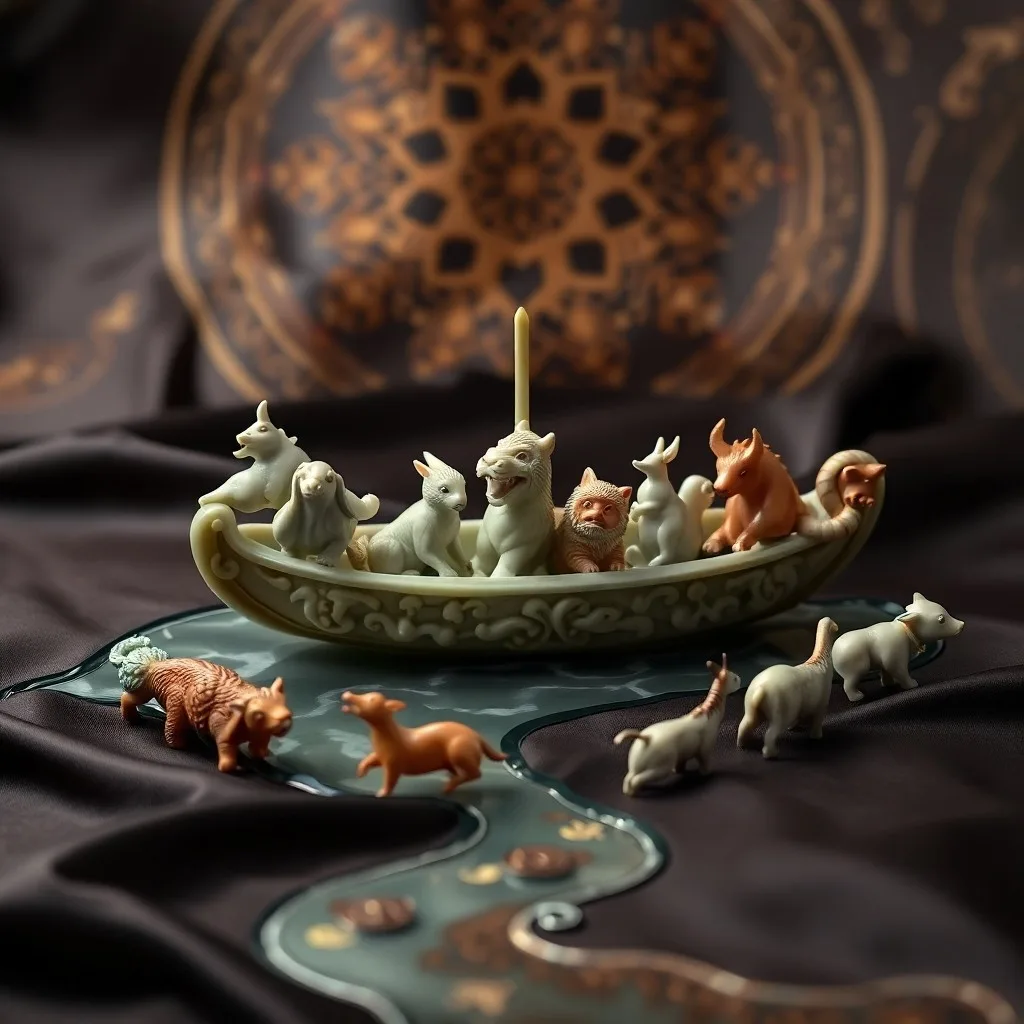
A vibrant depiction of the legendary Great Race, where animals vie for a place in the Chinese Zodiac.
The Great River Crossing
The central challenge of the Great Race was a wide, fast-flowing river. Many animals, especially those who couldn't swim well, were daunted by this obstacle. However, the promise of eternal honor fueled their courage and ingenuity. Animals began to form alliances, some out of genuine friendship, others out of strategic necessity, all hoping to gain an advantage in the arduous journey ahead.
The river represented the trials and tribulations of life, requiring not just physical strength but also wit, adaptability, and sometimes, a little help from others. The varying abilities of the animals meant that the race would not simply be a test of speed, but a complex interplay of strengths and weaknesses, showcasing the diverse ways one can achieve success.
The Cunning Rat and the Diligent Ox
The Rat, being small and a poor swimmer, knew he couldn't cross the river alone. He spotted the strong and kind Ox, who was about to enter the water. The Rat, with his characteristic cunning, asked the Ox if he could ride on his back. The good-natured Ox agreed, unaware of the Rat's ulterior motive. As they neared the other side, the Rat, seeing the finish line, stealthily jumped off the Ox's head and scurried to claim first place.
The Ox, despite his strength and perseverance, arrived second, forever embodying diligence and reliability. This act of the Rat cemented its reputation for intelligence and opportunism, making it the first animal of the zodiac. This story teaches us that sometimes wit can overcome brute force, though it also subtly introduces themes of betrayal and self-interest.
The Powerful Tiger's Struggle
The Tiger, a symbol of power and bravery, was a fierce competitor. He swam with all his might, battling the strong currents of the river. Despite his immense strength, the river's force was considerable, pushing him off course several times. He struggled valiantly, his roars echoing across the water, but eventually made it to the shore, securing the third position.
The Tiger's journey highlights the challenges even the strongest among us face. His placement signifies courage and competitiveness, but also acknowledges that even raw power can be tested and delayed by external forces. Those born under the Tiger sign are often seen as ambitious and powerful, reflecting this legendary struggle.
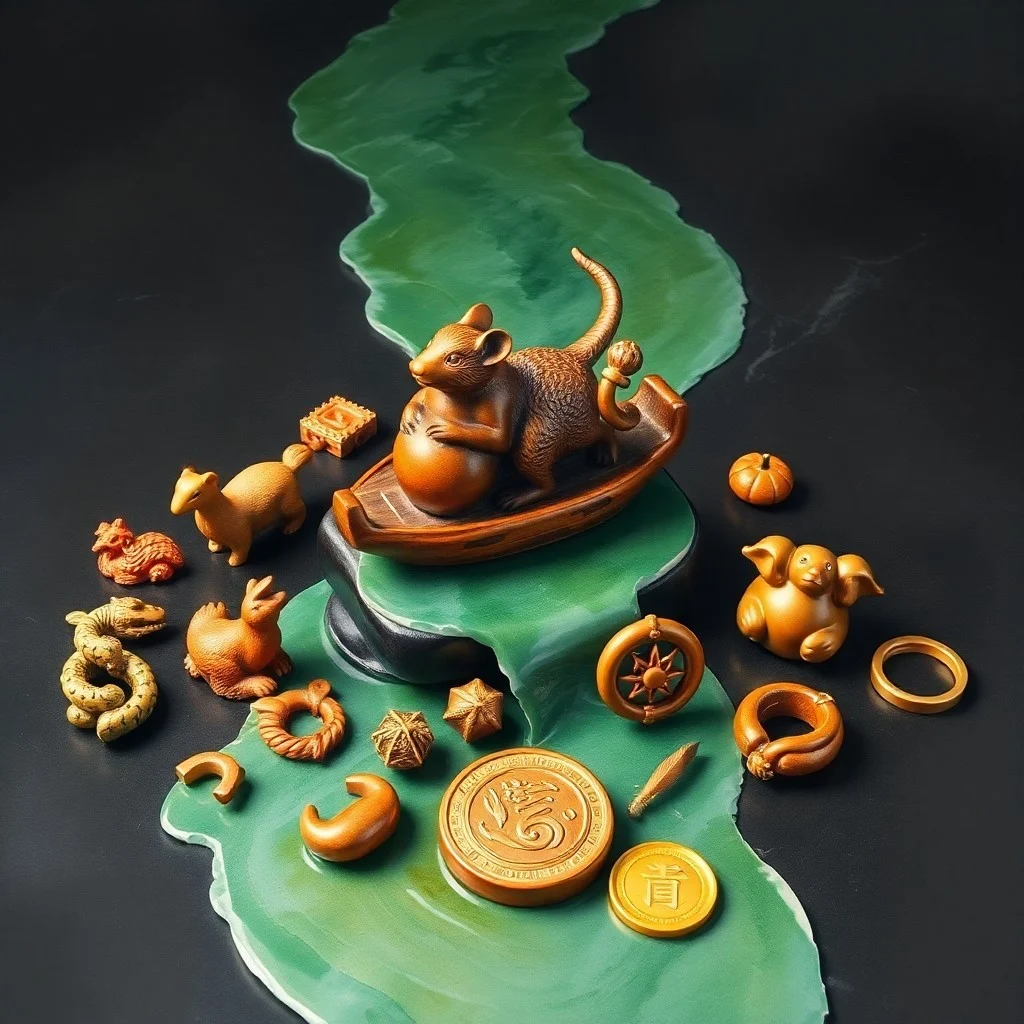
An ancient scroll depicting the timeless journey and order of the Chinese Zodiac animals.
The Agile Rabbit's Leap
The Rabbit, known for its speed and agility on land, was not a strong swimmer. However, he was clever. He hopped across stones and logs that floated in the river. Just as he was about to fall, a floating log carried him to the other side. He quickly jumped off and bounded to the finish line, securing the fourth place.
The Rabbit's tale emphasizes resourcefulness and quick thinking. It shows that even without inherent strength, one can find creative ways to overcome obstacles. Those born in the Year of the Rabbit are often characterized by their gentleness, caution, and ability to navigate difficult situations with grace.
The Noble Dragon's Detour
The mighty Dragon, a symbol of power and good fortune, was expected to win easily due to his ability to fly. Yet, he arrived in fifth place. When asked by the Jade Emperor why he was delayed, the Dragon explained his noble detour. He had seen a village suffering from drought and stopped to bring rain, then later helped the Rabbit by blowing a gust of wind to push his log to shore.
The Dragon's story is a testament to generosity and selflessness. Despite his inherent advantages, he chose to help others, embodying true leadership and compassion. This act reinforces the Dragon's revered status in Chinese culture, representing benevolence and wisdom, even at the cost of personal gain in the race. You can learn more about Dragon personalities and their influence.
The Sly Snake and the Swift Horse
Following the Dragon, the Horse galloped towards the finish line, seemingly poised for sixth place. However, just as he was about to cross, the cunning Snake, who had been hiding wrapped around the Horse's leg, slithered down and darted forward, surprising everyone. The Snake claimed sixth place, leaving the Horse to settle for seventh.
This moment in the race illustrates the Snake's characteristic slyness and ability to surprise, while the Horse represents speed and enthusiasm, sometimes at the expense of vigilance. The Snake's unexpected move highlights the unpredictable nature of competition and the importance of being aware of one's surroundings. Dive deeper into the meaning and traits of the Snake in the Chinese Zodiac.
A mystical portal surrounded by the twelve animal silhouettes, symbolizing their entry into the zodiac cycle.
The Cooperative Goat, Monkey, and Rooster
Next to arrive were the Goat, Monkey, and Rooster, demonstrating the power of teamwork. They found a raft and worked together to navigate the river. The Rooster spotted the raft, the Monkey cleared weeds and obstacles, and the Goat used its strength to push the raft. Through their combined efforts, they successfully crossed the river.
The Goat took eighth place, the Monkey ninth, and the Rooster tenth. Their story emphasizes the virtues of cooperation, mutual aid, and strategic planning. It shows that by working together, even diverse individuals can achieve common goals that might be impossible alone. This trio exemplifies harmony and collective intelligence.
The Playful Dog's Delay
The Dog, a superb swimmer, was expected to finish much earlier. However, being a lover of water and play, he couldn't resist splashing and frolicking in the river. He enjoyed the swim so much that he took his time, arriving in eleventh place. His playful nature, while endearing, cost him a higher position in the zodiac.
The Dog's narrative highlights a balance between duty and enjoyment. It suggests that while dedication is important, one's intrinsic nature can sometimes lead to delightful distractions. Those born in the Year of the Dog are often seen as loyal, honest, and sometimes a bit carefree, reflecting this endearing characteristic from the race.
The Last-Place Pig
Finally, after a long wait, the Pig arrived, securing the twelfth and final spot. When asked about his delay, the Pig explained that he had gotten hungry during the race, stopped for a hearty meal, and then fell asleep. After his nap, he continued his journey and eventually made it to the Heavenly Gate.
The Pig's story is often interpreted as a symbol of contentment and simple pleasures, but also a reminder of the consequences of indulgence and procrastination. Despite being last, the Pig represents honesty and good fortune, often associated with a comfortable life. His relaxed approach to the race provides a humorous and relatable conclusion to the competition. You can explore the meaning and traits of the Pig in the Chinese Zodiac.
Lessons from the Great Race
The Great Race is rich with moral and philosophical lessons that extend beyond simply explaining the zodiac order. It teaches that success can be achieved through various means: the Rat's cunning, the Ox's diligence, the Tiger's strength, the Rabbit's agility, the Dragon's benevolence, the Snake's slyness, the Horse's speed, the Goat, Monkey, and Rooster's teamwork, the Dog's playful spirit, and the Pig's contentment.
It illustrates that every personality type has its strengths and weaknesses, and that unexpected events or choices can alter one's path to victory. The legend encourages introspection about one's own approach to challenges and how different virtues contribute to life's journey. It's a timeless narrative that continues to offer guidance and entertainment.
| Rank | Animal | Key Trait from Race | Associated Personality Traits |
|---|---|---|---|
| 1st | Rat | Cunning, cleverness | Intelligent, resourceful, charming, ambitious, opportunistic |
| 2nd | Ox | Diligence, strength | Hardworking, reliable, patient, determined, honest |
| 3rd | Tiger | Bravery, power, struggle | Courageous, confident, competitive, unpredictable, adventurous |
| 4th | Rabbit | Agility, resourcefulness | Gentle, quiet, elegant, kind, responsible, cautious |
| 5th | Dragon | Nobility, benevolence | Enthusiastic, confident, intelligent, charismatic, powerful |
| 6th | Snake | Slyness, wisdom | Enigmatic, intelligent, wise, charming, intuitive |
| 7th | Horse | Speed, enthusiasm | Energetic, active, independent, animated, impatient |
| 8th | Goat (Sheep/Ram) | Cooperation, gentleness | Calm, gentle, sympathetic, artistic, thoughtful |
| 9th | Monkey | Ingenuity, adaptability | Sharp, clever, curious, mischievous, innovative |
| 10th | Rooster | Diligence, observation | Observant, hardworking, courageous, confident, honest |
| 11th | Dog | Loyalty, playfulness | Loyal, honest, cautious, responsible, stubborn |
| 12th | Pig (Boar) | Contentment, honesty | Compassionate, generous, diligent, honest, good-tempered |
Cultural Significance and Legacy
The Great Race legend continues to hold immense cultural significance in China and throughout East Asia. It's not merely a children's story but a fundamental narrative that shapes understanding of personality, compatibility, and destiny within the Chinese Zodiac. Each New Year celebration is marked by the transition to a new animal sign, bringing with it specific predictions and cultural practices.
The story influences everything from naming conventions to marriage compatibility and career choices, providing a framework for interpreting human behavior and predicting future events. It's a vibrant thread woven into the fabric of daily life, celebrating the diversity of characteristics and the value of both individual effort and collective spirit. Exploring this legend helps us appreciate the depth and richness of Tarot Esoteric Geometry: Unlocking Universal Truths Sacred Shapes.
Fuente: Contenido híbrido asistido por IAs y supervisión editorial humana.


Comments
Post a Comment