
Pendulum Dowsing: Intuitive Guidance for Yes/No Questions | StarPluto
Pendulum dowsing, an ancient practice rooted in various cultures and traditions, offers a fascinating pathway to intuitive guidance and self-discovery. Often associated with divination and energy work, it involves using a weighted object—a pendulum—suspended from a string or chain, to gain insights into questions that can be answered with a simple "yes" or "no." This method is believed to tap into the subconscious mind or universal energy fields, providing clarity on decisions, locating lost items, or even assessing energetic imbalances.
Far from being a mere parlor trick, dowsing is approached by many as a serious tool for personal development and spiritual exploration. Its efficacy is often attributed to the ideomotor effect, where subtle, unconscious muscular movements in response to internal thoughts or external stimuli cause the pendulum to swing. This comprehensive guide will delve into the intricacies of pendulum dowsing, offering a structured approach for beginners and seasoned practitioners alike to harness its potential for intuitive guidance.
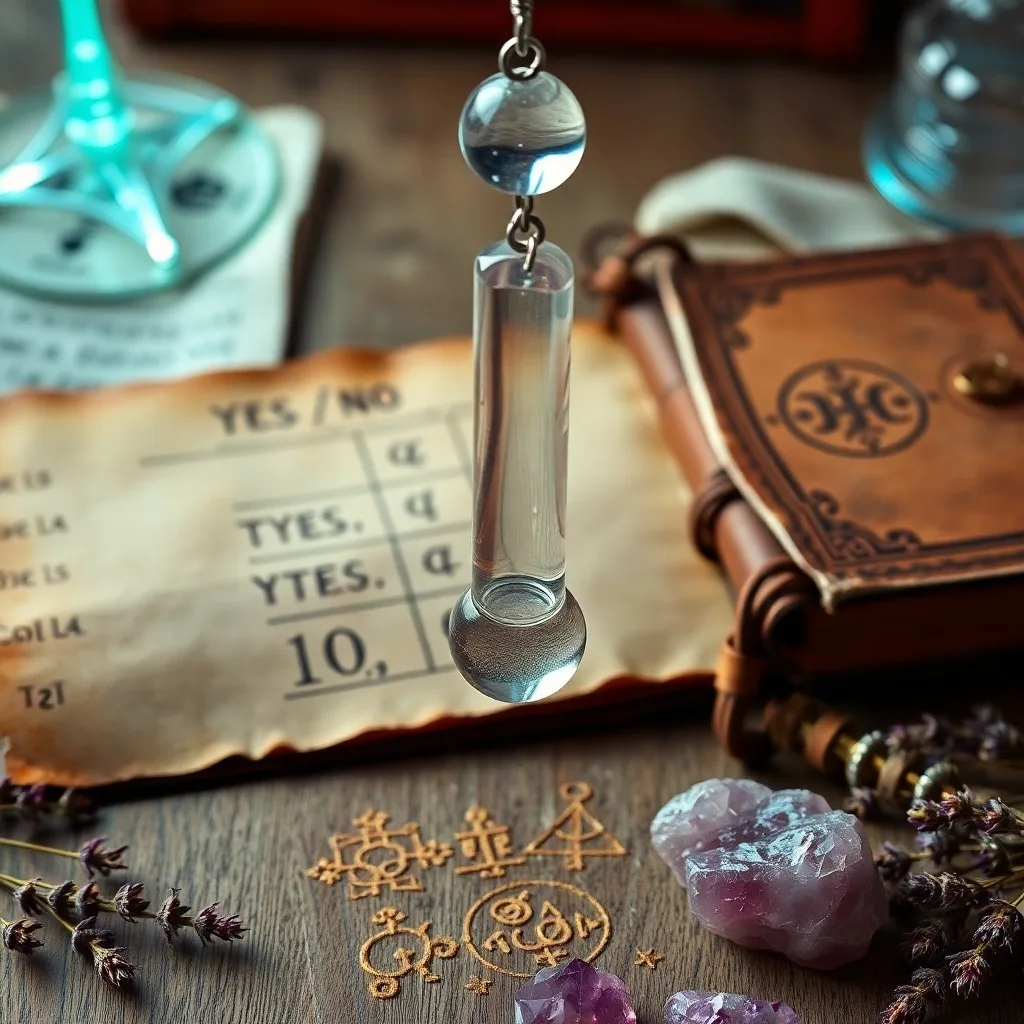 A digital illustration capturing the essence of intuitive guidance through pendulum dowsing, connecting to cosmic energies.
What is Pendulum Dowsing?
Pendulum dowsing is a form of divination that uses a suspended, weighted object to receive answers to questions. The pendulum acts as a receiver and transmitter of information, translating subtle energy fluctuations into discernible movements. These movements are typically interpreted as "yes," "no," or "maybe," providing a direct line to insights that may be hidden from the conscious mind.
Historically, dowsing, also known as divining, has been used for centuries across various cultures to locate water, minerals, and even lost objects. While the tools and specific methods have evolved, the core principle remains the same: to access information beyond conventional means. Modern pendulum dowsing extends these applications to personal guidance, energy healing, and spiritual inquiry.
The practice is rooted in the belief that everything possesses an energetic signature, and a trained dowser can attune to these frequencies. The pendulum, being a sensitive instrument, responds to these subtle energies, reflecting them through its motion. This interaction is often described as a dialogue between the conscious self, the subconscious, and the universal field of information.
The Science and Intuition Behind Dowsing
While dowsing is often associated with metaphysical or spiritual practices, scientific explanations primarily point to the ideomotor effect. This psychological phenomenon describes unconscious physical movements in response to thoughts or suggestions. For instance, when a dowser anticipates a "yes," their subconscious mind might trigger tiny, imperceptible muscle contractions in their hand, causing the pendulum to swing in the pre-determined "yes" direction.
However, many practitioners believe that the ideomotor effect is merely the mechanism through which a deeper, intuitive connection manifests. They argue that the pendulum acts as an amplifier for the subtle signals received from the subconscious mind, which in turn accesses a broader field of information, sometimes referred to as the collective unconscious or universal intelligence. This perspective suggests that dowsing is a bridge between our analytical mind and our innate intuitive capabilities.
Research into dowsing has yielded mixed results, with many controlled scientific studies failing to demonstrate its effectiveness beyond chance. Nevertheless, for millions of individuals worldwide, the personal experience of dowsing provides undeniable proof of its value for self-reflection and decision-making. The key lies in understanding that dowsing is less about predicting the future and more about accessing internal wisdom and clarifying current energies.
Choosing Your Pendulum: A Personal Connection
Selecting a pendulum is a deeply personal process, as the connection between the dowser and their tool is paramount. While any weighted object on a string can function as a pendulum, many prefer specific materials for their energetic properties or aesthetic appeal. Common materials include crystals, metals, and wood, each offering unique characteristics.
- Crystals: Often chosen for their perceived energetic properties. Clear quartz is popular for its amplifying qualities, amethyst for intuition, and rose quartz for emotional clarity. The shape can vary from faceted to smooth, depending on personal preference.
- Metals: Brass, copper, and silver are frequently used due to their durability and conductivity. Metal pendulums are often favored for their precision and grounding qualities.
- Wood: Wooden pendulums are lightweight and can feel very natural in the hand. They are often chosen for their connection to nature and their ability to absorb and transmute energy.
When choosing a pendulum, it's recommended to hold different ones and see which one "feels right" or resonates with you. The weight and length of the chain can also influence its movement; a lighter pendulum may respond more subtly, while a heavier one might have a more pronounced swing. Ultimately, the best pendulum is the one you feel most comfortable and connected with, as this fosters a stronger intuitive link.
 An antique brass pendulum and various crystals arranged on a polished table, essential tools for intuitive dowsing.
Preparing for a Dowsing Session
Preparation is crucial for a successful and accurate dowsing session. Creating a calm and focused environment helps to minimize external distractions and internal chatter, allowing for a clearer connection to your intuition. Consider the following steps before you begin:
- Clear Your Space: Ensure your dowsing area is tidy and free from clutter. Some practitioners like to light a candle, burn incense, or play soft music to enhance the atmosphere.
- Clear Your Mind: Take a few deep breaths to center yourself. Meditate briefly or simply focus on your breath to quiet your mind and release any tension or preconceived notions.
- Cleanse Your Pendulum: Especially if your pendulum is made of crystal, it's beneficial to cleanse it regularly to remove any accumulated energies. Methods include rinsing it under cool water, placing it in moonlight, or smudging it with sage.
- Set Your Intention: Clearly state your purpose for the session. For example, "I intend to receive clear and accurate guidance regarding [your question]." This helps to focus your energy and the pendulum's response.
By taking these preparatory steps, you create an optimal energetic field for dowsing, enhancing the reliability and clarity of the answers you receive. It's about establishing a sacred space, both externally and internally, for intuitive communication.
Calibrating Your Pendulum: Establishing Your Code
Before you can ask specific questions, you need to establish a clear communication code with your pendulum. This involves asking it to show you its distinct movement for "yes," "no," and "maybe" (or "rephrase"). This calibration process is fundamental, as it personalizes the dowsing experience to your unique energetic connection with the pendulum.
Hold the pendulum by its chain between your thumb and forefinger, allowing it to hang freely. Rest your elbow on a table to keep your hand steady. Then, ask the following questions aloud or silently:
- "Show me my 'yes'." Observe the pendulum's movement. It might swing back and forth, side to side, or in a clockwise circle. This will be your personal "yes" signal.
- "Show me my 'no'." Again, observe the movement. It will likely be a different pattern from your "yes."
- "Show me my 'maybe' or 'rephrase'." This signal indicates that the question is unclear, cannot be answered at this time, or requires more information.
Repeat these calibration steps several times until you are confident in recognizing each distinct movement. It's important to remember that these signals are unique to you and your pendulum; what constitutes a "yes" for one person might be a "no" for another. This initial setup is critical for accurate interpretation of future responses.
Formulating Effective Questions for Clarity
The quality of your dowsing results directly correlates with the quality of your questions. Pendulums are best suited for clear, concise, and unambiguous "yes" or "no" questions. Avoid open-ended questions or those that involve complex scenarios, as these will likely result in a "maybe" response or confusing movements.
Here are guidelines for formulating effective questions:
- Be Specific: Instead of "Should I change jobs?", ask "Is it in my highest good to accept the job offer from Company X?"
- Keep it Simple: Break down complex issues into a series of simple yes/no questions. For example, if you want to know if a new business venture is viable, you might ask: "Is this business idea profitable?", "Will I find the necessary resources?", "Is now the right time to start?"
- Be Neutral: Avoid emotionally charged questions or those with a strong personal bias. Try to phrase questions in a way that allows for an objective answer.
- Focus on the Present/Immediate Future: Pendulums are generally more accurate for current energies and short-term outcomes rather than distant future predictions.
- Use "Is it in my highest good?": This phrasing ensures that the answers align with your overall well-being and spiritual path, rather than just immediate desires.
Practicing question formulation will significantly improve the accuracy and usefulness of your dowsing sessions. Remember, the pendulum reflects what you ask, so asking well-formed questions is key to receiving meaningful answers.
 A vibrant watercolor illustration depicting the subtle energy flows and intuitive connection facilitated by a pendulum.
Techniques for Effective Pendulum Dowsing
Once your pendulum is calibrated and your questions are ready, the actual dowsing process involves a few key techniques to ensure optimal results. Consistency in your approach will help establish a stronger connection and clearer communication.
- Holding the Pendulum: Hold the chain between your thumb and forefinger, allowing about 4-6 inches of chain to hang down. Your grip should be relaxed but firm enough to prevent accidental movement. Keep your elbow stable, ideally resting it on a surface.
- Centering the Pendulum: Before asking a question, gently hold the pendulum still over the center of your palm or a dowsing chart. Wait for it to stop moving completely.
- Asking the Question: Clearly state your "yes" or "no" question, either aloud or in your mind. Focus intently on the question, but remain detached from the outcome.
- Observing the Movement: Watch the pendulum without consciously trying to influence its motion. Be patient; sometimes it takes a few moments for the movement to become clear. Note the direction and intensity of its swing.
- Confirming the Answer: After receiving a clear answer, you can optionally ask a confirming question, such as "Is this answer truly a 'yes'?" to validate the response.
It's important to approach dowsing with an open mind and a state of neutrality. Any strong desire for a particular answer can introduce bias, potentially influencing the pendulum's movement through the ideomotor effect. Regular practice helps in distinguishing between conscious influence and genuine intuitive responses.
Interpreting Pendulum Responses
While the primary responses in pendulum dowsing are "yes," "no," and "maybe," understanding the nuances of these movements can provide deeper insights. The intensity and clarity of the swing often convey additional information.
- Strong, Clear Swing: A vigorous and consistent swing in your "yes" or "no" direction usually indicates a very clear and confident answer. This suggests a strong energetic alignment with the response.
- Weak, Hesitant Swing: A faint or wavering swing might suggest a less certain answer, or that there are underlying factors influencing the situation. It could also mean that the energy is not fully aligned, or that there's some internal resistance.
- "Maybe" or "Rephrase": This movement, often a small, erratic circle or a very slight wobble, indicates that the question is not well-formed, that the answer is not yet clear, or that more information is needed. It's a signal to re-evaluate your question.
- No Movement: Sometimes the pendulum remains completely still. This can mean that there is no answer available at this time, that you are too emotionally invested, or that the question is outside the scope of what the pendulum can answer.
It's crucial to trust your initial interpretation and avoid re-asking the same question repeatedly if you don't like the answer. This can lead to confusion and diminish the clarity of your dowsing. Instead, rephrase the question or take a break and return to it later with a fresh perspective. Keeping a dowsing journal can help you track your questions and responses, allowing you to identify patterns and improve your interpretation skills over time.
Ethical Considerations in Dowsing
As with any practice involving intuition and energy, ethical guidelines are essential for responsible pendulum dowsing. Respect for oneself and others, along with a clear understanding of the practice's limitations, forms the foundation of ethical dowsing.
- Personal Responsibility: Always remember that dowsing is a tool for guidance, not a substitute for personal responsibility or critical thinking. You are ultimately responsible for your decisions and actions.
- Respect for Others' Privacy: Avoid asking questions about other people without their explicit consent. Dowsing into someone else's personal life without permission is an invasion of privacy and unethical.
- No Medical or Legal Advice: Pendulum dowsing should never be used to diagnose medical conditions, prescribe treatments, or provide legal advice. Always consult qualified professionals for these matters.
- Avoid "Should" Questions: Frame questions to explore possibilities rather than seeking absolute directives. Instead of "Should I do X?", ask "Is it beneficial for me to do X?" or "Will doing X lead to a positive outcome for me?"
- Maintain Neutrality: Strive for emotional detachment when dowsing. Your personal desires or fears can bias the results.
By adhering to these ethical principles, practitioners ensure that pendulum dowsing remains a tool for empowerment and positive growth, rather than a source of dependency or misuse. It fosters a respectful relationship with the intuitive process.
Common Applications of Pendulum Dowsing
The versatility of pendulum dowsing allows for its application in various aspects of life, offering a unique perspective on everyday challenges and spiritual inquiries. While its historical uses focused on locating physical resources, modern dowsing has expanded significantly.
Here are some common applications:
- Decision Making: From choosing between two options to making significant life choices, dowsing can help clarify which path aligns best with your highest good.
- Locating Lost Objects: A traditional use, where dowsers use maps or simply their intuition to pinpoint the location of misplaced items.
- Energy Assessment: Dowsing can be used to assess the energy levels of chakras, rooms, or even food and supplements, helping to identify imbalances or beneficial items.
- Food and Supplement Choices: Some dowsers use their pendulum to determine which foods, vitamins, or herbs are most beneficial for their body at a given time.
- Spiritual Guidance: For those on a spiritual path, a pendulum can assist in connecting with higher self, spirit guides, or for general spiritual inquiry.
- Identifying Geopathic Stress: Advanced dowsers may use pendulums to detect harmful earth energies (geopathic stress) in homes or workplaces.
It's important to approach these applications with discernment and to cross-reference information with other forms of research or professional advice when necessary. Pendulum dowsing is a complementary tool, not a standalone solution for complex problems.
Tips for Beginners and Advanced Practitioners
Whether you're just starting your dowsing journey or looking to refine your skills, certain practices can enhance your connection and the accuracy of your readings. Consistency and mindful engagement are key to developing proficiency.
- Practice Regularly: Like any skill, dowsing improves with consistent practice. Dedicate a few minutes each day to connect with your pendulum, even if it's just for calibration.
- Start with Known Answers: Begin by asking questions you already know the answer to (e.g., "Is my name [your name]?"). This builds confidence and reinforces your pendulum's signals.
- Trust Your Intuition: While the pendulum provides a visual cue, pay attention to any subtle feelings or thoughts that arise during the session. These are often part of the intuitive message.
- Keep a Dowsing Journal: Document your questions, the pendulum's responses, and the actual outcomes. This helps you track accuracy, identify patterns, and learn from your experiences.
- Stay Hydrated and Grounded: Being well-hydrated and feeling grounded can improve your energetic clarity, leading to more precise dowsing.
- Explore Dowsing Charts: For more advanced dowsing, consider using dowsing charts (also known as intention charts or radionic charts). These are visual aids with various options, allowing the pendulum to point to specific answers beyond simple yes/no.
Remember that dowsing is a partnership between you and your tool. Cultivating a respectful and patient approach will deepen this connection and unlock greater intuitive potential. The journey of dowsing is one of continuous learning and self-discovery, constantly refining your ability to listen to inner wisdom.
Limitations and Misconceptions of Pendulum Dowsing
While pendulum dowsing can be a powerful tool, it's crucial to understand its limitations and common misconceptions to use it effectively and responsibly. Dowsing is not a magic bullet or a substitute for rational thought and action.
- Not a Fortune-Telling Device: Dowsing provides guidance based on current energies and probabilities, not fixed future outcomes. The future is fluid and influenced by free will.
- Subject to Bias: Personal desires, fears, or strong emotional states can unconsciously influence the pendulum's movement, leading to inaccurate readings. Objectivity is key.
- Limited to Yes/No: While dowsing charts expand possibilities, the core function is binary. Complex questions requiring detailed answers are not suitable for direct pendulum inquiry.
- Requires Practice and Patience: Expecting instant, perfect results can lead to frustration. Developing a strong connection and accurate interpretation takes time and dedication.
- Not a Replacement for Professional Advice: For serious health, legal, or financial matters, always consult qualified professionals. Dowsing is a complementary tool for personal insight.
Understanding these limitations helps set realistic expectations and encourages a balanced approach to dowsing. It empowers practitioners to integrate intuitive guidance with practical wisdom, fostering a more holistic decision-making process. By respecting its boundaries, the true potential of pendulum dowsing as a tool for self-awareness and subtle energy exploration can be fully realized.
In conclusion, pendulum dowsing offers a unique and accessible method for tapping into intuitive wisdom and receiving clear, concise answers to yes/no questions. By choosing a pendulum that resonates with you, preparing your mind and space, calibrating your signals, and formulating clear questions, you can unlock a powerful channel for personal guidance. Remember to practice ethical dowsing, trust your intuition, and understand its limitations to integrate this ancient art effectively into your modern life. The journey of dowsing is one of continuous discovery, inviting you to explore the subtle energies that connect us all.
Fuente: Contenido híbrido asistido por IAs y supervisión editorial humana.


Comments
Post a Comment