
Mayan Calendar Astro-Archaeology: Celestial Cycles, Lost Narratives
Astro-archaeology stands as a fascinating interdisciplinary field, merging the study of ancient cultures with the rigorous science of astronomy. It seeks to uncover how prehistoric and ancient peoples understood the cosmos, integrating their celestial observations into their architecture, rituals, and societal structures. Among the civilizations that exemplify this profound cosmic connection, the Maya of Mesoamerica hold a preeminent position, renowned for their sophisticated calendar systems and intricate astronomical knowledge.
This article delves into the rich tapestry of Mayan astro-archaeology, exploring how their monumental architecture served as celestial observatories, how their complex calendars charted the movements of the heavens, and how these observations shaped their worldview and spiritual narratives. We will journey through their advanced understanding of time and space, deciphering the lost cosmic narratives embedded within their stone cities and ancient codices.
Table of Contents
- The Foundations of Mayan Astro-Archaeology
- The Intricacies of the Mayan Calendar System
- Celestial Observations and Architectural Alignments
- Deciphering Lost Cosmic Narratives
- Modern Interpretations and Ongoing Research
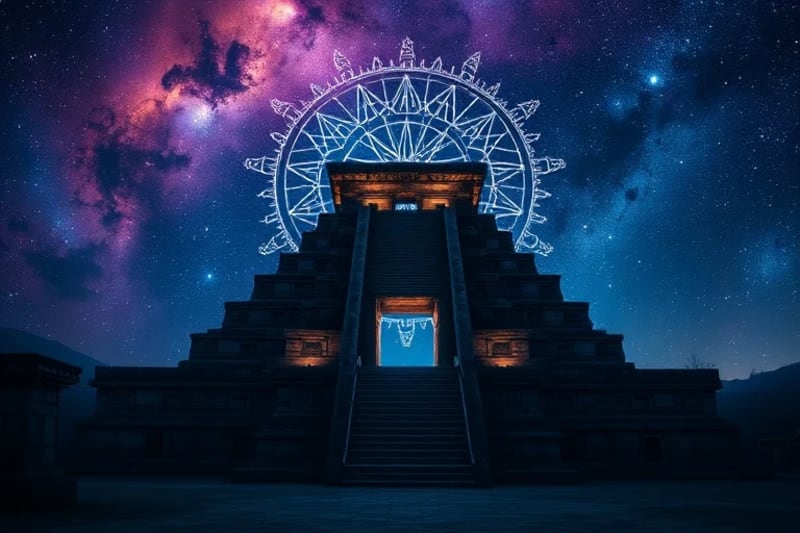
Conceptual rendering of ancient Mayan observatories, celestial alignments, and the profound connection between monumental architecture and cosmic phenomena that shaped their worldview.
This visual representation is a conceptual AI render, illustrating the majestic scale and astronomical precision embedded in Mayan civilization's architectural legacy, drawing inspiration from historical accounts and archaeological findings.The Foundations of Mayan Astro-Archaeology
The Mayan civilization flourished in Mesoamerica for over two millennia, leaving behind an extraordinary legacy of art, writing, mathematics, and astronomy. Spanning from the Preclassic period (c. 2000 BCE – 250 CE) through the Classic (c. 250 – 900 CE) and Postclassic (c. 900 – 1521 CE) eras, their influence extended across what is now southeastern Mexico, all of Guatemala and Belize, and parts of El Salvador and Honduras.
Key archaeological sites such as Chichen Itza, Palenque, Tikal, and Copán are not merely ruins but complex astronomical instruments. Within these urban centers, a specialized class of priests and astronomers meticulously observed the heavens. Their observations were not abstract scientific pursuits but were deeply integrated into their religious beliefs, agricultural practices, and political governance.
Early evidence of Mayan astronomical prowess includes carved stelae and wall paintings depicting celestial events and deities. These early records suggest a sophisticated understanding of cyclical time and the predictable movements of celestial bodies, laying the groundwork for their renowned calendar systems.
The Intricacies of the Mayan Calendar System
The Mayan calendar system is arguably one of the most complex and accurate time-keeping mechanisms developed in the ancient world. It was not a single calendar but a sophisticated interlocking series of cycles, each serving distinct purposes.
- The Tzolkin (Sacred Calendar): This 260-day cycle is formed by combining 20 day names with 13 numbers (20 x 13 = 260). It was primarily used for divination, naming ceremonies, and determining auspicious dates for rituals and prophecies. Its spiritual significance was paramount, guiding personal and communal life.
- The Haab' (Civil Calendar): Comprising 365 days, this calendar was more akin to our solar year, divided into 18 months of 20 days each, plus a 5-day period known as the Wayeb'. The Haab' tracked agricultural cycles, seasonal changes, solstices, and equinoxes, crucial for farming and societal organization.
- The Calendar Round: The Tzolkin and Haab' cycles intermeshed to form a larger 52-year cycle known as the Calendar Round. A specific date would repeat only once every 52 years, marking a significant period of renewal and often associated with ceremonies to avert cosmic catastrophe.
- The Long Count Calendar: For tracking longer spans of time, the Maya developed the Long Count, a linear calendar that counted days from a mythical starting point in 3114 BCE. This system allowed them to record historical events, astronomical phenomena, and prophecies across vast epochs. The famous "end date" of December 21, 2012, was merely the completion of a major cycle (b'ak'tun) within this system, not an apocalyptic prediction.
Beyond these primary calendars, the Maya also tracked the cycles of Venus with astonishing precision, lunar cycles, and were capable of predicting solar and lunar eclipses. Their understanding of celestial mechanics allowed for incredibly accurate predictions of planetary movements and eclipses, echoing the profound influence of fixed stars on world events as observed in various ancient cultures.
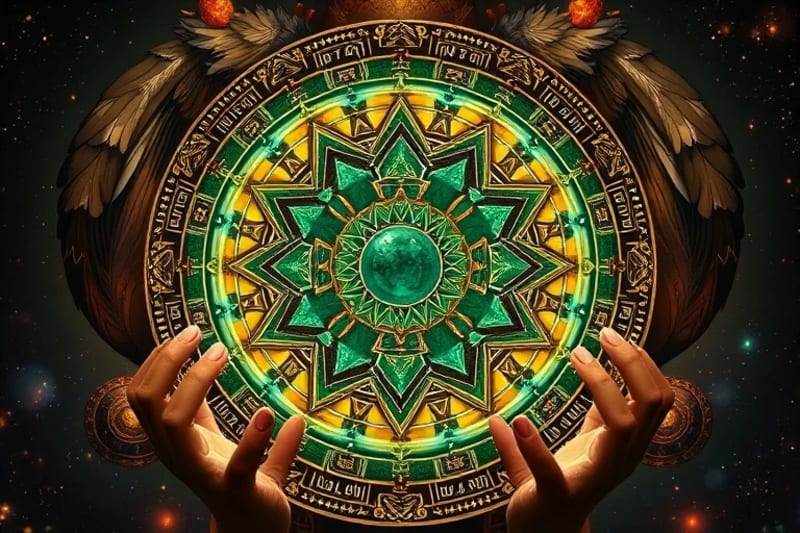
Intricate symbols and glyphs from the Mayan calendar, surrounded by artifacts representing their rich cultural and astronomical heritage.
Celestial Observations and Architectural Alignments
Mayan architecture was not merely functional or aesthetic; it was meticulously designed to align with significant celestial events. Buildings served as giant astronomical instruments, allowing priests and rulers to track the movements of the sun, moon, and planets, thereby legitimizing their power and dictating important societal activities.
One of the most famous examples is El Caracol, the observatory at Chichen Itza. Its circular tower and various windows are precisely aligned to track the extreme positions of Venus, a planet of immense importance to the Maya, associated with warfare and agricultural cycles. The precision involved in these constructions often incorporated principles akin to sacred geometry and Feng Shui, aligning not just with celestial bodies but also with energetic flows of the landscape.
Another iconic example is the Temple of Kukulcan (El Castillo) at Chichen Itza. During the spring and autumn equinoxes, the sun's angle creates a shadow of a serpent undulating down the pyramid's northern staircase, culminating in a stone serpent head at the base. This dramatic visual spectacle symbolized the descent of Kukulcan (the feathered serpent deity) to Earth, marking crucial agricultural transitions.
Other structures across the Mayan world are aligned to solstices, specific star risings and settings, and even the zenith passage of the sun. These alignments demonstrate an advanced understanding of observational astronomy and geodesy, allowing the Maya to integrate their cosmic knowledge directly into the physical fabric of their cities.

An abstract, conceptual representation of the intricate celestial mechanics and cosmic order understood by the ancient Maya.
Deciphering Lost Cosmic Narratives
The astronomical observations of the Maya were not merely data points; they were woven into a rich tapestry of mythology, prophecy, and spiritual belief. The cosmos was a living entity, and celestial events were direct communications from the gods, influencing human destiny and the cycles of creation and destruction.
The Popol Vuh, the sacred book of the K'iche' Maya, describes the creation of the world and humanity, with strong cosmological undertones. Deities like Itzamná (the creator god, often associated with the sun and sky) and Kinich Ahau (the sun god) played central roles, their movements across the sky reflecting their divine will and power. The cyclical nature of their calendars reinforced the belief in recurring cosmic ages, each with its own beginning and end.
The Dresden Codex, one of the few surviving Mayan books, is a primary source for understanding their astronomical knowledge. It contains detailed tables for predicting eclipses, the cycles of Venus, and other celestial phenomena, often accompanied by glyphs and illustrations that link these events to specific deities and prophecies. This intricate worldview, where every element was interconnected, resonates with broader cosmic principles of manifesting reality, suggesting a universal understanding of the forces that shape existence.
The quest to understand these ancient celestial narratives continues, with modern archeo-astrology playing a crucial role in deciphering the complex messages left by civilizations like the Maya. By combining archaeological evidence with astronomical calculations, researchers can reconstruct the cosmic worldview of this remarkable civilization.
Modern Interpretations and Ongoing Research
The Mayan calendar, particularly the Long Count, gained significant global attention leading up to December 21, 2012. This date, marking the end of a 13-b'ak'tun cycle, was widely misinterpreted in popular culture as a prediction of the end of the world. However, Mayan scholars consistently clarified that it signified merely the completion of a grand cycle and the beginning of a new one, a concept of renewal rather than destruction.
Contemporary archaeological and astronomical research continues to shed new light on Mayan astro-archaeology. Advanced technologies like LIDAR (Light Detection and Ranging) are revolutionizing the field, allowing researchers to uncover previously hidden cities and architectural alignments beneath dense jungle canopies. These discoveries often reveal even more intricate connections between Mayan settlements and celestial phenomena.
Ongoing studies focus on refining our understanding of specific astronomical events recorded by the Maya, correlating them with modern astronomical data, and further deciphering the complex glyphic texts that describe their cosmic beliefs. The enduring legacy of Mayan astronomical knowledge continues to inspire awe and provide invaluable insights into the human quest to understand our place in the universe.
Explore More Cosmic Insights
In conclusion, the astro-archaeology of the Mayan calendar reveals a civilization deeply attuned to the rhythms of the cosmos. Their sophisticated calendar systems, precise architectural alignments, and rich mythological narratives demonstrate an unparalleled integration of astronomy into every facet of their existence. The Maya's profound understanding of celestial cycles and their ability to translate this knowledge into tangible structures and enduring narratives continue to captivate and educate us, offering a timeless testament to humanity's innate desire to comprehend the universe.
Source: Hybrid content assisted by AI and human editorial supervision.


Comments
Post a Comment