
Archeo-Astrology Deciphering Ancient Celestial Narratives
Archeo-astrology stands as a fascinating interdisciplinary field, bridging the rigorous methodologies of archaeology with the ancient wisdom of astrology. It delves into how prehistoric and ancient cultures understood and integrated celestial phenomena into their daily lives, spiritual practices, and architectural designs. Far from being a mere historical curiosity, this discipline offers profound insights into the human quest for meaning, order, and connection with the cosmos. By examining the astronomical alignments of ancient structures, the symbolism in their art, and the narratives embedded in their myths, archeo-astrology deciphers the celestial languages of our ancestors.
This advanced exploration moves beyond simply identifying alignments; it seeks to reconstruct the entire cosmological worldview of past societies. It investigates how celestial events—solstices, equinoxes, planetary movements, and stellar cycles—were not just observed but were woven into the very fabric of their societal structures, religious beliefs, and understanding of fate and destiny. The relevance of these ancient narratives extends into modern times, offering a unique lens through which to view concepts like synchronicity, collective consciousness, and the enduring human relationship with the universe.
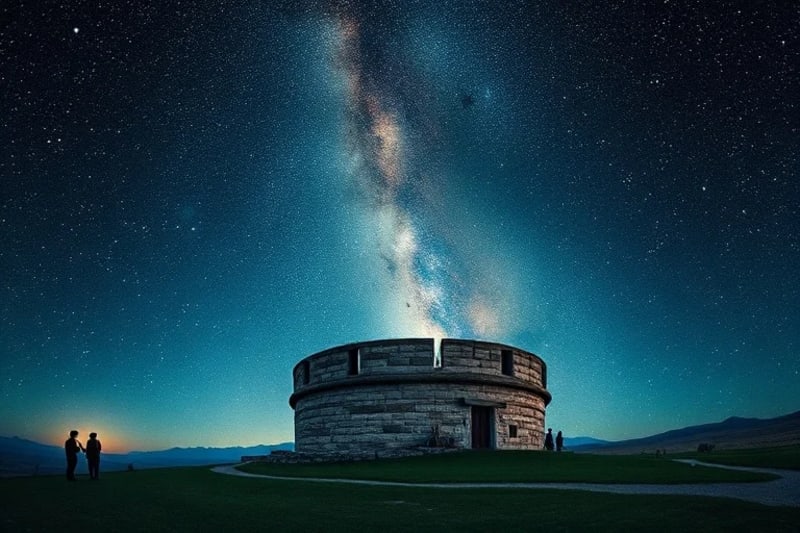
An ancient observatory under a vast, star-filled sky, revealing the profound connection between early civilizations and celestial mechanics.
Table of Contents
- Introduction to Archeo-Astrology
- Historical Roots: Cradle of Celestial Wisdom
- Deciphering Ancient Celestial Records
- The Language of the Stars: Symbols and Mythologies
- Archeo-Astrology and Modern Synchronicity
- Methodologies and Interdisciplinary Approaches
- The Future of Archeo-Astrology
Introduction to Archeo-Astrology
Archeo-astrology is the scientific study of the astronomical practices, celestial beliefs, and cosmological worldviews of ancient peoples. It is distinct from astrology as commonly understood today, focusing instead on the empirical evidence of how past societies interacted with the sky. This field examines physical artifacts such as megalithic monuments, temples, burial sites, and ancient cities, analyzing their orientations and internal geometries for astronomical significance. It also incorporates textual analysis of ancient scripts, myths, and religious texts to understand the conceptual frameworks that underpinned these celestial observations.
The core premise is that the cosmos was not merely a backdrop for human existence but an active participant in it, influencing everything from agricultural cycles to political legitimacy and spiritual destiny. For ancient cultures, the sky was a living map, a divine script, and a cosmic clock. Understanding their interpretation of this script allows us to gain deeper insights into their cognitive processes, technological capabilities, and philosophical underpinnings. This interdisciplinary approach draws from archaeology, astronomy, anthropology, history, and even ethnography, creating a rich tapestry of knowledge.
Historical Roots: Cradle of Celestial Wisdom
The roots of archeo-astrology stretch back to the earliest organized human societies. Evidence of celestial observation can be found across diverse cultures and continents. In Mesopotamia, the Sumerians, Akkadians, Babylonians, and Assyrians developed sophisticated astronomical systems, creating detailed star catalogs and predicting celestial events. Their ziggurats often had astronomical alignments, and their cuneiform tablets reveal a complex interplay between celestial omens and earthly affairs.
Ancient Egypt is another prime example, with monumental structures like the Great Pyramids of Giza aligned with cardinal directions and specific stars. Temples such as Karnak and Abu Simbel exhibit precise alignments with solstices and equinoxes, demonstrating an advanced understanding of solar cycles. In the Americas, the Maya civilization developed an incredibly accurate calendar system and astronomical tables, meticulously tracking the movements of the Sun, Moon, and Venus. Their observatories, like El Caracol at Chichen Itza, attest to their dedication to celestial mechanics.

A collection of ancient astronomical tools, including an astrolabe and inscribed tablets, showcasing early human ingenuity in celestial mapping.
Beyond these well-known examples, cultures across Europe (Stonehenge, Newgrange), Asia (ancient Chinese observatories), and Africa also left indelible marks of their celestial knowledge. These sites are not merely architectural marvels; they are time capsules of ancient cosmologies, embodying a universal human impulse to find order and meaning in the celestial dance above. The study of these diverse traditions reveals both unique cultural interpretations and surprisingly common themes in humanity's relationship with the cosmos.
Deciphering Ancient Celestial Records
Deciphering ancient celestial records requires a meticulous approach, combining archaeological excavation with astronomical calculations. Researchers use sophisticated software to reconstruct the ancient sky, accounting for precession (the slow wobble of the Earth's axis) which alters the apparent position of stars over millennia. This allows them to determine which stars or constellations would have been visible and significant at the time a monument was built or a text was written.
Key methods include:
- Site Orientation Analysis: Measuring the precise alignment of structures (e.g., entrances, central axes, windows) to determine if they point to significant celestial events like solstices, equinoxes, or the rising/setting of specific stars or planets.
- Iconographic and Textual Interpretation: Analyzing astronomical symbols in art, hieroglyphs, cuneiform, and other ancient scripts. This involves linguistic and cultural expertise to understand the intended meaning and context.
- Ethnoastronomy: Studying contemporary indigenous cultures that maintain traditional astronomical knowledge to gain insights into how ancient societies might have perceived and utilized celestial information.
- Mathematical and Geometrical Analysis: Examining the internal geometry and proportions of ancient buildings for encoded astronomical constants or relationships.
The integration of these methods helps build a comprehensive picture of ancient celestial understanding. For instance, the detailed astronomical observations encoded in Mayan codices or Egyptian temple ceilings provide invaluable data points that corroborate architectural findings. This multidisciplinary detective work allows us to peer into the minds of ancient astronomers and priests, understanding their worldview. Further insights into how universal truths are encoded in symbols can be found in the study of Sacred Geometry: Unlocking Universal Truths, Esoteric Symbols.
The Language of the Stars: Symbols and Mythologies
Beyond the precise measurements and alignments, ancient civilizations imbued the celestial sphere with rich symbolic meaning and mythological narratives. The stars were not just points of light; they were deities, heroes, animals, and cosmic forces that shaped human destiny. Constellations often served as mnemonic devices for agricultural cycles, moral lessons, and tribal histories. For example, the annual appearance of certain stars would signal the time for planting or harvesting, becoming deeply intertwined with survival and prosperity.
Myths often served as allegories for celestial phenomena. The epic journeys of heroes might mirror the path of the Sun through the zodiac, or the battles between gods could represent planetary conjunctions or eclipses. These narratives provided a framework for understanding the seemingly chaotic events of the cosmos, transforming them into a coherent, meaningful story. This symbolic language of the stars permeated every aspect of life, from personal omens to state-level prophecies. The concept of archetypes, as explored by Jung, finds strong resonance here, as celestial patterns often correspond to universal human experiences and psychological structures. For a deeper dive into how ancient wisdom bridges with psychological concepts, explore Jungian Archetypes Chinese Zodiac Bridging Ancient Wisdom.
Archeo-Astrology and Modern Synchronicity
The insights gleaned from archeo-astrology have profound implications for understanding modern concepts of synchronicity. Carl Jung defined synchronicity as a meaningful coincidence of two or more causally unrelated events. From an archeo-astrological perspective, ancient peoples lived in a world where such meaningful coincidences were not anomalies but expected patterns, woven into the very fabric of the cosmos. The celestial cycles were seen as direct reflections or even drivers of earthly events, creating a constant interplay between macrocosm and microcosm.
An abstract representation of synchronicity, illustrating the interconnectedness of cosmic patterns and human experience through luminous threads of light.
Ancient astrologers and priests were essentially practitioners of synchronicity, observing and interpreting the simultaneous occurrences in the heavens and on Earth. They sought patterns, correlations, and meanings in these alignments, believing that the cosmic dance offered clues to human events, psychological states, and collective destinies. This perspective suggests that our modern understanding of random chance might be a cultural construct, and that a deeper, more interconnected reality, akin to the Hermetic principles of "as above, so below," might be at play. The wisdom encoded in texts like the Emerald Tablet further emphasizes this profound connection, exploring manifestation through universal principles. Delve deeper into these concepts with Emerald Tablet Manifestation Hermetic Principles Quantum.
By studying how ancient cultures perceived and utilized these cosmic correspondences, we can begin to re-evaluate our own relationship with the universe. It encourages us to look for meaningful patterns in our lives, to recognize the subtle interplay between inner and outer worlds, and to perhaps rediscover a sense of cosmic belonging that many modern societies have lost. Archeo-astrology, therefore, is not just about the past; it is about re-enchanting our present and future with a deeper awareness of cosmic order.
Methodologies and Interdisciplinary Approaches
The rigorous methodology of archeo-astrology is crucial for its academic credibility. It employs statistical analysis to determine the probability that observed alignments are intentional rather than accidental. For instance, if a structure aligns precisely with a solstice sunrise, statistical models can assess the likelihood of such an alignment occurring by chance. This scientific rigor differentiates archeo-astrology from speculative interpretations.
Key methodologies include:
| Methodological Approach | Description | Key Disciplines Involved |
|---|---|---|
| Field Survey & Photogrammetry | Precise measurement of architectural orientations and features using GPS, total stations, and 3D modeling to document sites accurately. | Archaeology, Surveying, Geomatics |
| Archaeoastronomical Software | Utilizing specialized software to reconstruct ancient sky views, calculate celestial positions for specific dates, and model astronomical phenomena. | Astronomy, Computer Science |
| Iconography & Epigraphy | Analysis of visual symbols, carvings, and written texts to identify astronomical representations and their cultural significance. | Art History, Linguistics, Philology |
| Cultural Contextualization | Integrating findings within the broader cultural, religious, and social frameworks of the ancient society to understand the meaning of celestial observations. | Anthropology, History, Religious Studies |
| Statistical Validation | Applying statistical tests to determine the non-randomness and significance of observed astronomical alignments. | Statistics, Mathematics |
The interdisciplinary nature of archeo-astrology ensures a holistic understanding, preventing isolated interpretations. By combining hard scientific data with cultural insights, researchers can paint a more accurate and nuanced picture of ancient cosmologies, moving beyond mere speculation to evidence-based conclusions.
The Future of Archeo-Astrology
The field of archeo-astrology continues to evolve, driven by technological advancements and new archaeological discoveries. Lidar scanning, drone photogrammetry, and advanced computational modeling are revolutionizing how ancient sites are documented and analyzed, allowing for unprecedented precision in alignment studies. The discovery of previously unknown sites with astronomical significance further expands our understanding of global celestial traditions.
Future research will likely focus on more nuanced interpretations of ancient celestial narratives, exploring not just what was observed, but how these observations influenced social structures, power dynamics, and even individual psychology. There is also growing interest in connecting archeo-astronomical findings with cognitive archaeology, investigating how celestial patterns shaped human thought processes and the development of abstract reasoning. As our understanding of the universe expands, so too does our appreciation for the profound wisdom embedded in the celestial narratives of our ancient ancestors, offering timeless insights into the human condition and our place in the cosmos.
Explore Related Cosmic Insights
- Composite Chart Synastry: Relationship Entity Explained - Understand how celestial mechanics influence interpersonal dynamics.
- Scorpio Ascendant: Transformation, Power, and Intensity - Delve into how specific astrological placements shape individual destinies.
- Tarot Sacred Geometry Divination Universal Truths - Discover how ancient symbols and geometry connect to divination practices.
- Pisces Zodiac Sign: Intuition, Dreams, Compassion - Explore the intuitive and mystical aspects of zodiac signs, echoing ancient wisdom.
- Transpersonal Planets Transit: Uranus, Neptune, Pluto - Learn about the profound influence of outer planets on collective consciousness and individual transformation.
Source: Hybrid content assisted by AI and human editorial supervision.


Comments
Post a Comment