
Dwarf Planets Astrology: Eris, Makemake, Haumea Birth Chart Influence
Astrology, a profound ancient discipline, has continually evolved as our understanding of the cosmos expands. For centuries, the traditional planets from the Sun to Pluto formed the bedrock of natal chart interpretation. However, the discovery of numerous celestial bodies beyond Neptune, particularly dwarf planets in the Kuiper Belt, has opened new dimensions for astrological inquiry. These distant worlds, once mere astronomical curiosities, are now recognized by many modern astrologers as potent symbols carrying unique energetic signatures that influence our psyche and life path. Their slow orbits and remote locations suggest an impact on collective consciousness, generational themes, and deeply embedded personal patterns that may take a lifetime to unfold.
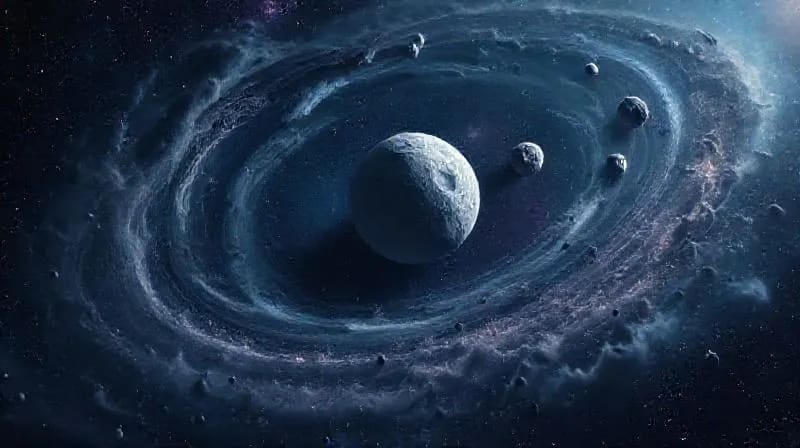 A cosmic tapestry illustrating the profound, often hidden, influences of distant dwarf planets on the human psyche and collective evolution.
Conceptual rendering generated by advanced AI, exploring themes of cosmic discovery and astrological expansion.
The inclusion of dwarf planets like Eris, Makemake, and Haumea in astrological analysis offers a more nuanced and comprehensive understanding of the birth chart. These bodies often represent archetypal energies that challenge existing structures, reveal hidden truths, and connect us to primal forces of creation and transformation. Their influence is not always overt but can manifest as subtle yet powerful undercurrents, shaping our deepest motivations, our responses to societal norms, and our capacity for profound personal growth. This article delves into the specific astrological meanings of Eris, Makemake, and Haumea, exploring how their positions in a natal chart can illuminate previously unexamined facets of an individual's destiny and potential.
Table of Contents
- Eris in Astrology: The Awakener of Truth and Discord
- Makemake in Astrology: The Fertile Creator and Spiritual Guide
- Haumea in Astrology: The Force of Creation, Rebirth, and Fertility
- Interpreting Dwarf Planets in the Natal Chart
- Integrating Dwarf Planets into Modern Astrological Practice
Eris in Astrology: The Awakener of Truth and Discord
Eris, discovered in 2005, is named after the Greek goddess of discord and strife. Her discovery was so significant that it directly led to Pluto's reclassification as a dwarf planet, reshaping our understanding of the solar system. Astrologically, Eris embodies themes of truth-telling, challenging the status quo, and revealing hidden injustices. She represents the urge to expose what is unfair, unbalanced, or corrupt, often through disruptive means. Her energy is not inherently negative but serves as a catalyst for necessary change, forcing us to confront uncomfortable realities and re-evaluate our values.
 The shattering of illusions, a core theme associated with the dwarf planet Eris, often bringing hidden truths to light.
Conceptual artwork, rendered by AI, exploring the disruptive yet clarifying energy of discord.
In a natal chart, Eris's placement by sign and house indicates where an individual might experience or instigate significant disruption in the pursuit of truth or justice. She highlights areas where one feels compelled to speak out against perceived wrongs, even if it means creating conflict. This energy can manifest as a strong desire for authenticity, a refusal to conform to societal expectations that feel inauthentic, or a drive to champion the underdog. Eris often challenges us to look beyond superficial harmony and address deeper, systemic issues. For instance, Eris in Aries might signify a pioneering spirit willing to fight for individual rights, while Eris in Libra could point to a struggle for true equality and justice in relationships or society.
Aspects to Eris are also crucial. A conjunction with personal planets intensifies her influence, making the individual a potent force for change or a lightning rod for controversy. Hard aspects (squares, oppositions) can indicate internal or external battles related to truth, power, and justice. Soft aspects (trines, sextiles) might suggest a more integrated ability to navigate conflict constructively, using discord as a tool for evolution rather than destruction. Eris's long orbital period (approximately 557 years) means her sign placement affects entire generations, pointing to collective themes of awakening and confrontation with societal shadows. Understanding Eris can help individuals harness their inner warrior for justice, transforming potential chaos into meaningful progress.
Makemake in Astrology: The Fertile Creator and Spiritual Guide
Makemake, another significant dwarf planet in the Kuiper Belt, was discovered shortly after Eris and is named after the Rapa Nui (Easter Island) creator god of humanity and fertility. Astrologically, Makemake represents themes of creation, resourcefulness, spiritual connection, and the ability to manifest abundance, particularly in isolated or challenging circumstances. It embodies the primal life force and the capacity for self-sufficiency, often highlighting areas where an individual can generate new beginnings or sustain life against odds. Makemake's energy is deeply connected to indigenous wisdom, the sacredness of life, and the cycles of nature.
In the birth chart, Makemake's sign and house placement reveal where an individual possesses a strong creative drive, a unique ability to generate resources, or a profound connection to spiritual or ancestral wisdom. It can indicate a natural talent for bringing things into being, whether it's art, ideas, or even communities. This dwarf planet often points to a deep respect for life, an understanding of natural laws, and an innate capacity for survival and thriving. For example, Makemake in Taurus might signify a talent for creating tangible beauty and wealth from the earth, while in Pisces, it could represent a powerful connection to universal creative currents and spiritual healing.
Makemake's influence can also highlight themes of isolation or self-reliance, reflecting its distant location in the solar system. Individuals with prominent Makemake placements might find their greatest creative breakthroughs or spiritual insights when they retreat from the mainstream, fostering their unique vision in a more solitary environment. It encourages us to tap into our inner wellspring of creativity and to honor the sacredness of our own life force. Its connection to fertility extends beyond physical procreation to encompass the fertility of ideas, projects, and spiritual practices. Exploring its placement can offer insights into one's unique creative blueprint and capacity for sustained manifestation. This dwarf planet encourages us to cultivate our inner garden, fostering growth and abundance from within.
Haumea in Astrology: The Force of Creation, Rebirth, and Fertility
Haumea, named after the Hawaiian goddess of childbirth and fertility, is unique among dwarf planets for its rapid rotation and elongated shape, which gives it a distinctive appearance. Astrologically, Haumea embodies themes of rapid creation, continuous rebirth, and the cyclical nature of life. She represents the potent, transformative power of giving birth to new ideas, projects, or even aspects of oneself. Her energy is dynamic, fast-paced, and deeply connected to ancestral lineage, feminine creative power, and the ability to regenerate and innovate.
 A symbolic representation of primordial creation and the fertile energies associated with Makemake and Haumea.
AI-generated conceptual art depicting the cosmic womb of creation and spiritual genesis.
In a natal chart, Haumea's placement by sign and house indicates where an individual experiences powerful bursts of creative energy, a capacity for rapid manifestation, or a profound connection to their ancestral roots and the wisdom passed down through generations. It highlights areas where one can continually reinvent themselves or bring forth innovative solutions. Haumea's influence can manifest as a strong desire to create, to nurture new life (in all its forms), and to participate in cycles of destruction and renewal. For instance, Haumea in Cancer might suggest a powerful connection to family lineage and the creation of nurturing environments, while in Aquarius, it could indicate a genius for birthing revolutionary ideas that benefit humanity.
Haumea also speaks to our ability to adapt and regenerate. Like the goddess who gives birth continuously, individuals with strong Haumea placements may possess an extraordinary resilience and capacity to bounce back from challenges, transforming adversity into new opportunities for growth. She encourages us to embrace the constant flow of life, to let go of what no longer serves, and to continually birth new versions of ourselves and our reality. Her presence in the chart can illuminate one's unique creative lineage and the potential for rapid, transformative output. This dwarf planet reminds us that creation is an ongoing process, a dance between destruction and renewal, and that we are all participants in this cosmic birthing process.
Interpreting Dwarf Planets in the Natal Chart
When integrating dwarf planets into natal chart analysis, it's essential to approach them with a nuanced perspective. Their influence is often subtler than that of the traditional planets but can be profoundly impactful, especially during transits or when they form strong aspects to personal planets or angles. They tend to operate on deeper, more subconscious levels, influencing our archetypal experiences and collective unconscious. Here are key considerations for interpretation:
- Sign Placement: The zodiac sign where a dwarf planet resides describes the mode or style through which its energy is expressed. For example, Eris in Aries expresses discord through direct action, while in Pisces, it might manifest as subtle disillusionment or spiritual questioning.
- House Placement: The house indicates the area of life where the dwarf planet's themes are most likely to play out. Eris in the 7th house (relationships) might bring conflict to partnerships for the sake of truth, while Makemake in the 2nd house (resources) could signify unique ways of generating wealth or self-sufficiency.
- Aspects: Aspects to personal planets (Sun, Moon, Mercury, Venus, Mars) and angles (Ascendant, Descendant, Midheaven, IC) are particularly significant. Conjunctions amplify the dwarf planet's energy, while squares and oppositions indicate tension or challenges related to its themes. Trines and sextiles suggest easier integration or natural talents aligned with the dwarf planet's symbolism.
- Retrograde Motion: If a dwarf planet is retrograde in the natal chart, its energy may be internalized, processed more slowly, or experienced in a more subjective or karmic way. This can suggest a need to re-evaluate or re-do themes associated with that dwarf planet.
The dwarf planets often represent evolutionary impulses, pushing us beyond our comfort zones and challenging us to grow in profound ways. They can highlight areas of our lives where we are meant to break free from old patterns, embrace our unique creative power, or confront uncomfortable truths. For a deeper understanding of how celestial bodies influence health, one might explore Medical Astrology: Diagnosing Healing Birth Chart Health Markers, which examines planetary connections to well-being.
Integrating Dwarf Planets into Modern Astrological Practice
The ongoing discovery and integration of dwarf planets like Eris, Makemake, and Haumea signify a dynamic evolution within astrology. These distant celestial bodies invite us to expand our understanding of human consciousness and our place within the cosmos. They offer a richer tapestry of archetypal energies, providing insights into the deeper currents that shape individual lives and collective experiences. Modern astrological practice benefits immensely from their inclusion, moving beyond a geocentric, limited view to embrace a more holistic and expansive cosmic perspective.
By studying these dwarf planets, astrologers can offer more precise and profound interpretations, helping individuals to:
- Uncover Hidden Potentials: Dwarf planets often illuminate latent talents, unacknowledged needs, or unexplored dimensions of the self.
- Navigate Complex Challenges: Understanding the disruptive energy of Eris, for example, can help individuals harness conflict for positive transformation rather than being overwhelmed by it.
- Connect with Deeper Purpose: Makemake and Haumea can reveal unique creative pathways and a profound connection to life's generative forces, inspiring individuals to manifest their true potential.
- Understand Generational Themes: Due to their slow movement, dwarf planets define generational experiences, offering insights into collective shifts in values, consciousness, and societal structures.
The study of dwarf planets encourages a continuous learning process, inviting both astrologers and enthusiasts to remain open to new discoveries and evolving interpretations. As our astronomical tools advance, so too does our astrological vocabulary, leading to a more comprehensive and dynamic understanding of the intricate dance between the cosmos and human experience. These distant worlds are not just celestial objects; they are profound symbols reflecting the ever-expanding journey of self-discovery and collective evolution. The rich symbolism of celestial bodies, including asteroids like Juno, Pallas, and Vesta, further enriches natal chart analysis, as detailed in Juno Pallas Vesta Asteroids Birth Chart: Decoding Influence.
Explore Our Cosmic Ecosystem
Dive deeper into the fascinating world of astrology and esoteric knowledge with our curated selection of articles:
- Lilith Astrology: Primal Instincts, Shadow Feminine | StarPluto
- Akashic Library: Universal Knowledge & Soul Records Guide | StarPluto
- Lucid Dreaming Astral Projection: Esoteric Realms Exploration
- AI-Powered Dream Interpretation: Decoding Symbolic Language
- Tarot Feng Shui Fusion: Harmonizing Home Energy
- Ecliptismo Kármico: Eclipses y el Viaje Transformador del Alma
- Alquimia Kármica Arquetipos Sombrios: Dolor Ancestral, Poder Transformador
- Medalla San Benito: Simbolismo, Protección y Explicación Letras | Profecías de la Virgen
Source: Hybrid content assisted by AI and human editorial supervision.


Comments
Post a Comment