
Lucid Dreaming Astral Projection: Esoteric Realms Exploration
Lucid Dreaming and Astral Projection: Conscious Exploration of Esoteric Realms
The human mind possesses an extraordinary capacity to transcend ordinary consciousness, venturing into realms that defy conventional understanding. Among the most fascinating of these experiences are lucid dreaming and astral projection, two distinct yet often conflated phenomena that offer unique pathways to conscious exploration beyond the physical world. Both practices invite individuals to become active participants in their inner and outer realities, fostering profound insights and personal growth.
This comprehensive guide delves into the essence of lucid dreaming and astral projection, exploring their definitions, historical contexts, and the techniques used to achieve them. We will also examine their potential benefits, address common concerns, and differentiate between scientific and esoteric perspectives. Whether you are a curious beginner or an experienced explorer, understanding these practices can unlock new dimensions of self-awareness and spiritual understanding.

Exploring the vastness of inner and outer dimensions through conscious intent.
Table of Contents
- What is Lucid Dreaming?
- Techniques for Lucid Dreaming
- Benefits of Lucid Dreaming
- What is Astral Projection?
- Techniques for Astral Projection
- Differences and Similarities
- Safety and Ethical Considerations
- Scientific vs. Esoteric Perspectives
- Conclusion
What is Lucid Dreaming?
Lucid dreaming refers to the experience of becoming consciously aware that one is dreaming while the dream is still occurring. This state allows the dreamer to exert a degree of control over the dream narrative, characters, and environment. It is a unique hybrid state of consciousness, blending elements of waking awareness with the immersive nature of sleep.
Historically, references to lucid dreaming can be found in ancient spiritual traditions, including Tibetan Buddhism, where "dream yoga" practices aim to achieve lucidity for spiritual development. In modern times, scientific research, notably by Dr. Stephen LaBerge at Stanford University, has provided empirical evidence for the existence of lucid dreaming, often using eye-movement signals from sleepers to confirm their conscious awareness within a dream.
The experience of lucidity can range from a fleeting awareness to full control, allowing dreamers to fly, explore fantastical landscapes, interact with dream characters, or even practice real-world skills. It's a powerful tool for self-discovery and creative expression, offering a safe space to confront fears or explore desires without real-world consequences.
Techniques for Lucid Dreaming
Achieving lucidity often requires consistent practice and a combination of techniques. These methods aim to heighten self-awareness during waking hours and train the mind to recognize the dream state.
- Reality Checks (RCs): Throughout the day, ask yourself, "Am I dreaming?" and perform a physical check. Common RCs include trying to push a finger through your palm, looking at text (which often shifts in dreams), or checking a clock multiple times (time usually changes in dreams). Consistent reality checking in waking life trains the mind to do so in dreams.
- Dream Journaling: Keep a dream journal by your bed and record every dream immediately upon waking. This practice improves dream recall and helps identify recurring dream signs or patterns, which can act as triggers for lucidity.
- Mnemonic Induction of Lucid Dreams (MILD): Before falling asleep, set an intention to become lucid. Repeat a mantra like "Next time I'm dreaming, I will remember I'm dreaming." Visualize yourself becoming lucid in a dream and controlling it.
- Wake Back to Bed (WBTB): Wake up after about 5-6 hours of sleep, stay awake for 20-60 minutes doing something calming (like reading about lucid dreaming or meditating), and then go back to sleep. This increases the likelihood of entering REM sleep, where dreams are most vivid, with heightened awareness.
- Wake-Initiated Lucid Dreams (WILD): This advanced technique involves transitioning directly from a waking state into a dream without losing consciousness. It often involves deep relaxation and focusing on hypnagogic imagery or sensations until a dream scene forms.

The power of documenting dreams to unlock conscious awareness.
Benefits of Lucid Dreaming
The conscious control offered by lucid dreaming extends beyond mere entertainment, providing a wealth of potential benefits for personal development and psychological well-being. These advantages make it a compelling area of exploration for many.
- Overcoming Phobias and Anxiety: Lucid dreams offer a safe, controlled environment to confront and desensitize oneself to fears, such as public speaking, heights, or social anxiety. The dreamer can practice coping mechanisms and build confidence.
- Skill Development: Athletes, musicians, and artists have used lucid dreaming to rehearse performances, practice complex movements, or explore new creative ideas. Studies suggest that mental rehearsal in a lucid dream can translate to improved real-world performance.
- Problem Solving and Creativity: The dream state can tap into subconscious resources, offering novel solutions to waking life problems. Lucid dreamers can actively seek answers, brainstorm ideas, or gain new perspectives on challenges.
- Self-Discovery and Spiritual Growth: Exploring the depths of one's subconscious mind, interacting with dream archetypes, or simply experiencing boundless freedom can lead to profound insights into one's identity, purpose, and spiritual nature.
- Healing from Trauma: For individuals dealing with past traumas, lucid dreaming can provide a space to re-experience and reframe difficult memories in a controlled and empowering way, facilitating emotional processing and healing.
What is Astral Projection?
Astral projection, often described as an out-of-body experience (OBE), is the sensation of the consciousness or "astral body" detaching from the physical body and traveling independently. Unlike lucid dreaming, which occurs within the confines of the dream world, astral projection is perceived as a journey into a non-physical dimension, often referred to as the "astral plane."
This phenomenon is deeply rooted in various spiritual, mystical, and esoteric traditions across cultures and throughout history. Ancient Egyptians, shamans, and mystics from diverse backgrounds have described similar experiences, often attributing them to spiritual journeys, encounters with spirits, or visits to other realms. The concept of an "astral body" or "subtle body" capable of independent travel is central to many of these beliefs.
Proponents of astral projection describe vivid experiences of floating above their physical bodies, traveling to distant locations, or even interacting with other entities on the astral plane. While scientific evidence for astral projection remains elusive, the subjective experiences reported by individuals are often profound and life-altering, leading to a deeper understanding of consciousness and reality.
Techniques for Astral Projection
Similar to lucid dreaming, achieving astral projection typically involves a combination of deep relaxation, focused intention, and specific visualization exercises. These techniques aim to induce a state of mind where the consciousness can separate from the physical form.
- Deep Relaxation and Meditation: Begin by finding a quiet, undisturbed space. Lie down comfortably and enter a state of profound physical and mental relaxation, often achieved through progressive muscle relaxation or guided meditation. The goal is to quiet the physical senses while maintaining mental alertness.
- The Vibrational State: Many experiencers report a "vibrational state" as a precursor to projection. This involves sensations of buzzing, tingling, or internal vibrations throughout the body. Focus on these vibrations, allowing them to intensify without fear.
- Visualization and Exit Techniques: Once in a deep state of relaxation and experiencing vibrations, various visualization techniques can be employed. The "rope technique" involves imagining a rope hanging above you and mentally "climbing" it to pull your consciousness out of your body. Other methods include imagining yourself floating upwards or rolling out of your body.
- Intention Setting: Clearly state your intention to project before starting the practice. This mental directive helps focus your subconscious and conscious mind towards the desired outcome.
- Maintaining Awareness: The key is to remain consciously aware throughout the process, avoiding falling asleep. This delicate balance between deep relaxation and mental alertness is crucial for successful projection.
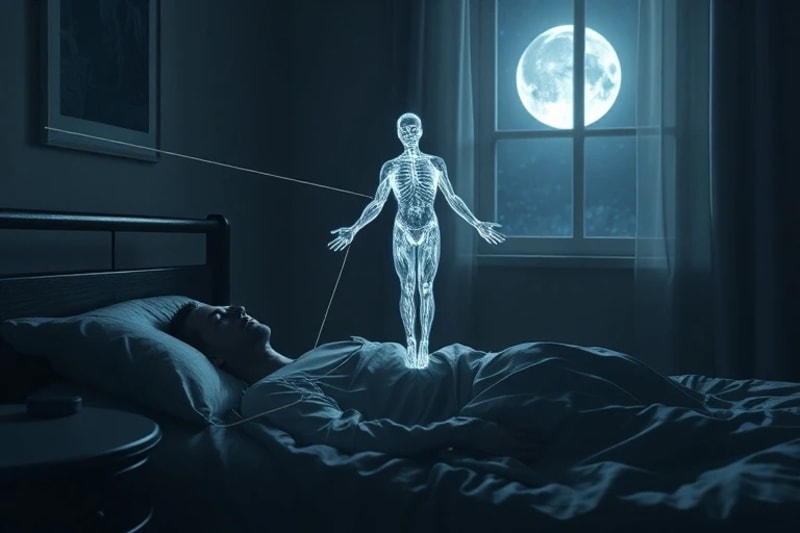
The subtle body embarking on a journey beyond the physical realm.
Differences and Similarities
While both lucid dreaming and astral projection involve altered states of consciousness and offer profound experiences, they are generally considered distinct phenomena. Understanding their nuances is crucial for anyone exploring these esoteric realms.
| Feature | Lucid Dreaming | Astral Projection |
|---|---|---|
| Nature of Experience | Conscious awareness within a dream. | Sensation of consciousness leaving the physical body. |
| Environment | A subjective, internally generated dream world. | Perceived as an objective, non-physical "astral plane." |
| Control | High degree of control over dream elements. | Exploration of a pre-existing environment, less direct control over the plane itself. |
| Scientific Status | Empirically verified through sleep lab studies. | Lacks empirical scientific validation; primarily anecdotal. |
| Primary Goal | Self-exploration, skill rehearsal, creative problem-solving. | Exploration of non-physical realms, spiritual insight, meeting entities. |
Despite these differences, both share common ground in their ability to expand one's perception of reality and consciousness. Both require a relaxed state, focused intention, and often involve vivid, immersive experiences that can feel more real than waking life. They both represent a journey into the deeper aspects of the self and the cosmos.
Safety and Ethical Considerations
Embarking on journeys into altered states of consciousness, whether through lucid dreaming or astral projection, requires a mindful approach to safety and ethical conduct. While generally considered safe, certain precautions and considerations can enhance the experience and prevent potential discomfort.
- Managing Fear: Both experiences can sometimes induce fear, especially during the initial stages or when encountering unexpected elements. It's crucial to remember that in lucid dreams, you are in control, and in astral projection, you are always connected to your physical body. Approaching these states with a calm and curious mindset is key.
- Setting Intentions: Before engaging in either practice, set clear, positive intentions. For lucid dreaming, this might be to explore, learn, or overcome a fear. For astral projection, it could be to seek knowledge, visit a specific place, or connect with higher consciousness.
- Grounding Techniques: After returning from a profound experience, it's important to ground yourself back into physical reality. Simple grounding exercises like focusing on your breath, eating a meal, or engaging in physical activity can help.
- Ethical Exploration: In astral projection, some traditions emphasize respecting the privacy and energetic boundaries of others. Avoid attempting to "spy" on people or interfere with their energy fields. Focus on personal growth and exploration.
- Mental Health: Individuals with certain mental health conditions, particularly those involving psychosis or dissociation, should exercise caution and consult with a healthcare professional before intentionally exploring these states.
Scientific vs. Esoteric Perspectives
The discourse surrounding lucid dreaming and astral projection often navigates between rigorous scientific inquiry and profound esoteric interpretations. Each perspective offers valuable insights, though they approach the phenomena from fundamentally different epistemological frameworks.
From a scientific standpoint, lucid dreaming is largely understood as a unique state of consciousness that occurs during REM sleep. Neuroscientific studies, using techniques like EEG, have shown increased activity in the prefrontal cortex—the area associated with higher-order cognitive functions like self-awareness and decision-making—during lucid dreams. Researchers hypothesize that lucidity arises from a temporary activation of these waking-like brain regions within the sleeping brain. The subjective experience, while vivid, is considered a product of the brain's internal processes.
Astral projection, however, falls squarely into the realm of esoteric and metaphysical studies. Mainstream science currently lacks empirical methods to verify the existence of an "astral body" or an "astral plane" independent of the physical brain. Scientific explanations for OBEs often attribute them to neurological phenomena, such as temporal lobe stimulation, sleep paralysis with vivid hallucinations, or dissociative states. Researchers acknowledge the profound subjective reality of these experiences but seek to explain them through known biological and psychological mechanisms.
Conversely, esoteric traditions view astral projection as a genuine separation of consciousness from the physical body, allowing for exploration of non-physical dimensions. They posit that the astral body is a subtle energetic counterpart to the physical body, connected by a "silver cord" that prevents permanent separation. From this perspective, the experiences are not mere hallucinations but encounters with a deeper, more expansive reality. This view often integrates with broader spiritual frameworks, including concepts of soul travel, spirit guides, and multi-dimensional existence. The profound personal transformations reported by practitioners often serve as validation within these traditions.
The ongoing dialogue between these perspectives highlights the complexity of consciousness itself. While science seeks measurable, repeatable phenomena, esoteric traditions embrace subjective experience and spiritual insight. Both paths, however, contribute to our understanding of the vast potential of the human mind and its connection to reality.
Conclusion
Lucid dreaming and astral projection represent two of the most intriguing frontiers of conscious exploration. While lucid dreaming offers a playground within the mind, allowing for unparalleled self-discovery and skill enhancement, astral projection promises journeys into perceived non-physical dimensions, challenging our understanding of existence. Both practices, though distinct in their nature and scientific validation, share a common thread: the expansion of consciousness beyond its ordinary waking state.
Engaging with these esoteric realms requires patience, practice, and a respectful approach to the profound experiences they offer. By understanding the techniques, benefits, and potential considerations, individuals can embark on their own conscious explorations, unlocking new levels of awareness, creativity, and spiritual insight. Whether viewed through a scientific lens or an esoteric perspective, the journey into lucid dreams and astral planes remains a testament to the boundless potential of the human spirit.
Fuente: Contenido híbrido asistido por IAs y supervisión editorial humana.


Comments
Post a Comment