
Quantum Entanglement Esoteric Synchronicity Non-Local Connections
In the vast tapestry of existence, certain phenomena defy conventional understanding, hinting at a deeper, more interconnected reality. Among these, quantum entanglement and esoteric synchronicity stand out as intriguing concepts that challenge our perceptions of space, time, and causality. While one originates from the rigorous domain of quantum physics and the other from philosophical and psychological inquiry, both point towards the existence of profound non-local connections that transcend physical proximity.
This article delves into the fascinating parallels and potential intersections between these two seemingly disparate fields. We will explore the scientific underpinnings of quantum entanglement, examine the philosophical depth of esoteric synchronicity, and ultimately seek to explain how these non-local connections might offer a more comprehensive view of our universe and our place within it. By bridging the gap between cutting-edge physics and ancient wisdom, we can begin to unravel the mysteries of an interconnected cosmos.
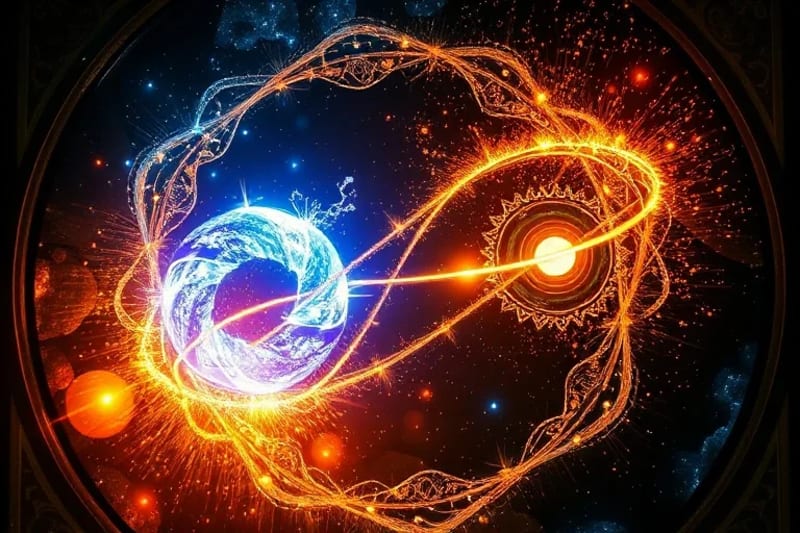
A visual representation of two quantum particles linked by an ethereal thread of light, symbolizing the profound non-local connections that defy classical physics.
Understanding Quantum Entanglement
Quantum entanglement is one of the most perplexing and profound phenomena predicted by quantum mechanics. It describes a situation where two or more particles become linked in such a way that the quantum state of each particle cannot be described independently of the others, even when separated by vast distances. Measuring the property of one entangled particle instantaneously influences the state of its counterpart, regardless of the spatial separation.
First conceptualized by Albert Einstein, Boris Podolsky, and Nathan Rosen (EPR) in 1935, they famously referred to it as "spooky action at a distance." This term highlighted their discomfort with the idea that information could seemingly travel faster than the speed of light, violating the principles of special relativity. However, subsequent experiments, notably those based on Bell's theorem, have repeatedly confirmed the reality of entanglement.
The core principle of entanglement is that the particles share a single, unified quantum state. When one particle's property (like spin or polarization) is measured, its state collapses into a definite value, and the entangled partner instantaneously assumes a correlated state. This correlation is not due to any hidden local variables or pre-existing properties, but rather an intrinsic, non-local connection.
- Key Characteristics of Quantum Entanglement:
- Non-Locality: The influence between entangled particles occurs instantaneously, regardless of distance.
- Correlation: Measurements on entangled particles are perfectly correlated, even if random individually.
- Indivisibility: The quantum state of the system cannot be broken down into individual particle states.
- Measurement-Dependent: The act of measurement collapses the shared quantum state.
- Experimental Verification: Decades of experiments, starting with John Bell's inequalities, have provided strong evidence for entanglement, ruling out classical explanations.
- Technological Applications: Entanglement is foundational for emerging technologies like quantum computing, quantum cryptography, and quantum teleportation.
While quantum entanglement doesn't allow for instantaneous communication of classical information, its existence profoundly reshapes our understanding of reality. It suggests that the universe is not merely a collection of isolated parts but a deeply interwoven whole, where connections can exist beyond the constraints of space and time. This scientific insight provides a compelling backdrop for exploring similar non-local phenomena in other domains.
Exploring Esoteric Synchronicity
Moving from the subatomic to the psychological, we encounter the concept of synchronicity, famously coined by Swiss psychiatrist Carl Jung. Synchronicity refers to "meaningful coincidences" – events that are not causally related but occur together in a way that is significant to the observer. Unlike mere chance, synchronous events feel deeply connected, often revealing a hidden order or purpose.
Jung developed this concept in collaboration with Wolfgang Pauli, a Nobel laureate physicist who also grappled with the implications of quantum mechanics. They proposed synchronicity as an "acausal connecting principle," suggesting that alongside causality (cause and effect), there exists another fundamental principle of connection in the universe. This principle manifests as a meaningful alignment between an inner psychological state and an outer event.
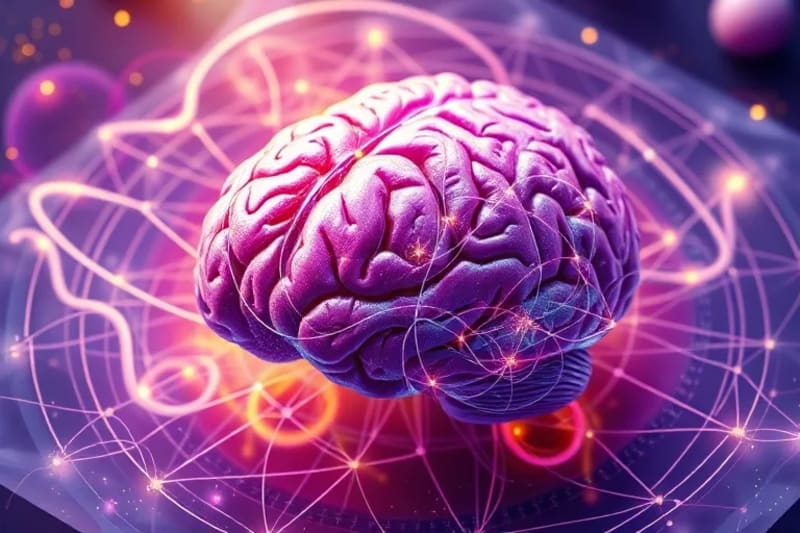
An artistic depiction of the human brain as part of a larger cosmic network, illustrating the potential for non-local information exchange and universal consciousness.
Esoteric traditions have long recognized phenomena akin to synchronicity, often attributing them to divine intervention, cosmic alignment, or the subtle workings of a universal mind. From ancient divination practices to the concept of karma and destiny, many spiritual systems posit an underlying interconnectedness that guides events in a non-linear fashion. Synchronicity, in this esoteric context, becomes a language through which the universe communicates with us, revealing insights and guiding our paths.
Consider an individual contemplating a difficult decision, and then unexpectedly encountering a book, a conversation, or a symbol that directly addresses their dilemma. Such an event, while explainable by chance, takes on profound meaning when viewed through the lens of synchronicity. It suggests that there is a deeper, unseen ordering principle at play, orchestrating events to convey a message or facilitate a realization.
| Aspect | Causality (Classical Physics) | Synchronicity (Jungian/Esoteric) |
|---|---|---|
| Relationship between events | Direct cause and effect; linear progression. | Meaningful coincidence; acausal connection. |
| Underlying principle | Physical forces, energy transfer. | Archetypal patterns, collective unconscious, universal mind. |
| Nature of connection | Local, limited by speed of light. | Non-local, transcends space and time. |
| Significance | Objective, measurable. | Subjective, deeply personal meaning. |
The concept of synchronicity invites us to look beyond the surface of events and consider the deeper, symbolic meanings embedded within our experiences. It suggests that the universe is not a random collection of occurrences but a dynamic, intelligent system constantly interacting with our inner world.
The Bridge of Non-Local Connections
The striking commonality between quantum entanglement and esoteric synchronicity lies in their shared emphasis on non-local connections. Both phenomena describe interactions or correlations that appear to operate outside the conventional limits of space and time, challenging the classical mechanistic worldview.
In quantum physics, non-locality is a verified experimental fact, albeit one that continues to puzzle physicists. It implies that reality at its most fundamental level is intrinsically interconnected, where individual components are not truly separate. This interconnectedness is not mediated by signals or forces traveling through space, but rather by a deeper, underlying unity.

An abstract watercolor illustrating the subtle, far-reaching impact of a ripple, symbolizing the non-local influence of synchronous events and quantum interactions.
Similarly, synchronicity points to a non-local connection between the inner world of consciousness and the outer world of physical events. If our thoughts, emotions, and intentions can align meaningfully with external occurrences without direct causal links, it suggests a profound interconnectedness between mind and matter, perhaps mediated by a universal field of information or consciousness. This idea resonates with theories like David Bohm's "implicate order," which posits a hidden, undivided wholeness underlying the observable "explicate order" of the universe.
Both concepts challenge the notion of strict reductionism, where complex phenomena can be fully understood by breaking them down into their smallest parts. Instead, they advocate for a holistic perspective, where the whole is greater than the sum of its parts, and fundamental connections exist at a level beyond our immediate sensory perception. This shift in perspective has profound implications for how we view reality, science, and spirituality.
- Shared Principles of Non-Locality:
- Instantaneous Influence: Beyond the speed of light (quantum entanglement).
- Acausal Correlation: Meaningful connections without direct cause (synchronicity).
- Underlying Unity: Suggests a fundamental interconnectedness of existence.
- Challenge to Classical Physics: Both push the boundaries of conventional scientific models.
The convergence of these ideas suggests that the universe might operate on principles far more intricate and interconnected than previously imagined. It opens the door to a scientific understanding that embraces the subtle, the symbolic, and the deeply meaningful aspects of existence, moving beyond a purely materialist interpretation.
Implications for Consciousness and Reality
If non-local connections are a fundamental aspect of reality, what does this imply for consciousness? The standard scientific model often treats consciousness as an emergent property of the brain, a local phenomenon confined within our skulls. However, the insights from quantum entanglement and synchronicity suggest a more expansive view.
Some theories propose that consciousness itself might be a non-local phenomenon, not confined to individual brains but rather an aspect of a universal field. This aligns with ancient spiritual traditions that speak of a "collective consciousness" or a "universal mind" from which individual minds draw. In this view, our individual consciousness could be seen as a localized expression of a much larger, interconnected awareness.
The role of the observer in quantum mechanics, where the act of measurement influences the state of a particle, has also led to speculation about the relationship between consciousness and reality. While not directly implying that consciousness creates reality, it highlights a profound interaction between the observer and the observed, suggesting that our subjective experience is not entirely separate from the objective world.
- Potential Impact on Understanding Consciousness:
- Non-Local Consciousness: Consciousness as a universal field rather than solely brain-bound.
- Observer Effect: The active role of consciousness in shaping observed reality.
- Collective Unconscious: Jung's concept of a shared reservoir of archetypes and experiences, a potential medium for non-local information.
- Redefining Reality: Moving from a purely materialist view to one that incorporates information, energy, and consciousness as fundamental components.
These ideas suggest that our personal experiences of intuition, empathy, and even premonition might be manifestations of these deeper non-local connections. When we feel a sudden urge to call someone who then calls us, or when we "know" something without logical reason, it could be a subtle form of non-local information exchange, akin to a personal synchronicity.
Integrating Science and Spirituality
The exploration of quantum entanglement and esoteric synchronicity offers a unique opportunity to bridge the historical divide between science and spirituality. For centuries, these two domains have often been seen as contradictory, with science focusing on the measurable and repeatable, and spirituality on the subjective and transcendent.
However, the concept of non-local connections provides a common ground. Scientific discoveries in quantum physics are increasingly revealing a universe that is far stranger and more interconnected than classical physics ever imagined. These findings resonate with the insights of ancient spiritual traditions that have always emphasized the unity of all things, the interconnectedness of mind and cosmos, and the existence of unseen forces shaping our reality.
Integrating these perspectives does not mean abandoning scientific rigor for mystical belief, but rather expanding our scientific framework to accommodate phenomena that defy classical explanations. It involves adopting a more holistic worldview that acknowledges both the material and the immaterial, the local and the non-local, as integral parts of a unified reality. This approach can lead to a richer understanding of existence and a more profound appreciation for the mysteries that still lie beyond our current comprehension.
For individuals, embracing the idea of non-local connections can foster a sense of deeper meaning and purpose. Recognizing synchronistic events as more than mere chance can lead to increased self-awareness, intuition, and a feeling of being guided by a larger intelligence. It encourages mindfulness and a more attentive engagement with the subtle cues and patterns that emerge in daily life.
Future Perspectives and Research
The intersection of quantum physics and esoteric concepts like synchronicity is a frontier ripe for interdisciplinary research. While direct experimental links between quantum entanglement and psychological synchronicity remain elusive, theoretical frameworks are emerging that attempt to unify these phenomena. Further exploration into the nature of information, energy, and consciousness at fundamental levels could provide crucial insights.
Researchers are exploring quantum models of consciousness, investigating how the brain might leverage quantum processes, and examining the role of entanglement in biological systems. Simultaneously, studies on the statistical significance of synchronistic events and their psychological impact continue to refine our understanding of these meaningful coincidences. The goal is not to force a direct causal link but to explore if both are manifestations of a deeper, unifying principle.
As technology advances, particularly in quantum computing and neuroscience, our ability to probe the fundamental nature of reality and consciousness will only increase. This could lead to breakthroughs that either confirm or reshape our current understanding of non-local connections. The journey to comprehend these profound links is ongoing, promising a future where the boundaries between science, philosophy, and spirituality become increasingly blurred.
The exploration of quantum entanglement and esoteric synchronicity invites us to embrace a more expansive and interconnected view of the universe. It encourages us to look beyond the obvious, to question established paradigms, and to remain open to the profound mysteries that continue to unfold at the edges of our knowledge. These non-local connections, whether at the quantum level or in the realm of meaningful coincidences, suggest a universe that is far more intelligent, subtle, and unified than we have ever dared to imagine. For further reading on related topics, consider exploring Yod Astrology: Finger of Destiny, which delves into complex astrological configurations that signify unique life paths and fated events, often perceived through a lens of profound synchronicity.
Source: Hybrid content assisted by AIs and human editorial supervision.


Comments
Post a Comment