
Ancient Egyptian Star Lore: Unveiling Pharaohs' Cosmic Beliefs
Ancient Egyptian Star Lore: Deciphering the Cosmic Beliefs of the Pharaohs
The civilization of ancient Egypt, spanning millennia, was deeply intertwined with the celestial realm. Far from being mere observers, the Egyptians integrated their understanding of the stars, planets, and cosmic cycles into every facet of their existence—from religious beliefs and mythology to practical applications like agriculture, architecture, and the measurement of time. Their unique perspective on the cosmos, often referred to as "star lore," offers a fascinating window into a worldview where the earthly and divine were inextricably linked through the celestial tapestry.
For the ancient Egyptians, the night sky was not just a distant spectacle but a living, breathing entity, home to gods and a map for the journey of the deceased. The movements of celestial bodies were seen as divine actions, influencing human destiny and the natural world. This article delves into the intricate world of ancient Egyptian star lore, exploring how they observed, interpreted, and ultimately lived by the cosmic rhythms.
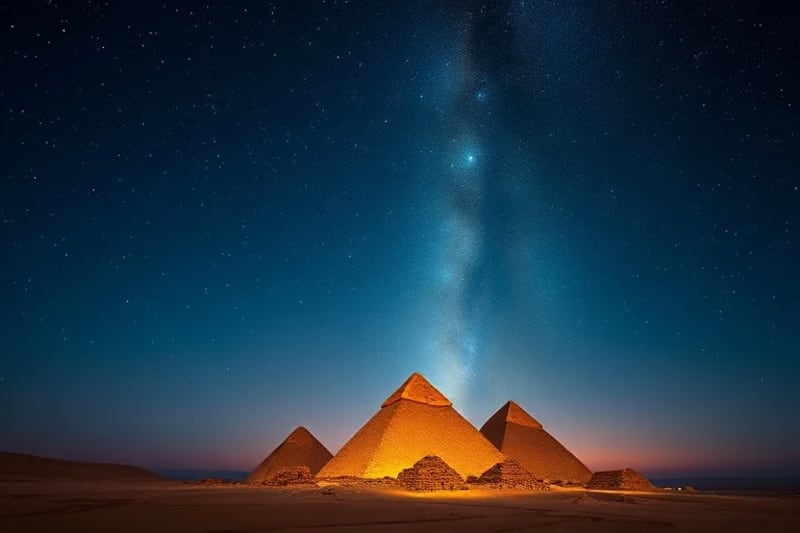
The majestic night sky above the ancient Chrono-Astrology Ancestral Echoes Navigating Personal Time Cycles, a testament to their enduring fascination with the cosmos.
Table of Contents
- The Egyptian Cosmic Worldview
- Celestial Deities and Mythology
- Astronomical Observations and Tools
- The Decans and Star Clocks
- Stars and the Afterlife
- Practical Applications of Star Lore
- Legacy and Enduring Influence
The Egyptian Cosmic Worldview
At the heart of ancient Egyptian star lore was a sophisticated cosmic worldview. They believed the universe originated from a primordial watery chaos, Nun, from which the creator god Atum emerged. The sky was personified by the goddess Nut, who arched her body over the Earth god Geb, separating the heavens from the earth. Every night, Nut would swallow the sun god Ra, who would then journey through the underworld (Duat) before being reborn from her womb at dawn, symbolizing the eternal cycle of death and rebirth.
This cyclical understanding of the cosmos profoundly influenced their perception of time, life, and the afterlife. The stars were not static points of light but living entities, often associated with specific deities or the souls of the deceased. The imperishable stars, those circumpolar stars that never set below the horizon, held particular significance, representing eternity and the realm of the gods and blessed dead.
The Egyptians observed the heavens with remarkable precision for their era, developing a calendar system that was one of the most accurate in the ancient world. Their observations were driven by both religious devotion and practical necessity, particularly the annual flooding of the Nile, which was crucial for agriculture and directly linked to the heliacal rising of certain stars.
Celestial Deities and Mythology
Many Egyptian deities were intimately connected with celestial bodies. Beyond Nut, who embodied the sky itself, other gods played crucial roles in the cosmic drama:
- Ra (Re): The sun god, the most important deity, whose daily journey across the sky represented creation, order, and renewal.
- Thoth: The god of wisdom, writing, and the moon, often depicted as an ibis or baboon. He was associated with the accurate measurement of time and astronomical calculations.
- Osiris: The god of the underworld and rebirth, who was often identified with the constellation Orion (Sopdet in Egyptian). His connection to the stars symbolized the cyclical nature of life, death, and resurrection.
- Isis: Osiris's wife and sister, associated with the star Sirius (Sopdet), whose heliacal rising heralded the annual flooding of the Nile.
These deities were not just abstract concepts but active participants in the celestial mechanics. Their myths provided a narrative framework for understanding the movements of the sun, moon, and stars, giving meaning to the observable universe and offering comfort in the face of the unknown.
Astronomical Observations and Tools
Despite lacking telescopes, the ancient Egyptians developed sophisticated methods for observing the night sky. Their clear desert skies provided an excellent vantage point, and their meticulous record-keeping allowed them to track celestial movements over long periods. Early astronomical observations were likely conducted with the naked eye, but specialized tools soon emerged.
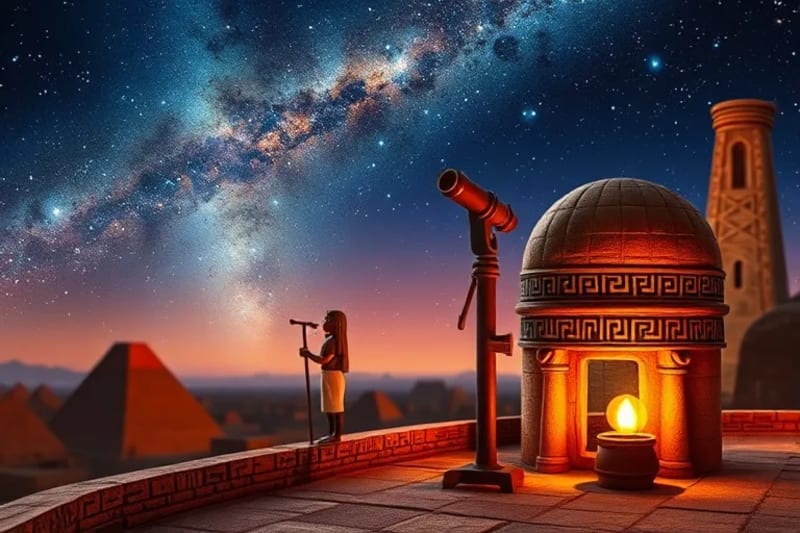
An ancient Egyptian astronomer meticulously charting the stars with traditional instruments.
Key instruments included:
- Merkhet: A "star clock" or "time measurer," consisting of a plumb line and a sighting tool, used in conjunction with a north-south alignment to determine time at night by observing the transit of specific stars.
- Bay: A palm rib with a V-shaped sight, used with a merkhet to align with the North Star and establish a meridian.
- Sundials and Water Clocks: While not strictly for stars, these were essential for measuring time during the day and night, complementing stellar observations.
These tools, combined with their keen observational skills, allowed them to develop a practical astronomy that served both their religious and societal needs. The precision of their measurements is evident in the alignment of their temples and pyramids, which often corresponded with astronomical events.
The Decans and Star Clocks
One of the most significant contributions of Egyptian star lore was the system of the Decans. These were 36 groups of stars (or small constellations) that rose sequentially above the eastern horizon at intervals of about 10 days, marking the passage of time throughout the year. Each decan was associated with a specific deity, a period of time, and sometimes even specific omens or influences.
The Decans formed the basis of their sidereal calendar and were crucial for their "star clocks" found inscribed on the lids of sarcophagi and on temple ceilings. These clocks allowed priests and astronomers to tell time at night by observing which decan was rising. The 36 decans, each representing 10 days, neatly divided the 360-day year (with an additional 5 epagomenal days).
The study of the Decans was not merely academic; it had profound religious and astrological implications. They were believed to influence human destiny and were invoked in magical texts and rituals. The concept of decans later influenced Hellenistic astrology, demonstrating the enduring impact of Egyptian astronomical thought on subsequent cultures.
Stars and the Afterlife
Perhaps the most profound aspect of Egyptian star lore was its connection to the afterlife. The Egyptians believed that after death, the pharaoh, and later all worthy individuals, would ascend to the stars to join the gods. The Pyramid Texts, some of the oldest religious texts in the world, describe the pharaoh's journey to the "imperishable stars" (the circumpolar stars) in the northern sky, where he would become one with Osiris.
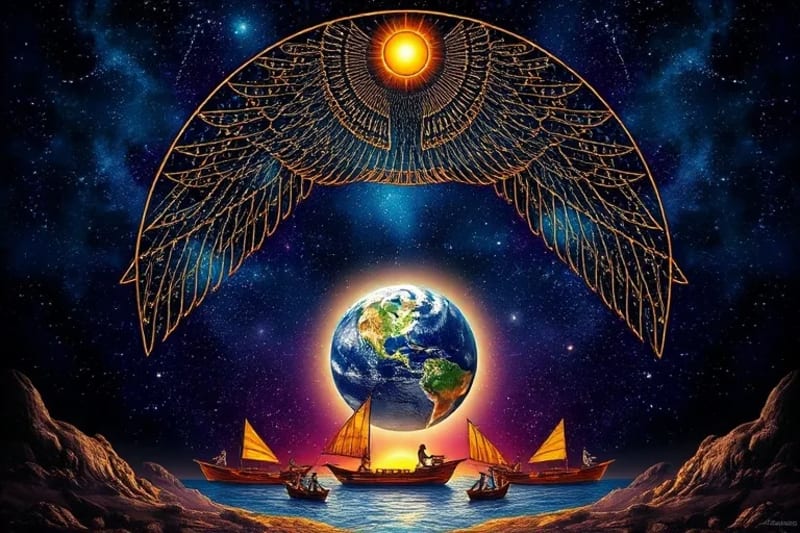
The goddess Nut, adorned with stars, embodying the celestial vault and the eternal cycles of the cosmos.
The constellation Orion (Sopdet) was particularly significant, often identified with Osiris, symbolizing rebirth and the eternal cycle. The deceased pharaoh was thought to merge with Osiris-Orion, while his queen would become Isis-Sirius. This celestial destiny was not merely symbolic; it was a literal journey that the deceased undertook, guided by the stars.
The ceilings of tombs and temples were often decorated with intricate astronomical charts, depicting constellations, decans, and the paths of celestial bodies. These "astronomical ceilings" served as maps for the deceased, guiding them through the Duat (underworld) and towards their stellar apotheosis. The Denderah Zodiac, a famous ceiling relief from the Temple of Hathor, is a prime example of such celestial mapping, blending Egyptian and later Hellenistic astronomical traditions.
Practical Applications of Star Lore
Beyond religious and mythological significance, ancient Egyptian star lore had crucial practical applications that underpinned their society:
- Calendar System: The heliacal rising of Sirius (Sopdet) was the most important astronomical event, as it coincided with the annual flooding of the Nile, signaling the start of the agricultural year. This observation formed the basis of their civil calendar, a 365-day system that was remarkably accurate.
- Agriculture: The timing of planting and harvesting crops was directly linked to the celestial calendar, ensuring the prosperity of their agrarian society.
- Architecture and Alignment: Many temples and pyramids were precisely aligned with cardinal directions or specific astronomical events, such as solstices, equinoxes, or the rising of particular stars. This alignment was not just for aesthetic purposes but held deep religious and symbolic meaning, connecting the earthly structures to the cosmic order. The Great Pyramid of Giza, for instance, is aligned almost perfectly with true north.
- Timekeeping: As mentioned, the decans and star clocks allowed for precise timekeeping during the night, essential for religious rituals and daily life.
The integration of astronomy into their daily lives highlights the holistic nature of ancient Egyptian thought, where science, religion, and practical living were inseparable. Their ability to observe and interpret the cosmos allowed them to thrive in a challenging environment and build a civilization that endured for millennia.
The ancient Egyptians' understanding of the stars was not merely observational; it was a profound spiritual engagement with the cosmos. Their star lore provided a framework for understanding the universe, guiding their lives from the cycles of agriculture to the journey of the soul in the afterlife.
This intricate system, incorporating deities, constellations, and precise timekeeping, demonstrates a civilization deeply attuned to the rhythms of the heavens.
Legacy and Enduring Influence
The star lore of ancient Egypt left an indelible mark on subsequent civilizations. Their calendar system, particularly the 365-day year, influenced the Roman calendar and, by extension, our modern calendar. The concept of the decans was adopted and adapted by Hellenistic astrologers, becoming a foundational element in Western astrology. Many of the constellations recognized today have roots in ancient Near Eastern and Egyptian traditions, even if their specific interpretations evolved over time.
The alignment of their monumental architecture with celestial events continues to fascinate modern researchers, offering insights into their advanced astronomical knowledge and their spiritual connection to the cosmos. Scholars continue to study the intricate astronomical ceilings and texts to fully decipher the depth of their cosmic understanding, revealing a civilization that truly looked to the stars for guidance, meaning, and eternity.
In essence, ancient Egyptian star lore was a comprehensive system that blended science, religion, and daily life into a cohesive worldview. It allowed them to navigate their world, plan their future, and prepare for the afterlife, all under the watchful eyes of the celestial deities and the eternal dance of the stars. Understanding their cosmic beliefs is key to appreciating the richness and complexity of one of history's most enduring civilizations. For more on ancient celestial alignments, see our article on Fixed Stars Cosmic Navigators Aligning Destiny Galactic Pathways.
Source: Hybrid content assisted by AIs and human editorial supervision.


Comments
Post a Comment