
Chinese Zodiac Climate Cycles: Ancient Wisdom Ecological Foresight
The intricate tapestry of Chinese astrology extends far beyond personal horoscopes, delving into profound connections between celestial movements, earthly phenomena, and even long-term climate cycles. Ancient Chinese wisdom, rooted in meticulous observation of nature and the cosmos, developed sophisticated systems like the Chinese Zodiac and the Five Elements theory. These frameworks were not merely tools for predicting individual destinies but served as comprehensive models for understanding the dynamic interplay of forces shaping the natural world, including weather patterns and ecological shifts.
In an era grappling with unprecedented environmental challenges, revisiting these ancient perspectives offers a unique lens through which to consider ecological foresight. This article explores how traditional Chinese astrological concepts, particularly the cyclical nature of the Zodiac and the generative and destructive interactions of the Five Elements, can provide valuable insights. By examining historical records and the underlying philosophy, we can uncover a rich heritage of environmental understanding that complements contemporary scientific approaches to climate and ecology.
 A harmonious blend of ancient Chinese landscapes and subtle zodiac imagery, illustrating the profound connection between celestial movements and terrestrial environments.
The Foundations of Chinese Zodiac and Elements
At the heart of Chinese astrological thought are two fundamental systems: the Chinese Zodiac and the Five Elements theory. The Zodiac, a 12-year cycle represented by animals, is well-known for its association with personality traits and yearly predictions. However, its original application was far broader, encompassing agricultural planning, seasonal changes, and even societal trends.
Each Zodiac animal is associated with specific characteristics and, crucially, with one of the Five Elements. The Five Elements – Wood, Fire, Earth, Metal, and Water – form a dynamic system of creation and control, influencing everything from human health to the natural environment. This intricate relationship creates a complex predictive model that goes beyond simple annual forecasts.
The cyclical interaction of these elements is key to understanding their impact on climate. For instance, Wood feeds Fire, Fire creates Earth (ash), Earth bears Metal, Metal holds Water, and Water nourishes Wood. Conversely, Wood controls Earth, Earth controls Water, Water controls Fire, Fire controls Metal, and Metal controls Wood. These relationships describe a constant state of flux and balance within the natural world.
Understanding these foundational principles is essential for deciphering the ancient wisdom regarding climate and ecological patterns. The Chinese calendar, a lunisolar system, further integrates these cycles, providing a detailed framework for tracking environmental shifts over time.
Elemental Cycles and Climate Patterns
The Five Elements are directly linked to various natural phenomena and, by extension, to climate patterns. Each element corresponds to a season, a direction, a color, and specific weather conditions. When an element is dominant in a particular year or period, its associated climatic characteristics are expected to be more pronounced. This forms the basis of ancient Chinese meteorological predictions.
For example, a strong Wood element year might be associated with abundant rainfall and lush growth, while a dominant Fire year could indicate hotter temperatures and potential droughts. Earth years often signify stability but can also bring about periods of stagnation or landslides. Metal is linked to dryness and crisp air, and Water to coldness and heavy precipitation. These elemental influences are not isolated but interact in complex ways, creating nuanced predictions.
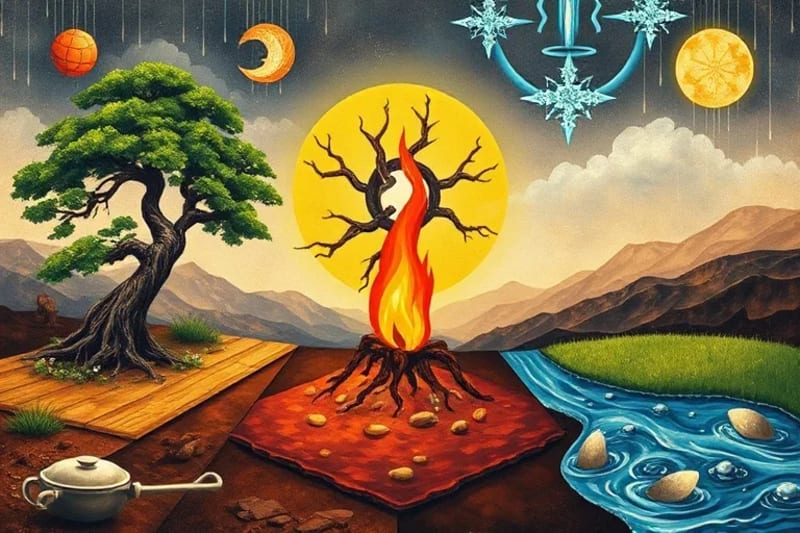 A detailed oil painting illustrating the dynamic interplay of the Five Elements, each influencing distinct climate patterns and natural conditions.
Ancient texts often describe how an imbalance or excess of one element could lead to extreme weather events. For instance, too much Fire without sufficient Water to control it could result in severe droughts and heatwaves. Conversely, an overabundance of Water without Earth to contain it might lead to widespread floods. These observations underscore a holistic understanding of ecological balance.
The 60-year cycle, formed by the combination of the 12 Zodiac animals and the five elemental phases, provides an even broader framework for long-term climate analysis. Each year within this cycle has a unique elemental and animal signature, allowing for detailed historical comparisons of weather and agricultural outcomes. This cyclical view suggests that climate patterns, while variable, often recur over extended periods, offering a basis for understanding elemental interactions.
Zodiac Animals and Environmental Traits
Beyond the elements, each of the 12 Zodiac animals carries its own set of environmental associations. These associations are often tied to the animal's natural habitat, behavior, or mythological significance. For example, the Dragon, a powerful symbol of water and rain, is often linked to periods of abundant precipitation and agricultural prosperity. The Tiger, a creature of the mountains and forests, might signify periods of wild growth or challenges in natural resource management.
The Rat, associated with water and resourcefulness, could indicate years of fluctuating water levels or periods requiring careful resource allocation. The Ox, a symbol of hard work and agriculture, points to years focused on cultivation and steady growth. These animal archetypes provide a symbolic language for interpreting broader ecological trends and human interaction with the environment, offering insights into archetypal patterns.
Consider the Horse, a swift and dynamic animal, which might be associated with rapid changes in weather or the spread of phenomena like wildfires. The Pig, linked to abundance and comfort, could indicate years of good harvests and general environmental ease. These interpretations are not literal predictions but rather symbolic indicators of prevailing environmental energies and challenges.
The combination of the Zodiac animal and its ruling element creates a nuanced forecast. A Wood Dragon year, for instance, might suggest vigorous growth and heavy rains, potentially leading to both abundance and challenges like flooding. A Metal Tiger year, on the other hand, could imply dry, harsh conditions in wild areas, demanding resilience and strategic planning.
Historical Records and Predictive Insights
Historical Chinese records, particularly those related to agriculture and imperial decrees, contain extensive documentation of weather patterns, crop yields, and natural disasters. These records often correlate specific events with the prevailing Zodiac animal and elemental year. Scholars and court astrologers meticulously tracked these cycles to advise rulers on agricultural policies, disaster preparedness, and even military campaigns, which were often influenced by environmental conditions.
For example, periods of prolonged drought or severe flooding were often attributed to specific elemental imbalances or the influence of certain Zodiac animals. These historical observations, while not scientific in the modern sense, represent centuries of empirical data collection. They offer a rich database for analyzing long-term climate trends and the cyclical nature of environmental challenges.
 A conceptual 3D render bridging ancient Chinese divination tools with modern ecological data, symbolizing the integration of traditional wisdom and contemporary science.
The "Book of Changes" (I Ching), another cornerstone of Chinese thought, also contains principles that can be applied to understanding natural cycles. Its hexagrams often describe states of equilibrium and disequilibrium, reflecting the constant shifts in the environment. While not directly an astrological text, its philosophical underpinnings align with the cyclical and interconnected worldview of Chinese astrology.
By studying these historical correlations, modern researchers can gain a deeper appreciation for the ancient understanding of climate variability. This approach can help identify long-term patterns that might be overlooked by shorter-term scientific models, offering a broader temporal context for ecological studies.
Modern Applications for Ecological Foresight
While modern climate science relies on complex computational models and satellite data, the ancient Chinese Zodiac and Five Elements theory can still offer complementary insights. Their value lies not in precise numerical predictions but in providing a conceptual framework for understanding systemic interactions and long-term cyclical trends. This holistic perspective encourages a deeper appreciation for interconnectedness within ecosystems.
For instance, understanding the elemental balance of a given year can help anticipate general environmental conditions. A "Water Tiger" year might suggest a focus on water management, flood prevention, and the health of aquatic ecosystems. Conversely, a "Fire Horse" year could prompt increased vigilance regarding droughts, heat stress, and wildfire risks. These broad strokes can inform proactive ecological planning.
Furthermore, the cyclical nature of the 60-year calendar can be used to identify historical analogues for current climate conditions. By examining what happened in previous years with similar elemental and Zodiac combinations, we might gain insights into potential long-term outcomes or recurring patterns. This historical data, when correlated with modern scientific observations, can enrich our understanding of climate dynamics.
This approach moves beyond simplistic astrological readings to leverage the underlying philosophical framework for ecological foresight. It encourages a systems-thinking perspective, recognizing that environmental changes are rarely isolated events but rather part of larger, interconnected cycles. This ancient wisdom promotes a more integrated understanding of our planet.
Integrating Ancient Wisdom with Contemporary Science
The integration of ancient Chinese wisdom with contemporary climate science is not about replacing one with the other, but rather about finding points of synergy. Ancient systems offer a qualitative, holistic understanding of cycles and interdependencies, while modern science provides quantitative, detailed data and predictive models. Combining these approaches can lead to a richer, more comprehensive ecological foresight.
One area of potential integration lies in long-term climate projections. While scientific models are excellent for short-to-medium term forecasts, long-term predictions often involve greater uncertainty. The cyclical patterns identified in Chinese astrological records could offer a macro-level framework, suggesting general trends and recurring themes that scientific models might then refine with precise data.
Moreover, the emphasis on balance and harmony within the Five Elements theory resonates strongly with modern ecological principles of ecosystem health and sustainability. Ancient texts frequently warn against disrupting natural balances, a message that is highly relevant in the current context of environmental degradation. This philosophical alignment can inspire more sustainable practices.
By studying how ancient civilizations observed and responded to climate variations through their astrological systems, we can gain valuable lessons in resilience and adaptation. This cross-cultural dialogue between traditional knowledge and modern science is crucial for developing innovative solutions to global environmental challenges. It represents a bridge between past wisdom and future necessities.
The Future of Eco-Astrology
The concept of "eco-astrology," which blends astrological principles with ecological awareness, is gaining traction as humanity seeks more holistic ways to understand its relationship with the planet. The Chinese Zodiac and Five Elements theory offer a robust framework for this emerging field, providing a language to discuss environmental energies and their cyclical manifestations. This approach can foster a deeper connection to nature.
Future research could involve correlating historical climate data with specific elemental and Zodiac years, using modern statistical methods to identify significant patterns. This interdisciplinary approach could validate or refine aspects of ancient predictions, revealing previously unappreciated correlations. Such studies would bridge the gap between ancient wisdom and contemporary empirical evidence.
Ultimately, the ancient wisdom embedded in the Chinese Zodiac and Five Elements theory serves as a powerful reminder of our interconnectedness with the cosmos and the natural world. It encourages a long-term, cyclical perspective on climate and ecological change, urging us to observe, adapt, and live in harmony with the rhythms of the Earth. This foresight is invaluable in navigating the complexities of our environmental future.
Embracing these ancient models can enrich our understanding of environmental dynamics, providing a philosophical depth that complements scientific inquiry. It's a call to look both inward to our traditions and outward to the stars and cycles of nature for guidance. This integrated view holds the potential for more profound and sustainable ecological foresight.
Fuente: Contenido híbrido asistido por IAs y supervisión editorial humana.


Comments
Post a Comment