
Shadow Work Planetary Retrogrades Natal Chart Potentials
In the intricate tapestry of astrological self-discovery, two concepts often emerge as profound catalysts for personal growth: shadow work and the influence of planetary retrogrades within one's natal chart. While seemingly distinct, these elements converge to offer a powerful pathway for unearthing hidden potentials and transforming challenging aspects of the self into sources of strength. This exploration delves into how these astrological phenomena, when consciously engaged, can illuminate the unexplored corners of our psyche, leading to deeper self-awareness and holistic development.
Understanding the interplay between shadow work and retrograde planets is not merely an academic exercise. It is a practical guide to navigating the complexities of our inner world, especially those traits or experiences that we might unconsciously suppress or project onto others. By embracing these often-overlooked facets of our being, we unlock a richer, more authentic existence. This article aims to provide an introductory yet comprehensive overview, making these advanced astrological concepts accessible to a broader audience seeking profound personal insight.
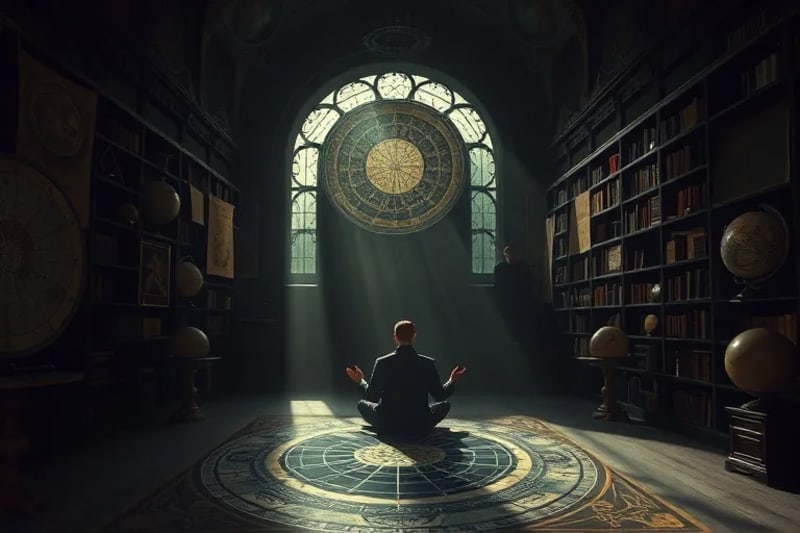
A solitary figure delves into ancient astrological charts, symbolizing the deep introspection required for shadow work and understanding cosmic influences.
The journey begins with recognizing that our natal chart is more than a static blueprint; it is a dynamic map of our potential, including both our conscious strengths and our unconscious challenges. Planetary retrogrades, particularly when present at birth, suggest an internal processing of planetary energies, often leading to unique perspectives and a rich inner life. When combined with shadow work, this internal focus becomes a potent tool for personal evolution.
This guide will explore the foundational principles of shadow work, the astrological significance of retrograde planets, and practical methods to integrate these insights. We will examine how specific retrograde planets can manifest as "shadow" aspects and offer exercises to facilitate their conscious integration. The ultimate goal is to transform perceived weaknesses into profound strengths, fostering a more complete and empowered self.
1. Understanding Shadow Work in Astrology
Shadow work, a concept popularized by Swiss psychiatrist Carl Jung, refers to the process of exploring and integrating the unconscious aspects of our personality. These "shadow" elements often include traits, desires, and experiences that we deem unacceptable, shameful, or contrary to our conscious self-image. Consequently, we repress them, pushing them into the unconscious where they can still influence our behavior, relationships, and overall well-being in subtle yet powerful ways.
In an astrological context, the shadow can be illuminated by various placements in the natal chart. Challenging aspects, difficult house placements, or even the signs ruled by certain planets can point to areas where we might be prone to repression or projection. For instance, a heavily aspected twelfth house or a challenging Pluto placement might indicate a strong, often hidden, unconscious drive that requires conscious acknowledgment. The purpose of shadow work is not to eliminate these parts but to bring them into awareness, understand their origins, and integrate them constructively.
Jung believed that true individuation—the process of becoming a whole, integrated person—requires confronting and assimilating the shadow. Without this integration, the shadow often manifests as self-sabotage, projection onto others, or a persistent feeling of incompleteness. When we engage in shadow work, we reclaim lost parts of ourselves, leading to greater authenticity, self-acceptance, and personal power. This process is deeply transformative, allowing us to harness energies that were previously working against us.
2. The Dynamics of Planetary Retrogrades
From an astronomical perspective, a planetary retrograde is an optical illusion where a planet appears to move backward in its orbit from Earth's vantage point. Astrologically, this phenomenon is interpreted as a period of introspection, re-evaluation, and internal processing rather than outward action. When a planet is retrograde in a natal chart, it suggests that the energies associated with that planet are internalized, processed uniquely, and often developed differently from those with direct planetary motion.
Individuals born with retrograde planets often experience the themes of that planet in a more subjective, reflective, or unconventional manner. For example, a natal Mercury retrograde might signify a person who thinks deeply, processes information internally, and may struggle with conventional communication, preferring to express themselves in unique ways. This internal focus can be a powerful asset, fostering depth and originality, but it can also present challenges if not understood and integrated.
The energies of a retrograde planet are not inherently "bad" or "weak." Instead, they represent a different mode of operation, urging us to look inward before acting outward. This internal orientation naturally aligns with the principles of shadow work, as both encourage introspection and the exploration of hidden dynamics. Understanding your natal retrogrades can provide crucial clues about where your deepest internal processing occurs and where your unique strengths lie, often beneath a surface of apparent difficulty.
3. Identifying Retrograde Planets in Your Natal Chart
To begin integrating shadow work with your natal retrogrades, the first step is to identify which planets were retrograde at the time of your birth. Most online natal chart calculators will indicate retrograde planets with an "R" symbol next to the planetary glyph. Typically, the outer planets (Jupiter, Saturn, Uranus, Neptune, Pluto) are retrograde for a significant portion of the year, making them common natal retrogrades. Inner planets (Mercury, Venus, Mars) retrograde less frequently, so their natal retrograde status is less common but often more acutely felt.
Once identified, consider the following aspects for each retrograde planet:
- The Planet's Archetype: What does this planet represent generally in astrology (e.g., Mercury for communication, Venus for values, Mars for action)?
- The Sign It's In: How does the sign modify the planet's expression (e.g., Mercury retrograde in Gemini vs. Mercury retrograde in Taurus)?
- The House It Occupies: Which area of life is most affected by this internalized energy (e.g., Venus retrograde in the 7th house of relationships)?
- Aspects to Other Planets: How does this retrograde planet interact with other energies in your chart?
Symbolic roots reaching for the stars, representing the profound process of uncovering hidden potentials and deep wisdom within the self.
These layers of interpretation help paint a comprehensive picture of how the retrograde energy operates within your unique psychological makeup. For instance, a natal Jupiter retrograde might suggest a deep, personal quest for meaning and truth, often questioning conventional beliefs and developing a unique philosophy. This internal search, while potentially isolating at times, can lead to profound wisdom and a highly individualized spiritual path. Exploring these nuances is key to understanding your unique astrological blueprint.
4. Shadow Work with Specific Retrograde Planets
Each retrograde planet in a natal chart offers a distinct area for shadow exploration. By understanding the core themes of each planet, we can pinpoint where our internalized energies might be creating unconscious patterns or hidden strengths. This targeted approach allows for more effective shadow integration, transforming potential challenges into unique gifts.
Mercury Retrograde (Natal)
Individuals with natal Mercury retrograde often possess a highly introspective mind. Their shadow might involve a fear of miscommunication, a tendency to overthink, or feeling misunderstood by others. Shadow work here involves embracing their unique thought processes, valuing internal reflection over quick external expression, and recognizing their capacity for profound insights. It's about finding authentic ways to communicate their rich inner world, perhaps through writing or art, rather than forcing conventional speech. For further insight into communication patterns, consider exploring Zodiac Archetypes.
Venus Retrograde (Natal)
A natal Venus retrograde suggests a deeply internalized sense of values, aesthetics, and relationships. The shadow might manifest as unconventional relationship patterns, difficulty accepting love, or a struggle with self-worth. Shadow work involves re-evaluating personal values independently of societal norms, cultivating self-love, and understanding their unique approach to connection. It's about recognizing that their internal barometer for love and beauty is valid and often leads to profound, authentic bonds, even if they don't conform to typical expectations.
Mars Retrograde (Natal)
With natal Mars retrograde, the drive and assertiveness are often internalized. The shadow might involve passive-aggression, difficulty asserting boundaries, or a fear of direct confrontation. Shadow work focuses on understanding and channeling their internal warrior. This means learning to assert themselves in ways that feel authentic, perhaps through strategic planning or indirect influence, rather than explosive outbursts. It's about recognizing their immense inner strength and learning to deploy it effectively and consciously, transforming potential frustration into focused determination.
Jupiter Retrograde (Natal)
Natal Jupiter retrograde indicates an internalized search for meaning, truth, and expansion. The shadow could involve a fear of taking risks, questioning belief systems excessively, or feeling a lack of faith. Shadow work encourages them to trust their inner guru, develop a personal philosophy, and expand their consciousness through internal exploration rather than external pursuits. Their unique wisdom comes from deep contemplation and a personal understanding of universal laws, often leading to profound spiritual insights.
Saturn Retrograde (Natal)
A natal Saturn retrograde signifies an internalized sense of responsibility, structure, and authority. The shadow might manifest as self-doubt, a fear of failure, or feeling burdened by obligations. Shadow work here involves building internal structures, becoming their own authority figure, and taking responsibility for their own life path. It's about recognizing that their greatest achievements come from diligent, self-imposed discipline and a deep understanding of their personal boundaries and limitations. This placement often leads to immense resilience and mastery over their chosen field, built from within.
5. Integrating Shadow Work and Retrogrades for Growth
The synergy between shadow work and natal retrograde planets lies in their shared emphasis on internal processing and self-reflection. When a planet is retrograde at birth, its energies are often experienced subjectively, leading to a natural inclination for introspection. This makes individuals with natal retrogrades particularly well-suited for shadow work, as they are already accustomed to looking inward. The challenge, however, is to move beyond mere reflection to active integration.
Integration means acknowledging the suppressed aspects of the retrograde planet and consciously choosing to express them in a healthy, constructive manner. For example, someone with a natal Mars retrograde who has suppressed their anger might learn to assert their needs calmly and directly, rather than allowing resentment to build. This process transforms the internalized energy from a potential source of frustration into a unique and powerful resource.

Abstract art depicting the dynamic interplay of light and shadow, symbolizing the transformative journey of integrating hidden aspects into a harmonious whole.
The benefits of this integration are manifold. It leads to greater self-acceptance, reduced internal conflict, and a more authentic expression of one's true self. By embracing the "shadow" aspects of their retrograde planets, individuals can tap into unique talents and perspectives that might otherwise remain dormant. This journey of self-discovery is not always easy, but it is profoundly rewarding, paving the way for a more integrated and empowered existence. For those interested in understanding deeper karmic patterns, exploring North Node Transits can offer additional insights.
6. Practical Exercises for Shadow Integration
Engaging in shadow work requires consistent effort and a willingness to confront uncomfortable truths. Here are some practical exercises tailored to integrating the energies of natal retrograde planets:
- Journaling Prompts: Dedicate a journal specifically to your retrograde planet. Ask yourself: "What aspects of [Planet's energy, e.g., communication for Mercury] do I suppress or fear to express?" "When do I feel misunderstood or resistant to [Planet's energy]?" "What unique gifts or perspectives has my internalized [Planet's energy] given me?"
- Active Imagination: Jungian active imagination involves engaging with your unconscious through visualization. Imagine your retrograde planet as a character or symbol. What does it look like? What does it want to tell you? Dialogue with it, asking how you can better integrate its energy into your conscious life.
- Projection Awareness: Pay attention to what frustrates or irritates you about others. Often, these are reflections of our own unacknowledged shadow traits. If someone's assertiveness bothers you, it might be a clue about your own suppressed Mars energy. If their unconventional values annoy you, it could point to your Venus shadow.
- Creative Expression: Since retrograde energies are internalized, creative outlets can be powerful tools for expression. Write poetry, paint, compose music, or dance to embody the themes of your retrograde planet. This allows the energy to flow without the pressure of conventional expression.
- Mindful Observation: Simply observe your thoughts, feelings, and behaviors related to your retrograde planet's themes without judgment. Notice patterns, triggers, and reactions. This detached observation is the first step towards conscious choice and integration.
These exercises help to bridge the gap between the conscious and unconscious, allowing you to gradually bring your retrograde planet's hidden potentials into the light. Consistency is key, as shadow work is an ongoing process of self-discovery and refinement. Over time, you will notice a greater sense of wholeness and authenticity in your life.
7. Navigating Challenges and Embracing Transformation
The path of shadow work, especially when intertwined with natal retrograde energies, is not without its challenges. It can bring up uncomfortable emotions, past traumas, and deeply ingrained fears. However, it is precisely through confronting these difficulties that true transformation occurs. The perceived "weaknesses" of a retrograde planet, when consciously addressed, become unique strengths and profound sources of wisdom.
Embracing your natal retrogrades through shadow work means accepting that your internal processing is a gift, not a burden. It allows you to develop a rich inner life, unconventional perspectives, and a deep understanding of the themes associated with that planet. For example, a natal Saturn retrograde, often associated with internal blocks, can ultimately lead to unparalleled self-mastery and resilience, built from a deep, personal understanding of structure and discipline.
The ultimate outcome of this journey is a more integrated, authentic, and empowered self. By unearthing the hidden potentials within your natal chart's retrograde placements, you move beyond superficial understanding to a profound connection with your soul's blueprint. This process is a testament to the transformative power of astrology and the enduring wisdom of self-exploration. It is a continuous evolution, leading to a life lived with greater purpose, presence, and personal power. For a broader perspective on natal chart strengths, consider reading about Planetary Dignities for Self-Mastery.
Source: Hybrid content assisted by AIs and human editorial supervision.


Comments
Post a Comment