
Holographic Universe Manifestation Quantum Principles Co-creation
Holographic Universe & Manifestation: Quantum Principles for Co-creation
The concept of the holographic universe is a fascinating and often debated theory that challenges our conventional understanding of reality. It proposes that our three-dimensional world, and everything in it, might be an illusion, a projection from a deeper, two-dimensional information source. This radical idea, rooted in quantum physics and theoretical cosmology, opens up profound implications, especially when explored through the lens of manifestation and conscious co-creation. Far from being mere philosophical speculation, this perspective suggests a fundamental interconnectedness that could redefine our interaction with the world and our ability to shape our experiences.
Understanding the holographic paradigm requires a willingness to look beyond the surface of perceived reality. It invites us to consider that the universe might function much like a cosmic hologram, where every part contains information about the whole. This article delves into the scientific underpinnings of this theory, explores its connections to quantum principles, and elucidates how these insights can empower individuals in their journey of conscious manifestation and co-creation.
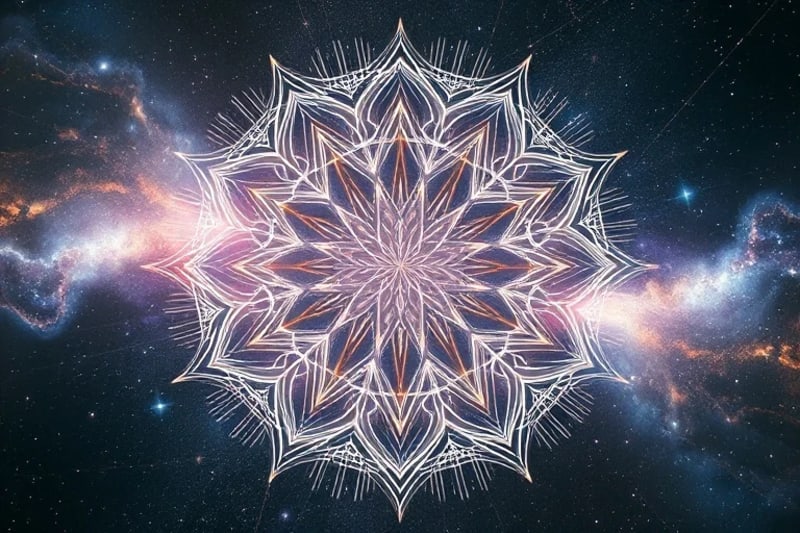
A vast, ethereal cosmic tapestry, hinting at the universe's holographic nature.
This exploration will navigate the complex interplay between consciousness, quantum mechanics, and the fabric of existence, offering a framework for understanding how our thoughts and intentions might literally contribute to the unfolding of our reality. By embracing these principles, we can move from passive observers to active participants in the grand design of the universe.
Table of Contents
- The Holographic Universe Theory: A Scientific Overview
- Quantum Physics and Reality: Bridging the Gap
- Conscious Manifestation: Principles and Practice
- The Role of Observation and Intention
- Co-creation in a Holographic Reality
- Practical Applications for Everyday Life
- Ethical Considerations and Responsibility
The Holographic Universe Theory: A Scientific Overview
The holographic universe theory gained prominence through the work of physicists like David Bohm and neuroscientist Karl Pribram. Bohm, a protégé of Albert Einstein, proposed that the universe is not a collection of separate parts but an undivided whole, with an underlying order he termed the "implicate order." Our perceived reality, the "explicate order," is merely a projection or unfolding of this deeper, more fundamental level of existence.
Pribram, independently researching how the brain processes information, found evidence suggesting that memories are not stored in specific locations but are distributed throughout the brain in a holographic manner. He theorized that the brain itself operates like a hologram, interpreting frequencies from a higher-dimensional realm to construct our sensory experience of reality. When these two theories converged, they offered a compelling framework for understanding the universe as a vast, dynamic hologram.
Key principles supporting this theory include:
- Non-locality: A phenomenon in quantum physics where particles remain connected and can influence each other instantaneously, regardless of distance. This suggests an underlying unity beyond spatial separation.
- Information as fundamental: Some theories propose that information, rather than matter or energy, is the most basic building block of the universe. A hologram is essentially a pattern of interference that encodes vast amounts of information.
- Black Hole Thermodynamics: Theoretical work by physicists like Jacob Bekenstein and Stephen Hawking on black holes suggests that the information content of a black hole is proportional to its surface area, not its volume. This "holographic principle" implies that a 3D volume can be fully described by information on a 2D surface.
While still a theoretical model, the holographic universe offers a powerful metaphor for understanding the interconnectedness of all things and the potential for reality to be far more fluid and malleable than commonly believed. It challenges the reductionist view of science, proposing a holistic perspective where consciousness might play a more active role in shaping our experience.
Quantum Physics and Reality: Bridging the Gap
Quantum physics, the study of matter and energy at the most fundamental level, has consistently revealed a reality that defies classical intuition. Concepts such as wave-particle duality, superposition, and entanglement point towards a universe where particles exist in multiple states simultaneously until observed, and where seemingly separate entities are intrinsically linked. These phenomena provide a scientific backdrop for the more esoteric ideas of manifestation.

A delicate hand reaching towards a vortex of light, symbolizing the act of conscious manifestation.
The "observer effect" in quantum mechanics is particularly relevant. It suggests that the act of observation itself influences the outcome of an experiment, collapsing a wave function of possibilities into a single, definite reality. While scientists debate the precise role of consciousness in this effect, it opens the door to the idea that our awareness and focus are not passive but actively participate in shaping the world around us. This is a critical bridge between quantum theory and the principles of manifestation.
If the universe is indeed holographic, then the information that constitutes our reality is not fixed but exists as a field of potential. Our consciousness, through attention and intention, could be the mechanism by which certain potentials are selected and brought into manifest form. This doesn't imply magical thinking but rather a deeper understanding of the energetic and informational nature of reality.
The implications are profound: if our thoughts and beliefs are forms of energy and information, and if reality responds to these inputs, then we possess an inherent capacity to influence our personal holographic projection. This perspective moves beyond a purely materialist view, integrating the subjective experience of consciousness into the objective framework of physics.
Conscious Manifestation: Principles and Practice
Conscious manifestation, often discussed in New Age circles, finds a more grounded explanation within the holographic and quantum frameworks. It is not about wishing for something and expecting it to appear out of thin air, but rather about aligning one's internal state—thoughts, emotions, beliefs—with desired external outcomes. This alignment, from a quantum perspective, could be seen as tuning into a specific frequency or selecting a particular potential from the universal field of possibilities.
The core principles of conscious manifestation include:
- Clarity of Intention: Clearly defining what you wish to manifest. Vague desires lead to vague results. This is akin to providing precise data input to the holographic field.
- Emotional Resonance: Feeling the emotions associated with having already achieved your desire. Emotions are powerful energetic signals that communicate with the universe.
- Belief and Expectation: Holding an unwavering belief that your desire is possible and will come to fruition. Doubts and limiting beliefs act as interference patterns, disrupting the manifestation process.
- Consistent Focus: Regularly directing your attention towards your desired outcome, without obsession or attachment to the "how."
- Inspired Action: Taking practical steps that align with your intention, even if they seem small or unrelated at first. This demonstrates your commitment to the universe.
From a holographic standpoint, these practices are not merely psychological tricks but active engagements with the informational fabric of reality. By consistently holding a clear intention and an emotional state congruent with your desire, you are, in essence, "programming" the holographic projection of your experience. This requires discipline and self-awareness, as unconscious beliefs can often override conscious desires.
The Role of Observation and Intention
In the quantum realm, observation is not a passive act; it's an interaction that shapes reality. When we apply this to the holographic universe, our conscious observation and intention become powerful tools for co-creation. Every thought, every feeling, and every belief acts as a form of observation, influencing the probabilities of what manifests in our experience.
Consider the double-slit experiment, where particles behave differently depending on whether they are observed. While the direct analogy to macroscopic reality is complex, the principle suggests that our attention gives form to potential. In a holographic universe, where reality is fundamentally information, our focused intention could be seen as the "decoder" or "renderer" that brings specific information patterns into our perceived physical world.
Intention, therefore, is not merely a wish but a directed energetic command. When we set an intention, we are, in a sense, sending a signal into the universal field, requesting a specific informational pattern to coalesce into our reality. The strength and clarity of this signal are enhanced by emotional congruence and unwavering belief. This explains why practices like visualization and affirmations are so central to manifestation; they help to solidify the internal "signal" being broadcast.
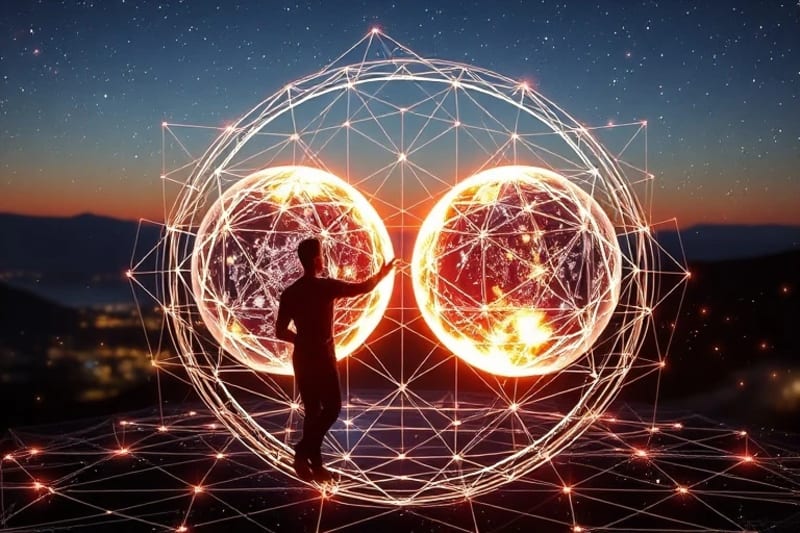
Interlocking geometric shapes and light constructs, illustrating the precision of co-creation.
It's important to distinguish this from magical thinking. The holographic model suggests a universe governed by laws, albeit laws far more subtle and interconnected than classical physics describes. Our role is to understand and work with these laws, rather than against them, to consciously shape our experiences. This involves cultivating a state of awareness that recognizes our inherent connection to the universal field.
Co-creation in a Holographic Reality
If individual consciousness can influence reality, then what happens when multiple consciousnesses interact? This leads to the concept of co-creation, where shared intentions and collective focus can manifest larger, more complex realities. In a holographic universe, where everything is interconnected, our individual "projections" are not isolated but constantly interacting and influencing one another.
Co-creation can occur on various scales:
- Interpersonal: Relationships are a prime example of co-creation. Two individuals bring their unique holographic projections (beliefs, expectations, past experiences) into interaction, and the shared reality of the relationship emerges from this dynamic interplay.
- Group Dynamics: Teams, families, and communities co-create their shared environment and experiences. Collective beliefs, values, and intentions can powerfully shape the group's reality.
- Global Scale: On a larger scale, humanity's collective consciousness, beliefs, and fears contribute to the global holographic projection. Major historical events, cultural shifts, and societal norms can be viewed as manifestations of collective co-creation.
Understanding co-creation within a holographic framework highlights the immense responsibility we have, not just for our individual lives, but for the collective reality. Every thought and action, however small, sends ripples through the interconnected field. This perspective encourages empathy, cooperation, and a conscious effort to align with positive, life-affirming intentions for the greater good.
The challenge lies in harmonizing diverse individual intentions into a coherent collective one. This often requires open communication, shared vision, and a willingness to transcend individual ego for the benefit of the whole. Ultimately, co-creation in a holographic reality suggests that we are all artists, painting the grand canvas of existence together, stroke by conscious stroke.
Practical Applications for Everyday Life
Integrating the principles of the holographic universe and quantum manifestation into daily life can lead to profound shifts in perspective and experience. It's about cultivating a conscious approach to reality rather than passively reacting to circumstances. Here are some practical applications:
- Mindfulness and Meditation: These practices enhance awareness of thoughts and emotions, allowing for greater control over the "signals" being sent to the universal field. By observing your inner state, you can consciously choose to align with desired outcomes.
- Vision Boards and Visualization: Creating visual representations of your goals and regularly visualizing their achievement helps to solidify your intention and emotional resonance. This acts as a clear blueprint for the holographic projection.
- Affirmations and Positive Self-Talk: Consciously choosing positive language and beliefs about yourself and your capabilities helps to reprogram limiting subconscious patterns. This shifts your internal frequency to one that is more aligned with your desires.
- Gratitude Practice: Expressing gratitude for what you already have, and for what is on its way, raises your vibrational frequency. Gratitude signals abundance to the universe, attracting more of it.
- Emotional Intelligence: Developing the ability to understand and manage your emotions is crucial. Negative emotions can create interference patterns, while positive emotions amplify your manifestation power.
- Setting Clear Intentions: Before starting a task, a day, or a project, take a moment to clearly state your intention. This simple act directs your energy and focuses your observation.
By consistently applying these practices, individuals can begin to experience a greater sense of agency and empowerment over their lives. The world may still present challenges, but the holographic perspective offers tools to navigate them with a proactive, co-creative mindset. This approach fosters resilience and an understanding that even perceived obstacles can be reframed as opportunities for growth and further manifestation.
Ethical Considerations and Responsibility
With great power comes great responsibility. If we are indeed co-creators in a holographic universe, then the ethical implications of our thoughts and intentions become paramount. The principle of interconnectedness means that what we manifest for ourselves inevitably impacts the collective. This calls for a conscious approach to manifestation that considers the greater good.
Key ethical considerations include:
- Harmonious Intentions: Ensuring that our desires do not come at the expense of others or the planet. True manifestation aligns with universal principles of harmony and well-being.
- Non-Attachment: While clarity of intention is vital, attachment to specific outcomes can lead to suffering. The universe often delivers in ways we don't expect, and flexibility is key.
- Self-Reflection: Regularly examining our motivations behind our desires. Are they rooted in ego, fear, or a genuine desire for growth and contribution?
- Collective Well-being: Extending our manifestation practices to include intentions for global peace, environmental healing, and social justice. Our collective reality is a reflection of our collective consciousness.
The holographic universe model, particularly when combined with quantum principles, suggests a profound level of interconnectedness and responsibility. It moves beyond individualistic desires to emphasize our role as stewards of a shared reality. By embracing these ethical considerations, we can ensure that our journey of manifestation and co-creation contributes positively to the unfolding of a more conscious and harmonious world.
In conclusion, the holographic universe theory, supported by insights from quantum physics, offers a compelling framework for understanding reality as a dynamic, information-rich projection. Within this framework, conscious manifestation and co-creation are not mystical acts but rather the natural consequence of our interconnectedness and the power of our observation and intention. By cultivating clarity, emotional resonance, and ethical awareness, we can actively participate in shaping our personal and collective realities, moving towards a future that is truly co-created with purpose and wisdom.
Source: Hybrid content assisted by AIs and human editorial supervision.


Comments
Post a Comment