
Tarot Geomancy Fusion Earth Insights Divination
In the vast tapestry of esoteric practices, humanity has long sought methods to understand the unseen forces shaping our lives and the world around us. Among the myriad forms of divination, Tarot and Geomancy stand out as ancient systems, each with unique strengths. While often practiced independently, their fusion offers a powerful, nuanced approach to gaining profound insights, particularly those rooted in the earthly realm and our connection to it. This comprehensive guide explores the historical context, core principles, methodologies, and practical applications of integrating Tarot and Geomancy for unparalleled earth-based wisdom.
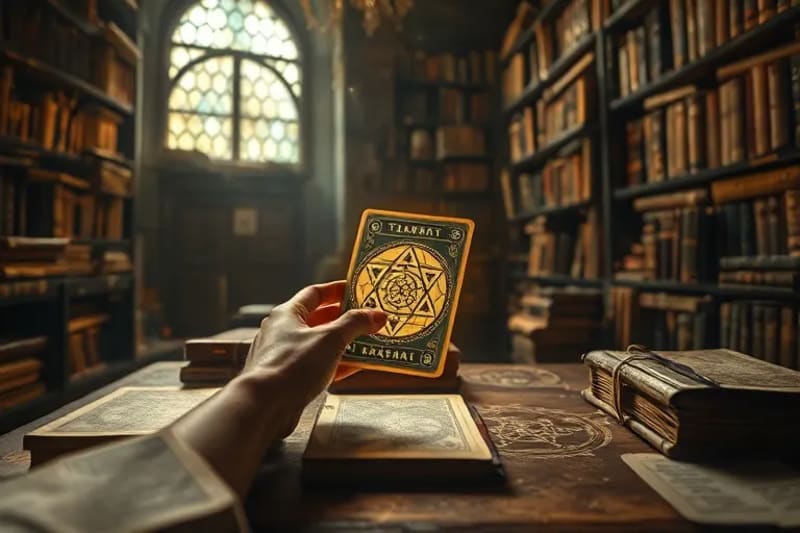
Exploring the synergy of ancient Tarot and Geomancy for deeper insights.
The concept of "earth-based insights" refers to guidance that is practical, grounded, and often directly related to physical circumstances, environmental energies, personal foundations, and the tangible aspects of existence. This contrasts with more ethereal or purely spiritual forms of divination, though the two are not mutually exclusive. By combining the symbolic richness of Tarot with the elemental and spatial precision of Geomancy, practitioners can access a holistic perspective that bridges the spiritual and the material, offering actionable wisdom for navigating complex situations.
This article delves into the origins of both practices, elucidates their individual mechanisms, and then reveals how their synergistic application can unlock a deeper understanding of our environment, our personal grounding, and the energetic currents that flow through the earth and influence our lives. Whether you are a seasoned diviner or a curious newcomer, the fusion of Tarot and Geomancy presents an exciting frontier for personal growth and ecological awareness.
Table of Contents
- Historical Roots of Tarot and Geomancy
- Understanding Tarot: The Symbolic Narrative
- Understanding Geomancy: Earth's Whispers
- The Synergy: How Tarot and Geomancy Fuse
- Methodologies for Integrated Readings
- Benefits of Earth-Based Insights
- Practical Applications and Ethical Considerations
- Conclusion: A Holistic Path to Wisdom
Historical Roots of Tarot and Geomancy
To appreciate the power of their fusion, it is essential to understand the individual histories and evolution of Tarot and Geomancy. Both practices boast rich, complex lineages that span centuries and continents, reflecting humanity's enduring quest for meaning and foresight.
Tarot: From Game to Oracle
The origins of Tarot cards can be traced back to 15th-century Italy, where they emerged as playing cards for a game known as Tarocchi. These early decks, such as the Visconti-Sforza Tarot, featured four suits similar to modern playing cards, along with a distinct set of twenty-one trump cards and a Fool card. It wasn't until the late 18th century that Tarot began to be associated with occultism and divination, largely due to French occultists like Antoine Court de Gébelin, who erroneously linked them to ancient Egyptian wisdom. This shift marked the transformation of Tarot from a parlour game into a profound tool for self-discovery and prophecy.
The 19th and 20th centuries saw the proliferation of esoteric Tarot decks, most notably the Rider-Waite-Smith deck (published in 1909) and the Thoth Tarot (designed by Aleister Crowley and Lady Frieda Harris). These decks, with their rich symbolism and detailed imagery, cemented Tarot's place in Western esotericism, offering a visual language for exploring psychological archetypes, spiritual journeys, and future possibilities. The enduring appeal of Tarot lies in its ability to tell a story, reflecting the querent's inner world and external circumstances through a series of archetypal images.
Geomancy: Divination by Earth's Patterns
Geomancy, meaning "earth divination," is a method of interpreting markings on the ground or patterns formed by randomly generated dots. Its roots are even more ancient and geographically diverse than Tarot, with evidence of similar practices found across Africa, the Middle East, and Europe. The most formalized system of geomancy, particularly Western geomancy, developed in the medieval Islamic world before being transmitted to Europe. Practitioners would cast sixteen random points, often by drawing lines in sand or dirt, or by making marks on paper without counting. These points were then grouped into various figures, each with specific meanings.
The sixteen geomantic figures, such as Via (the Way), Populus (the People), and Acquisitio (Acquisition), are composed of four lines, each containing either one or two points. These figures are then arranged into a complex chart, known as a geomantic shield or house chart, which is interpreted to answer specific questions. Geomancy is inherently connected to elemental forces and astrological correspondences, making it a highly grounded form of divination that speaks directly to material conditions, physical locations, and practical outcomes. Its structured, logical progression from random input to detailed interpretation makes it a powerful complement to the intuitive nature of Tarot.
Understanding Tarot: The Symbolic Narrative
Tarot operates as a symbolic narrative, utilizing seventy-eight cards divided into two main sections: the Major Arcana and the Minor Arcana. Each card is a repository of archetypal meaning, psychological insight, and potential life events. The strength of Tarot lies in its ability to offer a rich, multi-layered story that resonates with the querent's current situation and underlying psychological landscape.
- Major Arcana: These twenty-two cards represent significant life lessons, karmic influences, and major archetypal themes. They speak to the grand journey of life, from the innocence of The Fool to the completion of The World. When a Major Arcana card appears in a reading, it often signifies a pivotal moment, a profound transformation, or an overarching theme that demands attention.
- Minor Arcana: Comprising fifty-six cards, the Minor Arcana is divided into four suits: Wands, Cups, Swords, and Pentacles. These suits correspond to the four elements and different aspects of human experience:
- Wands (Fire): Represents inspiration, creativity, passion, ambition, and action.
- Cups (Water): Governs emotions, relationships, intuition, and spirituality.
- Swords (Air): Deals with intellect, communication, challenges, and conflict.
- Pentacles (Earth): Relates to material possessions, finances, career, health, and the physical world.
Tarot readings are highly intuitive, relying on the reader's ability to synthesize the meanings of individual cards, their positions in a spread, and their interaction with each other. The imagery on the cards often triggers personal associations and insights, making each reading a unique and deeply personal experience. It excels at revealing motivations, emotional states, and the psychological undercurrents of a situation.
Understanding Geomancy: Earth's Whispers
Geomancy, in contrast to Tarot's narrative flow, provides a more structured and often more direct answer to specific questions, particularly those concerning tangible matters. It is a system of divination that interprets patterns and figures derived from the earth itself, or representations thereof. The core of geomancy lies in its sixteen figures, each embodying a unique combination of elemental qualities and planetary associations.
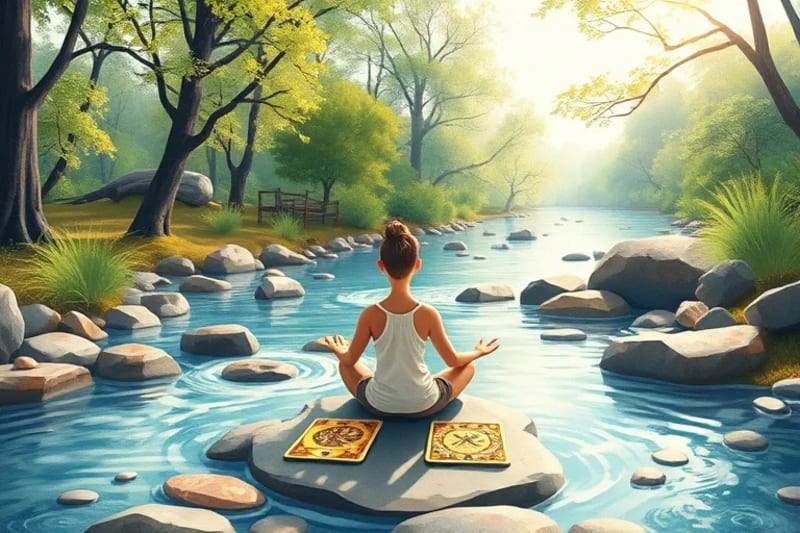
A tranquil scene depicting the blend of geomancy and tarot in nature.
The process of generating a geomantic chart typically involves a series of random dot castings, often four rows of dots, which are then reduced to single or double points. These points form the four "mothers" (Matres), which then generate four "daughters" (Filiae), four "nieces" (Nepotes), and finally the "right witness," "left witness," and the "judge." This systematic construction culminates in a "reconciler" figure, offering a final synthesis of the reading. The entire process is highly logical and mathematical, providing a clear and often unambiguous answer.
Each of the sixteen geomantic figures has a distinct character, astrological rulership, and elemental association. For example:
- Via (The Way): Represents travel, journeys, beginnings, and paths. Associated with the element of Water and the sign of Cancer.
- Populus (The People): Signifies crowds, community, fluctuation, and general circumstances. Associated with Water and Cancer.
- Conjunctio (Conjunction): Indicates union, partnership, joining, or coming together. Associated with Air and Gemini.
- Carcer (Prison): Represents restriction, delay, confinement, or obstacles. Associated with Earth and Capricorn.
- Acquisitio (Acquisition): Denotes gain, profit, success, or acquisition of something desired. Associated with Fire and Sagittarius.
Geomancy is particularly adept at addressing questions related to property, money, health, travel, and the outcome of practical endeavors. Its directness and connection to the earth make it an ideal tool for "earth-based insights," providing concrete advice and predictions regarding physical realities.
The Synergy: How Tarot and Geomancy Fuse
The fusion of Tarot and Geomancy creates a divination system that is greater than the sum of its parts. Where Tarot offers psychological depth and narrative richness, Geomancy provides concrete detail and a strong connection to the material world. Together, they form a comprehensive oracle capable of addressing both the inner and outer dimensions of any query.
The synergy between these two practices can be understood through their complementary natures:
- Bridging the Abstract and Concrete: Tarot excels at revealing the "why" and the "how" from a psychological and spiritual perspective, while Geomancy provides the "what" and the "where" in terms of tangible outcomes and physical influences. For instance, Tarot might reveal a fear of commitment (The Devil reversed), while Geomancy might pinpoint a specific financial obstacle (Carcer in the house of money) as the practical manifestation of that fear.
- Elemental Correspondence: Both systems utilize elemental associations (Fire, Water, Air, Earth). Tarot's suits directly correspond to these elements, and each geomantic figure also carries elemental qualities. This shared framework allows for a seamless integration, where the elemental balance or imbalance revealed by one system can be confirmed and elaborated upon by the other. For example, a predominance of Swords (Air) in Tarot might indicate mental conflict, which could be further elucidated by air-dominant geomantic figures like Albus or Tristitia, detailing the nature of the intellectual struggle.
- Astrological Overlaps: Geomantic figures are deeply tied to planetary and zodiacal rulerships. Tarot, particularly in more advanced interpretations, also has strong astrological correspondences. This shared astrological language provides another layer of depth, allowing practitioners to cross-reference insights and gain a more precise understanding of timing and planetary influences on earthly events. Psycho-Astrology Archetypal Psychology Jungian Shadow Natal Chart Wholeness can offer further context on these archetypal connections.
By combining these systems, a reader can move beyond a superficial interpretation, gaining a multi-dimensional view of a situation. The Tarot provides the narrative and emotional landscape, while Geomancy offers the practical, grounded details and potential outcomes, making the insights profoundly "earth-based" and actionable.
Methodologies for Integrated Readings
There are several effective ways to integrate Tarot and Geomancy into a single reading, each offering a unique approach to synthesizing their insights. The choice of methodology often depends on the nature of the question and the practitioner's preference.
1. Sequential Reading:
- Step 1 (Tarot First): Begin with a Tarot spread (e.g., a Celtic Cross or a three-card spread) to gain an initial overview of the situation, its emotional dynamics, and underlying influences. This provides the broader narrative and psychological context.
- Step 2 (Geomancy Second): Once the Tarot reading is complete, formulate a more specific, concrete question based on the insights gained from the Tarot. Then, cast a geomantic chart to answer this precise question, focusing on practical outcomes, timing, or physical manifestations. This allows Geomancy to provide grounded details that elaborate on the Tarot's narrative.
2. Complementary Spreads:
- Combined Layout: Design a custom spread where certain positions are designated for Tarot cards and others for geomantic figures. For example, a spread could have Tarot cards for "spiritual influences" and "emotional state," while geomantic figures are used for "material resources" and "physical obstacles." This creates a single, integrated visual representation.
- Parallel Readings: Conduct a full Tarot reading and a full geomantic reading independently for the same question. Then, compare and contrast the results, looking for common themes, reinforcing messages, or areas where one system offers clarity that the other might not have emphasized. This method is excellent for cross-validation and deep analysis.
3. Elemental Focus:
- Elemental Bridge: Use the elemental correspondences as a bridge between the two systems. If a Tarot reading highlights a strong Earth element (e.g., many Pentacles), then focus the geomantic inquiry on earth-related figures (like Carcer or Tristitia) to delve deeper into the material aspects of the situation. Conversely, if Geomancy points to a specific elemental imbalance, use Tarot to explore the psychological or emotional roots of that imbalance.
Regardless of the method chosen, the key is to allow each system to inform and enrich the other, creating a dialogue between the symbolic and the concrete, the spiritual and the material. This holistic approach ensures that the insights gained are not only profound but also practical and actionable.
Benefits of Earth-Based Insights
The fusion of Tarot and Geomancy offers a unique set of benefits, particularly for those seeking "earth-based insights." These insights are characterized by their practicality, grounding, and direct relevance to our physical existence and interaction with the environment.
- Enhanced Practical Guidance: By combining the psychological depth of Tarot with the concrete nature of Geomancy, readings provide advice that is both spiritually resonant and practically applicable. This means not just understanding the "why" of a problem, but also receiving clear indications on "what to do" in the material world.
- Deeper Connection to Earth Energies: Geomancy, by its very nature, connects to the earth. When paired with Tarot, it can help individuals understand how their personal energy and life path are intertwined with the physical environment, local energies, and even global ecological patterns. This fosters a sense of grounding and belonging.
- Holistic Problem Solving: Many life challenges have both internal (psychological, emotional) and external (financial, environmental, relational) components. The integrated approach allows for a holistic diagnosis, addressing all facets of a problem rather than just one dimension.
- Clarified Decision Making: When faced with choices that have tangible consequences, the fusion offers robust guidance. Tarot can illuminate the emotional and spiritual implications of each option, while Geomancy can predict the most likely practical outcomes, leading to more informed and confident decisions.
- Increased Self-Awareness and Grounding: Understanding how internal states manifest in external realities, and vice versa, leads to profound self-awareness. This process helps individuals become more grounded, recognizing their place within the larger energetic framework of the planet. Quantum Entanglement Esoteric Synchronicity can provide further context on interconnectedness.
These benefits extend beyond personal growth, potentially informing decisions related to community, environmental stewardship, and even broader societal issues, by providing a framework for understanding the interplay between human actions and earthly consequences.
A conceptual representation of advanced geomantic and tarot integration.
Practical Applications and Ethical Considerations
The combined power of Tarot and Geomancy can be applied to a wide array of practical situations, offering guidance that is both insightful and actionable. From personal dilemmas to broader environmental concerns, the earth-based insights derived from this fusion are invaluable.
Personal Applications:
- Career and Finance: Tarot can reveal underlying passions and fears related to career, while Geomancy can indicate the most auspicious times for investments, job changes, or business ventures, and potential obstacles.
- Relocation and Home: For decisions about moving or buying property, Tarot can explore emotional attachments and aspirations, while Geomancy can assess the energetic suitability of a location, potential challenges, and the overall "feel" of a new home.
- Health and Well-being: While not a substitute for medical advice, the fusion can offer insights into the energetic roots of physical ailments (Tarot) and practical steps for environmental or lifestyle adjustments that support healing (Geomancy).
- Personal Grounding: Regular readings can help individuals stay grounded, connected to their physical reality, and aware of how their actions impact their immediate environment.
Environmental and Community Applications:
- Ecological Projects: For community gardens, conservation efforts, or sustainable development, this fusion can provide guidance on the energetic flow of the land, potential challenges, and the most harmonious approaches.
- Understanding Local Energies: Practitioners can use the combined systems to understand the historical and current energetic patterns of a specific locale, which can inform urban planning, land use, or even artistic endeavors.
Ethical Considerations:
As with all forms of divination, ethical practice is paramount when fusing Tarot and Geomancy. Practitioners must:
- Maintain Objectivity: Strive to interpret the symbols and figures without imposing personal biases or desired outcomes.
- Respect Free Will: Present insights as guidance and possibilities, not as unchangeable decrees. Empower the querent to make their own choices.
- Confidentiality: Uphold strict confidentiality regarding the querent's questions and personal information.
- Avoid Over-Reliance: Encourage querents to use divination as a tool for self-reflection and informed decision-making, rather than as a substitute for personal responsibility or professional advice (e.g., medical, legal). Ethical Divination: Best Practices, Tarot, Numerology offers further guidelines.
By adhering to these ethical principles, the fusion of Tarot and Geomancy can serve as a powerful and responsible tool for navigating the complexities of both our inner and outer worlds.
Conclusion: A Holistic Path to Wisdom
The integration of Tarot and Geomancy represents a sophisticated and deeply rewarding approach to divination. By weaving together the rich symbolic narrative of Tarot with the grounded, elemental precision of Geomancy, practitioners can unlock a unique dimension of "earth-based insights." This fusion provides a holistic lens through which to view life's challenges and opportunities, offering guidance that is both spiritually profound and practically applicable to our physical existence.
Whether seeking clarity on personal matters, understanding environmental dynamics, or simply desiring a deeper connection to the energetic currents of the earth, the synergistic power of Tarot and Geomancy offers an unparalleled path to wisdom. As we navigate an increasingly complex world, tools that bridge the gap between the spiritual and the material become ever more valuable. This ancient yet adaptable fusion stands as a testament to humanity's enduring quest for understanding, inviting us to listen more closely to the whispers of both the cards and the earth itself.
Source: Hybrid content assisted by AIs and human editorial supervision.


Comments
Post a Comment