
Archaeoastronomy: Decoding Ancient Sites Celestial Alignments
Archaeoastronomy is a fascinating interdisciplinary field that investigates the astronomical practices, celestial knowledge, and cosmic worldviews of ancient cultures. It delves into how prehistoric and historical societies observed the sky, interpreted celestial phenomena, and integrated these understandings into their architecture, rituals, and daily lives. Far from being a mere curiosity, archaeoastronomy reveals profound insights into the intellectual sophistication, technological capabilities, and spiritual beliefs of our ancestors, demonstrating their deep connection to the cosmos.
This field bridges the gap between archaeology, astronomy, anthropology, and history, offering a unique lens through which to understand human civilization's relationship with the heavens. From the precise alignments of megalithic structures to the complex calendrical systems of Mesoamerican civilizations, the evidence of ancient astronomical observation is abundant and diverse. By studying these remnants, researchers can reconstruct ancient cosmologies and appreciate the universal human impulse to find meaning and order in the celestial sphere.

Ancient megalithic structures often reveal precise Tarot Quantum Mechanics Intersecting Divination Reality, showcasing the advanced astronomical knowledge of early civilizations.
The study of archaeoastronomy is not simply about identifying astronomical alignments in ancient structures; it extends to understanding the cultural context, the societal implications, and the spiritual significance of these observations. It seeks to answer questions about why certain celestial events were important, how this knowledge was transmitted, and what role it played in the social and political organization of ancient societies. This educational journey will explore the core tenets of archaeoastronomy, its historical development, key methodologies, and some of the most compelling examples from around the globe.
What is Archaeoastronomy?
Archaeoastronomy is defined as the scientific study of the astronomical practices of ancient people. It examines the ways in which past societies understood and interacted with celestial phenomena. Unlike the history of astronomy, which focuses on the development of scientific astronomical theories and instruments, archaeoastronomy concentrates on the cultural, social, and religious aspects of ancient skywatching.
The field encompasses a wide range of investigations, from analyzing the orientation of temples and tombs to deciphering ancient texts and oral traditions that describe celestial events. It seeks to uncover the practical applications of astronomical knowledge, such as timekeeping, calendar construction, and navigation, as well as its symbolic and ritualistic functions. Essentially, archaeoastronomy aims to reconstruct the "sky-lore" of ancient cultures, revealing their unique perspectives on the universe.
Key aspects of archaeoastronomy include:
- Identification of Alignments: Detecting precise orientations of ancient structures (e.g., temples, burial mounds, rock art) towards significant celestial events like solstices, equinoxes, or specific star risings/settings.
- Calendar Systems: Reconstructing ancient calendrical practices based on lunar, solar, or lunisolar cycles, often embedded in architectural features or written records.
- Cosmological Beliefs: Interpreting how celestial observations influenced myths, religions, and worldviews, and how these beliefs were manifested in art and ritual.
- Technological Ingenuity: Understanding the sophisticated observational techniques and instruments (or lack thereof) used by ancient skywatchers.
Historical Roots and Key Discoveries
The roots of archaeoastronomy can be traced back to the 18th and 19th centuries when antiquarians first noted astronomical orientations in ancient monuments. However, it was not until the mid-20th century that the field gained scientific rigor, largely due to the pioneering work of figures like Alexander Thom and Gerald Hawkins.
Alexander Thom, a Scottish engineer, meticulously surveyed hundreds of megalithic sites in Britain and France from the 1950s to the 1970s. His detailed measurements revealed consistent astronomical alignments, particularly with the solstices and equinoxes, suggesting a sophisticated understanding of celestial mechanics among Neolithic builders. Thom's work on Stonehenge, for example, demonstrated its function as a complex observatory, capable of predicting lunar and solar events.
Gerald Hawkins, an American astronomer, used computer analysis in the 1960s to study the alignments at Stonehenge. His findings, published in "Stonehenge Decoded," provided compelling statistical evidence that many of the monument's features were intentionally aligned with significant astronomical events, including the solstices, equinoxes, and major lunar standstills. These early studies, though initially met with skepticism, laid the groundwork for modern archaeoastronomy.
Since then, the field has expanded globally, with discoveries ranging from the astronomical knowledge embedded in the pyramids of ancient Egypt to the elaborate calendrical systems of the Maya. These findings consistently highlight that ancient people were not merely passive observers of the sky but active interpreters and integrators of celestial rhythms into their cultural fabric.
Methods and Tools of Archaeoastronomy
Archaeoastronomical research employs a diverse set of methodologies, drawing from both archaeological and astronomical sciences. The primary goal is to establish whether observed alignments are intentional and culturally significant, rather than coincidental. This often involves rigorous statistical analysis and careful contextual interpretation.
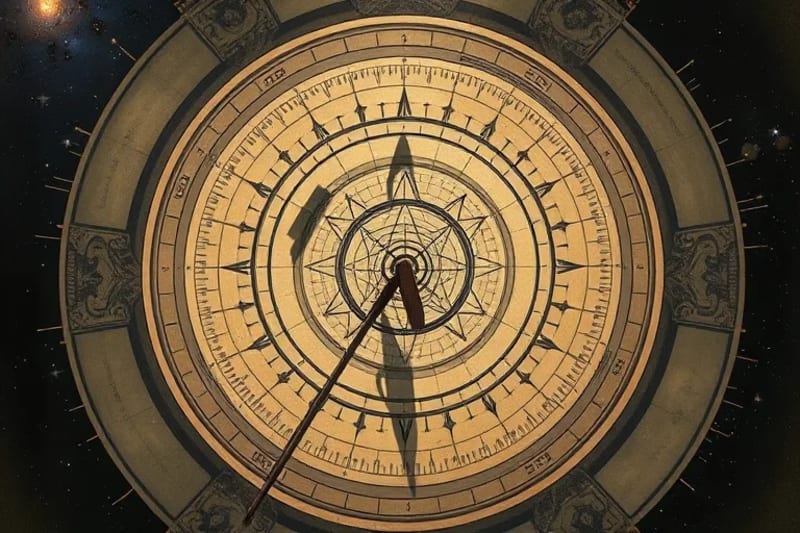
Reconstructing ancient Mesoamerican Astrology AI Oracles Bridging Ancient Modern often involves studying early tools and diagrams.
Key methods include:
- Site Survey and Measurement: Precise surveying techniques are used to map ancient structures and determine their exact orientations. This includes using modern GPS, total stations, and laser scanners to achieve high accuracy.
- Astronomical Calculations: Once orientations are known, astronomers calculate the positions of celestial bodies (sun, moon, stars, planets) at the time the structures were built. This requires accounting for phenomena like precession of the equinoxes, which shifts star positions over millennia.
- Statistical Analysis: To differentiate intentional alignments from random chance, statistical methods are employed. Researchers compare the observed alignments to a random distribution of orientations to determine their statistical significance.
- Ethnoastronomy and Ethnography: Studying the astronomical knowledge of contemporary indigenous cultures can provide valuable insights into how ancient societies might have perceived and utilized the sky.
- Iconographic and Textual Analysis: Examining ancient art, inscriptions, and written documents for references to celestial bodies, myths, and astronomical events helps to contextualize physical alignments.
- Computer Simulations: Advanced software can recreate the ancient sky as it would have appeared from specific sites at specific times, allowing researchers to visualize and test potential alignments.
The tools used in archaeoastronomy range from traditional surveying equipment to sophisticated computer models. The interdisciplinary nature of the field demands a blend of archaeological fieldwork, astronomical theory, and cultural interpretation to draw robust conclusions.
Famous Archaeoastronomical Sites
Across the globe, numerous ancient sites stand as testaments to humanity's enduring fascination with the cosmos. These sites offer compelling evidence of sophisticated astronomical knowledge and its integration into monumental architecture.
Stonehenge, England
Perhaps the most iconic archaeoastronomical site, Stonehenge is famous for its precise alignment with the summer solstice sunrise and the winter solstice sunset. On these days, the sun's rays perfectly align with the monument's central axis, illuminating specific stones. While its exact purpose remains debated, it clearly served as a sophisticated calendar and a ceremonial center for observing the sun's annual cycle.
Chichen Itza, Mexico
The El Castillo pyramid at Chichen Itza, built by the Maya civilization, is a marvel of archaeoastronomy. During the spring and autumn equinoxes, the sun creates a shadow illusion of a serpent (Kukulkan) slithering down the pyramid's staircase. This precise alignment demonstrates the Maya's advanced understanding of solar movements and their integration into religious symbolism.
Newgrange, Ireland
This Neolithic passage tomb, older than Stonehenge and the Egyptian pyramids, features a remarkable alignment with the winter solstice sunrise. For a few minutes around the solstice, a narrow beam of light penetrates a 'roofbox' above the entrance, traveling down the 19-meter passage to illuminate the chamber at the back. This event likely held profound spiritual significance for its builders.
Goseck Circle, Germany
Considered the oldest known solar observatory in the world, the Goseck Circle is a Neolithic enclosure dating back to around 4900 BC. Its wooden palisades have openings that align precisely with the sunrise and sunset on the winter and summer solstices, indicating its use as a sophisticated calendrical device for agricultural and ceremonial purposes.
The Significance of Celestial Alignments in Ancient Cultures
The meticulous efforts ancient cultures invested in aligning their structures with celestial events were driven by a multitude of practical, social, and spiritual reasons. These alignments were far more than architectural feats; they were fundamental to the organization and belief systems of these societies.
One of the most crucial practical applications was timekeeping and calendar development. Agricultural societies relied heavily on predicting seasonal changes for planting and harvesting. Solar and lunar alignments provided accurate markers for these cycles, enabling the creation of reliable calendars. This knowledge was often held by a priestly or elite class, reinforcing their authority and control over the community's well-being.
Ancient cultures often integrated their understanding of Tarot Quantum Mechanics Intersecting Divination Reality into their spiritual and daily lives.
Spiritually, celestial bodies were often deified or seen as manifestations of divine power. Aligning temples or sacred spaces with these celestial events connected the earthly realm with the cosmic, facilitating rituals, ceremonies, and communication with the gods. Solstices and equinoxes, in particular, were often seen as powerful times for renewal, sacrifice, and celebration, marking transitions in both the natural and spiritual worlds.
Moreover, astronomical knowledge played a significant role in social cohesion and political legitimation. Rulers or priests who could accurately predict eclipses or other celestial events were often perceived as having divine favor or superior wisdom, strengthening their grip on power. The construction of monumental structures with astronomical alignments also served as a display of power, wealth, and organizational capacity, solidifying the social hierarchy.
In essence, celestial alignments were not just about observing the sky; they were about living in harmony with the cosmos, managing resources, reinforcing social structures, and connecting with the divine. They represent a holistic worldview where the earthly and heavenly realms were intricately intertwined.
Challenges and Criticisms in Archaeoastronomy
Despite its compelling findings, archaeoastronomy is not without its challenges and criticisms. The interdisciplinary nature of the field sometimes leads to methodological debates and differing interpretations. One of the main criticisms revolves around the "chance alignment" argument. With countless possible alignments in any complex structure, some critics argue that researchers might be selectively identifying alignments that fit their hypotheses, leading to confirmation bias.
To counter this, modern archaeoastronomy emphasizes rigorous statistical analysis to determine the probability that an alignment is intentional rather than random. Researchers also look for multiple, consistent alignments within a single site or across a cultural region, which strengthens the case for intentional design. Furthermore, corroborating evidence from historical texts, iconography, or ethnographic studies is crucial.
Another challenge is the preservation of ancient sites. Erosion, human activity, and natural disasters can alter structures over millennia, making precise measurements difficult. The original context of many artifacts and structures is also often lost, requiring researchers to infer cultural significance from fragmented evidence.
The interpretation of ancient cosmologies can also be problematic. Researchers must be careful not to project modern scientific understandings onto ancient belief systems. Instead, the goal is to understand the world through the eyes of the people who built these structures, respecting their unique cultural and spiritual frameworks. This requires a nuanced approach that combines scientific rigor with anthropological sensitivity.
Despite these challenges, the field continues to evolve, with new technologies and interdisciplinary collaborations enhancing its reliability and expanding its scope. The ongoing dialogue and critical self-reflection within the archaeoastronomical community ensure its continued scientific integrity.
The Future of Archaeoastronomy
The future of archaeoastronomy is bright, driven by advancements in technology and an increasing appreciation for interdisciplinary research. New tools and methodologies are continually being developed, allowing for more precise analyses and the discovery of previously unnoticed patterns.
Remote sensing technologies, such as LiDAR (Light Detection and Ranging) and satellite imagery, are revolutionizing the way sites are discovered and mapped. These technologies can reveal hidden structures and subtle alignments that are invisible from the ground, opening up vast new areas for investigation, particularly in densely forested or remote regions. Virtual reality and augmented reality are also beginning to play a role, allowing researchers and the public to experience ancient celestial events as they would have appeared millennia ago.
Furthermore, the integration of big data analytics and artificial intelligence is poised to transform the field. AI algorithms can process vast amounts of archaeological data, identify complex patterns, and even suggest potential astronomical alignments that human observers might overlook. This could lead to a deeper understanding of the statistical significance of alignments and the underlying principles of ancient design.
The expansion of archaeoastronomical research into new geographical areas and cultural contexts is also a key trend. While much of the early work focused on Europe and Mesoamerica, there is growing interest in the astronomical traditions of Africa, Asia, Oceania, and indigenous cultures worldwide. This global perspective enriches our understanding of the diverse ways humanity has engaged with the cosmos.
Ultimately, archaeoastronomy continues to unveil the profound intellectual and spiritual legacy of ancient civilizations. It reminds us that the human quest to understand our place in the universe is a timeless endeavor, connecting us across millennia to those who first looked up at the stars and sought to decode their mysteries.
Fuente: Contenido híbrido asistido por IAs y supervisión editorial humana.


Comments
Post a Comment