
Uranian Astrology: Midpoints & Predictive Harmonics Unlocked
Uranian Astrology, also known as the Hamburg School of Astrology, represents a distinct and highly specialized branch of astrological practice. Developed in the early 20th century by Alfred Witte and Friedrich Sieggrün, this system offers a remarkably precise and often startlingly accurate method for analyzing natal charts and forecasting events. Unlike traditional astrology, which primarily focuses on the twelve zodiac signs, houses, and major planetary aspects, Uranian Astrology introduces a unique set of tools, most notably midpoints and Transneptunian Planets (TNP), to uncover deeper layers of cosmic influence.
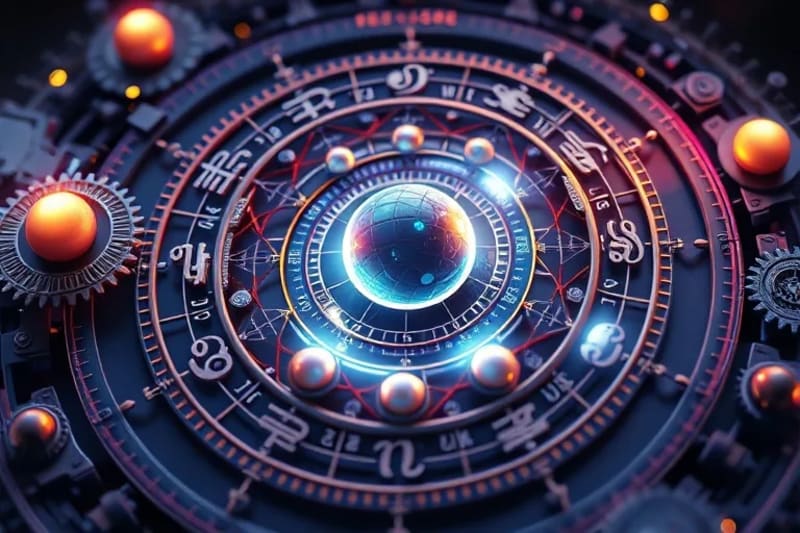
An abstract representation of the intricate and precise celestial mechanics at the heart of Uranian Astrology, emphasizing its unique approach to cosmic interpretation.
The foundational premise of Uranian Astrology is that every point in the natal chart – planets, house cusps, and even theoretical points – interacts with every other point, forming sensitive "midpoints" that reveal specific life themes and events. This system moves beyond psychological interpretation, aiming for a more objective and event-oriented analysis, often used for highly detailed predictive work. Its analytical rigor and emphasis on mathematical precision set it apart, appealing to those who seek a more scientific or deterministic approach to astrological understanding.
This introductory guide aims to unlock the fundamental concepts of Uranian Astrology, making its intricate principles accessible to a broader audience. We will explore its core components, differentiate it from conventional methods, and highlight how its unique tools provide a powerful lens for understanding life's complexities and future trajectories. Understanding these advanced Tarot Quantum Mechanics Intersecting Divination Reality can provide a richer perspective on personal and global events.
Table of Contents
- Origins and Evolution of Uranian Astrology
- The Core Concept: Midpoints Explained
- Transneptunian Planets (TNP): Beyond the Visible
- The 90-Degree Dial Chart: A Visual Key
- Principles of Uranian Chart Interpretation
- Predictive Harmonics and Forecasting Techniques
- Advantages and Applications of Uranian Astrology
- Uranian vs. Traditional Astrology: Key Differences
Origins and Evolution of Uranian Astrology
Uranian Astrology emerged from the rigorous research of Alfred Witte (1878-1941), a German surveyor and astrologer. During World War I, Witte meticulously observed planetary positions and their correlation with specific events, particularly in military contexts. His work led him to conclude that traditional astrological methods were insufficient for the precision he sought. He began experimenting with new points and relationships within the zodiac, eventually formulating the concept of midpoints and discovering several hypothetical planets beyond Neptune.
Witte's initial findings were further developed and systematized by his student, Friedrich Sieggrün (1877-1951), who helped establish the "Hamburg School" of astrology. This school emphasized a scientific, empirical approach, focusing on verifiable correlations between celestial configurations and earthly events. The system gained traction for its ability to pinpoint specific timings and details, often with remarkable accuracy, leading to its adoption by a dedicated community of practitioners worldwide. The methodology continues to evolve, with modern astrologers integrating new computational tools to enhance its precision.
The Core Concept: Midpoints Explained
At the heart of Uranian Astrology lies the concept of midpoints. A midpoint is simply the exact halfway point between any two astrological factors in a chart. For example, if the Sun is at 10° Aries and the Moon is at 20° Gemini, their midpoint would be calculated by finding the angular distance between them and dividing by two, then adding it to the first point. This results in a highly sensitive degree that acts as a focal point where the energies of the two original factors converge and express themselves.
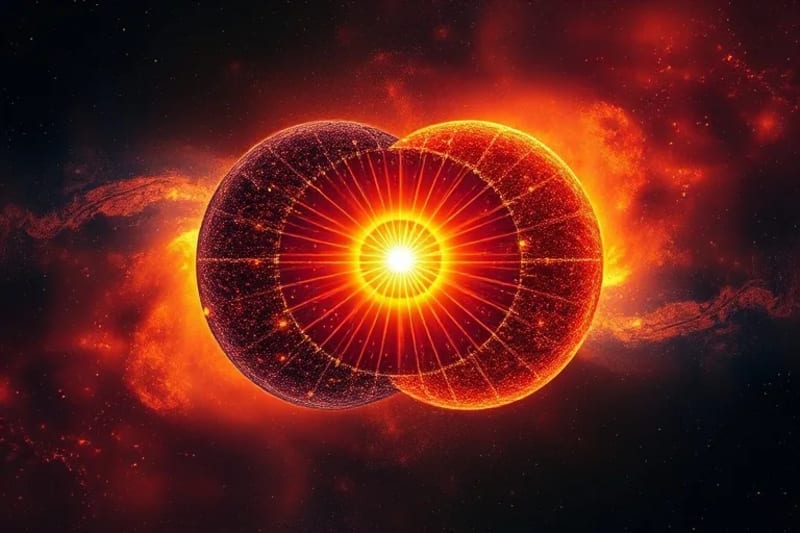
A visual metaphor for midpoints, illustrating how two distinct planetary energies converge to create a powerful, sensitive third point in the astrological chart.
Uranian astrologers consider not just planetary midpoints (e.g., Sun/Moon, Venus/Mars) but also midpoints involving house cusps, the Ascendant, Midheaven, and even other midpoints. The interpretation of a midpoint involves understanding the combined energies of the two factors it connects. For instance, Sun/Moon can represent one's personality or partnership, while Mars/Saturn might indicate challenges or disciplined action. When a third planet or sensitive point aspects a midpoint, it "triggers" or activates that midpoint's theme, bringing it into conscious experience or manifesting it as an event.
The calculation of midpoints is precise, often using a 360-degree zodiac without regard for signs, focusing purely on angular distances. This mathematical approach allows for an objective analysis, reducing subjective interpretation. The power of midpoints lies in their ability to reveal hidden dynamics and potential events that might not be apparent through traditional aspect analysis alone. They act as highly specific indicators, offering a detailed roadmap of an individual's life path and potential experiences.
Transneptunian Planets (TNP): Beyond the Visible
Another defining feature of Uranian Astrology is its inclusion of eight hypothetical Transneptunian Planets (TNP). These are not physical bodies discovered by astronomers but rather mathematical points derived from Witte's empirical observations. They are believed to represent specific archetypal energies and influences that extend beyond the traditional planetary pantheon. The TNPs are:
- Cupido: Represents family, community, social groups, marriage, and art.
- Hades: Associated with secrets, hidden things, suffering, decay, and the past.
- Zeus: Symbolizes leadership, creation, force, machinery, and assertion.
- Kronos: Relates to authority, government, mastery, superiority, and independence.
- Apollon: Represents science, trade, expansion, success, and multiplicity.
- Admetos: Associated with foundations, beginnings, endings, specialization, and isolation.
- Vulcanus: Denotes immense power, strength, intensity, and deep processes.
- Poseidon: Symbolizes spirituality, enlightenment, wisdom, ideals, and media.
These TNPs are integrated into midpoint calculations and aspect analysis, adding layers of nuance and specificity to interpretations. For example, a midpoint involving Zeus might indicate a strong drive for leadership or involvement with powerful structures, while Hades could point to hidden issues or karmic patterns. Their inclusion allows Uranian astrologers to delve into highly specific areas of life experience that might be less clearly defined by traditional planets alone. The interpretation of these points requires a deep understanding of their symbolic meanings and how they interact within the chart's complex web of influences.
The 90-Degree Dial Chart: A Visual Key
To simplify the visualization and interpretation of numerous midpoints and aspects, Uranian Astrology utilizes a unique tool called the 90-degree dial chart. Unlike the traditional 360-degree circular chart, the 90-degree dial compresses the entire zodiac into a 90-degree segment. This means that all cardinal signs (Aries, Cancer, Libra, Capricorn) occupy the same degree on the dial, as do all fixed signs (Taurus, Leo, Scorpio, Aquarius) and all mutable signs (Gemini, Virgo, Sagittarius, Pisces).
The primary advantage of the 90-degree dial is its ability to instantly reveal hard aspects (conjunctions, oppositions, squares, and semi-squares/sesquiquadrates) and midpoints. When planets or points align on the dial, they are in a significant angular relationship. This visual compression makes it much easier to identify complex configurations, such as planetary pictures (three or more factors forming a significant midpoint structure), which are crucial for Uranian interpretation. This visual aid is indispensable for performing Tarot Quantum Mechanics Intersecting Divination Reality with precision.
The dial allows astrologers to quickly scan for "equal houses," where any two points at the same degree on the dial are considered to be in an aspect. This streamlines the process of identifying activated midpoints and planetary pictures, which are the building blocks of Uranian analysis. Mastering the 90-degree dial is a cornerstone of practicing Uranian Astrology, enabling practitioners to navigate its intricate mathematical landscape with greater ease and efficiency.
Principles of Uranian Chart Interpretation
Interpreting a Uranian chart involves a systematic process that differs significantly from traditional methods. The focus shifts from individual planetary meanings in isolation to the combined energies expressed through midpoints and planetary pictures. Here are some key principles:
- Planetary Pictures: These are combinations of three or more factors that form a specific midpoint structure. For example, A=B/C means that planet A is at the midpoint of planets B and C. Each planetary picture has a specific meaning, often describing an event or a particular quality.
- Axis Interpretation: Uranian Astrology places significant emphasis on axes, such as the Ascendant/Descendant (personal relationships) and Midheaven/IC (career/home life). Midpoints involving these axes are particularly potent.
- Keywords and Phrases: Each planet and TNP has a set of keywords and phrases associated with its meaning. These are combined to interpret midpoints and planetary pictures, creating a precise description of the energy or event.
- Symmetry and Balance: The system looks for symmetrical arrangements of planets and points on the 90-degree dial, indicating areas of heightened sensitivity or potential.
The interpretation is often highly literal and event-oriented. For example, the planetary picture Mars/Saturn = Ascendant might indicate a physical injury to the native, or a difficult confrontation. The precision of these interpretations is what draws many to Uranian Astrology, as it offers concrete insights rather than broad psychological tendencies. This method requires a methodical approach, often involving extensive lists of planetary picture definitions and their potential manifestations. Further understanding can be gained by studying Tarot Quantum Mechanics Intersecting Divination Reality in this context.
Predictive Harmonics and Forecasting Techniques
Uranian Astrology excels in predictive work, offering a sophisticated array of techniques for forecasting specific events and periods. The primary predictive methods include:
- Transits: The movement of current planets over natal midpoints and planetary pictures. When a transiting planet forms an aspect to a natal midpoint, it activates the themes associated with that midpoint.
- Progressions: Symbolic movements of the natal chart points forward in time. Uranian progressions, particularly the solar arc direction, are highly valued for their accuracy in timing significant life events.
- Directions: Similar to progressions, but often involving specific rates of movement. The "mundane directions" are particularly important in Uranian work, moving the entire chart forward by a specific arc, often one degree per year.
- Harmonics: While not a primary focus in the same way as midpoints, harmonic charts can be used to explore different "octaves" or levels of experience within the chart, revealing underlying patterns and potentials.

A conceptual visualization of predictive harmonics, where abstract patterns of energy interact with crystalline structures, representing the intricate and resonant nature of future astrological influences.
The combination of these techniques, especially when viewed through the 90-degree dial, allows Uranian astrologers to pinpoint event timings with remarkable precision. The emphasis is on identifying when specific planetary pictures are activated by transits or directions, leading to the manifestation of their associated themes. This makes Uranian Astrology a powerful tool for planning, understanding critical periods, and gaining foresight into future developments.
Advantages and Applications of Uranian Astrology
The unique methodology of Uranian Astrology offers several distinct advantages and applications:
- Precision in Forecasting: It excels in timing events, making it valuable for electional astrology (choosing optimal times for actions), mundane astrology (predicting global events), and personal forecasting.
- Objective Analysis: The mathematical basis and clear definitions of planetary pictures reduce subjective interpretation, leading to more consistent and verifiable results.
- Detailed Insights: The use of midpoints and TNPs allows for a highly granular analysis, uncovering specific details about relationships, career, health, and other life areas that might be missed by traditional methods.
- Problem Solving: It can be used to diagnose the astrological roots of recurring problems or challenges, offering insights into their timing and potential resolution.
- Research Tool: Its empirical foundation makes it a valuable system for astrological research, allowing practitioners to test hypotheses and observe correlations.
Uranian Astrology is particularly favored by those who appreciate a structured, logical approach to the cosmos. Its capacity for detailed predictive techniques and event-oriented analysis makes it a powerful complement to more psychologically focused astrological systems. While it requires dedication to learn its intricate rules and symbols, the depth of insight it provides can be profoundly rewarding for both practitioners and clients.
Uranian vs. Traditional Astrology: Key Differences
While both Uranian and traditional astrology aim to understand cosmic influences, their methodologies and focus diverge significantly. Here's a comparative overview:
| Feature | Uranian Astrology | Traditional Astrology |
|---|---|---|
| Primary Focus | Event-oriented, objective analysis, precise timing. | Psychological interpretation, character analysis, general life themes. |
| Key Tools | Midpoints, Transneptunian Planets (TNP), 90-degree dial, planetary pictures. | Zodiac signs, houses, major aspects (conjunction, opposition, square, trine, sextile), planetary rulerships. |
| Planets Used | Sun, Moon, traditional planets + 8 TNPs (Cupido, Hades, Zeus, Kronos, Apollon, Admetos, Vulcanus, Poseidon). | Sun, Moon, Mercury, Venus, Mars, Jupiter, Saturn, Uranus, Neptune, Pluto. |
| Chart Visualization | Primarily 90-degree dial for quick aspect/midpoint identification. | 360-degree circular chart. |
| Predictive Methods | Solar Arc Directions, Transits to midpoints, Mundane Directions. | Transits, Secondary Progressions, Solar Returns, Profections. |
| Interpretation Style | Literal, specific, often event-driven. | Symbolic, psychological, archetypal. |
While traditional astrology provides a rich tapestry for understanding personality and broad life cycles, Uranian Astrology offers a microscope for examining the precise mechanics and timing of events. Neither system is inherently superior; rather, they serve different purposes and can often complement each other, providing a more holistic and detailed astrological perspective. The choice between them often depends on the astrologer's focus and the client's specific needs for insight.
Fuente: Contenido híbrido asistido por IAs y supervisión editorial humana.


Comments
Post a Comment