
Hermetic Kabbalah: Tree Life Spiritual Attainment
Hermetic Kabbalah represents a profound system of esoteric philosophy, offering a comprehensive map of the universe and the human soul. At its core lies the iconic symbol of the Tree of Life, a diagrammatic representation of the ten Sephiroth and the twenty-two paths connecting them. This ancient wisdom tradition, blending elements of Jewish mysticism with Western occultism, provides a structured framework for spiritual attainment and understanding the nature of reality.
For centuries, seekers have turned to the Tree of Life as a guide for self-discovery, personal growth, and connection to the divine. It is not merely an abstract concept but a living blueprint for consciousness, revealing the stages of creation and the journey back to the source. This article will delve into the intricate layers of Hermetic Kabbalah, exploring its historical context, fundamental structure, and practical applications for those on a spiritual path.
Table of Contents
- Introduction to Hermetic Kabbalah and the Tree of Life
- Historical Roots and Evolution of Kabbalah
- The Structure of the Tree of Life: Sephiroth and Paths
- Exploring the Ten Sephiroth: Emanations of Divinity
- The Twenty-Two Paths: Journeys of Consciousness
- Practical Applications for Spiritual Attainment
- Kabbalah in Modern Esoteric Thought
- Common Misconceptions and Ethical Considerations
- Conclusion: The Enduring Wisdom of the Tree of Life
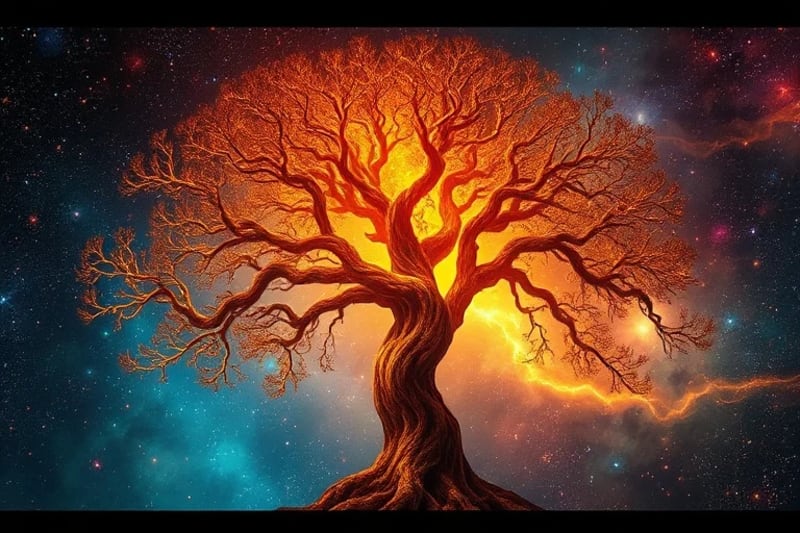
The mystical Tree of Life, a central symbol in Hermetic Kabbalah, illuminates the pathways to spiritual understanding.
Introduction to Hermetic Kabbalah and the Tree of Life
Hermetic Kabbalah is a Western esoteric tradition that emerged from a synthesis of Jewish Kabbalah, Renaissance Hermeticism, and other magical and philosophical systems. Unlike its Jewish counterpart, which is primarily a theological and mystical discipline for interpreting the Torah, Hermetic Kabbalah is often more focused on practical applications for personal spiritual development and magical work.
The Tree of Life serves as its principal glyph, a complex symbolic diagram that maps the divine emanations, the structure of the cosmos, and the human psyche. This diagram is understood as a universal model, applicable to everything from the macrocosm of the universe to the microcosm of individual consciousness. Studying the Tree of Life allows practitioners to gain insights into divine principles and their manifestation in the material world.
Historical Roots and Evolution of Kabbalah
The origins of Kabbalah can be traced back to ancient Jewish mystical traditions, particularly the Merkavah mysticism of the Talmudic period. These early forms focused on visionary experiences and the ascent through heavenly palaces. The formal development of Kabbalah as a distinct system began in the 12th and 13th centuries, primarily in medieval Provence and Spain, culminating in seminal texts like the Zohar.
During the Renaissance, Christian scholars became interested in Kabbalah, seeing it as a means to understand Christian theology through a new lens. Figures like Pico della Mirandola and Johannes Reuchlin integrated Kabbalistic ideas into Christian Hermeticism. This cross-cultural exchange laid the groundwork for what would later become Hermetic Kabbalah, distinct from its Jewish roots but retaining many core concepts.
By the 19th and 20th centuries, organizations such as the Hermetic Order of the Golden Dawn further developed Hermetic Kabbalah into a structured system of magical and spiritual practice. They synthesized Kabbalistic principles with Tarot, astrology, alchemy, and ceremonial magic, creating a rich and multifaceted tradition. This evolution cemented its role as a cornerstone of Western esotericism.
The Structure of the Tree of Life: Sephiroth and Paths
The Tree of Life is composed of ten interconnected spheres, known as the Sephiroth (singular: Sephirah), and twenty-two connecting lines, known as the Paths. These elements are arranged in three columns, often referred to as the Pillars of Mercy, Severity, and Balance. This intricate arrangement symbolizes the flow of divine energy from the infinite source down into manifestation.
The Sephiroth represent distinct attributes or emanations of God, or aspects of consciousness, while the Paths symbolize the relationships and transitions between these divine qualities. Understanding their interplay is crucial for deciphering the Tree's profound symbolism. Each Sephirah and Path holds specific meanings, correspondences, and lessons for the spiritual aspirant.

A vibrant watercolor illustrating the ten Sephiroth, each with its unique symbolic representation and color.
Exploring the Ten Sephiroth: Emanations of Divinity
Each of the ten Sephiroth represents a specific divine quality or stage of creation, from the ultimate unity of Keter to the material world of Malkuth. They are not separate entities but facets of a single divine consciousness. Understanding each Sephirah helps in comprehending the entire energetic flow of the universe.
- Keter (Crown): The highest Sephirah, representing pure divine will, unity, and the potential of all creation. It is beyond human comprehension, the ultimate source.
- Chokmah (Wisdom): The first flash of creation, pure wisdom, the masculine principle, and the expansive force of the universe. It is the raw, undifferentiated idea.
- Binah (Understanding): The great mother, understanding, the feminine principle, and the form-giving force that shapes Chokmah's wisdom. It brings structure to potential.
- Chesed (Mercy/Love): Expansion, benevolence, compassion, and the desire to give and create. It is the loving aspect of the divine.
- Geburah (Severity/Justice): Restriction, discipline, strength, and the power to judge and limit. It provides necessary boundaries and tests.
- Tiphareth (Beauty/Harmony): The central Sephirah, representing balance, beauty, harmony, and consciousness. It is often associated with the heart and the Christ consciousness.
- Netzach (Victory/Eternity): Emotion, instinct, passion, and the drive for victory and endurance. It embodies the vital life force and natural urges.
- Hod (Glory/Intellect): Intellect, reason, communication, and the ability to analyze and articulate. It represents the structured mind.
- Yesod (Foundation): The foundation, the astral plane, dreams, and the subconscious mind. It is the repository of images and forms before they manifest.
- Malkuth (Kingdom/Earth): The lowest Sephirah, representing the material world, physical manifestation, and the culmination of all divine emanations. It is our physical reality.
These Sephiroth are often grouped into three triads: the Supernal Triad (Keter, Chokmah, Binah), the Ethical Triad (Chesed, Geburah, Tiphareth), and the Astral/Ethereal Triad (Netzach, Hod, Yesod), culminating in Malkuth. This hierarchical structure illustrates the descent of spirit into matter and the potential for ascent back to spirit.
The Twenty-Two Paths: Journeys of Consciousness
Connecting the ten Sephiroth are twenty-two Paths, each corresponding to a letter of the Hebrew alphabet and a Major Arcana card of the Tarot. These Paths represent the various modes of consciousness and the symbolic journeys one undertakes between different divine principles. They are not merely lines but active channels of energy and experience.
Each Path embodies a specific lesson, challenge, or spiritual quality that must be integrated to move from one Sephirah to another. For instance, the path connecting Keter and Chokmah (Aleph, The Fool) represents the initial spark of creation and the leap of faith into the unknown. The path between Tiphareth and Netzach (Lamed, Justice) signifies the balance between emotion and intellect.
Meditating on these Paths, understanding their Tarot correspondences, and exploring their associated Hebrew letters can provide profound insights into one's spiritual journey. They offer a dynamic framework for understanding personal development and the intricate connections within the cosmos. This system allows for a personalized approach to spiritual growth, where individuals can focus on specific paths relevant to their current challenges or aspirations.
Practical Applications for Spiritual Attainment
Hermetic Kabbalah is not just a theoretical system; it is a practical path to spiritual attainment. Practitioners utilize the Tree of Life in various ways to foster personal transformation and deepen their connection to the divine. These methods often involve meditation, ritual, and self-reflection.
- Pathworking: This involves meditating on specific Paths and Sephiroth, visualizing oneself traveling through them, and integrating their symbolic meanings. Pathworking can lead to profound psychological and spiritual insights, helping individuals to overcome blockages and develop specific divine qualities.
- Ritual and Ceremony: Many Hermetic traditions incorporate Kabbalistic principles into ceremonial magic, using the Sephiroth and Paths as a framework for invoking divine energies or achieving specific magical goals. These rituals are often highly structured and symbolic.
- Self-Analysis and Shadow Work: The Tree of Life can be used as a diagnostic tool for understanding one's own psychological makeup. By mapping personal experiences, strengths, and weaknesses onto the Sephiroth, individuals can identify areas for growth and engage in shadow work.
- Astrological and Tarot Correspondences: Each Sephirah and Path has extensive correspondences with astrological planets, signs, and Tarot cards. Integrating these systems provides a richer, multi-layered understanding of the Tree and its influence on personal destiny and daily life.
Through consistent practice, the Tree of Life becomes a living guide, helping individuals to harmonize their inner world with the universal order. It offers a structured approach to evolving consciousness and realizing one's higher potential. This journey is often referred to as the "ascent of the soul" or the "Great Work."
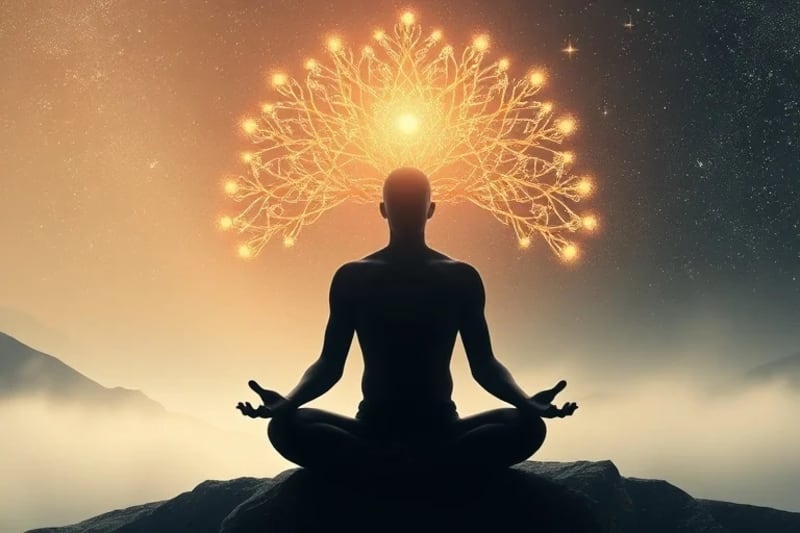
A meditative figure with the Tree of Life subtly integrated into their energy field, symbolizing inner transformation.
Kabbalah in Modern Esoteric Thought
In contemporary esotericism, Hermetic Kabbalah continues to be a vibrant and influential tradition. Its adaptability and comprehensive nature make it appealing to a wide range of practitioners. Many modern occultists, mystics, and spiritual seekers incorporate its principles into their personal practices.
The Tree of Life is frequently used as a foundational system for understanding other esoteric disciplines, including ceremonial magic, Hermeticism, and even some forms of New Age spirituality. Its universal archetypes resonate deeply with individuals seeking a structured approach to spiritual development. The concept of divine emanations and the journey of consciousness remains highly relevant.
Modern interpretations often emphasize the psychological aspects of the Tree, viewing the Sephiroth as states of consciousness or archetypal forces within the human mind. This approach allows for a more accessible and secular understanding of Kabbalistic principles, making them applicable to personal growth and self-improvement without necessarily adhering to traditional religious dogma. It integrates well with concepts of metaphysics and manifestation.
Common Misconceptions and Ethical Considerations
Despite its profound wisdom, Hermetic Kabbalah is often subject to misunderstandings. One common misconception is confusing it entirely with Jewish Kabbalah; while related, they have distinct focuses and practices. Hermetic Kabbalah is an independent system that draws inspiration from various sources.
Another misconception is that Kabbalah is solely about magic or fortune-telling. While some practitioners engage in ceremonial magic, the primary goal of Hermetic Kabbalah is spiritual enlightenment and self-mastery. The magical aspects are often seen as tools for internal transformation rather than external manipulation.
Ethical considerations are paramount in any esoteric practice. Responsible engagement with Kabbalah emphasizes personal responsibility, integrity, and a commitment to ethical conduct. Practitioners are encouraged to develop wisdom and compassion alongside their spiritual power, ensuring that their actions align with higher principles. The pursuit of spiritual attainment should always be balanced with a strong moral compass.
Conclusion: The Enduring Wisdom of the Tree of Life
Hermetic Kabbalah, with its central symbol of the Tree of Life, offers a timeless and comprehensive system for understanding the universe and the human place within it. It provides a detailed map for spiritual attainment, guiding seekers through the complexities of divine emanations and the journey of consciousness. From its historical roots to its modern applications, the Tree of Life remains a powerful tool for personal growth and enlightenment.
By exploring the Sephiroth and the Paths, individuals can unlock deeper insights into their own nature and their connection to the divine. The practical applications of pathworking, ritual, and self-analysis empower practitioners to actively engage in their spiritual evolution. As a cornerstone of Western esotericism, Hermetic Kabbalah continues to inspire and transform those who embark on its profound journey.
Source: Hybrid content assisted by AIs and human editorial supervision.


Comments
Post a Comment