
Lunar Calendar Traditions: Chinese New Year Cultural Guide
The Lunar Calendar, a system of timekeeping based on the cycles of the Moon, has profoundly shaped human societies for millennia. Unlike the solar calendar, which tracks the Earth's orbit around the Sun, the lunar calendar synchronizes with the Moon's phases, typically resulting in months of 29 or 30 days. This ancient method of reckoning time has been central to agricultural practices, religious observances, and cultural festivals across various civilizations, most notably in East Asia. Its influence extends far beyond mere chronology, embedding itself deeply into the fabric of social customs, spiritual beliefs, and communal celebrations.
Among the myriad festivals governed by the lunar calendar, the Chinese New Year stands out as one of the most widely celebrated and culturally significant events globally. Known in China as the Spring Festival or Lunar New Year, it marks the beginning of a new year on the traditional lunisolar Chinese calendar. This vibrant holiday is steeped in rich traditions, symbolic rituals, and a deep sense of family and community. It is a time for renewal, reconciliation, and welcoming prosperity, reflecting centuries of history and cultural evolution. Understanding the Lunar Calendar and its associated festivals offers a unique window into the diverse ways humanity perceives and interacts with the cosmos.
 A vibrant street scene during Chinese New Year, showcasing traditional red lanterns and festive decorations that illuminate the cultural celebrations.
Table of Contents
- Understanding the Lunar Calendar
- The Chinese New Year (Spring Festival)
- Key Traditions and Customs
- Symbolism and Meanings
- The Chinese Zodiac Connection
- Regional Variations and Global Impact
- Modern Celebrations and Future Relevance
Understanding the Lunar Calendar
The Lunar Calendar operates on the principle of lunar cycles, where each month begins with the new moon. A complete cycle of the Moon's phases, from new moon to new moon, takes approximately 29.5 days. Consequently, lunar months typically alternate between 29 and 30 days. This system, while intuitive for observing celestial patterns, presents a challenge when trying to align with the solar year, which dictates seasons and agricultural cycles.
To reconcile the discrepancy between the lunar and solar year, many lunar calendars, including the Chinese calendar, are actually lunisolar. This means they incorporate intercalary or "leap" months periodically to ensure that seasonal festivals remain consistent with the time of year. For instance, the Chinese calendar adds an extra month approximately every three years, ensuring that the Spring Festival, despite being lunar-based, always falls within the spring season. This intricate balance highlights the sophisticated astronomical knowledge of ancient civilizations.
Historical records indicate that lunar calendars have been in use for thousands of years, with evidence dating back to ancient Mesopotamia and Egypt. Their primary utility was often linked to agriculture, enabling communities to predict planting and harvesting seasons. Beyond practical applications, the rhythmic ebb and flow of the moon's phases also held significant spiritual and mythological importance, influencing various cultural narratives and religious practices.
The Chinese New Year (Spring Festival)
The Chinese New Year, or Spring Festival (春节, Chūn Jié), is the most important traditional Chinese holiday. It marks the start of a new year in the Chinese lunisolar calendar, typically falling between January 21st and February 20th each year. The festival is not just a single day but a period of celebration that traditionally lasts for 15 days, culminating in the Lantern Festival (元宵节, Yuánxiāo Jié).
The origins of Chinese New Year are steeped in legend and ancient agricultural practices. One popular myth tells of a mythical beast called Nian (年兽), which would emerge on New Year's Eve to prey on villagers and livestock. People discovered that Nian was afraid of loud noises, bright lights, and the color red. This led to the traditions of lighting firecrackers, hanging red decorations, and wearing red clothing to ward off evil spirits and bring good fortune for the coming year.
The festival is fundamentally about family reunion and honoring ancestors. Millions of people travel across China and globally to be with their families, making it the largest annual human migration in the world. This emphasis on familial bonds and collective well-being underscores the core values of Chinese culture, where harmony and respect for elders are paramount. The days leading up to the New Year are filled with preparations, including thorough cleaning of homes to sweep away bad luck and make way for good fortune.
Key Traditions and Customs
Chinese New Year is rich with traditions, each carrying specific meanings and hopes for the future. These customs are meticulously observed to ensure a prosperous and harmonious year ahead. The preparations often begin weeks before the New Year's Day itself, transforming homes and communities into vibrant hubs of activity.
- Cleaning and Decorating: Before the New Year, homes are thoroughly cleaned to "sweep away" any bad luck from the previous year. Decorations, predominantly in red and gold, are then put up. These include couplets (福, fú) with auspicious sayings, paper cuttings, and red lanterns.
- Reunion Dinner (年夜饭, Niányèfàn): The New Year's Eve dinner is arguably the most important meal of the year. It is a time for all family members, including those who have traveled far, to gather and share a lavish meal. Dishes served are often symbolic, such as fish (余, yú, symbolizing abundance) and dumplings (饺子, jiǎozi, symbolizing wealth).
- Red Envelopes (红包, Hóngbāo): Adults give red envelopes filled with money to children and unmarried young adults. This practice symbolizes the transfer of good fortune and blessings from elders to the younger generation. The amount of money is often an even number, as odd numbers are associated with funerals.
- Firecrackers and Fireworks: Traditionally used to scare away evil spirits like Nian, firecrackers and fireworks are an integral part of the celebrations, creating a festive and noisy atmosphere. While their use is restricted in some urban areas due to safety and pollution concerns, they remain a powerful symbol of the festival.
- Visiting Relatives and Friends: The days following New Year's Day are spent visiting relatives and friends, exchanging greetings, and sharing festive treats. This reinforces social bonds and community spirit.
- Lion and Dragon Dances: These vibrant performances, often seen in public spaces, are believed to bring good luck and drive away evil spirits. The lion and dragon costumes, operated by several performers, move rhythmically to the beat of drums and gongs.
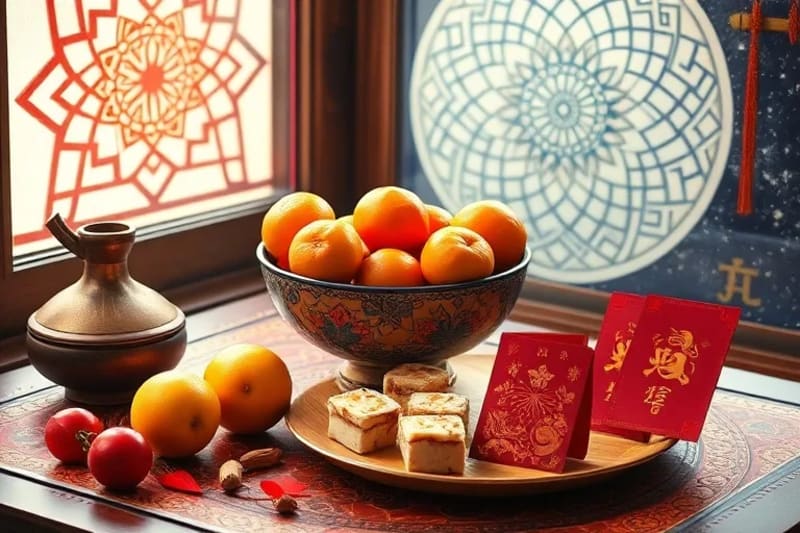 A traditional still life arrangement featuring symbolic Chinese New Year offerings, including fruit, sweet cakes, and red money envelopes.
Symbolism and Meanings
Every aspect of Chinese New Year is imbued with profound symbolism, reflecting a collective desire for prosperity, happiness, and good fortune. Colors, foods, and actions all carry specific meanings, guiding individuals to cultivate positive energy for the coming year. The overarching theme is one of renewal and hope, leaving behind the old and embracing the new with optimism.
Red, the most prominent color during the festival, symbolizes good luck, happiness, and prosperity. It is believed to ward off evil spirits and misfortunes. Gold, often paired with red, represents wealth and abundance. These colors are ubiquitous in decorations, clothing, and even the packaging of gifts, creating a visually striking and auspicious environment.
Food plays a central role, with many dishes chosen for their auspicious names or shapes. For example, fish (鱼, yú) is eaten because its pronunciation is similar to the word for "surplus" or "abundance." Dumplings (饺子, jiǎozi) resemble ancient Chinese gold ingots, symbolizing wealth. Noodles are often served long and uncut to represent longevity, while glutinous rice cakes (年糕, niángāo) signify progress and a higher income or position in the coming year. These culinary traditions are not just about sustenance but about manifesting positive outcomes through symbolic consumption.
Actions also carry significant weight. Giving gifts in pairs, avoiding arguments, and refraining from sweeping on New Year's Day (to avoid sweeping away good luck) are common practices. The exchange of "Gong Xi Fa Cai" (恭喜发财), meaning "Wishing you prosperity," is a common greeting, encapsulating the collective aspiration for a fortunate year.
The Chinese Zodiac Connection
Integral to the Lunar Calendar and Chinese New Year is the Chinese Zodiac, a 12-year cycle of animal signs. Each year is associated with one of 12 animals: Rat, Ox, Tiger, Rabbit, Dragon, Snake, Horse, Goat, Monkey, Rooster, Dog, and Pig. These animals are believed to influence the personality traits and fortunes of individuals born in that particular year. The cycle begins anew each Chinese New Year, with the animal of the year dictating the general characteristics and energies of the next twelve months.
The legend of the Chinese Zodiac tells of the Jade Emperor summoning all animals for a great race. The order in which they arrived determined their placement in the zodiac cycle. This story not only provides a whimsical origin for the zodiac but also imparts moral lessons about cleverness, diligence, and perseverance, as exemplified by the Rat's cunning victory or the Ox's steady determination.
Beyond the animal signs, the Chinese Zodiac also incorporates the Five Elements (Wood, Fire, Earth, Metal, Water), creating a 60-year cycle. Each animal year is combined with one of these elements, adding further layers of complexity and nuance to astrological interpretations. For example, a "Wood Dragon" year will have different characteristics than a "Fire Dragon" year. This intricate system allows for detailed predictions and insights into personal compatibility, career prospects, and overall life path.
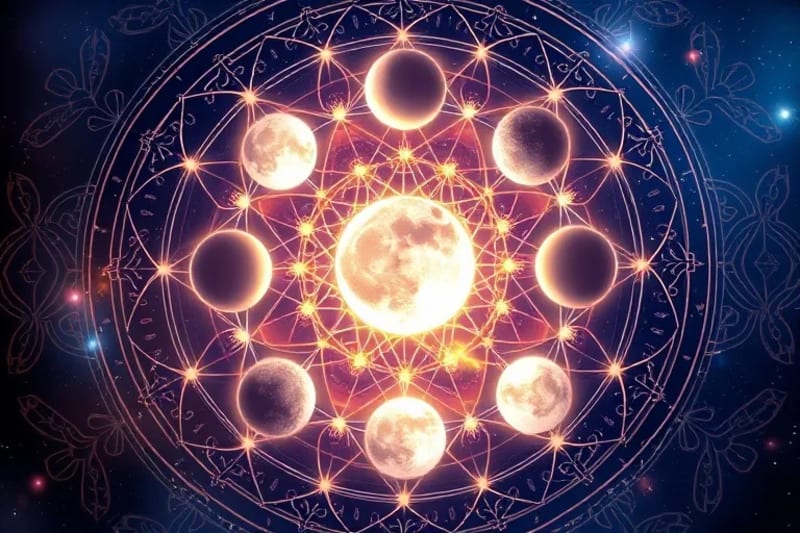 An abstract 3D render depicting the lunar cycle, with celestial bodies and traditional Chinese motifs symbolizing ancient wisdom and cosmic harmony.
Regional Variations and Global Impact
While the core traditions of Chinese New Year are widely observed, significant regional variations exist across China and among Chinese communities worldwide. These differences reflect local customs, historical influences, and the diverse culinary landscapes of different provinces. For instance, in northern China, dumplings (饺子) are a staple of the New Year's Eve dinner, while in the south, glutinous rice cakes (年糕) and spring rolls are more prevalent.
Beyond mainland China, Lunar New Year is celebrated with enthusiasm in many other East Asian and Southeast Asian countries, albeit with their own unique names and customs. In Vietnam, it is known as Tết Nguyên Đán (Tết), in Korea as Seollal, and in Tibet as Losar. Each culture incorporates elements of the lunar calendar while maintaining distinct traditions, such as specific foods, games, and rituals that reflect their national identity. This widespread celebration underscores the profound cultural exchange and historical interconnectedness of the region.
The global Chinese diaspora has also played a crucial role in spreading the festivities worldwide. Major cities like London, New York, San Francisco, and Sydney host spectacular Chinese New Year parades and cultural events, transforming their Chinatowns into vibrant centers of celebration. These global festivities not only preserve cultural heritage but also foster cross-cultural understanding and appreciation, inviting people from all backgrounds to partake in the joy and symbolism of the Lunar New Year. The festival has become a truly international phenomenon, bridging cultural divides and celebrating shared values of family, hope, and prosperity.
Modern Celebrations and Future Relevance
In the modern era, Chinese New Year continues to evolve, adapting to contemporary lifestyles while retaining its fundamental essence. While traditional rituals remain important, there's also a growing embrace of modern forms of celebration. Digital red envelopes, sent via messaging apps, have become increasingly popular, especially among younger generations, blending ancient customs with technological advancements. Online shopping for New Year's goods and virtual family gatherings are also becoming more common, reflecting the digital transformation of society.
Despite these modern adaptations, the core values of family reunion, honoring ancestors, and wishing for good fortune remain at the heart of the festival. The Lunar Calendar, though no longer the primary system for daily life in most places, continues to serve as a cultural anchor, connecting people to their heritage and to the rhythms of nature. Its enduring relevance lies in its ability to provide a collective moment for reflection, gratitude, and renewed aspirations.
The study of lunar calendars and festival traditions offers valuable insights into human history, astronomy, and cultural anthropology. It reminds us of the diverse ways societies have organized their lives around celestial cycles and imbued these cycles with profound meaning. As global interconnectedness grows, the celebration of Chinese New Year and other lunar festivals serves as a powerful reminder of our shared humanity and the universal desire for peace, prosperity, and communal harmony.
Fuente: Contenido híbrido asistido por IAs y supervisión editorial humana.


Comments
Post a Comment