
Chinese Zodiac Economic Trends: Macro-Astrology Markets
The intricate dance between ancient wisdom and modern economics often seems disparate, yet for centuries, various cultures have sought patterns in celestial and earthly cycles to predict human affairs. Among these, the Chinese Zodiac stands out as a profound system that not only delineates personality traits but also offers a unique lens through which to interpret macro-economic trends. This approach, often termed macro-astrology, delves into the cyclical nature of the 12 animal signs and their associated elements to forecast shifts in global markets, industries, and consumer behavior.
Understanding the Chinese Zodiac's influence on economic cycles requires moving beyond simplistic daily horoscopes. It involves analyzing the energetic qualities of each animal year, combined with the five elements (Wood, Fire, Earth, Metal, Water), to discern broader patterns that may impact financial stability, innovation, and international relations. While not a scientific forecasting tool in the conventional sense, it provides a fascinating framework for observing historical correlations and anticipating potential future directions, appealing to those who seek alternative perspectives on market dynamics.
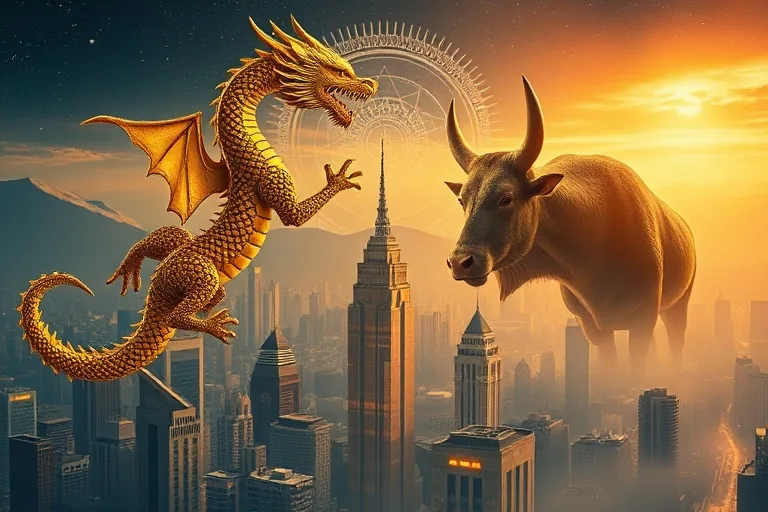
A powerful depiction of ancient zodiac symbols interacting with modern economic landscapes, suggesting a harmonious yet influential relationship.
This article explores the fundamental principles of Chinese Zodiac macro-astrology and its potential applications in understanding global economic trends. We will delve into the characteristics of each animal sign and elemental influence, examine historical correlations, and discuss how these ancient insights can offer a complementary perspective to conventional economic analysis. Our aim is to provide an educational and informative overview for those curious about the intersection of astrology and finance, fostering a deeper appreciation for diverse predictive models.
Table of Contents
- Foundations of Chinese Zodiac Macro-Astrology
- Animal Signs and Their Economic Impact
- The Five Elements and Market Dynamics
- Historical Correlations and Case Studies
- Integrating Macro-Astrology into Economic Analysis
- Future Outlook and Predictions
Foundations of Chinese Zodiac Macro-Astrology
The Chinese Zodiac, or Sheng Xiao, is a repeating cycle of 12 years, with each year represented by an animal and its reputed attributes. This system is deeply rooted in Chinese philosophy, particularly the concept of Yin and Yang, and the Five Elements theory. Unlike Western astrology, which focuses on constellations, the Chinese Zodiac is primarily based on lunar cycles and the year of birth, assigning an animal sign that is believed to influence an individual's personality, destiny, and even the collective energy of a given year.
In macro-astrology, these annual energies are extrapolated to global events, including economic performance. Each animal year is thought to carry a specific energetic signature that can manifest in various sectors of society. For example, a year of the Dragon might be associated with bold ventures and rapid growth, while a year of the Ox might suggest steady, hard-won progress. These interpretations are not deterministic but rather indicative of prevailing themes and challenges that may shape the economic landscape.
- Cyclical Nature: The 12-year cycle ensures a regular return of animal energies, allowing for pattern recognition over time.
- Elemental Overlay: Each animal year is further influenced by one of the five elements (Wood, Fire, Earth, Metal, Water), creating a 60-year cycle (12 animals x 5 elements).
- Collective Consciousness: The underlying belief is that these energies subtly influence collective human behavior, affecting market sentiment, investment decisions, and policy-making.
The interaction between the animal sign and its element is crucial. A Wood Dragon year, for instance, might emphasize growth and innovation (Wood) combined with ambition and power (Dragon), potentially leading to technological breakthroughs and expanding markets. Conversely, a Water Rat year might bring adaptability and fluidity (Water) alongside shrewdness and resourcefulness (Rat), possibly indicating periods of financial maneuvering and hidden opportunities.
Animal Signs and Their Economic Impact
Each of the 12 Chinese Zodiac animals is associated with distinct characteristics that can be metaphorically applied to economic trends. Understanding these archetypes provides a framework for interpreting potential market behaviors during their respective years. Here's a brief overview of how each animal sign might influence the global economy:
| Animal Sign | Associated Economic Traits | Potential Market Impact |
|---|---|---|
| Rat | Resourcefulness, shrewdness, adaptability, accumulation. | Periods of new beginnings, financial speculation, shrewd investments, and potential for hidden growth. |
| Ox | Diligence, stability, persistence, hard work, conservative growth. | Steady, slow but sure economic growth, focus on foundational industries, agricultural stability, and long-term investments. |
| Tiger | Bravery, impulsiveness, leadership, risk-taking, dynamism. | Volatile markets, bold ventures, entrepreneurial spirit, potential for rapid gains or losses, and significant policy changes. |
| Rabbit | Caution, diplomacy, peace, refinement, sensitivity. | Periods of consolidation, focus on diplomacy and trade agreements, consumer spending on luxury goods, and stable but moderate growth. |
| Dragon | Power, ambition, charisma, innovation, grand ventures. | Strong economic growth, technological breakthroughs, large-scale projects, potential for market exuberance and speculation. |
| Snake | Wisdom, intuition, mystery, introspection, strategic planning. | Careful financial planning, uncovering hidden information, periods of market correction or quiet accumulation, and focus on research and development. |
| Horse | Energy, enthusiasm, freedom, travel, rapid movement. | Booming travel and tourism sectors, rapid market movements, increased international trade, and focus on speed and efficiency. |
| Goat (Sheep/Ram) | Gentleness, creativity, empathy, peace, artistic pursuits. | Growth in creative industries, arts, fashion, and social welfare programs. Potential for harmonious but sometimes indecisive economic policies. |
| Monkey | Intelligence, wit, innovation, trickery, adaptability. | Periods of rapid technological advancement, market volatility due to speculation, clever financial schemes, and adaptable business strategies. |
| Rooster | Diligence, confidence, punctuality, meticulousness, honesty. | Focus on precision, quality control, and efficiency. Potential for strong performance in manufacturing and service industries, often with a conservative approach. |
| Dog | Loyalty, integrity, justice, protection, responsibility. | Emphasis on ethical business practices, social responsibility, and regulatory reforms. Markets may be cautious, with a focus on security and trust. |
| Pig (Boar) | Generosity, optimism, prosperity, enjoyment, indulgence. | Periods of general prosperity, increased consumer spending, focus on leisure and entertainment, and potential for speculative bubbles due to optimism. |
A digital painting illustrating the interconnectedness of global financial markets with the symbolic energies of the Chinese Zodiac.
These interpretations are broad generalizations and are always nuanced by the elemental influence of the year. For instance, a Fire Dragon year might amplify the Dragon's ambitious nature, leading to even more explosive growth or intense market volatility. Conversely, a Water Dragon year might temper this with adaptability and a strategic approach, guiding growth towards more sustainable paths.
The Five Elements and Market Dynamics
Beyond the animal signs, the Five Elements (Wood, Fire, Earth, Metal, Water) play a critical role in Chinese Zodiac macro-astrology, adding another layer of complexity and nuance to economic predictions. Each element is associated with specific qualities, industries, and market behaviors. The interaction between these elements—their cycles of creation and destruction—can indicate periods of growth, contraction, or transformation within the global economy.
- Wood (Growth & Innovation): Represents growth, expansion, new beginnings, creativity, and flexibility. Economically, Wood years often favor industries like technology, education, renewable energy, and fashion. They can signify periods of innovation, venture capital growth, and expanding markets.
- Fire (Energy & Volatility): Symbolizes passion, dynamism, rapid change, but also destruction and volatility. Fire years can see booming stock markets, inflation, and rapid technological adoption. Industries like entertainment, defense, and energy may thrive, but there's also a higher risk of market bubbles and sudden downturns.
- Earth (Stability & Consolidation): Associated with stability, nurturing, practicality, and consolidation. Earth years often bring focus to real estate, agriculture, infrastructure, and traditional banking. They are periods for building foundations, reducing debt, and cautious, steady growth.
- Metal (Structure & Precision): Represents strength, precision, discipline, and reform. Metal years can favor industries like manufacturing, automotive, finance, and law. They often involve restructuring, efficiency improvements, and a focus on quality and tangible assets.
- Water (Flow & Communication): Symbolizes fluidity, communication, introspection, and hidden depths. Water years can boost industries related to shipping, logistics, communication, and liquid assets. They may bring periods of global trade expansion, diplomatic efforts, and a focus on understanding underlying market currents.
The interplay of these elements with the animal signs creates a dynamic predictive model. For instance, a Wood Dragon year (2024) combines the Dragon's ambition with Wood's growth, suggesting strong innovation and expansion, particularly in green technologies and digital sectors. Conversely, a Metal Tiger year might indicate a period of intense competition and structural reforms within industries, driven by the Tiger's assertiveness and Metal's precision.
Historical Correlations and Case Studies
While anecdotal, proponents of Chinese Zodiac macro-astrology often point to historical events that seem to align with the energetic qualities of specific years. These correlations are not presented as definitive proof but rather as intriguing patterns that warrant further observation. For example, the year 2008, a Earth Rat year, was marked by the global financial crisis. The Rat's shrewdness combined with Earth's stability (or lack thereof when destabilized) could be interpreted as a period where foundational economic structures were challenged, leading to a deep, systemic crisis.
A modern 3D render symbolizing the intricate balance of elemental forces within the dynamic and often unpredictable global financial markets.
Another example is the year 2000, a Metal Dragon year, which saw the dot-com bubble burst. The Dragon's ambition and innovation, combined with Metal's precision and potential for sharp cuts, could be seen as a period of intense technological growth followed by a necessary market correction. The Metal element, when out of balance, can signify sharp declines or restructuring, which aligns with the market's re-evaluation of tech stocks.
The year 2020, a Metal Rat year, brought the COVID-19 pandemic and significant global economic disruption. The Rat's association with hidden issues and Metal's qualities of contraction and restructuring could be interpreted as a year of unforeseen challenges that forced a global re-evaluation of supply chains, work models, and social structures. The market volatility and subsequent recovery efforts reflect the adaptability and resourcefulness often attributed to the Rat.
These retrospective analyses offer a compelling narrative for those who seek to understand the deeper, cyclical forces at play in economic history. While correlation does not imply causation, the consistent alignment of certain economic themes with specific Zodiac energies provides a thought-provoking perspective. For more on historical astrological patterns, consider exploring astrology and predictions.
Integrating Macro-Astrology into Economic Analysis
For traditional economists, integrating macro-astrology into their models might seem unconventional. However, its value lies not in replacing conventional analysis but in offering a complementary, qualitative layer of insight. By understanding the prevailing energetic themes of a given year, analysts can potentially anticipate shifts in consumer sentiment, investor confidence, and industry focus that might not be immediately apparent through quantitative data alone.
For instance, knowing that a particular year is a Water Pig year might suggest a period of increased consumer spending on leisure and luxury, alongside potential for market exuberance. This qualitative understanding can help refine investment strategies, marketing campaigns, and even policy decisions, providing a broader context for market behavior. It encourages a holistic view, acknowledging that human psychology and collective mood play significant roles in economic outcomes.
- Sentiment Analysis: Zodiac energies can inform predictions about collective mood, which directly impacts market sentiment.
- Sector Focus: Elemental influences can highlight which industries are likely to thrive or face challenges in a given year.
- Risk Management: Awareness of potentially volatile years (e.g., Fire or Tiger years) can encourage more cautious investment strategies.
- Long-Term Planning: The 60-year elemental cycle provides a framework for very long-term economic forecasting and strategic development.
While macro-astrology does not offer precise stock market predictions, it can serve as a valuable heuristic tool. It prompts observers to look for specific types of opportunities or risks that align with the year's energetic signature. This approach is particularly useful for those who believe in the interconnectedness of all phenomena and seek to understand the subtle influences that shape our world. The insights gained from such an approach can be surprisingly relevant when combined with a deep understanding of modern spiritual and technological tools.
Future Outlook and Predictions
Looking ahead, Chinese Zodiac macro-astrology continues to offer intriguing insights into potential global economic trends. The transition from one animal year and element to another often signals shifts in the collective consciousness that can manifest in market behavior. For example, the current cycle is moving towards a period where innovation and structural adjustments might be paramount, depending on the specific animal and element combination.
The year 2025, for instance, will be a Wood Snake year. The Snake's wisdom and intuition, combined with Wood's growth and innovation, could suggest a period of strategic, sustainable growth driven by careful planning and insightful decision-making. Industries focused on research, development, and long-term environmental solutions might see significant advancements. There could be a focus on uncovering inefficiencies and implementing clever, adaptive solutions.
As we navigate complex global economic landscapes, integrating diverse predictive models can offer a richer, more nuanced understanding. Chinese Zodiac macro-astrology, with its emphasis on cyclical patterns and energetic influences, provides a unique perspective that can complement traditional economic forecasts. It encourages a broader view of market forces, acknowledging the subtle interplay between human nature, cosmic rhythms, and financial outcomes.
Ultimately, while macro-astrology is not a substitute for rigorous economic analysis, it serves as a fascinating tool for contemplation and pattern recognition. It invites us to consider the deeper currents that shape our world, offering a window into how ancient wisdom can still resonate in our modern financial realities. Exploring these connections can broaden our perspective and potentially reveal opportunities or challenges that might otherwise go unnoticed. For a deeper dive into planetary influences on life events, see our guide on Critical Degrees in Predictive Astrology.
Fuente: Contenido híbrido asistido por IAs y supervisión editorial humana.


Comments
Post a Comment