
Ecological Astrology: Humanity's Role in Earth's Planetary Cycles
Ecological astrology emerges as a vital and increasingly relevant field in the 21st century, offering a unique lens through which to understand humanity's intricate relationship with the Earth and its broader cosmic environment. This discipline moves beyond individualistic interpretations of astrological charts, extending its scope to encompass the collective consciousness and our shared impact on planetary cycles. It posits that just as celestial movements influence personal destinies, they also reflect and inform the larger ecological patterns and challenges faced by our planet.
By examining the interplay between celestial configurations and terrestrial events, ecological astrology provides a framework for comprehending the profound interconnectedness of all life. It invites us to consider how human actions, driven by collective psychological and spiritual states, resonate with planetary energies, shaping our environment in tangible ways. This approach encourages a deeper sense of stewardship and responsibility towards Earth, viewing our planet not merely as a resource, but as a living entity intricately linked to the cosmos.

A vibrant forest ecosystem bathed in ethereal light, symbolizing Earth's profound energetic field and its connection to cosmic rhythms.
The core premise of ecological astrology is that the Earth itself has a "birth chart" or a series of energetic imprints influenced by its position within the solar system. These imprints, combined with the ongoing transits and aspects of planets, create a dynamic energetic field that affects everything from climate patterns to geological shifts and the collective human psyche. Understanding these cosmic influences can help us navigate environmental crises with greater wisdom and foresight.
Table of Contents
Historical Roots of Cosmic-Earth Connection
The idea that celestial bodies influence terrestrial events is not new; it is deeply embedded in ancient civilizations across the globe. From the agricultural calendars of Mesopotamia to the sophisticated astronomical observatories of the Maya, early societies meticulously tracked planetary movements to predict seasons, floods, and even social upheavals. They understood that human life and the health of the Earth were inextricably linked to the cosmos.
Indigenous cultures, in particular, have long held a holistic worldview where the Earth, sky, and all living beings are part of a single, interconnected web. Their spiritual practices often involved observing celestial phenomena to guide their relationship with nature, recognizing the sacredness in every element. This ancient wisdom provides a foundational understanding for modern ecological astrology, reminding us of a time when humanity lived in closer harmony with natural and cosmic rhythms.
For instance, the concept of "mundane astrology" historically focused on predicting events for nations, cities, and the world at large, often including natural disasters and environmental conditions. While not explicitly "ecological" in the modern sense, these practices acknowledged the broad influence of planetary cycles on collective human experience and the physical environment. Ecological astrology builds upon this tradition, applying contemporary ecological understanding to ancient astrological principles.
Planetary Archetypes and Ecological Impact
In ecological astrology, each planet represents an archetypal energy that manifests not only in individual psychology but also in collective human behavior and its impact on the environment. Understanding these archetypes helps us decode the cosmic messages embedded in our ecological crises. The zodiac signs can be seen as different ecological zones or expressions of natural principles, while the houses represent various domains of Earthly life and human interaction with the environment.
- Saturn (Structure, Limits, Responsibility): This planet governs boundaries, systems, and the consequences of our actions. Ecologically, Saturn relates to climate change, resource depletion, and the need for sustainable structures. Its transits often highlight periods where humanity is forced to confront the limits of its growth and take responsibility for environmental degradation.
- Uranus (Innovation, Disruption, Awakening): Uranus represents sudden change, technological advancements, and revolutionary shifts. In an ecological context, it can signify breakthroughs in renewable energy, environmental activism, and disruptive events that force a re-evaluation of our relationship with nature. Uranus transits often coincide with periods of rapid ecological awareness or unexpected environmental crises.
- Neptune (Dissolution, Interconnectedness, Pollution): Neptune embodies the collective unconscious, spirituality, and the dissolution of boundaries. Ecologically, it relates to the interconnectedness of ecosystems, but also to pollution (especially water and air), pandemics, and the erosion of natural habitats. Neptune's influence can inspire deep empathy for nature or, conversely, create confusion and denial regarding environmental issues.
- Pluto (Transformation, Destruction, Regeneration): Pluto is the planet of profound transformation, death, and rebirth. Ecologically, it represents major extinctions, geological shifts, and the deep, often painful, processes of regeneration. Pluto transits can bring about the collapse of unsustainable systems, paving the way for radical ecological renewal and a deeper understanding of Earth's resilience.
- Lunar Cycles (Rhythms, Tides, Emotional Connection): The Moon governs natural rhythms, tides, and our emotional connection to the Earth. Lunar cycles influence plant growth, animal behavior, and human emotional responses to the environment. Understanding these cycles can help us attune to Earth's natural pulse and foster a more intuitive stewardship.

A conceptual depiction of human responsibility, with a hand gently holding a miniature Earth, interwoven with subtle planetary symbols.
The interplay of these planetary energies creates a complex astrological tapestry that reflects the current state of our planet. For example, a challenging aspect involving Saturn and Uranus might indicate a period where established environmental policies (Saturn) are being disrupted by new scientific discoveries or social movements (Uranus). Similarly, Neptune's influence can reveal hidden pollution or a collective yearning for a more spiritual connection to nature.
By studying these planetary archetypes within an ecological framework, we can gain insights into the root causes of environmental problems and identify periods that are more conducive to healing and sustainable action. This perspective encourages a shift from reactive problem-solving to proactive, cosmically informed stewardship.
The Anthropocene Through an Astrological Lens
The term "Anthropocene" describes the current geological epoch, where human activities have become the dominant influence on Earth's geology and ecosystems. Ecological astrology offers a unique perspective on this era, suggesting that our collective astrological chart and ongoing planetary transits reflect the psychological and spiritual underpinnings of this human-driven impact. The industrial revolution, for instance, can be seen as a period marked by significant planetary shifts that fueled technological advancement and resource exploitation.
From an astrological standpoint, the rise of industrialization and its subsequent environmental consequences might correlate with challenging aspects involving planets like Pluto (power, exploitation, deep transformation) and Uranus (technological innovation, disruption) in relation to Earth's own energetic signature. These alignments could signify a collective drive towards mastery over nature, often at the expense of ecological balance.
Understanding the Anthropocene through an astrological lens means recognizing that our collective consciousness, reflected in the planetary cycles, has a direct bearing on the physical state of the planet. It implies that a shift in human consciousness, facilitated by favorable astrological transits or conscious collective effort, is essential for mitigating environmental damage and fostering a regenerative future. This perspective emphasizes the profound responsibility humanity holds as an integral part of Earth's planetary cycles.
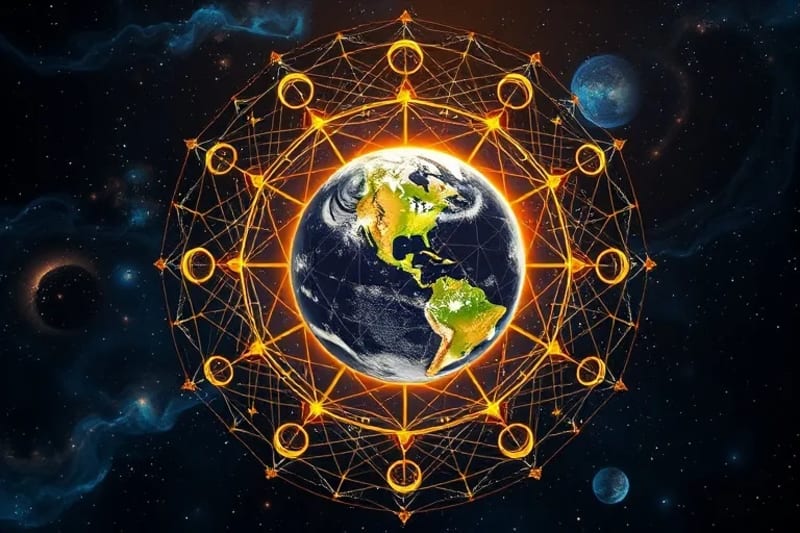
An abstract 3D render illustrating the intricate web of light that connects celestial bodies to Earth, symbolizing universal harmony.
The concept of "planetary stewardship" is central to this view. It suggests that humanity, as the only species capable of consciously altering the planet on a global scale, has a unique role to play in its care. Ecological astrology can provide insights into the optimal timing for environmental initiatives, periods of heightened collective awareness, and the underlying psychological patterns that contribute to unsustainable practices. It encourages us to align our actions with cosmic wisdom for the greater good of the planet.
Practical Applications for Environmental Stewardship
Ecological astrology is not merely a theoretical framework; it offers practical applications for fostering a more harmonious relationship with the Earth. By integrating astrological insights into environmental efforts, individuals and communities can develop more effective strategies for conservation, sustainability, and ecological healing.
- Personal Connection to Nature: Understanding one's natal chart through an ecological lens can reveal inherent connections to specific elements, landscapes, or natural rhythms. For example, a strong Earth element in a chart might indicate a deep need for grounding in nature, while prominent water placements could suggest a natural affinity for marine conservation. This personal insight can deepen individual commitment to environmental causes.
- Collective Action and Astrological Timing: Ecological astrologers can analyze global transits to identify auspicious periods for environmental activism, policy changes, or the launch of sustainable initiatives. For instance, a harmonious Jupiter-Neptune aspect might indicate a time of increased collective empathy and spiritual connection to nature, making it ideal for large-scale conservation efforts. Conversely, challenging aspects might highlight periods of resistance or necessary confrontation.
- Eco-therapy and Astrological Insights: Integrating astrological principles into eco-therapy can provide deeper insights into an individual's emotional and psychological blocks regarding environmental issues. By understanding how planetary placements in their chart relate to their relationship with nature, individuals can heal their own disconnection and become more effective advocates for the Earth.
- Sustainable Living Practices: Astrological knowledge can inform personal choices for sustainable living. For example, understanding lunar cycles can guide gardening and agricultural practices, optimizing planting and harvesting times. Awareness of planetary influences can also help in choosing periods for detoxifying the body and home, aligning with natural purification cycles.
Furthermore, ecological astrology can be used to analyze the "birth charts" of organizations or nations, revealing their inherent strengths and challenges in addressing environmental issues. This can provide strategic guidance for leaders and policymakers seeking to implement effective and sustainable solutions. The insights gained can help in predicting potential environmental flashpoints and preparing for them proactively.
The United Nations Framework Convention on Climate Change (UNFCCC) states in its preamble that "human activities have been substantially increasing the atmospheric concentrations of greenhouse gases, which in turn are enhancing the natural greenhouse effect and resulting on average in an additional warming of the Earth's surface and atmosphere."
This declaration underscores the urgent need for a shift in human behavior and policy, a shift that ecological astrology suggests can be informed by a deeper understanding of our cosmic interconnectedness.
By offering a holistic perspective that integrates the celestial with the terrestrial, ecological astrology empowers individuals and communities to become more conscious participants in Earth's evolutionary journey. It provides a roadmap for navigating the complexities of environmental challenges with greater awareness and intentionality.
Challenges and the Future of Ecological Astrology
Despite its potential, ecological astrology faces several challenges, primarily stemming from the prevailing scientific paradigm's skepticism towards astrological principles. Bridging the gap between empirical science and ancient wisdom requires careful articulation and demonstrable applications. The field must develop rigorous methodologies and case studies to illustrate its utility in understanding and addressing environmental issues.
One significant challenge is the need for more specialized research and data collection. While traditional astrology has vast historical data, applying it specifically to ecological phenomena requires new analytical approaches. This includes correlating specific planetary transits with large-scale environmental events, climate data, and collective human responses to ecological crises. Such research could strengthen the credibility and acceptance of ecological astrology.
The future of ecological astrology lies in its ability to foster a deeper environmental ethic and inspire collective action. By providing a cosmic context for our planetary challenges, it can help shift human consciousness from one of separation to one of profound interconnectedness. This shift is crucial for developing sustainable solutions that are not merely technological but also spiritually and psychologically aligned with the Earth's well-being.
Integration with other holistic disciplines, such as eco-psychology, permaculture, and indigenous ecological knowledge, will also be vital for the growth of this field. By combining diverse perspectives, ecological astrology can offer a richer, more comprehensive understanding of our place within the grand tapestry of life and the cosmos. It holds the promise of guiding humanity towards a future where we live in respectful and regenerative partnership with our planetary home.
Conclusion: Reconnecting with Earth's Cosmic Rhythm
Ecological astrology offers a compelling and timely framework for understanding humanity's profound role in Earth's planetary cycles. By re-establishing the ancient connection between celestial movements and terrestrial events, it provides a powerful tool for interpreting environmental challenges and inspiring conscious stewardship. This discipline urges us to recognize that our individual and collective actions are not isolated but are deeply interwoven with the cosmic dance of the planets.
Embracing ecological astrology means moving beyond anthropocentric views and recognizing Earth as a living, breathing entity influenced by and influencing the cosmos. It calls for a paradigm shift, where astrological insights are utilized to inform sustainable practices, foster environmental empathy, and guide collective efforts towards a regenerative future. As we navigate the complexities of the Anthropocene, the wisdom offered by ecological astrology can be a beacon, illuminating the path towards a harmonious coexistence with our planetary home.
Frequently Asked Questions About Ecological Astrology
Here are some common questions regarding the emerging field of ecological astrology.
- What is the primary difference between traditional and ecological astrology?
Traditional astrology primarily focuses on individual human experiences and destinies, while ecological astrology expands this focus to include the collective human impact on Earth's ecosystems and environmental health, interpreting planetary cycles through an ecological lens. It considers the Earth itself as having an astrological chart and being influenced by cosmic energies.
- How can ecological astrology help address climate change?
Ecological astrology can help by identifying the underlying collective psychological and energetic patterns (represented by planetary archetypes and transits) that contribute to environmental degradation. It can also suggest optimal timing for environmental initiatives, policy changes, and periods of heightened collective awareness, fostering a more conscious and effective response to climate change.
Fuente: Contenido híbrido asistido por IAs y supervisión editorial humana.


Comments
Post a Comment