
Chinese New Year Blessings: Rituals, Practices, Fortunate Year
The Chinese New Year, also known as the Lunar New Year or Spring Festival, stands as the most significant and widely celebrated holiday in Chinese culture and among Chinese communities worldwide. Far more than just a calendar event, it is a period steeped in rich history, profound symbolism, and time-honored traditions designed to usher in good fortune, prosperity, and harmony for the year ahead. This comprehensive guide delves into the essential rituals and practices that define this auspicious occasion, offering insights into how these traditions bless individuals and families.
Rooted in agrarian traditions and the lunar calendar, the festival's origins trace back thousands of years, evolving from ancient harvest festivals and sacrificial ceremonies. Each year is associated with one of the twelve animals of the Chinese Zodiac, which cycles through in a fixed order, influencing the characteristics and fortunes of those born in that year. Understanding these foundational elements is key to appreciating the depth and meaning behind each blessing and ritual.
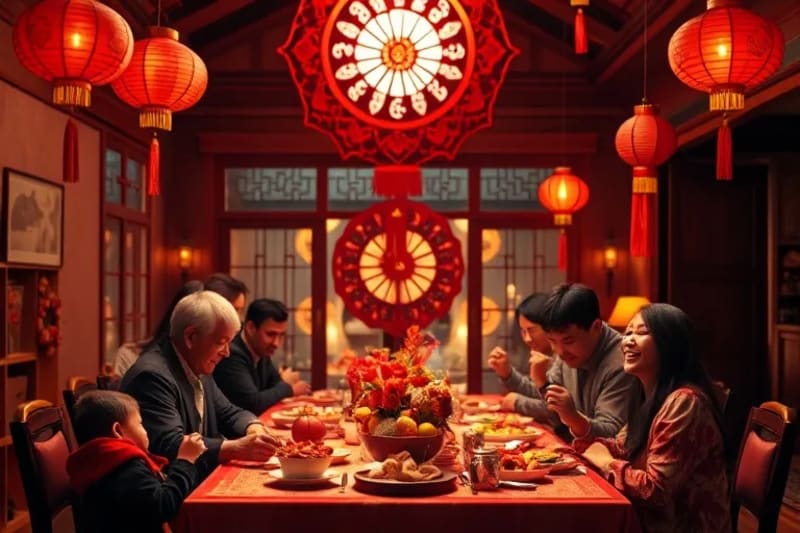
A vibrant scene illustrating the joyful atmosphere of a Chinese New Year celebration, adorned with traditional red lanterns and symbolic dishes.
The overarching goal of the Chinese New Year celebrations is to cleanse away the old, welcome the new, and ensure a year filled with happiness, health, and wealth. This is achieved through a series of meticulous preparations, symbolic actions, and community gatherings that reinforce family bonds and cultural identity. From elaborate feasts to symbolic gifts, every aspect plays a crucial role in shaping the fortunes of the coming year.
This article will explore the various stages of the Chinese New Year, from the preparatory phase leading up to New Year's Eve, through the main celebrations, and into the subsequent days of visiting and well-wishing. We will uncover the significance of each ritual, the symbolism behind the decorations, and the meaning embedded in the traditional foods and greetings. By understanding these practices, one can gain a deeper appreciation for the cultural richness and spiritual depth of this ancient festival.
Table of Contents
- Preparations for Prosperity: Cleansing and Decorating
- New Year's Eve: Reunion and Red Envelopes
- New Year's Day and Beyond: Greetings and Taboos
- Symbolism of Colors and Foods for Good Fortune
- The Chinese Zodiac and Its Influence
- Modern Adaptations and Global Celebrations
- Conclusion: Embracing the Spirit of Renewal
Preparations for Prosperity: Cleansing and Decorating
The period leading up to Chinese New Year is characterized by intense preparation, primarily focused on purification and ornamentation. These activities are not merely chores but are imbued with symbolic meaning, intended to sweep away bad luck and invite good fortune.
One of the most critical rituals is the "Spring Cleaning" (扫尘, sǎo chén), typically undertaken a few days before New Year's Eve. Every corner of the house is thoroughly cleaned to remove any lingering bad luck or misfortune from the previous year. This act symbolizes sweeping away the old and welcoming the new. However, it is crucial that all cleaning is completed before New Year's Day, as sweeping or cleaning on the first day is believed to sweep away good luck and wealth that has just arrived.
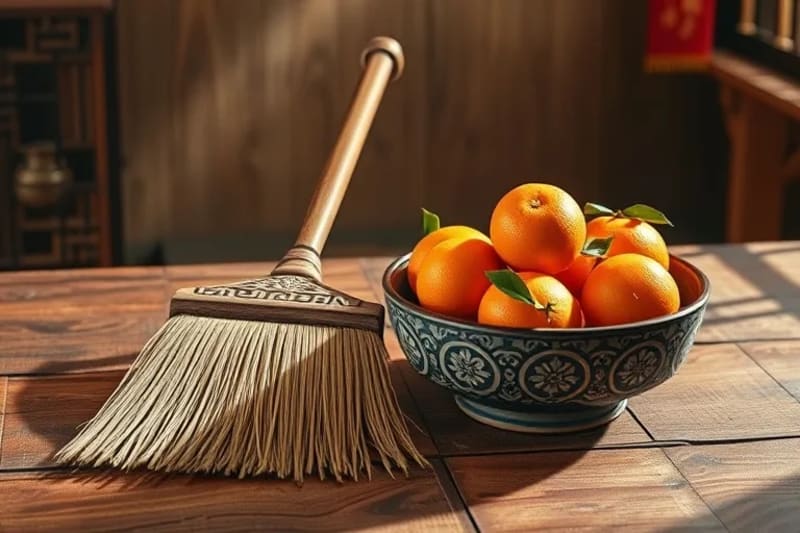
A still life arrangement featuring traditional cleaning tools and fresh oranges, symbolizing the essential preparations for welcoming the new year.
Following the cleansing, homes are adorned with auspicious decorations, predominantly in red and gold. Red symbolizes prosperity, happiness, and good luck, while gold represents wealth and fortune. Common decorations include:
- Red Lanterns: Hung outside homes and businesses, they ward off evil spirits and attract good luck.
- Couplets (春联, chūnlián): Poetic verses written on red paper, pasted on doorframes, expressing good wishes for the new year.
- Paper Cuttings (剪纸, jiǎnzhǐ): Intricate designs often featuring auspicious animals (like the zodiac animal of the year), flowers, or characters, pasted on windows.
- "Fu" Character (福): The character for "fortune" or "good luck" is often displayed upside down, as the Chinese word for "upside down" (倒, dào) sounds similar to the word for "arrive" (到, dào), signifying "good luck arrives."
- Potted Plants and Flowers: Such as plum blossoms (symbolizing perseverance and hope), orchids (fertility and abundance), and kumquat trees (wealth and good fortune), are used to beautify the home and bring vitality.
Another significant pre-New Year ritual is ancestral veneration. Families pay respects to their ancestors through offerings and prayers, acknowledging their heritage and seeking their blessings for the coming year. This practice reinforces the deep-seated value of filial piety and continuity within Chinese culture.
New Year's Eve: Reunion and Red Envelopes
New Year's Eve (除夕, Chúxì) is arguably the most important day of the entire festival, centered around family reunion and communal feasting. It is a time when family members, no matter how far they live, endeavor to return home for the annual "reunion dinner" (年夜饭, niányèfàn).
The reunion dinner is an elaborate affair, featuring dishes that are rich in symbolism. Fish (鱼, yú) is a must-have, as its pronunciation is similar to "surplus" (余, yú), signifying a wish for abundance in the coming year. Dumplings (饺子, jiǎozi) are also common, particularly in northern China, because their shape resembles ancient Chinese gold ingots, symbolizing wealth. Other dishes include spring rolls, glutinous rice cakes (年糕, niángāo), and longevity noodles, each carrying specific wishes for prosperity, progress, and a long life.
After dinner, families often gather to watch the New Year's Gala (春晚, Chūnwǎn), a variety show broadcast on CCTV, or engage in traditional activities like playing mahjong or cards. The tradition of "Shou Sui" (守岁) involves staying up late on New Year's Eve, often until midnight, to bid farewell to the old year and welcome the new. This act is believed to bring longevity to parents and good fortune to the family.
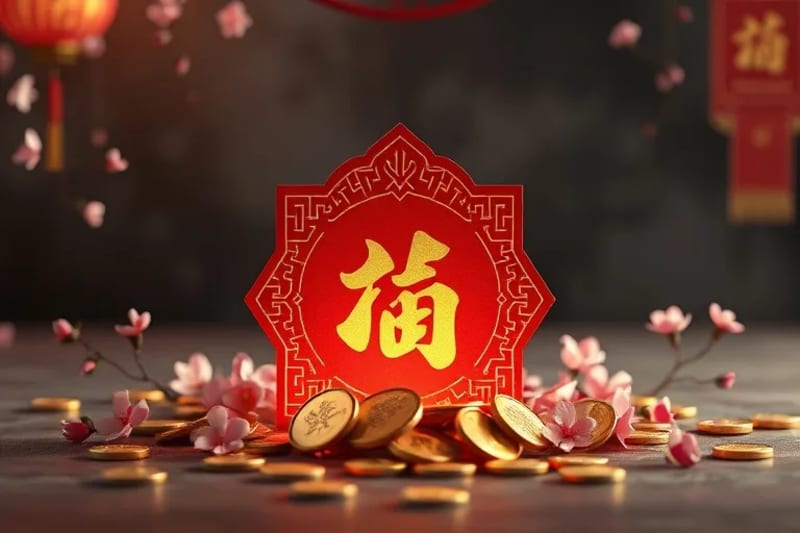
A beautifully rendered red envelope adorned with golden characters, encircled by sparkling gold coins and delicate plum blossoms, symbolizing prosperity and good luck.
A highlight for children and unmarried adults is the receiving of "red envelopes" (红包, hóngbāo), containing money. These envelopes are typically given by married adults and elders to younger generations. The red color of the envelope symbolizes good luck and is believed to ward off evil spirits, while the money inside is a wish for prosperity and blessings. The amount of money is often an even number, as odd numbers are associated with funerals, and certain numbers like 4 (四, sì), which sounds like "death" (死, sǐ), are avoided.
The fireworks and firecrackers that light up the night sky at midnight are another iconic tradition. Originally, firecrackers were used to scare away evil spirits and the mythical beast Nian, which was said to appear at the beginning of each new year to destroy crops and harm villagers. Today, they are a vibrant celebration of the new year's arrival, although regulations on their use vary by region due to safety and environmental concerns.
New Year's Day and Beyond: Greetings and Taboos
The first day of the Chinese New Year (初一, Chūyī) marks the beginning of the official celebrations, which can last for up to fifteen days, culminating in the Lantern Festival. This day is primarily dedicated to visiting family and friends, exchanging auspicious greetings, and adhering to specific taboos to ensure good luck throughout the year.
The most common greeting is "Gong Xi Fa Cai" (恭喜发财), which translates to "Wishing you prosperity and wealth." Other popular greetings include "Xin Nian Kuai Le" (新年快乐), meaning "Happy New Year," and "Shen Ti Jian Kang" (身体健康), wishing good health. These greetings are exchanged with sincerity, reinforcing social bonds and mutual well-wishing.
Several taboos are observed, particularly on New Year's Day, to avoid inadvertently bringing bad luck:
- No Sweeping or Cleaning: As mentioned, this is believed to sweep away good fortune.
- No Washing Hair: The Chinese word for hair (发, fà) is the same character as in "fa cai" (发财), meaning "to become wealthy." Washing hair is seen as washing away one's fortune.
- No Crying: Crying on New Year's Day is thought to bring a year of sadness.
- Avoid Breaking Things: Breaking dishes or other items is considered a bad omen, symbolizing a break in family unity or fortune. If something breaks, it should be immediately wrapped in red paper and the phrase "Sui Sui Ping An" (岁岁平安), meaning "peace year after year," should be uttered, as "sui" (岁) sounds like "broken" (碎).
- Do Not Lend or Borrow Money: This is believed to lead to financial struggles throughout the year.
- Avoid Sharp Objects: Knives and scissors are believed to cut off good fortune.
The subsequent days of the festival often involve continued visits to extended family, friends, and colleagues. Specific days may be designated for visiting parents-in-law or friends. The entire period is a vibrant display of community, respect, and shared hopes for a prosperous future.
Symbolism of Colors and Foods for Good Fortune
The symbolism embedded in colors and foods is central to Chinese New Year celebrations, with each element carrying specific wishes and blessings for the coming year. Understanding these symbols enhances the appreciation of the festival's cultural depth.
Auspicious Colors:
- Red: The most dominant color, symbolizing happiness, success, good fortune, and protection from evil. It is seen everywhere, from clothing to decorations.
- Gold/Yellow: Represents wealth, prosperity, and royalty. Often paired with red to amplify wishes for riches.
- Green: Symbolizes growth, vitality, and harmony, often seen in fresh plants and natural decorations.
Symbolic Foods and Their Meanings:
| Food Item | Symbolic Meaning | Reason for Symbolism |
|---|---|---|
| Fish (鱼, yú) | Abundance, Surplus (年年有余, niánnián yǒuyú) | The pronunciation of "fish" (yú) is similar to "surplus" (余). |
| Dumplings (饺子, jiǎozi) | Wealth, Prosperity | Their shape resembles ancient Chinese gold ingots. |
| Spring Rolls (春卷, chūnjuǎn) | Wealth, New Beginnings | Their golden-brown color and cylindrical shape resemble gold bars. |
| Glutinous Rice Cake (年糕, niángāo) | Higher Income or Position (年高, niángāo) | The pronunciation of "niángāo" sounds like "year high," implying advancement. |
| Longevity Noodles (长寿面, chángshòu miàn) | Long Life | The noodles are intentionally left long and uncut to symbolize a long life. |
| Sweet Rice Balls (汤圆, tāngyuán) | Reunion, Togetherness (团圆, tuányuán) | Their round shape and the pronunciation of "tāngyuán" sound like "tuányuán." |
| Oranges/Tangerines (桔子/橘子, júzi) | Good Luck, Wealth | The word for tangerine (橘, jú) sounds like "luck" (吉, jí), and orange (橙, chéng) sounds like "success" (成, chéng). |
These culinary traditions are deeply ingrained in the celebration, providing both nourishment and powerful symbolic messages for a fortunate year.
The Chinese Zodiac and Its Influence
The Chinese Zodiac (生肖, shēngxiào) is an integral part of Chinese culture and plays a significant role in the Chinese New Year. It is a repeating cycle of 12 years, with each year represented by an animal and its reputed attributes. These animals are Rat, Ox, Tiger, Rabbit, Dragon, Snake, Horse, Goat, Monkey, Rooster, Dog, and Pig.
According to legend, the order of the animals was determined by a race across a river, organized by the Jade Emperor. The animal associated with a person's birth year is believed to influence their personality, destiny, and compatibility with others. During Chinese New Year, people pay close attention to the characteristics of the incoming zodiac animal, as it is thought to set the tone for the entire year.
For example, a Year of the Dragon is often associated with power, nobility, and good fortune, while a Year of the Rabbit might suggest a period of peace, introspection, and gentleness. Astrologers and cultural commentators often provide predictions and advice based on the zodiac animal of the year, guiding people on how to best navigate its energies and maximize their luck.
Furthermore, the Chinese Zodiac is often combined with the Five Elements theory (Wood, Fire, Earth, Metal, Water), creating a 60-year cycle. Each element adds another layer of influence to the animal's characteristics, making each specific year unique. For instance, a Wood Dragon year will have different implications than a Metal Dragon year, affecting everything from personal relationships to economic trends.
The Chinese Zodiac is a classification scheme based on the lunar calendar that assigns an animal and its reputed attributes to each year in a repeating 12-year cycle. This system is deeply embedded in Chinese astrology and folk religion, influencing personal characteristics and annual fortunes.
The animals are: Rat, Ox, Tiger, Rabbit, Dragon, Snake, Horse, Goat, Monkey, Rooster, Dog, and Pig. Each animal is associated with specific traits and is believed to bring different energies to the year it governs.
Understanding one's own zodiac sign and the characteristics of the current year's animal can offer valuable insights into personal growth, career prospects, and relationship dynamics, making it a popular topic of discussion during the New Year period.
Modern Adaptations and Global Celebrations
While deeply rooted in ancient traditions, Chinese New Year celebrations have evolved and adapted to modern times and global contexts. The core essence of family reunion, cultural preservation, and wishing for good fortune remains, but the ways in which these are expressed have diversified.
In contemporary China, especially in urban areas, the intense travel rush before New Year's Eve, known as "Chunyun" (春运), is a phenomenon of massive scale, as millions journey home. Technology has also integrated into the celebrations; digital red envelopes (via apps like WeChat Pay and Alipay) have become incredibly popular, allowing people to send monetary gifts instantly across distances, especially among younger generations.
Globally, Chinese New Year is celebrated with increasing prominence in cities with significant Chinese diaspora communities, such as San Francisco, London, Sydney, and Vancouver. These celebrations often feature vibrant parades with dragon and lion dances, cultural performances, street markets, and fireworks displays, attracting both Chinese and non-Chinese participants. These events serve as a bridge between cultures, sharing the joy and richness of Chinese traditions with a wider audience.
The emphasis on environmental protection has also led to changes, with many cities implementing bans or restrictions on traditional firecrackers, leading to quieter, yet still festive, celebrations. The focus has shifted towards community events, light shows, and cultural performances that are less impactful on air quality and noise pollution.
Despite these modern adaptations, the fundamental spirit of renewal, gratitude, and hope for a prosperous future continues to define Chinese New Year. It remains a powerful reminder of cultural heritage and the enduring importance of family and community bonds.
Conclusion: Embracing the Spirit of Renewal
The Chinese New Year is a profound celebration that transcends mere festivity, acting as a powerful annual reset button for millions worldwide. Its rituals and practices, from the meticulous spring cleaning to the joyful reunion dinners and the exchange of red envelopes, are all meticulously designed to clear away the old and usher in a year brimming with blessings, prosperity, and harmony. The deep symbolism embedded in every color, food, and tradition serves as a constant reminder of cultural values, family unity, and the collective hope for a brighter future.
Understanding these time-honored customs offers more than just cultural insight; it provides a framework for intentional living and a connection to a rich heritage. Whether through the symbolic act of hanging couplets, the communal joy of sharing longevity noodles, or the thoughtful consideration of the year's zodiac animal, each element contributes to a holistic experience of renewal and positive anticipation. As the world continues to evolve, the Chinese New Year traditions demonstrate a remarkable ability to adapt while retaining their core essence, proving their timeless relevance and enduring appeal.
Embracing the spirit of the Chinese New Year means acknowledging the past, celebrating the present, and optimistically preparing for the future. It is a testament to resilience, community, and the universal human desire for good fortune and well-being. May the coming year bring you and your loved ones abundant blessings and prosperity.
Fuente: Contenido híbrido asistido por IAs y supervisión editorial humana.


Comments
Post a Comment