
Fixed Stars Mundane Astrology Global Eras Prediction
Mundane astrology, the branch of astrology dedicated to forecasting global events, geopolitical shifts, and the destinies of nations, often relies on the intricate dance of planets within the zodiac. However, a deeper, more profound layer of celestial influence comes into play through the study of fixed stars. These distant suns, seemingly static from our earthly perspective, exert powerful, archetypal energies that can mark significant historical turning points, shape entire eras, and trigger major global shifts. Unlike the cyclical nature of planetary transits, fixed stars often signify fated, long-lasting, or epoch-making events, acting as cosmic beacons that illuminate the grand narrative of human civilization.
The integration of fixed stars into mundane astrological analysis elevates predictive capabilities, offering insights into the underlying currents that drive collective human experience. This advanced approach moves beyond mere planetary cycles to explore the enduring cosmic patterns that dictate the rise and fall of empires, the emergence of new ideologies, and the very fabric of our shared reality. By understanding their specific significations and methodologies of application, astrologers can unlock a more nuanced and comprehensive understanding of global dynamics.
Table of Contents
- Understanding Fixed Stars in Mundane Astrology
- Methodologies of Fixed Star Application
- Predicting Global Shifts and Geopolitical Events
- Fixed Stars and the Shaping of Eras
- Challenges and Nuances in Interpretation
- Integrating Fixed Stars for Comprehensive Mundane Analysis

Celestial Observatory: Unveiling the ancient art of fixed star astrology for profound global predictions.
Understanding Fixed Stars in Mundane Astrology
Fixed stars are celestial bodies that maintain relatively constant positions in the celestial sphere over human timescales, in contrast to the wandering planets. While planets represent dynamic, evolving forces and psychological drives, fixed stars embody more fundamental, archetypal energies. Their influence is often described as more fated, powerful, and less subject to individual will or short-term fluctuations. In mundane astrology, these stars are not merely background elements; they are potent markers of collective destiny and significant historical junctures.
Historically, astrologers like Ptolemy extensively cataloged fixed stars and their natures, often associating them with planetary influences. For instance, Regulus, the heart of Leo, is often described as having a nature akin to Mars and Jupiter, signifying leadership, power, and often, a dramatic rise and fall. Algol, the demon star in Perseus, carries a reputation for violence, decapitation, and extreme events, often linked to mass hysteria or brutal conflicts. Sirius, the brightest star in the night sky, is associated with fame, honor, and significant societal influence, often tied to national identity or prominent figures.
The distinction between planetary and stellar influence is crucial. Planetary aspects describe the "how" and "when" of events, indicating the prevailing mood and specific challenges or opportunities. Fixed stars, however, often signify the "what" and the "nature" of major events, providing a deeper layer of meaning and often indicating the ultimate outcome or character of a period. Their influence is less about personal choice and more about the unfolding of larger cosmic patterns that affect entire populations and civilizations.
Methodologies of Fixed Star Application
Applying fixed stars in mundane astrology requires precise techniques and a deep understanding of their astronomical positions and astrological significations. The primary method involves observing conjunctions with critical points in mundane charts. These critical points include the angles (Ascendant, Descendant, Midheaven, Imum Coeli), the Sun, Moon, and other planets in charts cast for national foundations, ingresses (when the Sun enters cardinal signs), eclipses, and great conjunctions of outer planets.
One of the most potent applications is when a significant fixed star conjuncts a cardinal angle of a national chart or an ingress chart. For example, if a volatile fixed star like Antares aligns with the Midheaven (MC) in a nation's chart, it could signify periods of military conflict, public unrest, or challenges to leadership. Similarly, a conjunction with the Ascendant might indicate a shift in national identity or the emergence of a new public persona on the global stage. The orb of influence for fixed stars is generally very tight, often within 0.5 to 1 degree, emphasizing precision in analysis.
Another advanced technique involves the use of "parans," where fixed stars rise, culminate, set, or anti-culminate simultaneously with a planet or an angle. This method, popularized by astrologers like Bernadette Brady, offers a more nuanced understanding of how fixed stars weave their influence into the fabric of time. For instance, if a planet associated with communication (like Mercury) is in paran with a fixed star linked to innovation, it could signify a period of groundbreaking discoveries or revolutionary ideas spreading globally.
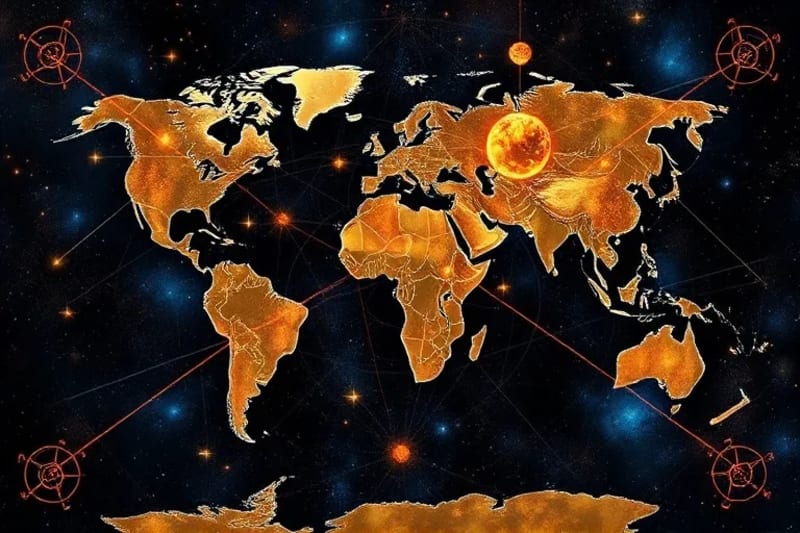
Global Influence: How fixed stars project their archetypal energies onto the world stage, shaping nations and events.
Eclipses, particularly solar eclipses, are powerful mundane indicators. When an eclipse occurs in close conjunction with a prominent fixed star, the star's influence is significantly amplified and imprinted onto the subsequent period. For example, a solar eclipse on Algol might precede a period of widespread violence or natural disasters, while one on Spica could herald a time of agricultural abundance or scientific breakthroughs. The duration of the eclipse's influence can extend for months or even years, depending on its visibility and magnitude.
Furthermore, the interaction of fixed stars with planetary cycles, such as the Jupiter-Saturn conjunctions or Uranus-Pluto squares, provides additional layers of interpretation. A great conjunction occurring on a specific fixed star can imbue that entire cycle with the star's particular qualities, setting the tone for decades of global development. This synthesis allows astrologers to identify both the immediate triggers and the long-term thematic undercurrents shaping world events.
Predicting Global Shifts and Geopolitical Events
The predictive power of fixed stars in mundane astrology is most evident when analyzing major global shifts, geopolitical realignments, and significant historical events. These stars act as cosmic triggers, activating latent potentials within national charts or ingress charts. For instance, the activation of certain fixed stars has historically coincided with periods of war, revolution, economic boom, or societal transformation. The key is to correlate the specific nature of the star with the type of event unfolding.
Consider the star Regulus, associated with kings, leaders, and power. Its influence often manifests in events related to monarchy, governmental power struggles, or the rise and fall of prominent figures. A mundane chart with Regulus strongly placed on the Midheaven or Ascendant might indicate a nation's destiny to play a leading role on the world stage, but also warns of potential hubris or dramatic reversals of fortune. The precession of the equinoxes slowly moves the zodiacal positions of fixed stars, meaning their influence shifts over vast historical periods, aligning with different signs and degrees over millennia.
Algol, often termed "the demon star," is frequently linked to events of extreme violence, mass suffering, and collective trauma. Its activation in mundane charts can correspond to periods of war, terrorism, or natural disasters involving significant loss of life. Conversely, stars like Spica and Arcturus are considered benefic, associated with prosperity, innovation, and progress. Their prominence in mundane charts can coincide with periods of economic growth, scientific advancement, or cultural flourishing. For further insights into celestial mechanics, explore Celestial Mechanics: Conscious Evolution.
The table below illustrates some prominent fixed stars and their general mundane significations:
| Fixed Star | Constellation | Mundane Significances |
|---|---|---|
| Regulus | Leo | Leadership, power, royalty, dramatic rise/fall, military success, hubris. |
| Algol | Perseus | Violence, decapitation, mass suffering, extreme events, natural disasters. |
| Sirius | Canis Major | Fame, honor, national identity, significant societal influence, loyalty, danger from dogs. |
| Spica | Virgo | Abundance, prosperity, scientific discovery, artistic talent, good fortune, agriculture. |
| Antares | Scorpius | War, destruction, courage, rashness, military strategy, danger from fire and weapons. |
Fixed Stars and the Shaping of Eras
Beyond predicting specific events, fixed stars play a crucial role in defining the character of entire historical eras. The slow movement of the vernal equinox through the zodiacal constellations, known as the precession of the equinoxes, means that over millennia, different fixed stars become prominent at the equinoctial points. This shift is believed to correlate with the overarching themes and spiritual consciousness of major astrological ages, such as the Age of Pisces or the dawning Age of Aquarius.
When a significant fixed star aligns with a critical point in the celestial sphere for an extended period, its influence can permeate the collective consciousness, shaping cultural values, technological advancements, and political structures for centuries. For example, the shift of the vernal equinox into the constellation of Pisces coincided with the rise of Christianity, a religion deeply rooted in Piscean symbolism of sacrifice, faith, and universal love. While not directly a fixed star influence, it illustrates how celestial alignments define ages.

Epochal Markers: Fixed stars as cosmic milestones, delineating the beginning and end of significant historical eras and civilizational shifts.
The great conjunctions of Jupiter and Saturn, occurring every 20 years, and particularly the 200-year shifts into new elemental triplicities, are also profoundly affected by their conjunctions with fixed stars. A Grand Conjunction on a star like Fomalhaut (associated with idealism, mysticism, and social reform) could herald an era marked by significant spiritual awakenings, humanitarian movements, or the pursuit of utopian ideals. Conversely, a conjunction on a more challenging star might signify a period of disillusionment or conflict.
Understanding these long-term stellar influences allows for a macro-level analysis of history, revealing the cosmic blueprint behind civilizational cycles. It provides a framework for comprehending why certain themes dominate particular epochs and how humanity's collective journey is guided by forces far beyond immediate planetary movements. The study of fixed stars in this context offers a profound perspective on the unfolding of destiny on a global scale, linking celestial mechanics to human history. For more on predictive techniques, see Predictive Fixed Stars: Global Events & Personal Turning Points.
Challenges and Nuances in Interpretation
Interpreting fixed stars in mundane astrology is a complex art that demands precision, experience, and a nuanced understanding of their multifaceted symbolism. One of the primary challenges lies in the precise calculation of their positions and the extremely tight orb of influence. Unlike planets, where orbs can extend several degrees, fixed star conjunctions are often considered effective only within a degree or less, requiring accurate ephemerides and astrological software.
Another nuance is that fixed stars do not operate in isolation. Their influence is always filtered through the planetary body or angle they conjunct, as well as the sign and house placement. For example, Algol conjunct Venus might manifest differently than Algol conjunct Mars. The former could indicate extreme issues in diplomacy or cultural values, while the latter might point to violent conflicts or aggressive actions. Context is paramount, and a holistic reading of the entire mundane chart is always necessary.
The subjective nature of interpretation also poses a challenge. While some fixed stars have well-established traditional meanings, their manifestation in modern contexts can vary. An astrologer must synthesize ancient wisdom with contemporary understanding, avoiding fatalistic pronouncements. Ethical considerations are also vital; mundane astrology should aim to understand and inform, not to incite fear or make definitive, unchangeable predictions. The goal is to identify potential energies and themes that may unfold, allowing for preparedness and informed action.
Furthermore, the sheer number of named fixed stars means that not all are equally significant in mundane analysis. Focus is typically placed on the brighter, more prominent stars and those with well-documented historical correlations. Distinguishing between a primary influence and a secondary, reinforcing one requires a keen eye and extensive practice. The art lies in discerning the signal from the noise, identifying the most potent stellar activations that genuinely mark significant global shifts.
Integrating Fixed Stars for Comprehensive Mundane Analysis
To achieve a truly comprehensive mundane analysis, fixed stars must be seamlessly integrated with traditional planetary astrology. They provide an additional layer of depth, often revealing the underlying archetypal forces at play behind planetary cycles. While planets describe the mechanics and timing of events, fixed stars often illuminate the deeper meaning, the fated quality, and the ultimate impact of these events on the collective. This synergistic approach offers a more complete picture of global dynamics.
Future research in mundane astrology will likely continue to refine our understanding of fixed stars, especially with advancements in astronomical data and computational tools. The precise tracking of stellar positions, combined with historical event databases, can lead to more accurate correlations and a deeper appreciation of their influence. Exploring the interplay between fixed stars, dwarf planets, and asteroids in mundane charts also represents a fertile ground for new insights, expanding the celestial tapestry of predictive astrology.
Ultimately, fixed stars serve as powerful reminders of humanity's place within a grand cosmic design. Their study in mundane astrology offers not just a tool for prediction, but a profound philosophical framework for understanding the ebb and flow of history, the evolution of consciousness, and the enduring influence of the heavens on earthly affairs. By looking to these distant suns, we gain a clearer perspective on the forces that shape our world and the eras we inhabit, guiding us through the intricate dance of cosmic destiny.
Source: Hybrid content assisted by AIs and human editorial supervision.


Comments
Post a Comment