
Precession Equinoxes Astrological Significance Ages Zodiac
The cosmos is a tapestry of intricate movements, and among the most profound is the Precession of the Equinoxes. This slow, majestic shift of Earth's axis profoundly influences our understanding of time, history, and spiritual evolution. While primarily an astronomical phenomenon, its implications for astrology are vast, shaping the very fabric of our collective consciousness and the unfolding of human civilization.
Unveiling the astrological significance of this celestial dance requires a journey through both scientific observation and ancient wisdom. It challenges conventional notions of zodiacal placement and introduces the concept of vast astrological ages. Understanding precession allows us to contextualize our current era and anticipate future shifts, offering a deeper perspective on humanity's journey.
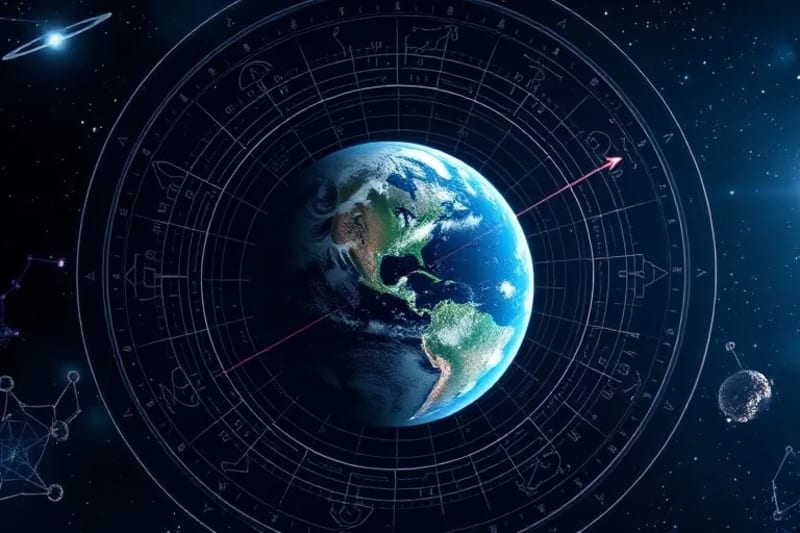
A cinematic view of Earth's axial tilt, illustrating the subtle yet powerful influence of the precession of equinoxes on our celestial alignment.
This article delves into the mechanics of precession, its historical recognition, and its pivotal role in defining astrological ages. We will explore the distinction between the Tropical and Sidereal Zodiacs, and how this astronomical reality impacts astrological interpretation. Join us as we uncover the profound cosmic rhythm that shapes our world.
1. Understanding the Precession of the Equinoxes
The Precession of the Equinoxes refers to the slow, westward shift of the equinoxes along the ecliptic, relative to the fixed stars. This phenomenon causes the "first point of Aries," the traditional starting point of the astrological year, to gradually move backward through the zodiacal constellations. It is a fundamental concept for understanding the long-term evolution of astrological thought and its connection to astronomical reality.
Discovered by the ancient Greek astronomer Hipparchus around 130 BCE, precession is not merely an abstract astronomical concept. It has profound implications for how we perceive the zodiac and the overarching spiritual themes of human history. The subtle wobble of our planet's axis, though imperceptible in a human lifetime, orchestrates a grand cosmic ballet over millennia.
2. The Astronomical Phenomenon Behind Precession
At its core, the Precession of the Equinoxes is caused by the gravitational forces of the Sun and Moon acting on Earth's equatorial bulge. Our planet is not a perfect sphere; it bulges slightly at the equator. This bulge, combined with Earth's axial tilt (obliquity), results in a slow, conical wobble of the Earth's axis, much like a spinning top that is slowing down.
This wobble, known as axial precession, completes one full cycle approximately every 25,920 years. This grand cycle is often referred to as the "Platonic Year" or "Great Year." As the axis wobbles, the celestial poles slowly trace out circles on the celestial sphere, causing the positions of the equinoxes and solstices to shift against the backdrop of the fixed stars. For more on celestial mechanics, explore Celestial Mechanics Eclipses Astrological Impact.
The vernal equinox, which marks the beginning of spring in the Northern Hemisphere, is the point where the Sun crosses the celestial equator moving northward. Due to precession, this point slowly regresses through the zodiacal constellations. It moves approximately one degree every 72 years, meaning it takes about 2,160 years to traverse an entire zodiacal sign.
3. Historical Observations and Ancient Wisdom
While Hipparchus is credited with its scientific discovery, evidence suggests that ancient civilizations had a sophisticated understanding, or at least an awareness, of precession. Many megalithic structures and ancient texts seem to encode knowledge of this grand cycle. The alignment of temples and pyramids with specific stellar constellations, which would change over millennia, hints at this profound awareness.
For instance, the ancient Egyptians observed the heliacal rising of Sirius, and their astronomical calculations were remarkably precise. The Mayan Long Count calendar, with its vast cycles, also resonates with the scale of precessional time. These cultures often viewed the cosmos as a living entity, with cycles far beyond human comprehension, yet deeply influential on earthly affairs.
Ancient texts from various traditions speak of "Great Years" or "World Ages," often associated with the rise and fall of civilizations. While not always explicitly naming precession, their cyclical view of history aligns with the long-term shifts this astronomical phenomenon describes. This suggests a deep, intuitive understanding of cosmic rhythms that transcended mere observation.
The concept of a cosmic clock governing epochs of human development is a recurring theme in esoteric traditions. These traditions often link celestial movements directly to the spiritual and cultural evolution of humanity, viewing the Precession of the Equinoxes as a primary driver of these grand cycles.
4. The Concept of Astrological Ages
The most significant astrological implication of precession is the concept of Astrological Ages. As the vernal equinox point retrogrades through the zodiacal constellations, it marks a shift from one "Age" to another. Each age is approximately 2,160 years long, corresponding to the time it takes for the equinox to pass through one constellation.
Currently, humanity is believed to be transitioning from the Age of Pisces into the Age of Aquarius. The Age of Pisces, which began around 1 AD, was characterized by themes of faith, sacrifice, duality, and the rise of major monotheistic religions. Its symbols often include fish, reflecting the constellation.
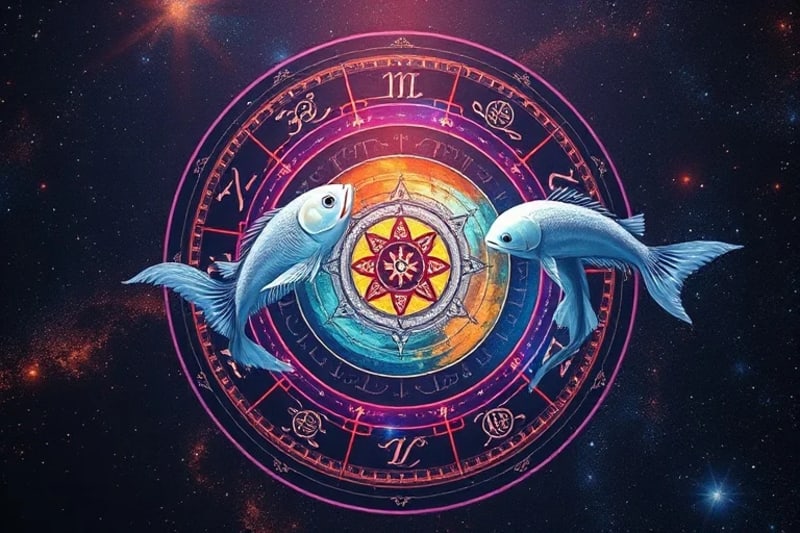
A digital painting illustrating the graceful transition of the zodiac wheel, symbolizing humanity's shift from the Age of Pisces to the Age of Aquarius.
The incoming Age of Aquarius is associated with themes of innovation, technology, humanitarianism, individuality, and collective consciousness. This transition is often seen as a period of significant upheaval and transformation, as old paradigms give way to new ways of thinking and living. The exact timing of this shift is debated among astrologers, but the general consensus points to our current era.
Each age is believed to imprint a specific energetic signature on human civilization, influencing cultural trends, spiritual movements, and technological advancements. Understanding these overarching energies provides a macro-astrological lens through which to view history and future developments.
5. Tropical vs. Sidereal Zodiac: A Precessional Divide
The Precession of the Equinoxes highlights a crucial distinction between two primary zodiacal systems: the Tropical Zodiac and the Sidereal Zodiac. Western astrology predominantly uses the Tropical Zodiac, which is based on the seasons and the Earth's relationship to the Sun. The first point of Aries in the Tropical Zodiac is fixed at the vernal equinox, marking the beginning of spring.
Conversely, the Sidereal Zodiac, primarily used in Vedic (Indian) astrology, is based on the actual constellations in the sky, relative to the fixed stars. Due to precession, the vernal equinox point has drifted significantly from the constellation Aries over the past two millennia. This drift, known as the Ayanamsha, is the difference between the two zodiacs.
The difference between these two systems is currently around 24 degrees, meaning that someone born with the Sun in Aries in the Tropical system might have their Sun in Pisces in the Sidereal system. Both systems offer valid, albeit different, insights into personality and destiny. The Tropical Zodiac reflects our psychological and seasonal experience, while the Sidereal Zodiac connects us to the deeper, stellar influences. This distinction is vital for understanding various astrological traditions and their interpretations of Fixed Stars Karmic Astrology.
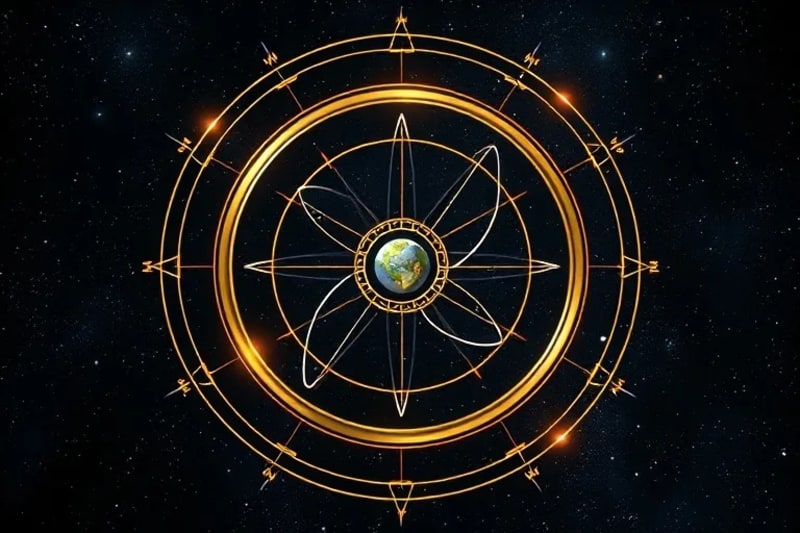
An abstract 3D render depicting the subtle yet powerful cosmic mechanism of precession, with intertwined rings symbolizing Earth's axis and the ecliptic.
6. Cultural and Spiritual Resonance of Precession
Beyond its astronomical and astrological definitions, the Precession of the Equinoxes holds profound cultural and spiritual significance. Many spiritual traditions view the Great Year as a cosmic breath, a grand cycle of involution and evolution for consciousness. It suggests that humanity's spiritual journey is not linear but unfolds in vast, repeating patterns.
The concept of "ages" provides a framework for understanding shifts in religious thought, philosophical paradigms, and collective human experience. For instance, the Age of Taurus (associated with fertility cults and bull worship) gave way to the Age of Aries (marked by warrior cultures and patriarchal deities), followed by the Age of Pisces. These shifts are often reflected in mythology and religious symbolism.
The current transition into the Age of Aquarius is often linked to a global awakening, a shift towards greater interconnectedness, and a re-evaluation of societal structures. This era is perceived as one where individual freedom and collective responsibility will be paramount, driven by technological advancement and a renewed focus on humanitarian ideals. Understanding these archetypes helps us interpret Zodiac Archetypes: Hero's Journey Through Sun Signs on a grand scale.
7. Modern Astrological Perspectives on the Great Year
Contemporary astrologers approach the Precession of the Equinoxes with varying degrees of emphasis. While natal astrology primarily uses the Tropical Zodiac for individual charts, the concept of Astrological Ages provides a crucial backdrop for mundane astrology, which studies global events and societal trends. It offers a macro-level understanding of collective karma and evolutionary paths.
Some astrologers believe that the shift between ages is not a sharp, defined line but rather a gradual process, with overlapping energies. This explains why we still see Piscean themes (e.g., spiritual yearning, escapism) while Aquarian energies (e.g., technological revolution, social justice movements) are increasingly prominent. This overlap creates a period of intense change and potential for both chaos and profound growth.
The Great Year also encourages a more holistic view of astrological influence, moving beyond individual birth charts to consider humanity's collective journey. It reminds us that we are part of a much larger cosmic narrative, where cycles of thousands of years shape the very essence of human experience and spiritual evolution.
8. Navigating the Shift: Living in a Precessional Era
Living in a period of precessional shift, particularly the transition into the Age of Aquarius, presents unique challenges and opportunities. Understanding these grand cosmic cycles can help individuals and societies navigate the turbulent waters of change with greater awareness and purpose. It encourages us to embrace innovation while honoring the wisdom of the past.
Key aspects of navigating this era include fostering a sense of global community, embracing technological advancements responsibly, and cultivating individual authenticity. The Aquarian energy calls for breaking free from outdated structures and embracing new forms of consciousness and social organization. It's a time for collective evolution and personal liberation.
By recognizing the profound influence of the Precession of the Equinoxes, we can align ourselves with the prevailing cosmic currents. This awareness empowers us to contribute consciously to the unfolding of the new age, fostering a future that reflects the highest ideals of humanity. It is a call to participate actively in the grand design of the cosmos.
Fuente: Contenido híbrido asistido por IAs y supervisión editorial humana.


Comments
Post a Comment