
Quantum Physics Celestial Mechanics: Universe Predictive System
The universe, in its vast and intricate complexity, has long been a subject of human inquiry, inspiring awe and a relentless quest for understanding. From the predictable dance of planets to the enigmatic behavior of subatomic particles, two fundamental branches of physics—celestial mechanics and quantum physics—offer profoundly different yet complementary perspectives on how the cosmos operates. Celestial mechanics, with its roots in classical physics, describes the motion of macroscopic objects under gravitational influence, providing a framework for predicting astronomical events with astonishing accuracy. Quantum physics, on the other hand, delves into the microscopic realm, revealing a universe governed by probabilities, uncertainty, and non-locality.
This article explores the fascinating interplay between these two pillars of modern science, examining how they contribute to our understanding of the universe as a potentially predictive system. While seemingly disparate, both fields offer unique insights into the underlying order and inherent unpredictability that define our reality. By bridging the deterministic elegance of celestial mechanics with the probabilistic mysteries of quantum physics, we can begin to appreciate a more holistic view of cosmic predictability and the profound connections that weave through all scales of existence.
Table of Contents
- The Grand Clockwork: Understanding Celestial Mechanics
- The Quantum Realm: Probabilities and Paradoxes
- Bridging the Gap: Determinism vs. Probabilism
- The Universe as a Predictive System: Macro and Micro
- Quantum Entanglement and Cosmic Connections
- Astrology's Ancient Lens: Interpreting Cosmic Predictability
- Future Horizons: Unifying Theories and Deeper Insights

The universe as a grand, interconnected system, where the macro-scale predictability of celestial mechanics intertwines with the micro-scale probabilistic nature of quantum physics.
The Grand Clockwork: Understanding Celestial Mechanics
Celestial mechanics is the branch of astronomy that deals with the motions of celestial bodies, such as planets, moons, asteroids, and comets. Rooted in Isaac Newton's laws of motion and universal gravitation, it describes how these objects move under the influence of each other's gravitational pull. This field has been instrumental in predicting eclipses, planetary alignments, and the trajectories of spacecraft with remarkable precision. Its success lies in the deterministic nature of classical physics: given the initial conditions (position and velocity) of all bodies, their future movements can theoretically be calculated indefinitely.
Historically, celestial mechanics provided humanity with its first profound understanding of cosmic order. Ancient civilizations meticulously tracked celestial movements, developing calendars and navigational tools based on these predictable cycles. The Copernican revolution, Kepler's laws of planetary motion, and Newton's synthesis solidified this understanding, portraying the solar system as a magnificent, predictable clockwork. This deterministic view suggested a universe where every event was predetermined by prior causes, a concept that profoundly influenced philosophy and science for centuries.
Key principles of celestial mechanics include:
Newton's Law of Universal Gravitation: Every particle attracts every other particle in the universe with a force that is directly proportional to the product of their masses and inversely proportional to the square of the distance between their centers.
Kepler's Laws of Planetary Motion: These describe the orbits of planets around the Sun, stating that orbits are elliptical, planets sweep out equal areas in equal times, and the square of a planet's orbital period is proportional to the cube of the semi-major axis of its orbit.
Orbital Elements: A set of six parameters that precisely define the path of a celestial body, allowing for accurate prediction of its position at any given time.
While generally robust, celestial mechanics can become complex in multi-body systems, leading to phenomena like chaotic motion in certain scenarios, such as the gravitational interactions within asteroid belts or complex stellar systems. However, for most large-scale astronomical phenomena, its predictive power remains unparalleled.
The Quantum Realm: Probabilities and Paradoxes
In stark contrast to the macroscopic predictability of celestial mechanics, quantum physics explores the fundamental nature of matter and energy at the atomic and subatomic levels. Developed in the early 20th century, this revolutionary theory revealed a universe far stranger than classical physics had ever imagined. At the quantum scale, particles can behave as both waves and particles (wave-particle duality), their properties are often indeterminate until measured, and events are governed by probabilities rather than absolute certainty.
The core tenets of quantum physics challenge our intuitive understanding of reality. Concepts like superposition, where a particle can exist in multiple states simultaneously, and quantum entanglement, where two particles become linked and share the same fate regardless of distance, defy classical logic. This probabilistic nature means that we can only predict the likelihood of certain outcomes, not their absolute occurrence. This fundamental uncertainty is enshrined in Werner Heisenberg's Uncertainty Principle, which states that certain pairs of physical properties, like position and momentum, cannot both be known with arbitrary precision simultaneously.
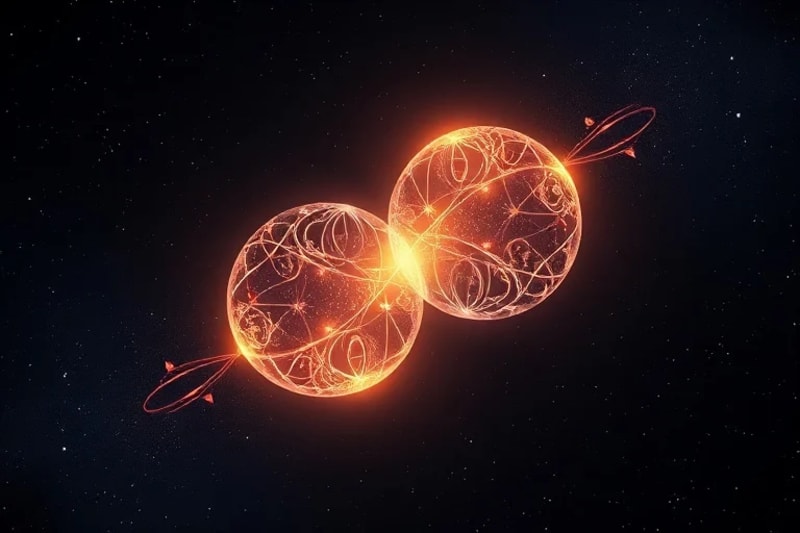
A visual metaphor for quantum entanglement, illustrating how particles can be intrinsically linked, influencing each other instantaneously across vast distances.
Key concepts in quantum physics include:
Quantization: Energy, momentum, and other physical quantities are not continuous but exist in discrete packets called quanta.
Wave-Particle Duality: Particles exhibit properties of both waves and particles, depending on how they are observed.
Superposition: A quantum system can exist in multiple states simultaneously until it is measured.
Entanglement: Two or more particles become linked in such a way that they share the same quantum state, even when separated by large distances.
Despite its counter-intuitive nature, quantum physics is one of the most successful theories in science, underpinning technologies from lasers and transistors to medical imaging. Its implications for understanding the fundamental building blocks of the universe are profound, suggesting that reality at its most basic level is far more fluid and interconnected than we perceive.
Bridging the Gap: Determinism vs. Probabilism
The apparent dichotomy between the deterministic clockwork of celestial mechanics and the probabilistic dance of quantum physics presents a significant challenge in our quest for a unified understanding of the universe. Classical physics, which governs celestial mechanics, assumes a reality where every effect has a definite cause, making the future theoretically predictable. Quantum physics, however, introduces an irreducible element of randomness, suggesting that at the most fundamental level, the universe operates on probabilities.
This tension between determinism and probabilism has fueled centuries of debate among physicists and philosophers. Albert Einstein famously rejected the inherent randomness of quantum mechanics, stating, "God does not play dice with the universe." Yet, experimental evidence consistently supports the probabilistic nature of quantum phenomena. The question then arises: how can a universe governed by quantum uncertainty at its core exhibit such predictable, classical behavior at larger scales?
The answer often lies in the concept of decoherence. When quantum systems interact with their environment, they lose their quantum properties (like superposition and entanglement) and transition into classical states. This process effectively "washes out" the quantum uncertainties, leading to the emergence of the deterministic world we observe daily. Therefore, celestial mechanics can be seen as an emergent property of quantum mechanics when dealing with vast numbers of particles and their interactions, where individual quantum fluctuations average out.
| Feature | Celestial Mechanics | Quantum Physics |
|---|---|---|
| Scale of Study | Macroscopic (planets, stars, galaxies) | Microscopic (atoms, subatomic particles) |
| Nature of Prediction | Deterministic (precise, absolute) | Probabilistic (likelihood, statistical) |
| Key Concepts | Gravity, orbits, classical laws of motion | Quantization, superposition, entanglement, uncertainty |
| Underlying Reality | Continuous, predictable trajectories | Discrete, wave-particle duality, observer-dependent |
The Universe as a Predictive System: Macro and Micro
Despite their differences, both celestial mechanics and quantum physics contribute to our understanding of the universe as a predictive system, albeit in different ways and with different limitations. Celestial mechanics provides the framework for predicting large-scale cosmic events with astonishing accuracy. We can forecast solar eclipses centuries in advance, plot the course of comets, and even predict the gravitational interactions that shape galaxies over billions of years. This predictability is crucial for space exploration, satellite navigation, and our fundamental understanding of cosmic evolution.
On the quantum level, predictability takes on a statistical nature. While we cannot predict the exact moment a radioactive atom will decay, we can predict the half-life of a large sample of such atoms with great precision. Similarly, quantum field theory allows us to predict the probabilities of particle interactions in accelerators, leading to the discovery of fundamental particles like the Higgs boson. This statistical predictability is essential for understanding the behavior of matter at its most fundamental level, informing fields from chemistry to materials science.
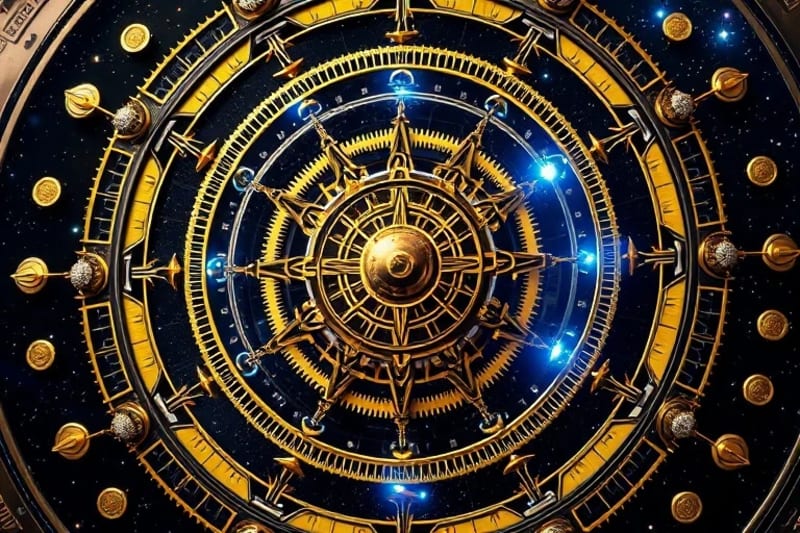
An artistic representation of the universe as a predictive system, where the classical order of celestial mechanics is subtly influenced by the underlying probabilistic nature of quantum reality.
The universe, therefore, can be viewed as a multi-layered predictive system. At the macroscopic level, it functions with a high degree of classical determinism, allowing for long-term forecasts of celestial events. At the microscopic level, it operates probabilistically, offering statistical predictions about the behavior of fundamental particles. The challenge and beauty lie in understanding how these two levels are intertwined and how the probabilistic nature at the base gives rise to the apparent order and predictability at higher scales.
Quantum Entanglement and Cosmic Connections
One of the most intriguing aspects of quantum physics, quantum entanglement, offers a tantalizing glimpse into a universe that might be far more interconnected than we can readily perceive. When two particles become entangled, they remain linked in such a way that measuring the state of one instantaneously influences the state of the other, regardless of the distance separating them. This "spooky action at a distance," as Einstein called it, suggests a non-local connection that transcends conventional space-time.
While entanglement is typically observed at the quantum scale, some theoretical physicists explore its potential implications for larger systems and even the fabric of the cosmos. Could the universe itself be a giant entangled system? If so, it might imply a deeper, underlying unity where all parts are intrinsically linked, potentially offering new avenues for understanding cosmic predictability and the flow of information across vast distances. This perspective resonates with ancient philosophical and spiritual traditions that emphasize the interconnectedness of all things.
The implications of quantum entanglement for a predictive universe are profound:
Unified Information Flow: Entanglement suggests that information might not be localized, implying a more holistic cosmic information network.
Beyond Local Causality: It challenges the classical notion that causes must precede effects locally, opening up possibilities for non-local influences.
Emergent Properties of Reality: The macroscopic predictability we observe might emerge from a deeply entangled quantum substrate, where correlations are fundamental.
While speculative, these ideas push the boundaries of our understanding, suggesting that the universe's predictive capabilities might stem from a fundamental interconnectedness that operates beyond the simple sum of its parts.
Astrology's Ancient Lens: Interpreting Cosmic Predictability
Throughout history, various systems have attempted to interpret and predict earthly events based on celestial phenomena. Astrology, one of the oldest such systems, posits a correlation between astronomical positions and events on Earth, including human affairs. While modern science largely views astrology as a pseudoscience due to its lack of empirical evidence and testable mechanisms, it represents a historical human endeavor to find meaning and predictability in the cosmos.
From an astrological perspective, the predictable cycles of celestial mechanics—planetary movements, lunar phases, and solstices—are seen as reflections or influences on terrestrial life. Astrologers interpret these patterns as indicators of trends, potentials, and energies, rather than deterministic decrees. This approach aligns, in a metaphorical sense, with the idea of a predictive system, albeit one based on symbolic interpretation rather than physical causation.
The enduring appeal of astrology lies in its attempt to connect the microcosm (human life) with the macrocosm (the universe). It seeks to provide a framework for understanding individual destinies and collective events within a grand cosmic design. While distinct from scientific inquiry, the philosophical underpinnings of astrology—that there is an inherent order and interconnectedness in the universe that can be deciphered—touch upon themes also explored by modern physics, particularly in discussions about emergent properties and non-local correlations.
For many, astrology offers a way to navigate life's uncertainties by seeking patterns in the predictable celestial dance. It serves as a testament to humanity's deep-seated desire to find meaning and order in the vast, often overwhelming, expanse of the universe, bridging the gap between observable cosmic cycles and the human experience.
Future Horizons: Unifying Theories and Deeper Insights
The quest to understand the universe as a predictive system continues to drive scientific exploration. One of the holy grails of modern physics is the development of a "Theory of Everything" (TOE) that would unify quantum mechanics with general relativity (Einstein's theory of gravity, which underpins celestial mechanics). Such a theory would provide a single, coherent framework to describe all fundamental forces and particles, potentially offering a complete picture of cosmic predictability from the smallest to the largest scales.
String theory and loop quantum gravity are leading candidates in this pursuit, attempting to reconcile the deterministic elegance of gravity with the probabilistic nature of the quantum world. A successful TOE could reveal how the macroscopic predictability of celestial mechanics emerges from the quantum foam, offering unprecedented insights into the universe's fundamental operating principles. It might also shed light on the nature of space-time, the origins of the universe, and perhaps even the true extent of cosmic interconnectedness.
As our understanding evolves, the universe continues to reveal itself as a system of profound complexity and subtle order. The interplay between the grand clockwork of celestial mechanics and the enigmatic dance of quantum particles paints a picture of a cosmos that is both predictable and unpredictable, deterministic and probabilistic. The journey to fully comprehend this intricate balance is far from over, promising future discoveries that will undoubtedly reshape our perception of reality and our place within the grand cosmic design.
Ultimately, the universe is a predictive system in many profound ways. From the precise timing of astronomical events to the statistical regularities of subatomic interactions, we can decipher patterns and forecast outcomes. Yet, the inherent quantum uncertainty reminds us that a complete, deterministic prediction of every single event may forever remain beyond our grasp, leaving room for both scientific inquiry and the enduring mystery that makes the cosmos so endlessly fascinating.
Fuente: Contenido híbrido asistido por IAs y supervisión editorial humana.


Comments
Post a Comment