
Hermetic Principles Astrology: Natal Chart Interpretation
The ancient philosophical tradition of Hermeticism, attributed to the mythical figure Hermes Trismegistus, offers a profound framework for understanding the universe and our place within it. Central to this tradition are the Seven Hermetic Principles, which describe the fundamental laws governing all existence. Among these, the principle of "As Above, So Below" stands out, providing a potent lens through which to interpret the intricate tapestry of a natal chart in astrology. This principle suggests a deep interconnectedness between the macrocosm (the universe, the celestial sphere) and the microcosm (the individual, the earthly realm), asserting that patterns observed in one reflect those in the other.
Astrology, at its core, is a symbolic language that maps the celestial configurations at the moment of an individual's birth onto their personality, life path, and potential. The natal chart, therefore, serves as a cosmic blueprint, a snapshot of the heavens that mirrors the inherent energies and predispositions within a person. By applying the Hermetic Principles, particularly "As Above, So Below," we can unlock deeper layers of meaning in this astrological map, transforming it from a mere predictive tool into a profound guide for self-understanding and spiritual evolution.

The profound principle of "As Above, So Below" beautifully depicted through a celestial and terrestrial mirror, symbolizing the deep interconnectedness of the universe and individual existence.
This article delves into the foundational Hermetic Principles and illustrates how each can enrich the interpretation of a natal chart. We will explore how these ancient laws provide a philosophical backbone to astrological insights, offering a holistic perspective on the forces that shape our lives and the potential for conscious co-creation with cosmic energies. Understanding these principles allows for a more nuanced and empowered approach to astrology, moving beyond fatalism towards self-mastery.
The Seven Hermetic Principles: A Philosophical Foundation
The Hermetic teachings, primarily compiled in texts like "The Kybalion," outline seven universal principles that govern physical, mental, and spiritual reality. These are not merely abstract concepts but active forces that can be observed and understood through diligent study and introspection. Each principle offers a unique perspective that, when applied to the natal chart, illuminates different facets of the individual's journey.
Before diving into their astrological applications, let's briefly define each of these powerful principles:
- The Principle of Mentalism: "The All is Mind; the Universe is Mental." This principle states that everything in the universe originates from a divine, universal mind. Our thoughts and consciousness are extensions of this Mind, shaping our reality.
- The Principle of Correspondence: "As Above, So Below; as Below, So Above." This is arguably the most famous Hermetic axiom, suggesting a direct correlation between all planes of existence—physical, mental, and spiritual. Patterns repeat at every level.
- The Principle of Vibration: "Nothing rests; everything moves; everything vibrates." All matter and energy are in a constant state of vibration, from the densest physical forms to the subtlest spiritual energies. Differences in vibration create differences in manifestation.
- The Principle of Polarity: "Everything is Dual; everything has poles; everything has its pair of opposites; like and unlike are the same; opposites are identical in nature, but different in degree; extremes meet; all truths are but half-truths; all paradoxes may be reconciled." This principle highlights the dualistic nature of reality, where seemingly opposing forces are merely different degrees of the same thing.
- The Principle of Rhythm: "Everything flows, out and in; everything has its tides; all things rise and fall; the pendulum-swing manifests in everything; the measure of the swing to the right is the measure of the swing to the left; rhythm compensates." This principle describes the cyclical, oscillating nature of phenomena, characterized by ebb and flow, rise and fall.
- The Principle of Cause and Effect: "Every Cause has its Effect; every Effect has its Cause; everything happens according to Law; Chance is but a name for Law not recognized; there are many planes of causation, but nothing escapes the Law." This principle asserts that there is no such thing as chance; every event is the result of a preceding cause, operating under universal laws.
- The Principle of Gender: "Gender is in everything; everything has its Masculine and Feminine Principles; Gender manifests on all planes." This principle refers to the creative and generative forces inherent in all things, not necessarily biological sex, but the dynamic interplay of active (masculine) and receptive (feminine) energies.
Applying "As Above, So Below" to Natal Chart Interpretation
The Principle of Correspondence, "As Above, So Below," is the cornerstone of astrological interpretation. It posits that the celestial patterns at the moment of birth are not random but are precise reflections of the individual's inner world and life experiences. The planetary positions, zodiac signs, and house placements in a natal chart are symbolic representations of an individual's psychological makeup, talents, challenges, and destiny.
For instance, the placement of Mars in a fiery sign like Aries in the 10th House of career doesn't just predict an aggressive career path; it reflects an inner drive, a pioneering spirit, and a need for independent action that manifests outwardly in professional ambitions. Conversely, a person exhibiting these traits in their life is, in turn, reflecting the cosmic signature of their birth chart. This reciprocal relationship underscores the idea that our inner and outer realities are inextricably linked, a direct manifestation of the "As Above, So Below" axiom.
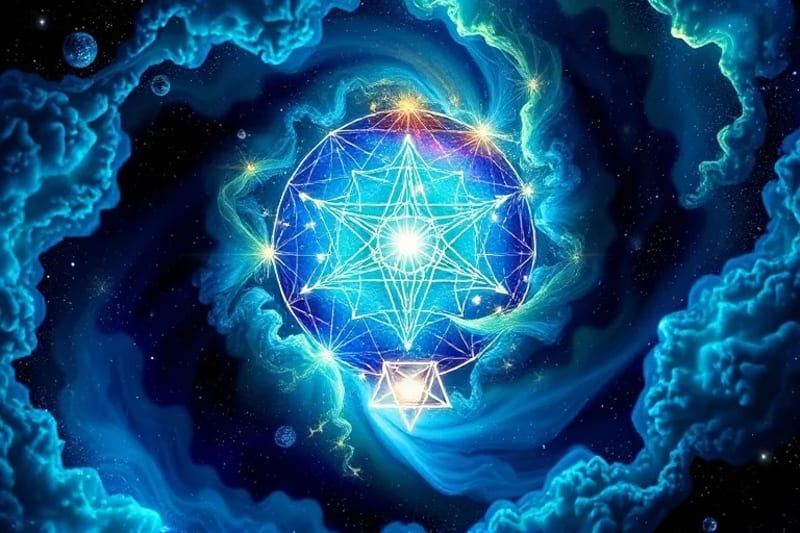
An artistic rendering of the Principle of Mentalism, showcasing how the universal mind and individual consciousness shape our perceived reality.
Understanding this principle encourages a holistic view of the self, where personal development is seen as an alignment with cosmic energies. It suggests that by understanding the "above" (the natal chart), we can better navigate and shape the "below" (our earthly life). This is not about predestination, but about recognizing inherent potentials and challenges, and consciously working with them.
The Principle of Mentalism and the Natal Chart
"The All is Mind; the Universe is Mental." This principle asserts that everything we perceive, including our natal chart, is a manifestation of the Universal Mind. In astrological terms, this means that the birth chart is not just a collection of symbols, but a mental construct, a thought-form of the cosmos that is imprinted upon our consciousness at birth. Our interpretation of the chart, and indeed our experience of its energies, is deeply influenced by our own mental state and beliefs.
When interpreting a natal chart through the lens of Mentalism, we recognize that our perception of our astrological placements can significantly alter their impact. If a person believes their challenging Saturn placement in the 7th House guarantees relationship struggles, this belief itself can contribute to that reality. Conversely, understanding that this placement represents an opportunity for profound growth in commitment and structure can transform the experience. The chart is a map, but our mind navigates the terrain.
This principle empowers individuals to engage actively with their chart. It encourages introspection and the conscious reshaping of mental patterns related to astrological influences. For example, if a chart shows a strong emphasis on a particular planet, say Mercury in Gemini, indicating a highly active and intellectual mind, the individual can consciously direct this mental energy towards constructive learning, communication, and problem-solving, rather than allowing it to scatter into anxiety or overthinking. The mind is the primary tool for harmonizing with the chart's energies.
The Principle of Vibration and Astrological Energies
"Nothing rests; everything moves; everything vibrates." This principle explains the dynamic nature of astrological energies. Each planet, sign, and house in a natal chart emits a unique vibrational frequency. These frequencies interact, creating a complex energetic signature that is the individual's birth chart. The "vibration" of a planet in a certain sign or house is not static; it's a living, breathing energy that influences our subtle energy fields.
Consider the high-frequency, expansive energy of Jupiter versus the dense, contracting energy of Saturn. In a natal chart, the interplay of these planetary vibrations creates specific experiences. A harmonious trine between Jupiter and Venus might manifest as an easy flow of abundance and love, a high vibrational state. Conversely, a challenging square between Mars and Pluto could represent intense, lower-frequency conflicts related to power and control, requiring conscious effort to raise the vibration to a more constructive expression.

A symbolic still-life featuring an astrolabe and a crystal globe, illustrating the Principle of Correspondence through the interconnectedness of celestial and inner worlds.
Understanding the Principle of Vibration allows astrologers and individuals to perceive the chart not just as fixed traits but as a spectrum of energetic potentials. We can learn to consciously "tune" our personal vibrations to align with the higher expressions of our chart placements. For instance, engaging in practices like meditation, sound healing, or mindful movement can help shift internal vibrations, positively influencing how astrological transits are experienced. This perspective is crucial for those seeking to integrate their Tarot Quantum Mechanics Intersecting Divination Reality into daily life.
The Principle of Polarity and Astrological Oppositions
"Everything is Dual; everything has poles." The Principle of Polarity is vividly expressed in astrology through oppositions, polarities, and the inherent duality within each zodiac sign. Every sign has an opposing sign that represents its complement, not its enemy. Aries (self) is opposite Libra (others); Taurus (material security) is opposite Scorpio (shared resources, transformation); Gemini (communication) is opposite Sagittarius (philosophy, higher learning).
In a natal chart, planetary oppositions (180-degree aspects) highlight areas where an individual experiences tension between two seemingly contradictory urges or needs. For example, a Sun opposite Moon aspect points to a fundamental internal conflict between the conscious ego (Sun) and the subconscious emotional nature (Moon). The Hermetic Principle of Polarity teaches that these are not irreconcilable differences but two ends of the same spectrum. The goal is not to eliminate one pole but to integrate both, finding a point of balance and synthesis.
This principle encourages us to view challenges in the natal chart as opportunities for integration rather than sources of perpetual struggle. A person with a strong opposition is called to master the art of balancing these energies, moving between the extremes to find a harmonious middle ground. This often leads to profound personal growth and the development of a more integrated personality. The understanding of Mesoamerican Astrology AI Oracles Bridging Ancient Modern can further illuminate these balancing acts.
The Principle of Rhythm and Astrological Cycles
"Everything flows, out and in; everything has its tides." The Principle of Rhythm is perfectly embodied in the cyclical nature of astrological transits and progressions. Life is a series of ebb and flow, growth and contraction, challenge and ease. The planets are constantly moving, forming new aspects to our natal chart, creating distinct periods of activity and rest.
For example, Saturn returns (approximately every 29.5 years) represent a period of intense responsibility and restructuring, a low tide where foundations are tested. After this period of consolidation, a new cycle of growth and expansion often begins. Similarly, Jupiter transits bring periods of opportunity and expansion, while Mercury retrogrades signal times for reflection and review. These are all manifestations of the universal rhythm.
Applying this principle to natal chart interpretation means recognizing that no phase is permanent. Periods of difficulty will pass, and periods of ease will also eventually transition. This understanding fosters patience and resilience, encouraging individuals to flow with the cosmic tides rather than resist them. It helps us to appreciate the compensatory nature of rhythm, knowing that every swing in one direction will eventually be balanced by a swing in the other. This cyclical view is also evident in the study of Fixed Stars Predictive Astrology.
The Principle of Cause and Effect in Karmic Astrology
"Every Cause has its Effect; every Effect has its Cause." This principle forms the basis of karmic astrology, suggesting that our natal chart is not merely a random configuration but a reflection of past actions and choices, and a blueprint for future consequences. Every placement, aspect, and house cusp in the chart can be seen as an effect of previous causes, and in turn, a cause for future effects.
For instance, challenging aspects involving the Lunar Nodes (Rahu and Ketu in Vedic astrology) often point to karmic lessons carried over from past lives. A difficult Pluto aspect might indicate deep-seated power struggles or transformative experiences that are effects of unresolved issues. The chart thus becomes a tool for understanding the karmic ledger, allowing individuals to consciously create new causes (positive actions, conscious choices) to generate more favorable effects.
This principle removes the concept of "bad luck" or "random events" from astrological interpretation. Instead, it places emphasis on personal responsibility and the power of conscious action. By understanding the karmic implications of their chart, individuals can work to resolve past patterns, heal ancestral wounds, and create a more desirable future. It's a powerful reminder that while we are born with certain predispositions, our free will allows us to influence the chain of cause and effect.
The Principle of Gender and Astrological Duality
"Gender is in everything; everything has its Masculine and Feminine Principles." In Hermeticism, "Gender" refers to the active (masculine, projective, Yang) and receptive (feminine, introjective, Yin) forces present in all phenomena. In astrology, this duality is evident in numerous ways: the active fire and air signs versus the receptive earth and water signs; the masculine planets (Sun, Mars, Jupiter) versus the feminine planets (Moon, Venus, Neptune); and the interplay of houses.
A natal chart analysis through this principle reveals the balance or imbalance of these generative forces within an individual. A chart heavily weighted towards masculine signs and planets might indicate a person who is highly assertive, action-oriented, and independent, but who may struggle with receptivity, empathy, or emotional processing. Conversely, a chart with a strong feminine emphasis might point to an individual who is nurturing, intuitive, and adaptable, but who may find it challenging to assert themselves or initiate action.
The goal is not to be exclusively masculine or feminine but to integrate both principles harmoniously. The Principle of Gender encourages individuals to cultivate both their active and receptive qualities, allowing for a more balanced and effective expression of their energies. This dynamic interplay is essential for creation, manifestation, and personal fulfillment, reflecting the cosmic dance of creation itself.
Integrating Hermetic Wisdom for a Deeper Natal Chart Reading
The Hermetic Principles offer a profound philosophical bedrock for astrological practice. By integrating these universal laws into natal chart interpretation, we move beyond a superficial reading of planetary positions to a deeper understanding of the energetic and mental dynamics at play. Each principle adds a layer of depth, transforming the chart into a living, dynamic blueprint for self-mastery and conscious evolution.
For the aspiring astrologer or the curious individual, applying these principles means:
- Holistic Perspective: Viewing the chart as a reflection of interconnected planes of existence ("As Above, So Below").
- Empowered Mindset: Recognizing the power of one's mind to shape the experience of astrological influences (Mentalism).
- Energetic Awareness: Understanding the vibrational frequencies of planets and signs, and learning to harmonize with them (Vibration).
- Integration of Opposites: Seeking balance and synthesis in areas of duality and conflict (Polarity).
- Flow with Cycles: Accepting and working with the natural ebb and flow of life's astrological rhythms (Rhythm).
- Conscious Causation: Taking responsibility for actions and choices, understanding their karmic implications (Cause and Effect).
- Balanced Creation: Cultivating both active and receptive energies for holistic personal development (Gender).
Ultimately, the Hermetic Principles elevate astrology from a descriptive art to a transformative science. They provide a framework for not just understanding what the stars say about us, but for actively participating in our cosmic journey, aligning our inner world with the universal laws that govern all existence. This profound integration allows for a richer, more meaningful, and ultimately more empowering interpretation of one's unique natal chart.
Fuente: Contenido híbrido asistido por IAs y supervisión editorial humana.


Comments
Post a Comment