
Mesoamerican Astrology AI Oracles Bridging Ancient Modern
The confluence of ancient wisdom and cutting-edge technology presents a fascinating frontier for understanding human destiny and cosmic patterns. Mesoamerican astrology, with its intricate calendar systems and profound spiritual insights, offers a rich tapestry for exploration. Now, the emergence of Artificial Intelligence (AI) oracles promises to bridge these seemingly disparate worlds, offering new avenues for interpreting ancient divinatory practices through algorithmic analysis.
This article delves into the foundational principles of Mesoamerican astrology, explores the capabilities of modern AI oracles, and examines how these two domains can converge. We will discuss the potential benefits and challenges of using AI to decipher and apply the complex wisdom embedded in ancient calendars, providing a comprehensive overview for enthusiasts and scholars alike.
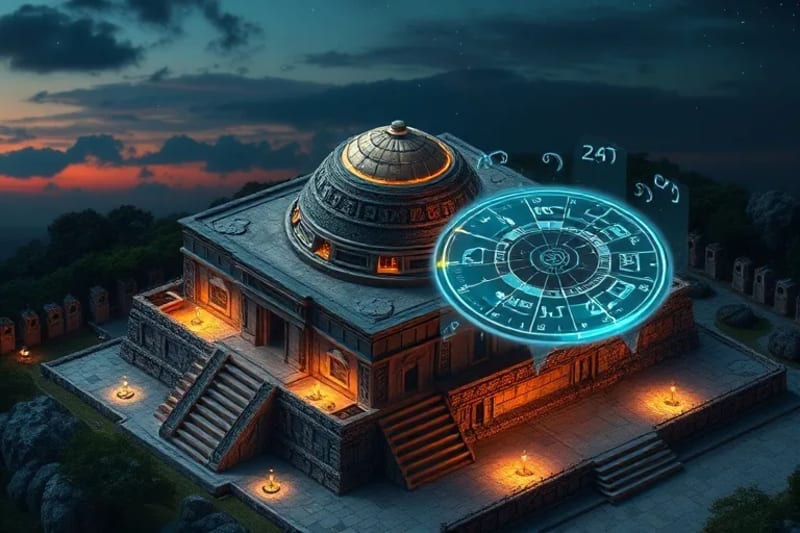
Precursors intellectuales, diagramas fundamentales y representaciones conceptuales que forjaron la visión de la astrología mesoamericana y la inteligencia artificial.
Fuente visual sujeta a disponibilidad del ecosistema: Wikimedia Commons bajo licencia CC BY-SA 4.0 o renderizado conceptual IA.
The concept of an "AI oracle" is not about replacing human intuition or spiritual connection, but rather about augmenting our ability to process and understand vast amounts of information. By applying advanced computational methods to the structured data of Mesoamerican calendars, we can potentially uncover patterns and correlations that have remained hidden or difficult to discern through traditional means.
Table of Contents
- The Foundations of Mesoamerican Astrology
- Decoding Ancient Wisdom: Calendars and Divination
- The Rise of AI Oracles in Modern Divination
- Bridging the Gap: AI and Mesoamerican Calendars
- Algorithmic Divination: Promises and Pitfalls
- Case Studies and Future Prospects
The Foundations of Mesoamerican Astrology
Mesoamerican astrology is deeply rooted in the sophisticated calendar systems developed by civilizations such as the Maya, Aztec, and Zapotec. Unlike Western astrology, which primarily focuses on planetary positions against zodiac constellations, Mesoamerican systems are cyclical and interwoven with daily life, agricultural cycles, and cosmic events.
The two most prominent calendars are the Tzolkin (or Sacred Round), a 260-day ritual calendar, and the Haab' (or Vague Year), a 365-day civil calendar. These two cycles intermesh to form a 52-year "Calendar Round," a period of significant astrological and societal importance. The Tzolkin combines 20 day-signs with 13 numbers, creating 260 unique combinations, each carrying specific energies and prophecies.
The Haab', on the other hand, consists of 18 months of 20 days each, plus a 5-day period known as the Wayeb'. This calendar tracked agricultural seasons and civic events, ensuring harmony with the natural world. The interplay between these calendars provided a comprehensive framework for understanding time, destiny, and the will of the deities.
Beyond these, the Maya also utilized the Long Count calendar, a linear count of days from a mythological starting point, used to record historical events and predict future cycles. This complex system allowed for precise astronomical observations and long-term prophecies, reflecting a profound understanding of celestial mechanics and their influence on earthly existence. For a broader understanding of how celestial bodies influence life, one might explore concepts like Astrological Houses: Decoding Life Areas.
Decoding Ancient Wisdom: Calendars and Divination
The Tzolkin calendar was central to Mesoamerican divination. Each of the 20 day-signs (e.g., Imix, Ik', Ak'bal, K'an) possessed distinct characteristics, associated with specific deities, animals, natural phenomena, and directional energies. When combined with the 13 numbers, these created a unique energetic signature for each day.
- Day-Signs: Represent fundamental archetypes and forces. For example, 'Ik'' (Wind) is associated with breath, spirit, and communication, while 'K'an' (Maize) signifies abundance, growth, and sustenance.
- Numbers: The numbers 1 through 13 represent different phases of a cycle, from initiation (1) to completion (13), adding intensity and specific qualities to the day-sign.
- Combinations: A day like '7 Ak'bal' (7 Night/Darkness) would combine the introspective, dream-like qualities of Ak'bal with the reflective and seeking nature of the number 7, suggesting a day for inner exploration and mystery.
Priests and diviners would interpret these combinations to advise on auspicious dates for ceremonies, marriages, battles, or even personal decisions. A person's birth date within the Tzolkin system revealed their core personality traits, life path, and potential challenges, much like a natal chart in other astrological traditions. This intricate system provided a roadmap for understanding one's destiny and navigating the cosmic flow, echoing the complex interplay of fate and free will explored in Karmic Debts Gifts: Advanced North South Node Astrology.
A conceptual still-life where ancient Mesoamerican artifacts merge with modern technology, symbolizing the bridge between past divination and AI.
The Rise of AI Oracles in Modern Divination
In the 21st century, the concept of an "oracle" has expanded beyond ancient seers to include sophisticated computational systems. AI oracles leverage machine learning, natural language processing, and vast datasets to identify patterns, make predictions, and offer insights. These systems can analyze historical data, textual information, and even real-time events to generate outputs that mimic traditional divinatory readings.
The power of AI lies in its ability to process information at a scale and speed impossible for humans. For ancient systems like Mesoamerican astrology, which involve complex calculations and interpretations of symbols, AI can become a powerful tool. It can parse thousands of glyphs, correlate calendar dates with historical events, and even simulate the intricate relationships between different calendar cycles.
However, it is crucial to understand that AI oracles are not sentient beings with spiritual insight. They are sophisticated algorithms designed to recognize and extrapolate patterns. Their "divination" is based on statistical probability and learned associations from the data they are trained on. This distinction is vital for maintaining an ethical and informed approach to their use in spiritual or divinatory contexts.
Bridging the Gap: AI and Mesoamerican Calendars
The synergy between AI and Mesoamerican calendars holds immense potential. AI can be programmed to accurately calculate any date within the Tzolkin, Haab', or Long Count systems, and then cross-reference these dates with historical records, astronomical events, and even modern psychological profiles. This could lead to a deeper understanding of the energetic implications of specific calendar days.
For instance, an AI oracle could analyze thousands of recorded birth dates and their corresponding life events, identifying statistical correlations between specific Tzolkin day-signs and certain personality traits, career paths, or challenges. This data-driven approach could either validate existing interpretations or reveal entirely new layers of meaning within the ancient system.
An abstract 3D render illustrating the complex interplay of cosmic energies, ancient glyphs, and modern binary code, representing algorithmic divination.
Translating the symbolic language of Mesoamerican astrology into algorithmic logic is a significant challenge. The ancient texts are rich in metaphor and cultural context, which can be difficult for an AI to fully grasp without extensive, carefully curated training data. However, advancements in natural language processing (NLP) are making it increasingly possible for AI to interpret complex symbolic systems. This mirrors the challenges and rewards of combining different ancient systems, as seen in I Ching Astrology Combining Ancient Oracles Guidance.
Ultimately, the role of human interpretation remains paramount. AI can provide data and patterns, but the nuanced understanding, spiritual connection, and ethical application of these insights still require human wisdom. The goal is not to replace the shaman or priest, but to empower them with advanced analytical tools.
Algorithmic Divination: Promises and Pitfalls
The application of AI to ancient divinatory practices like Mesoamerican astrology comes with a unique set of advantages and disadvantages. Understanding these can help us navigate this new frontier responsibly.
| Promises of AI Oracles | Pitfalls of AI Oracles |
|---|---|
| Enhanced Accessibility: Makes complex calendar calculations and interpretations available to a wider audience, democratizing access to ancient knowledge. | Loss of Intuition: Over-reliance on algorithms may diminish the role of human intuition, spiritual connection, and symbolic understanding. |
| Speed and Efficiency: Can process vast amounts of data and generate readings much faster than human practitioners. | Over-simplification: AI might reduce complex spiritual concepts and metaphors to mere data points, losing their profound depth. |
| Pattern Recognition: Capable of identifying subtle correlations and patterns in calendar data that might be missed by human analysis. | Data Bias: The quality and bias of the training data can lead to skewed or inaccurate interpretations, perpetuating existing biases. |
| Cross-Cultural Comparison: Facilitates comparative studies between different ancient astrological systems, revealing universal principles. | Spiritual Authenticity: Concerns about whether algorithmic outputs can truly convey the spiritual and sacred essence of ancient practices. |
| Educational Tools: Can create interactive learning platforms for students and researchers to explore Mesoamerican astrology. | Ethical Concerns: Questions regarding data privacy, responsible use of divinatory insights, and potential for misuse. |
Navigating these aspects requires a balanced approach, where AI is seen as a tool for exploration and analysis, rather than a definitive source of spiritual truth. The underlying principles of manifestation and divine laws, as discussed in Bio-Astral Projection: Conscious Journeys Through Starlight, still rely on human consciousness and intention.
Case Studies and Future Prospects
While the field is still nascent, hypothetical case studies illustrate the potential of AI in Mesoamerican astrology. Imagine an AI analyzing historical records of significant droughts or political upheavals in ancient Mesoamerica, correlating these events with specific conjunctions or patterns within the Tzolkin and Haab' calendars. Such analysis could reveal previously unrecognized cyclical influences.
Furthermore, AI could be used to create personalized "birth charts" based on Mesoamerican calendar systems. Users could input their birth date, and the AI would not only calculate their Tzolkin day-sign and number but also provide an interpretation based on a vast database of ancient texts and modern correlations. This could offer individuals a unique perspective on their personal destiny and challenges.
The future prospects include interactive AI platforms that allow users to explore the intricacies of Mesoamerican calendars, simulate historical divinations, and even generate artistic representations of their personal calendar glyphs. This fusion of ancient wisdom and modern technology promises to make these profound systems more accessible and engaging for a global audience, fostering a deeper appreciation for the intellectual achievements of ancient civilizations.
The evolution of divination in a technological age is not about replacing the old but enriching it. By carefully integrating AI tools, we can unlock new dimensions of understanding in Mesoamerican astrology, ensuring its wisdom continues to guide and inspire future generations.
Related Searches & Advanced Topics
For those interested in exploring further, the intersection of ancient wisdom and modern analytical tools offers numerous avenues. Consider delving into the specifics of how different cultures have interpreted celestial mechanics and their impact on human experience.
- 28 Lunar Mansions Chinese Astrology: Destiny Mapping
- Mundane Astrology: Planetary Cycles, Global Events
- AI Dream Interpretation: Decoding Symbolic Language Algorithmic Insights
- Chakra Balancing Basics: Aligning Energy Centers | StarPluto
Source: Hybrid content assisted by AI and human editorial supervision.


Comments
Post a Comment