
Cosmic Sociology AI Global Consciousness Digital Age
Cosmic Sociology AI Global Consciousness Digital Age
The confluence of cosmic sociology, artificial intelligence (AI), and the evolving landscape of global consciousness presents a fascinating frontier for interdisciplinary study. As humanity navigates an increasingly digital age, understanding the subtle and overt shifts in collective awareness becomes paramount. This exploration delves into how celestial mechanics, often viewed through an astrological lens, can offer a unique framework for mapping these profound transformations, augmented by the analytical power of AI.
1. Cosmic Sociology: Interplay of Cosmos and Society
Cosmic sociology, a nascent field, posits that human societies and their collective consciousness are not isolated phenomena but are intricately linked to broader cosmic patterns and energies. This perspective extends beyond terrestrial influences, suggesting that celestial events and planetary alignments may subtly or profoundly shape societal trends, cultural evolution, and even individual psychological states on a mass scale.
Historically, various cultures have observed and documented correlations between astronomical occurrences and earthly affairs, from agricultural cycles to political upheavals. While often dismissed as superstition, modern cosmic sociology seeks to re-examine these connections through a rigorous, interdisciplinary lens, integrating insights from astrophysics, psychology, anthropology, and data science.
The core hypothesis is that the universe is a dynamic, interconnected system where every component influences every other. Therefore, shifts in the celestial sphere—such as planetary movements, solar flares, or even the gravitational waves from distant cosmic events—could potentially resonate with and influence the collective human psyche, leading to discernible patterns in global consciousness.
 A visual representation of the intricate dance between cosmic forces, artificial intelligence, and the evolving global consciousness.
2. AI and Consciousness: Digital Age Implications
The advent of artificial intelligence introduces an unprecedented tool for analyzing and potentially understanding these complex cosmic-societal interactions. AI's capacity for processing vast datasets, identifying subtle patterns, and predicting trends far exceeds human capabilities, making it an ideal partner for cosmic sociological research.
In the digital age, global consciousness is increasingly mediated and shaped by digital platforms. Social media, news algorithms, and interconnected communication networks create a real-time, observable manifestation of collective thought, emotion, and behavior. AI can analyze this digital footprint to detect shifts in sentiment, emerging trends, and collective psychological states on a global scale.
For instance, AI algorithms can be trained to correlate specific celestial events with measurable changes in global mood indicators, economic activity, or even patterns of political unrest. By cross-referencing astronomical data with vast repositories of human-generated digital content, AI could potentially uncover previously hidden correlations, offering empirical support for cosmic sociological theories.
The implications of this convergence are profound. If AI can accurately map how cosmic energies influence global consciousness, it could lead to new predictive models for societal development, conflict resolution, and even public health. This requires a careful ethical framework, however, to ensure that such powerful insights are used responsibly.
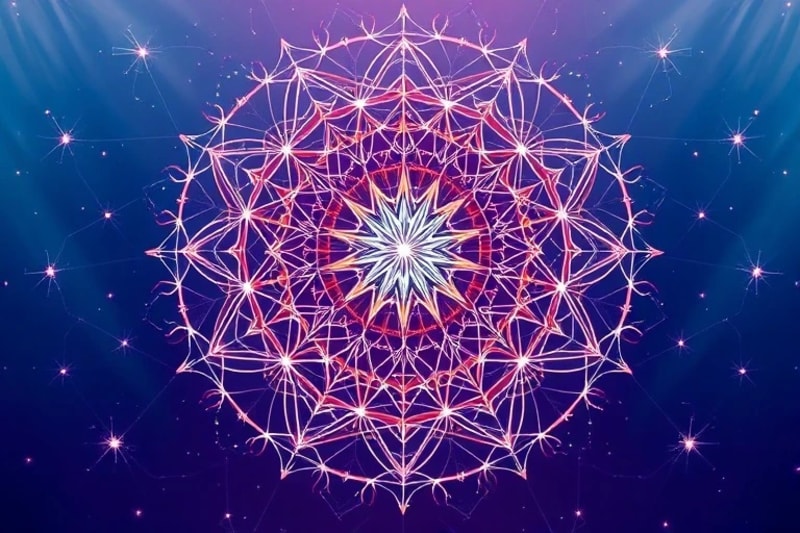 Abstract representation of global consciousness as an intricate network of luminous digital threads.
3. Celestial Mechanics: Astrological Framework
Celestial mechanics, the study of the motions of celestial bodies, forms the bedrock of astrological interpretation. While traditional astrology often focuses on individual natal charts, a cosmic sociological approach extends these principles to the collective. The precise movements and interactions of planets, asteroids, and other cosmic entities are believed to create an energetic backdrop against which human events unfold.
Key astrological concepts, such as planetary aspects (the angular relationships between planets), ingresses (when a planet enters a new zodiac sign), and retrogrades, describe specific energetic shifts. For instance, a challenging aspect between two outer planets, like Saturn and Pluto, is often associated with periods of significant societal restructuring, power struggles, and deep transformation. These macro-level astrological configurations can be seen as cosmic "weather patterns" influencing the global psychological climate.
The study of Lunar Nodes, for example, offers insights into collective karmic paths and evolutionary directions. These nodal axes represent points of spiritual growth and challenge for humanity as a whole. By tracking their movements through different zodiac signs and houses, researchers can identify periods where humanity is collectively pushed towards certain lessons or developments.
Furthermore, the concept of Mundane Astrology specifically applies astrological principles to world events, nations, and collective trends. It examines the charts of countries, significant historical moments, and major planetary cycles to understand global dynamics. Integrating AI with mundane astrology could allow for the analysis of vast historical data, correlating celestial patterns with geopolitical shifts, economic cycles, and cultural movements with unprecedented precision.
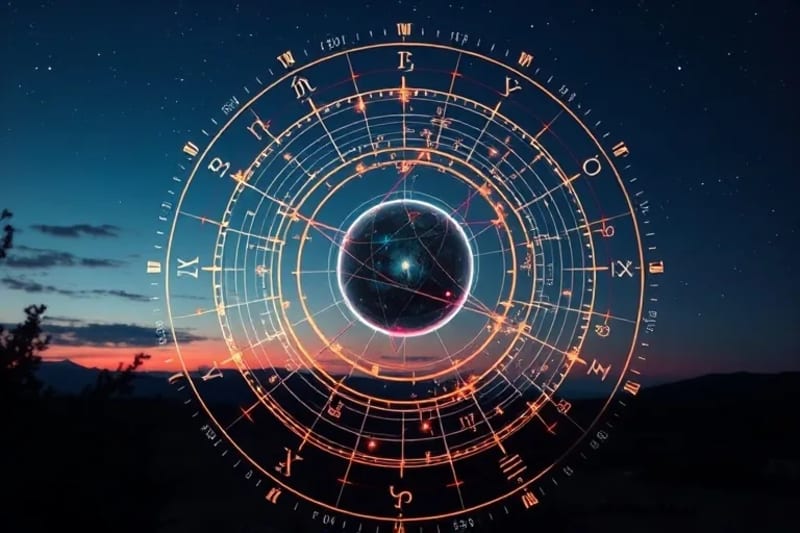 An intricate scientific illustration depicting celestial mechanics, enhanced with subtle digital data visualizations.
4. Planetary Influences: Mapping Global Shifts
Each planet in astrology is associated with specific archetypal energies and societal functions. Their movements and interactions are believed to trigger corresponding shifts in global consciousness. For instance, the outer planets—Uranus, Neptune, and Pluto—are particularly significant for generational and societal change due to their slow orbits and profound influence.
- Uranus: Represents innovation, disruption, revolution, and technological advancement. Its transits often coincide with periods of sudden societal upheaval, scientific breakthroughs, and shifts towards greater individual freedom or collective awakening.
- Neptune: Symbolizes spirituality, idealism, dissolution, and collective unconscious processes. Its influence can manifest as widespread spiritual movements, artistic renaissances, but also confusion, deception, or the erosion of old structures.
- Pluto: Governs transformation, power, death, and rebirth. Pluto's transits are associated with deep societal purging, the exposure of hidden truths, and fundamental shifts in power dynamics. Understanding Pluto in Houses can reveal areas of intense collective transformation.
By integrating AI with astrological ephemerides and historical data, researchers can build models to predict periods of heightened social tension, innovation, or spiritual awakening. This involves not just tracking individual planetary positions but also their complex interplay, including mutual receptions, retrogrades, and aspects to significant fixed stars. The concept of Fixed Stars and Planetary Aspects further enriches this analysis by adding another layer of cosmic influence.
The digital age provides an unprecedented amount of data to test these correlations. AI can analyze millions of news articles, social media posts, and economic indicators, looking for patterns that align with specific astrological configurations. This data-driven approach could move cosmic sociology from speculative theory to an empirically supported field, offering actionable insights into global consciousness shifts.
5. Ethical Considerations: Navigating the Future
The power to map and potentially predict global consciousness shifts, especially when combined with AI and celestial mechanics, comes with significant ethical responsibilities. The potential for misuse, manipulation, or misinterpretation of such insights is considerable, necessitating a robust framework for ethical governance.
Transparency in AI algorithms and data sources is crucial. Researchers must ensure that the models used to correlate cosmic events with societal trends are open to scrutiny and free from bias. The interpretation of results should always be presented with nuance, acknowledging the probabilistic nature of such predictions and avoiding deterministic pronouncements that could lead to fear or complacency.
Furthermore, the privacy and autonomy of individuals must be protected. While AI analyzes collective data, care must be taken to prevent the identification or targeting of specific groups or individuals based on these insights. The goal of cosmic sociology and AI should be to foster greater collective understanding and well-being, not to control or manipulate.
Ultimately, this interdisciplinary field offers a unique opportunity to deepen humanity's understanding of its place in the cosmos and its own collective evolution. By responsibly harnessing the analytical power of AI and integrating it with the ancient wisdom of celestial mechanics, we can begin to map the intricate dance of global consciousness in the digital age, guiding us towards a more informed and harmonious future.
Explore Further Insights
Source: Hybrid content assisted by AI and human editorial supervision.


Comments
Post a Comment