
Cosmic Sociology: Global Consciousness, Celestial Mechanics, Digital Age
Cosmic Sociology emerges as a groundbreaking interdisciplinary field, seeking to unravel the intricate connections between celestial mechanics, the evolving landscape of global consciousness, and the profound impact of the digital age on human society. This discipline transcends traditional boundaries, integrating insights from astronomy, sociology, psychology, and digital studies to offer a holistic understanding of humanity's place within the cosmos.
In an era defined by unprecedented technological advancement and increasing global interconnectedness, the need to explore how cosmic phenomena might subtly influence collective human experiences becomes ever more pertinent. Cosmic Sociology posits that our shared reality is not merely shaped by terrestrial forces but also by the grand ballet of planets, stars, and galaxies, mediated and amplified through our digital networks.
Table of Contents
- The Foundations of Cosmic Sociology
- Celestial Mechanics and Human Systems
- Global Consciousness in the Digital Era
- Ethical and Societal Implications
- Future Directions and Research
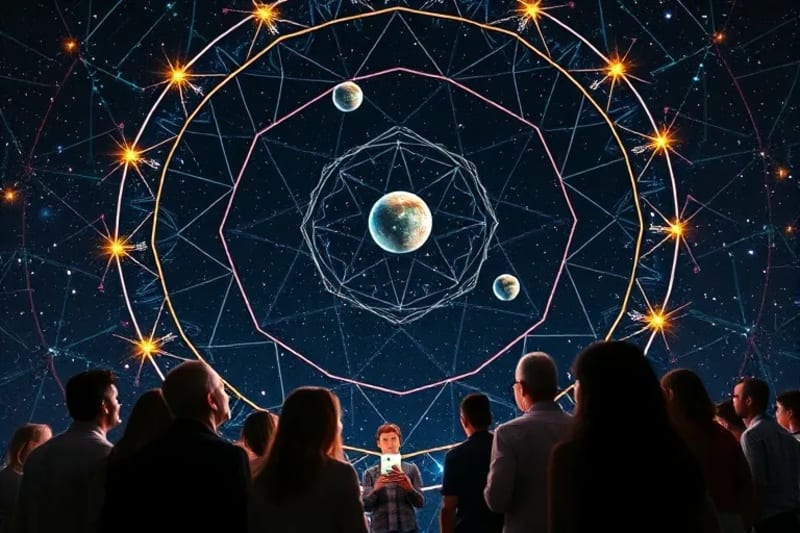
Precursors intellectuales, diagramas fundamentales y representaciones conceptuales que forjaron la visión de la humanidad sobre la interconexión cósmica y social.
Fuente visual sujeta a disponibilidad del ecosistema: Wikimedia Commons bajo licencia CC BY-SA 4.0 o renderizado conceptual IA.
The Foundations of Cosmic Sociology
The roots of Cosmic Sociology can be traced back to ancient civilizations, where the movements of celestial bodies were intimately linked to human destiny and societal structures. From Babylonian astrology to Mayan cosmology, early human societies meticulously observed the heavens, believing that planetary alignments and stellar patterns held profound significance for earthly affairs.
These historical perspectives, though often dismissed as superstition by modern science, laid the groundwork for understanding humanity's innate desire to find meaning in the cosmos. Modern astronomy and space exploration have since demystified many celestial phenomena, yet the underlying question of cosmic influence on human collective behavior persists, albeit through new lenses.
The concept of global consciousness, a collective awareness or interconnectedness among all humans, further enriches this foundation. Philosophers and mystics have long speculated about such a phenomenon, but the digital age has provided tangible evidence of its emergence, through instant global communication and shared experiences. This collective mind, now amplified by technology, may be more susceptible to subtle cosmic rhythms than previously imagined.
Celestial Mechanics and Human Systems
Celestial mechanics, the study of the motions of celestial bodies, offers a framework for understanding the precise and predictable dance of our solar system. While direct causal links between planetary positions and human events are scientifically unproven, Cosmic Sociology explores more nuanced correlations. For instance, the gravitational pull of the moon influences tides, and some studies suggest it might also affect biological rhythms or even collective psychological states, leading to phenomena explored in Full Moon Rituals: Zodiac Cleansing Guide.
Solar flares and geomagnetic storms, originating from our sun, are known to disrupt satellite communications and power grids. Beyond these technological impacts, research is slowly beginning to investigate potential subtle effects on human physiology and collective mood patterns. The digital age, with its constant flow of information, could either buffer or exacerbate these influences, creating a complex feedback loop.
Astrology, often viewed as a pseudoscience, provides a historical and cultural lens through which to examine perceived cosmic influences. While modern Cosmic Sociology approaches these topics with scientific rigor, it acknowledges the enduring human fascination with how celestial bodies, like Venus in Astrology, might symbolize aspects of human experience. The challenge lies in distinguishing cultural interpretations from empirically verifiable correlations.
The intricate dance of celestial bodies and their potential echoes in the human digital realm.
Global Consciousness in the Digital Era
The digital age has fundamentally transformed how humanity perceives itself and its place in the universe. The internet acts as a vast neural network, connecting billions of minds in real-time, facilitating the rapid spread of ideas, emotions, and collective trends. This unprecedented connectivity has given rise to what many describe as an emergent global consciousness, a shared mental space where collective thoughts and feelings coalesce.
Within this digitally enhanced global consciousness, cosmic events, from meteor showers to eclipses, are instantly shared and discussed, often triggering collective emotional responses. The shared experience of witnessing a rare astronomical phenomenon, amplified by social media, can create moments of profound unity and wonder across geographical and cultural divides. This collective experience can be seen as a form of Spiritual Growth Through Inner Worlds, extended to a global scale.
Cosmic Sociology examines how this digital interconnectedness might mediate or even amplify the subtle influences of celestial mechanics. Are global mood swings, market fluctuations, or even geopolitical tensions subtly correlated with specific planetary alignments or solar activity? While speculative, this line of inquiry opens new avenues for understanding the complex interplay between the macrocosm and the human microcosm.

A blend of ancient observation, scholarly pursuit, and modern information technology.
Ethical and Societal Implications
The exploration of Cosmic Sociology carries significant ethical and societal implications. It is crucial to approach this field with a commitment to scientific rigor, avoiding deterministic or fatalistic interpretations of cosmic influences. The goal is not to predict individual destinies based on stars, but to understand broad patterns of collective behavior and consciousness.
Promoting scientific literacy is paramount to ensure that discussions around celestial mechanics and global consciousness are grounded in evidence rather than misinformation. Cosmic Sociology encourages a balanced perspective, acknowledging humanity's profound connection to the cosmos while upholding the principles of critical thinking and empirical validation. This approach is vital when considering complex topics like Archetypal Planetary Transits.
Furthermore, this field can foster a sense of cosmic citizenship, reminding us that despite our differences, we are all inhabitants of a shared planet, orbiting a common star, within an immense universe. This perspective can inspire greater unity, cooperation, and a shared responsibility for our collective future, both on Earth and beyond.
Future Directions and Research
The future of Cosmic Sociology lies in robust interdisciplinary research. This will involve collaborations between astrophysicists, sociologists, cognitive scientists, and data analysts. Leveraging advancements in AI and big data analytics, researchers can analyze vast datasets of human behavior (social media trends, economic indicators, public sentiment) against astronomical data (solar activity, planetary alignments) to identify potential correlations.
Specific areas of research could include studying the impact of solar cycles on global economic trends, the correlation between major astronomical events and shifts in collective mood or social movements, and the psychological effects of space exploration on global consciousness. The integration of quantum sociology and the study of Quantum Ethics in AI could also provide novel theoretical frameworks for understanding these subtle interactions.
Ultimately, Cosmic Sociology aims to deepen our understanding of the human condition by placing it within its grand cosmic context. It encourages us to look both inward, at the complexities of human consciousness, and outward, at the vastness of the universe, recognizing the inseparable dance between the two. This holistic approach promises to unlock new insights into what it means to be human in a cosmic age.
The cosmos is within us. We are made of star-stuff. We are a way for the universe to know itself.
— Carl Sagan
The journey into Cosmic Sociology is just beginning, offering a compelling vision of a future where humanity's scientific understanding and spiritual quest converge. By embracing this interdisciplinary challenge, we can better navigate the complexities of our global society and our place in the universe, fostering a more informed and harmonious existence.
Explore More Cosmic Connections
Source: Hybrid content assisted by AI and human editorial supervision.


Comments
Post a Comment