
Cosmic Sociology Mapping Global Consciousness Trends
Cosmic sociology emerges as a fascinating interdisciplinary field, seeking to understand the intricate relationship between celestial mechanics and global consciousness trends. This innovative approach posits that planetary movements and astronomical phenomena do not merely influence individual destinies but also exert subtle yet profound effects on the collective human psyche, shaping societal patterns, cultural shifts, and historical trajectories. By analyzing vast datasets of human behavior, societal events, and astrological configurations, cosmic sociology aims to uncover hidden correlations and predictive insights into our shared human experience.
The concept challenges conventional sociological frameworks by introducing a cosmic dimension, suggesting that the "zeitgeist" of an era might be intrinsically linked to the celestial ballet unfolding above us. It moves beyond individual horoscopes to explore how planetary energies manifest on a macro scale, influencing everything from economic cycles to artistic movements and geopolitical tensions. This field represents a bold step towards integrating ancient wisdom with modern scientific inquiry, offering a holistic perspective on humanity's place within the cosmos.
 A cosmic tapestry illustrating the subtle yet profound connection between celestial mechanics and the intricate web of global consciousness.
Introduction to Cosmic Sociology
Cosmic sociology is a nascent discipline that bridges the gap between astrology, astronomy, and social sciences. It investigates the hypothesis that celestial events—such as planetary conjunctions, retrogrades, and transits—correlate with observable shifts in collective human behavior, mood, and societal structures. Unlike traditional astrology, which often focuses on individual charts, cosmic sociology examines these influences on a global scale, seeking patterns in mass psychology, cultural evolution, and historical epochs.
The field draws inspiration from various sources, including Jungian synchronicity, systems theory, and the growing understanding of subtle energetic fields. Researchers in cosmic sociology employ statistical analysis, historical data mining, and qualitative research to identify recurring themes and correlations. The ultimate goal is to develop a more comprehensive model of human society that accounts for both terrestrial and extraterrestrial influences, providing a deeper understanding of why and how humanity evolves.
The Foundations of Celestial Mechanics
At the heart of cosmic sociology lies celestial mechanics, the branch of astronomy that deals with the motions of celestial bodies. Understanding the precise orbits, positions, and interactions of planets, moons, and other cosmic entities is fundamental. These movements create predictable cycles and geometric relationships that are believed to resonate with energetic frequencies impacting Earth and its inhabitants. The gravitational pulls, electromagnetic fields, and subtle energy emissions from these bodies are hypothesized to act as catalysts for collective shifts.
Ancient civilizations meticulously tracked these celestial cycles, attributing significant meaning to planetary alignments and solar events. Modern cosmic sociology re-examines these ancient observations through a contemporary lens, utilizing advanced computational tools to map these cycles against historical events and social data. The precision of celestial mechanics allows for accurate forecasting of these cosmic influences, offering a framework for anticipating potential collective trends.
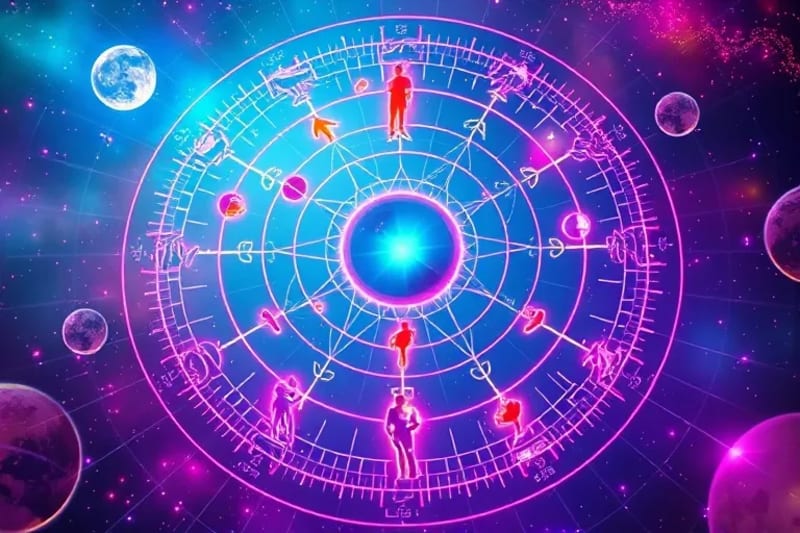 An artistic representation of planetary orbits and their dynamic influence on human consciousness across the globe.
Mapping Global Consciousness: Methodologies
Mapping global consciousness trends requires innovative methodologies that integrate diverse data sources. Researchers in cosmic sociology often employ:
- Big Data Analysis: Examining vast datasets of social media sentiment, global news trends, economic indicators, and public opinion polls to identify collective emotional states and behavioral patterns.
- Historical Correlation: Overlaying celestial charts with historical timelines to find correlations between major planetary configurations and significant societal events, such as revolutions, technological breakthroughs, or cultural renaissances.
- Psychometric Studies: Conducting large-scale psychological surveys to gauge collective attitudes, values, and beliefs, and then correlating these with ongoing celestial transits.
- Geospatial Analysis: Investigating how celestial influences might vary across different geographical locations, potentially linking to concepts like Locational Astrology or astrocartography.
These methods, while still evolving, aim to provide empirical evidence for the subtle cosmic influences on human collective experience. The challenge lies in distinguishing genuine correlations from mere coincidences and establishing robust causal or acausal links.
Planetary Cycles and Societal Shifts
Certain planetary cycles are frequently associated with specific types of societal shifts. For instance, the long cycles of outer planets like Uranus, Neptune, and Pluto are often linked to generational changes and profound transformations. Uranus, associated with innovation and rebellion, might correlate with periods of rapid technological advancement or social upheaval. Neptune, linked to spirituality and dissolution, could align with shifts in collective consciousness regarding faith, art, or the breakdown of old paradigms. Pluto, the planet of transformation and power, often coincides with periods of intense societal restructuring, death, and rebirth.
Shorter cycles, involving inner planets and their interactions, might influence more immediate trends in communication, commerce, or daily social interactions. Understanding these Celestial Mechanics Karmic Cycles Planetary Transits Destiny provides a framework for interpreting the underlying energetic currents that drive human history. The interplay of these cycles creates a complex cosmic rhythm that humanity dances to, often unconsciously.
 Interlocking geometric forms and light, symbolizing the subtle energetic influences of celestial bodies upon the collective human experience.
Synchronicity and Collective Human Experience
The concept of synchronicity, as introduced by Carl Jung, plays a vital role in cosmic sociology. Synchronicity refers to meaningful coincidences that lack a causal link but are deeply interconnected. In the context of global consciousness, cosmic sociology suggests that planetary alignments might act as archetypal patterns, triggering synchronous events and collective experiences across diverse populations.
For example, a specific planetary transit might coincide with a global surge in creative expression, a collective yearning for peace, or a widespread feeling of anxiety. These are not seen as direct causal effects in a linear sense, but rather as manifestations of an underlying cosmic order that resonates with the human psyche. Understanding these synchronous moments can offer profound insights into the evolution of human consciousness and our collective journey. The North Node Transits Personal Planets, for instance, can highlight periods of collective evolutionary growth, pushing humanity towards new directions and understanding.
Challenges and Future Directions in Cosmic Sociology
Despite its promising potential, cosmic sociology faces several challenges. The primary hurdle is establishing robust empirical evidence that can withstand scientific scrutiny. This involves developing sophisticated statistical models to account for confounding variables and demonstrating repeatable correlations. Additionally, the field must navigate the skepticism often associated with astrology, by grounding its theories in observable phenomena and rigorous research methods.
Future directions for cosmic sociology include leveraging artificial intelligence and machine learning to process vast amounts of data, identifying subtle patterns that human analysis might miss. Interdisciplinary collaboration between astronomers, sociologists, psychologists, and data scientists will be crucial. As our understanding of consciousness and the cosmos expands, cosmic sociology has the potential to offer a revolutionary perspective on human history, societal dynamics, and our collective future, guiding us towards a more harmonious existence aligned with cosmic rhythms. Embracing practices like Mindfulness Retrogrades Navigating Planetary Inner Calm could also be seen as an individual approach to aligning with these larger cosmic flows.
Explore Further
Source: Hybrid content assisted by AI and human editorial supervision.


Comments
Post a Comment