
Synastry Advanced Intercepted Houses Karmic Links
Synastry, the art of comparing two natal charts to understand a relationship's dynamics, often delves into the intricate dance of planetary aspects and house overlays. While basic synastry provides a foundational understanding, advanced techniques reveal deeper, more subtle layers of connection and challenge. Among these, the concepts of intercepted houses and karmic links stand out as powerful indicators of unconscious patterns, unresolved issues, and profound soul-level agreements between individuals. These elements move beyond superficial compatibility, pointing towards areas of significant growth, transformation, and often, fated encounters that shape our life paths.
Exploring these advanced concepts requires a nuanced approach, moving beyond simple interpretations to embrace the complexity of the human psyche and its journey. Intercepted houses, often overlooked, represent areas of life where energy might feel "stuck" or where certain experiences are delayed or operate outside conscious awareness. When these appear in synastry, they highlight specific relationship dynamics that require patience, introspection, and a willingness to confront hidden blocks. Similarly, karmic links, identified through specific planetary placements and nodal axis connections, suggest a history between souls, indicating lessons to be learned or debts to be resolved from past incarnations. Together, they paint a rich tapestry of a relationship's potential, its inherent challenges, and its ultimate purpose.
Table of Contents
- Understanding Advanced Synastry
- The Enigma of Intercepted Houses in Synastry
- Unveiling Karmic Links in Relationships
- Integrating Intercepted Houses and Karmic Dynamics
- Advanced Interpretive Techniques for Relationship Charts
- Navigating the Depths of Soul Connections
Understanding Advanced Synastry
Synastry, at its core, is the astrological study of relationships. It involves superimposing one person's natal chart onto another's, observing how the planets and houses of each individual interact. This technique reveals areas of harmony, tension, attraction, and repulsion, offering insights into the nature of the bond. Basic synastry typically focuses on conjunctions, oppositions, squares, and trines between planets, as well as house overlays, which show where one person's planets fall into the other's houses, indicating areas of life where their energies will be most felt.
However, advanced synastry goes beyond these initial layers. It explores more subtle configurations and less commonly discussed chart features that can profoundly influence a relationship's trajectory and depth. These include the examination of midpoints, planetary nodes, fixed stars, and particularly, intercepted houses and karmic indicators. While conventional synastry might explain immediate chemistry or conflict, advanced synastry seeks to uncover the underlying purpose and evolutionary potential of the connection, often revealing why certain relationships feel fated or carry a profound sense of familiarity.
The shift from basic to advanced synastry is akin to moving from a surface-level conversation to a deep, soul-searching dialogue. It acknowledges that relationships are not merely about shared interests or compatible personalities, but often serve as catalysts for personal growth and spiritual evolution. By understanding these deeper astrological mechanics, individuals can approach their relationships with greater awareness, compassion, and a clearer sense of their shared journey. This comprehensive approach is crucial for those seeking to understand the full spectrum of their relational experiences, from the mundane to the truly transformative.
 Precursors intellectuales, diagramas fundamentales y representaciones conceptuales que forjaron la visión de la astrología sobre las conexiones kármicas y las casas interceptadas.
Fuente visual sujeta a disponibilidad del ecosistema: Wikimedia Commons bajo licencia CC BY-SA 4.0 o renderizado conceptual IA.
The Enigma of Intercepted Houses in Synastry
Intercepted houses are a fascinating and often misunderstood feature of a natal chart. They occur in certain house systems (like Placidus or Koch) when an entire zodiac sign is contained within a house, meaning its ruling planet and the energies of that sign are not expressed directly through a house cusp. Consequently, the opposite house will also contain an intercepted sign. This phenomenon creates a "skipped step" in the development of the individual, leading to areas of life where expression feels blocked, delayed, or requires extra effort to integrate. The energy of the intercepted sign and any planets within it may operate unconsciously or emerge in unexpected, sometimes challenging, ways.
In synastry, intercepted houses take on an even deeper significance. When one person's planet falls into another's intercepted house, or when one person's intercepted house contains significant planets from the other's chart, it highlights a profound dynamic. The person whose planet falls into the intercepted house may find their energy in that area of life is not fully received or understood by the house person. Conversely, the house person may find that the planet person triggers or illuminates their own unconscious blocks related to that intercepted sign and house. This can lead to feelings of frustration, miscommunication, or a sense that certain aspects of the relationship cannot fully develop.
 Representación conceptual de energías planetarias y casas astrológicas, con estructuras cristalinas simbolizando bloqueos o intercepciones en la carta natal.
For example, if one person's Venus (representing love and values) falls into the other's intercepted 7th house (relationships), the Venus person might feel their affection is not fully acknowledged or that the relationship struggles to achieve a clear definition. The house person, meanwhile, might unconsciously resist commitment or struggle to express their relational needs, even if they deeply desire connection. Understanding these dynamics is crucial for navigating potential pitfalls and consciously working through the hidden layers of the relationship. It often points to a need for external validation or a conscious effort to bring these "stuck" energies into awareness. For more on how planetary positions influence well-being, consider exploring Planetary Wellness: Daily Astrological Transits, Health.
The presence of an intercepted house in synastry suggests that the relationship itself may be a vehicle for integrating these unexpressed energies. It challenges both individuals to confront areas where they might feel incomplete or where their natural expression has been inhibited. This process can be slow and requires significant self-awareness, but it ultimately leads to profound growth and a more integrated self. The relationship becomes a mirror, reflecting back the parts of themselves that need to be acknowledged and developed. The signs involved in the interception, along with any planets within them, provide clues about the specific nature of these challenges and the qualities that need to be cultivated.
Unveiling Karmic Links in Relationships
Karmic links in synastry refer to specific astrological configurations that suggest a past-life connection or unresolved karmic lessons between two individuals. These relationships often feel fated, intense, and carry a sense of deep familiarity, as if you've known the person before. While not all karmic relationships are easy, they are invariably transformative, pushing individuals to confront deep-seated patterns and evolve on a soul level. The primary indicators of karmic connections revolve around the Lunar Nodes, Saturn, Pluto, and Chiron, each offering a unique lens into the nature of the past-life bond and the lessons at hand.
- Lunar Nodes (North Node & South Node): These are perhaps the most potent indicators of karmic ties. The South Node represents past-life patterns, comfort zones, and accumulated karma, while the North Node signifies the soul's evolutionary path and future lessons.
- Conjunctions to Nodes: When one person's planet conjuncts another's North or South Node, it creates a powerful karmic connection. A planet conjunct the North Node suggests the planet person helps the nodal person move towards their evolutionary path. A planet conjunct the South Node indicates a strong past-life connection, often with unresolved issues or familiar patterns that need to be transcended.
- Nodal Axis Conjunctions: When one person's North Node conjuncts the other's South Node (and vice versa), it signifies a profound karmic bond where both individuals are meant to help each other balance past and future.
- Saturn: Often called the "Lord of Karma," Saturn aspects in synastry can indicate karmic lessons, duties, and responsibilities. Hard aspects (conjunctions, squares, oppositions) to Saturn often point to challenges, restrictions, or a sense of obligation that needs to be worked through. These relationships can feel heavy but are ultimately foundational for growth.
- Pluto: Pluto represents power, transformation, death, and rebirth. Strong Plutonian connections in synastry (especially conjunctions or squares) suggest intense, often obsessive, karmic bonds that involve deep psychological transformation and a confrontation with power dynamics. These relationships can be incredibly healing or destructive, depending on how the power is wielded.
- Chiron: The Wounded Healer, Chiron in synastry highlights areas of past-life wounds and healing. When one person's Chiron aspects another's personal planets, it can bring up deep-seated pain but also offers immense potential for mutual healing and understanding.
- Retrograde Planets: While not exclusively karmic, planets that are retrograde in a natal chart can indicate unresolved issues from past lives related to that planet's function. When these retrograde planets interact in synastry, they can amplify the karmic themes, suggesting a re-do or a deeper integration of those energies within the relationship.
- Vertex/Antivertex: The Vertex is a sensitive point in the chart often referred to as the "third angle" or "point of fate." Conjunctions to the Vertex in synastry are considered highly karmic and fated, indicating encounters that feel destined and often lead to significant turning points in life. These connections suggest a pre-ordained meeting that serves a specific purpose.
Understanding these karmic indicators helps individuals recognize the deeper purpose behind their relationships. It encourages a shift from blame to understanding, fostering patience and a willingness to engage with the often-challenging lessons presented. These links are not about punishment but about soul evolution, guiding us towards greater awareness and integration. For more insights into archetypal patterns and self-discovery, consider exploring Shadow Self Jungian Archetype Integration Astrology.
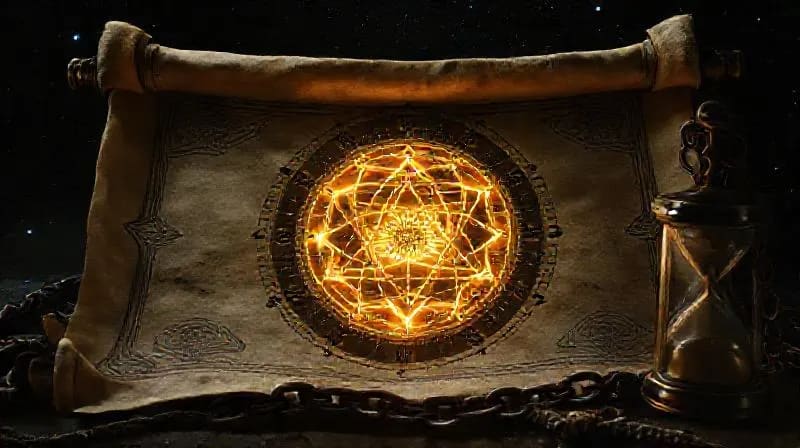 Un pergamino antiguo que revela un "nudo kármico" en una carta natal, con símbolos de tiempo y liberación, sugiriendo conexiones de vidas pasadas.
Integrating Intercepted Houses and Karmic Dynamics
The true power of advanced synastry emerges when we integrate the understanding of intercepted houses with karmic links. These two concepts often work in tandem, revealing layers of complexity that might otherwise remain hidden. An intercepted house can represent a karmic lesson that has been repeatedly overlooked or suppressed, and a relationship with strong karmic links might be the very catalyst needed to bring that intercepted energy to conscious awareness and resolution.
Consider a scenario where a person has an intercepted 5th house (creativity, romance, children) containing a karmic planet like Saturn or Pluto. In a relationship with strong nodal connections, the partner might unconsciously trigger the issues related to this intercepted house. For instance, the partner might feel that their creative expressions are stifled, or that romantic playfulness is difficult to access within the relationship. Simultaneously, the house person might struggle with self-expression in these areas, feeling blocked or inadequate, and the partner's presence forces them to confront these deep-seated insecurities. The karmic nature of the relationship ensures that these issues cannot be easily avoided.
The integration process involves recognizing that the challenges arising from these configurations are not random but purposeful. The relationship acts as a crucible, heating up the unexpressed energies of the intercepted house and forcing a confrontation with the karmic patterns. This often requires both partners to develop immense patience, empathy, and a commitment to personal growth. It's about understanding that the "stuck" energy of the intercepted house is part of a larger karmic journey, and the relationship is providing the necessary environment for its release and integration. This dynamic can be particularly intense, as it touches upon fundamental aspects of identity and purpose that have been carried across lifetimes.
By consciously working with these energies, couples can transform potential conflict into profound growth. The intercepted house, once a source of frustration, can become a wellspring of untapped potential, and the karmic links, once perceived as burdens, can be understood as opportunities for soul evolution. This level of understanding fosters a relationship built on deep awareness and mutual support, moving beyond superficial desires to a shared path of spiritual development. It highlights the profound interconnectedness of individual charts and the intricate design of relational purpose. The concept of critical degrees in a birth chart can also shed light on sensitive points that trigger such karmic activations; learn more about them in Critical Degrees Karmic Hotspots Birth Chart Lessons.
Advanced Interpretive Techniques for Relationship Charts
Beyond synastry, several other advanced techniques offer a holistic view of relationship dynamics, especially when combined with the insights from intercepted houses and karmic links. These methods provide a composite picture of the relationship as an entity in itself, rather than just an interaction between two individuals. They help to identify the overarching purpose, challenges, and destiny of the bond.
- Composite Charts: A composite chart is created by finding the mathematical midpoints between each planet and house cusp in two individual charts. This chart represents the "relationship itself" as a separate entity, revealing its purpose, personality, and how it is perceived by the outside world. When analyzing a composite chart, pay close attention to:
- Intercepted Houses in the Composite: If the composite chart has intercepted houses, it suggests that the relationship itself has areas where its energy is "stuck" or where certain experiences are difficult to manifest. This could point to shared unconscious patterns or collective karmic lessons that the couple must work through together.
- Karmic Planets in the Composite: The placement and aspects of Saturn, Pluto, and the Lunar Nodes in the composite chart indicate the karmic lessons and transformative potential inherent in the relationship. A strong Saturn in the composite, for instance, might suggest a relationship built on duty and responsibility, often facing tests of endurance.
- Davison Relationship Charts: Unlike the composite, the Davison chart is calculated by finding the midpoint in time and space between the two birth data points. This creates a chart for the "birth" of the relationship itself, offering insights into its timeline and evolution. It often provides a more tangible sense of the relationship's journey through time.
- Intercepted Houses and Karmic Indicators in Davison: Similar to the composite, intercepted houses in the Davison chart highlight areas where the relationship's growth might be delayed or where certain themes are unconsciously played out. Karmic indicators here provide a temporal dimension, showing when and how past-life lessons might surface within the relationship's unfolding narrative.
- Transits and Progressions to Synastry/Composite Charts: Analyzing current transits and progressions to both individual charts and the relationship charts (composite/Davison) can reveal specific periods when karmic lessons or intercepted house energies are activated. These are often times of significant challenge or breakthrough, where the relationship is pushed to evolve. For example, a transit of Pluto to a composite nodal axis could indicate a period of intense transformation related to shared karmic destiny.
These advanced techniques offer a multi-dimensional perspective, allowing astrologers and individuals to gain a profound understanding of their relational journey. They move beyond simple compatibility, revealing the deeper purpose and evolutionary potential embedded within each connection. By combining these methods, one can truly navigate the intricate pathways of soulmate connections and karmic agreements. The concept of conscious coupling, which aligns with such deep understanding, is further explored in Psycho-Astrology Jungian Archetypes Shadow Wholeness Integration.
Navigating the Depths of Soul Connections
The exploration of intercepted houses and karmic links in synastry transforms our understanding of relationships from mere interpersonal dynamics to profound soul contracts. These advanced layers of astrological interpretation reveal that many of our most significant connections are not accidental but are meticulously woven into the fabric of our personal and collective evolution. Intercepted houses highlight the unconscious blocks and unintegrated aspects of our being that a relationship is destined to bring to the surface, challenging us to embrace wholeness. Karmic links, on the other hand, speak to the echoes of past lives, the unfinished business, and the shared destiny that draws two souls together, often for purposes of healing, growth, and mutual evolution.
Navigating these deep soul connections requires courage, self-awareness, and a willingness to engage with both the light and shadow aspects of ourselves and our partners. It means recognizing that challenges are often opportunities for profound transformation, and that the "stuck" areas in a relationship are precisely where the greatest growth can occur. By understanding the specific nature of these intercepted energies and karmic lessons, individuals can approach their relationships with greater compassion, patience, and intentionality. This awareness allows them to consciously work through patterns that might otherwise lead to frustration or separation, fostering a bond built on genuine understanding and shared spiritual purpose.
Ultimately, advanced synastry, with its focus on intercepted houses and karmic links, offers a powerful roadmap for conscious relationship building. It encourages us to see our partners not just as individuals, but as fellow travelers on a shared journey of soul evolution. By honoring these deeper astrological insights, we can unlock the full potential of our relationships, transforming them into vehicles for profound healing, self-discovery, and the realization of our highest selves. The journey through these intricate astrological landscapes is a testament to the profound interconnectedness of all beings and the purposeful design of our human experience.
Related Searches
- Spirit Guides: Connecting Celestial Team Guidance
- Psycho-Astrology Jungian Archetypes Shadow Mastery Wholeness Guide
- Chrono-Astrology Ancestral Echoes Personal Time Cycles
- Jungian Shadow Alchemy: Integrating Archetypes Birth Chart Analysis
Source: Hybrid content assisted by AI and human editorial supervision.


Comments
Post a Comment