
Cosmic Sociology: Mapping Global Consciousness Trends
Cosmic Sociology emerges as a groundbreaking interdisciplinary field, seeking to understand and predict global consciousness trends by integrating the ancient wisdom of celestial mechanics with the cutting-edge capabilities of artificial intelligence. This innovative approach moves beyond traditional sociological analyses, proposing that planetary alignments and cosmic energies may exert subtle, yet discernible, influences on collective human behavior, thought patterns, and societal developments. By leveraging AI's capacity for complex data analysis, Cosmic Sociology aims to uncover hidden correlations and predictive models that could revolutionize our understanding of humanity's place within the cosmos.

A futuristic observatory visualizes the intricate dance between celestial mechanics and global data streams, illustrating the core principles of Cosmic Sociology.
Fuente visual sujeta a disponibilidad del ecosistema: Wikimedia Commons bajo licencia CC BY-SA 4.0 o renderizado conceptual IA.The concept posits that just as individual astrological transits can influence personal well-being, as explored in Planetary Wellness: Daily Astrological Transits, Health, larger celestial patterns might resonate with the collective psyche, shaping cultural shifts, economic cycles, and even major historical events. This field does not seek to replace conventional sociology but rather to augment it with a cosmic perspective, offering a more holistic framework for interpreting the intricate dynamics of global consciousness.
The integration of AI is crucial, as the sheer volume and complexity of both astronomical data and global human behavior data (social media trends, economic indicators, public sentiment) far exceed human analytical capabilities. AI algorithms can identify subtle correlations, predict emergent patterns, and even model potential future scenarios based on the interplay of these diverse data sets, opening new avenues for research and understanding.
This article will delve into the foundational principles of Cosmic Sociology, explore its historical antecedents, detail the methodologies employed, and discuss its potential applications and ethical implications. We aim to provide an introductory yet comprehensive overview for those curious about this fascinating convergence of ancient wisdom and modern technology.
Understanding Cosmic Sociology
Cosmic Sociology is defined as the systematic study of the relationship between celestial phenomena and collective human consciousness, utilizing advanced computational methods, particularly artificial intelligence, to identify patterns, correlations, and predictive insights. It operates on the premise that the universe is an interconnected system, and humanity, as an integral part of this system, is not immune to its larger rhythms and forces.
This field challenges the purely mechanistic view of society, suggesting that external cosmic influences, often dismissed by mainstream science, might play a more significant role than previously acknowledged. It bridges the gap between the macrocosm (the universe) and the microcosm (human society), proposing that the energetic signatures of planetary movements could subtly influence collective moods, aspirations, and decision-making processes on a global scale.
Unlike traditional astrology, which often focuses on individual horoscopes, Cosmic Sociology is concerned with broad, aggregate trends. It seeks to identify how specific astrological configurations correlate with large-scale societal phenomena, such as periods of innovation, conflict, economic prosperity, or spiritual awakening. The goal is not to predict individual fates but to map the ebb and flow of global consciousness.
Historical Roots of Celestial Influence
The idea that celestial bodies influence human affairs is as old as civilization itself. Ancient cultures across the globe, from the Babylonians and Egyptians to the Mayans and Chinese, developed sophisticated systems of astrology and celestial observation. They believed that the movements of planets and stars were intimately connected to earthly events, including the rise and fall of empires, agricultural cycles, and human temperament.
For millennia, astronomy and astrology were intertwined, with scholars meticulously charting celestial movements and interpreting their symbolic meanings. These ancient practices, while often seen as superstitious by modern science, laid the groundwork for understanding cyclical patterns and the potential for cosmic resonance. The rich tapestry of Astro-Archeology Unearthing Ancient Celestial Narratives Civilizations provides ample evidence of humanity's long-standing fascination with the cosmic connection.
Even during the Enlightenment, when scientific rationalism began to dominate, some thinkers continued to explore these connections, albeit often on the fringes of accepted academia. The challenge has always been the lack of empirical tools to rigorously test these hypotheses. This is where modern AI and big data analytics offer a transformative opportunity, allowing for the analysis of vast datasets that were previously unimaginable.
The Role of Artificial Intelligence
Artificial intelligence is the indispensable engine driving Cosmic Sociology. Its ability to process, analyze, and find patterns in massive, disparate datasets is critical for this field. Traditional statistical methods often fall short when dealing with the non-linear, complex relationships between celestial mechanics and nuanced human behaviors.
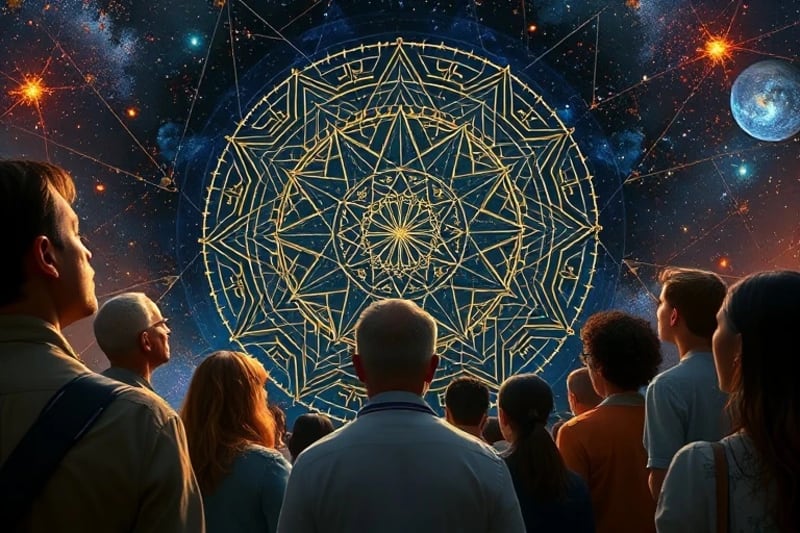
A diverse collective observes a celestial map, subtly enhanced by AI-driven data streams, symbolizing the integration of human experience and cosmic patterns.
Machine learning algorithms, particularly deep learning and neural networks, can identify subtle correlations between planetary positions, aspects, and various indicators of global consciousness. These indicators might include sentiment analysis from social media, global economic indices, public health data, cultural production trends, and even collective psychological states inferred from large textual corpora.
Furthermore, AI can help filter out noise and identify genuine signals from spurious correlations. By building sophisticated predictive models, AI can test hypotheses about cosmic influences on a scale and with a precision impossible for human researchers alone. This allows for an empirical, data-driven approach to questions that have long been confined to speculative or anecdotal realms.
The application of AI in this context also raises fascinating questions about the nature of consciousness itself, echoing discussions in Quantum Physics Non-Dual Consciousness Metaphysical Exploration. If AI can detect a cosmic influence on collective human thought, it suggests a deeper, perhaps quantum-entangled, connection between mind and matter on a universal scale.
Methodologies of Mapping Consciousness
The methodology of Cosmic Sociology involves several key steps, each leveraging AI and big data:
- Data Collection: This involves gathering vast amounts of data from two primary domains:
- Celestial Data: Precise ephemeris data, planetary positions, aspects, lunar cycles, solar activity, and other astronomical phenomena over extended historical periods.
- Global Consciousness Data: Aggregated, anonymized data reflecting collective human behavior and sentiment. This can include:
- Social media trends and sentiment analysis (e.g., global mood shifts).
- Economic indicators (stock market fluctuations, consumer confidence).
- Cultural production (e.g., themes in popular art, music, literature).
- Public health data (e.g., mental health trends, disease outbreaks).
- Geopolitical events and conflict patterns.
- Feature Engineering: Transforming raw data into features that AI algorithms can process. For celestial data, this might involve calculating specific astrological aspects, midpoints, or planetary strength indicators. For consciousness data, it could involve creating indices of collective optimism, anxiety, or innovation.
- Pattern Recognition and Correlation: Using machine learning models (e.g., recurrent neural networks, deep neural networks) to identify non-obvious correlations between celestial patterns and consciousness trends. This step is crucial for discovering previously unknown relationships.
- Predictive Modeling: Developing models that can forecast future trends in global consciousness based on upcoming celestial configurations. These models would be continuously refined and validated against new data.
- Validation and Interpretation: Rigorously testing the predictive power of the models and interpreting the findings in a sociologically meaningful context. This involves cross-referencing with historical events and existing sociological theories.
The interdisciplinary nature of this research requires collaboration between astronomers, astrologers, sociologists, psychologists, and AI specialists to ensure comprehensive and robust analysis.
Applications and Societal Impact
The potential applications of Cosmic Sociology are vast and could have significant societal impact:
- Predicting Social Trends: By understanding the cosmic influences on collective consciousness, societies might better anticipate periods of social unrest, innovation, or shifts in cultural values. This could inform policy-making, resource allocation, and public awareness campaigns.
- Economic Forecasting: If celestial mechanics correlate with collective mood and confidence, it could offer new layers of insight for economic forecasting, potentially identifying periods of market volatility or growth.
- Understanding Historical Cycles: Cosmic Sociology could provide a new lens through which to analyze historical events, revealing underlying cosmic rhythms that may have influenced major turning points in human history.
- Enhancing Well-being: A deeper understanding of collective consciousness could lead to strategies for fostering global harmony, resilience, and mental well-being, by aligning human activities with cosmic energies.
- Personal and Collective Growth: Individuals and groups could use these insights to better navigate challenging periods or capitalize on auspicious cosmic windows, much like how Alineación Profesional Carta Astral: Vocación Kármica y Éxito guides personal career paths.
While the field is nascent, its potential to offer a more integrated view of human existence within the cosmic tapestry is profound. It invites us to reconsider the boundaries of influence and connection, moving towards a more interconnected worldview.
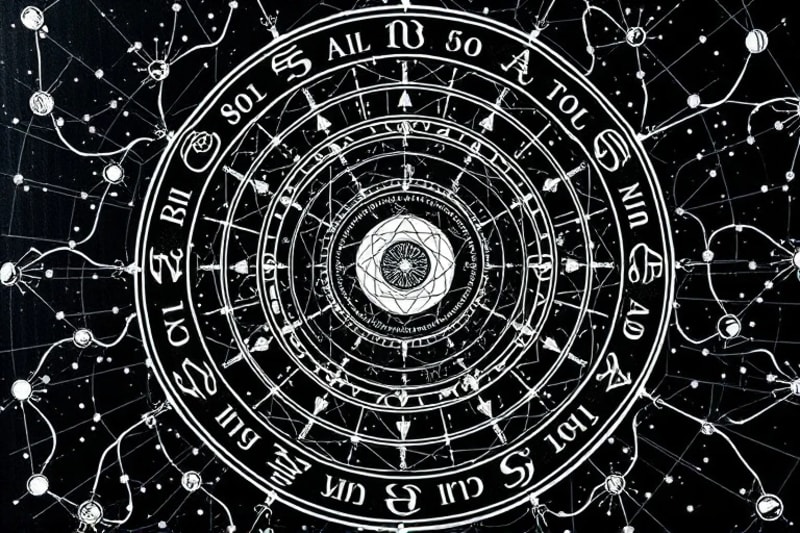
An abstract 3D render depicts neural network pathways merging with planetary orbits and zodiac symbols, illustrating the complex data fusion in Cosmic Sociology.
Ethical Considerations and Future Prospects
As with any powerful predictive tool, Cosmic Sociology comes with significant ethical considerations. The ability to predict collective consciousness trends could be misused, leading to manipulation or control. Therefore, transparency, ethical guidelines, and robust oversight are paramount to ensure that these insights are used for the greater good of humanity.
Data privacy and the potential for algorithmic bias must also be carefully addressed. While the data used for global consciousness trends would ideally be aggregated and anonymized, the sheer scale of data collection necessitates strict ethical protocols to protect individual liberties and prevent discriminatory outcomes.
The future of Cosmic Sociology lies in continued interdisciplinary research, the development of more sophisticated AI models, and the accumulation of long-term data sets. As our understanding of both the cosmos and human consciousness evolves, so too will the capabilities of this field. It represents a bold step towards a more integrated science, one that embraces the subtle yet profound connections between the universe and the human experience.
Ultimately, Cosmic Sociology invites us to view ourselves not as isolated entities, but as integral components of a vast, dynamic cosmic dance. By mapping these intricate rhythms, we may gain unprecedented insights into our collective journey and the future of global consciousness.
Explore Further Insights
-
Zi Wei Dou Shu Career Mapping: Unveiling Destiny Paths
Discover how ancient Chinese astrology maps individual career destinies, offering a complementary perspective to global consciousness trends.
-
Remote Viewing: Perception Beyond Physical Boundaries | StarPluto
Delve into the concept of non-local perception, which aligns with the idea of interconnected consciousness influenced by cosmic forces.
-
Composite Charts: Unveiling the Soul of a Relationship | StarPluto
Understand how astrological charts can reveal the dynamics of collective entities, from relationships to larger societal groups, through a cosmic lens.
-
Minor Asteroids Natal Chart: Unveiling Hidden Talents Wounds | StarPluto
Explore the subtle influences of smaller celestial bodies on individual psychology, offering parallels to how minor cosmic shifts might affect global consciousness.
Source: Hybrid content assisted by AI and human editorial supervision.


Comments
Post a Comment