
Quantum Physics Non-Dual Consciousness Metaphysical Exploration
The convergence of quantum physics and non-dual consciousness represents a fascinating frontier in our understanding of reality. For centuries, science and spirituality have often been perceived as distinct, even opposing, domains. However, as quantum mechanics delves into the fundamental nature of existence, its findings increasingly echo ancient mystical traditions that speak of an underlying unity and interconnectedness of all things. This article explores the profound parallels and potential synergies between these two seemingly disparate fields, offering a metaphysical exploration that challenges conventional perceptions of the universe and our place within it.
From the perplexing behaviors of subatomic particles to the profound insights of non-dual philosophies, a new narrative is emerging. This narrative suggests that reality might not be as solid, separate, or objective as it appears. Instead, it posits a universe where consciousness plays a fundamental role, and where the boundaries between observer and observed, matter and mind, are far more fluid than previously imagined. By examining the core tenets of quantum physics and non-dual consciousness, we can begin to appreciate a more integrated and holistic view of existence, one that has significant implications for both scientific inquiry and personal spiritual growth.

A serene figure in deep meditation, enveloped by cosmic light and intricate energy patterns, symbolizing the profound unity between individual consciousness and the vast, interconnected universe.
The Enigma of Quantum Physics
- The Enigma of Quantum Physics
- Unveiling Non-Dual Consciousness
- The Observer Effect: A Quantum-Consciousness Bridge
- Interconnectedness and Entanglement
- Beyond Materialism: A Holographic Universe?
- Implications for Personal Reality and Well-being
- Challenges and the Future of Integrated Understanding
- Frequently Asked Questions (FAQs)
Quantum physics, the study of matter and energy at the most fundamental level, has consistently baffled scientists since its inception. Unlike the classical physics of Newton, which describes a predictable and objective world, quantum mechanics reveals a reality that is probabilistic, interconnected, and profoundly influenced by observation. Key concepts within quantum physics challenge our everyday intuition and lay the groundwork for a metaphysical re-evaluation.
One of the most mind-bending phenomena is superposition, where a quantum particle can exist in multiple states simultaneously until it is measured. Schrödinger's cat thought experiment famously illustrates this: a cat in a box, whose fate is tied to a quantum event, is considered both dead and alive until the box is opened. This suggests that reality at the quantum level is not fixed but rather a spectrum of possibilities.
Another cornerstone is quantum entanglement, a phenomenon Einstein famously called "spooky action at a distance." When two particles become entangled, they remain connected regardless of the distance separating them. Measuring the property of one instantaneously influences the property of the other, as if they are part of a single, indivisible system. This non-local connection hints at a deeper, underlying unity in the universe.
The observer effect, perhaps the most controversial aspect, posits that the act of observation itself can alter the outcome of a quantum experiment. In the double-slit experiment, particles behave as waves when not observed, creating an interference pattern. However, when observed, they behave as particles, passing through one slit and creating two distinct lines. This suggests a participatory universe where consciousness might play a more active role than previously conceived.
Unveiling Non-Dual Consciousness
Non-dual consciousness, often referred to as "non-duality" or "Advaita" (Sanskrit for "not two"), is a philosophical and spiritual concept found in various traditions worldwide. It asserts that there is no fundamental separation between the self and the universe, or between the observer and the observed. At its core, non-duality teaches that all perceived distinctions are ultimately illusory, and that there is a single, unified reality or consciousness underlying everything.
This concept is deeply rooted in ancient Eastern philosophies such as Hinduism (especially Advaita Vedanta), Buddhism, Taoism, and Zen. It also finds echoes in Western mysticism, Gnosticism, and some indigenous spiritual practices. The central tenet is that the individual ego or "self" is not a separate entity but rather a manifestation or expression of a universal, all-encompassing consciousness, often referred to as Brahman, Tao, God, or the Absolute.
Proponents of non-duality argue that our everyday experience of a fragmented world—with separate objects, individuals, and events—is a product of our conceptual mind and sensory perception. When these mental constructs are transcended, one realizes the inherent oneness of existence. This realization is not merely intellectual but often described as a direct, experiential understanding that brings profound peace, interconnectedness, and freedom from suffering.
Key aspects of non-dual consciousness include:
- Unity of Existence: All phenomena, whether physical or mental, arise from and are ultimately expressions of a single, undifferentiated reality.
- Illusion of Separation: The belief in a separate "self" or individual ego is seen as a primary source of suffering and misunderstanding.
- Transcendence of Dualities: Concepts like good/evil, light/dark, birth/death are understood as relative aspects within the absolute unity.
- Direct Experience: Non-duality is not just a belief system but a state of awareness that can be directly experienced through practices like meditation, contemplation, or sudden insight.
The Observer Effect: A Quantum-Consciousness Bridge
The observer effect in quantum mechanics is arguably the most direct point of contact between modern physics and non-dual philosophy. While physicists debate the precise mechanism and interpretation of this effect – whether it's merely the disturbance caused by measurement tools or something more profound involving consciousness – its implications are startling. If the act of observation influences reality, it suggests that consciousness is not a passive byproduct of matter but an active participant in its formation.
This idea resonates deeply with non-dual teachings, which emphasize that the world we perceive is, to a significant degree, a construct of our consciousness. If there is no objective reality independent of an observer, then the distinction between subjective experience and objective world begins to dissolve. The universe, in this view, is not "out there" but intrinsically linked to our awareness. This challenges the classical scientific paradigm that assumes an external, independently existing reality that can be observed without alteration.
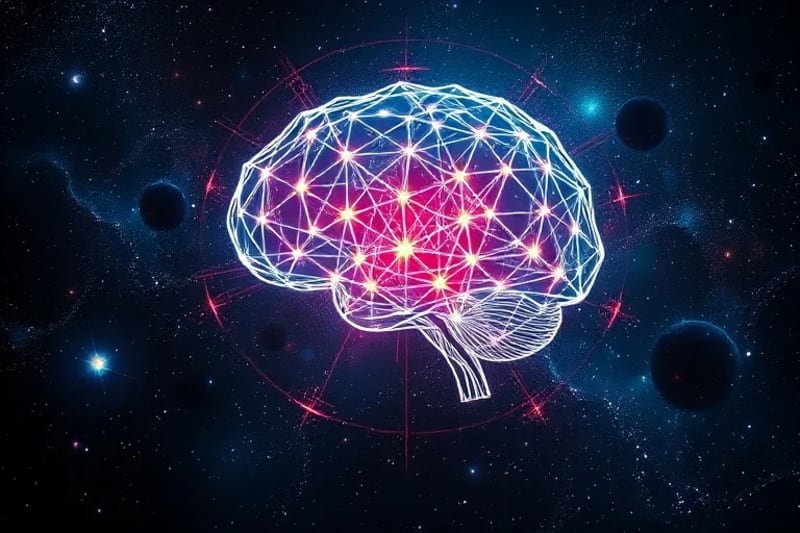
A digital painting depicting intricate, glowing threads of entangled particles extending from a human brain silhouette, symbolizing the profound, non-local connection between consciousness and the quantum fabric of the cosmos.
Some interpretations of quantum mechanics, such as the Copenhagen interpretation, suggest that the wave function (representing all possible states of a particle) collapses into a single definite state only upon measurement. This "collapse" implies that potentiality becomes actuality through interaction, and some argue that consciousness is integral to this interaction. While not all physicists agree on the role of consciousness, the very existence of this debate highlights a shift towards a more integrated understanding of mind and matter.
From a non-dual perspective, the observer is not separate from the observed; they are two sides of the same coin, or rather, not two at all. The "act" of observation is simply the universe becoming aware of itself through a particular locus of consciousness. This removes the paradox of the observer effect by positing that consciousness is not an emergent property of matter but a fundamental aspect of reality itself.
Interconnectedness and Entanglement
Quantum entanglement offers another compelling parallel with non-dual philosophy's emphasis on universal interconnectedness. The idea that two particles, once interacting, remain inextricably linked regardless of distance, defies classical notions of locality and independent existence. This "spooky action at a distance" suggests a universe where everything is fundamentally interwoven, a single tapestry of existence rather than a collection of separate parts.
In non-dual traditions, this interconnectedness is not just a physical phenomenon but a spiritual truth. The concept of "Advaita" directly translates to "not two," signifying that all beings and phenomena are ultimately expressions of a single, unified consciousness. This means that the suffering of one is the suffering of all, and the joy of one contributes to the collective well-being. The boundaries we perceive between ourselves, others, and the environment are seen as mental constructs rather than fundamental realities.
Consider the implications: if entanglement extends beyond the subatomic realm, even metaphorically, it suggests that our individual consciousnesses are not isolated islands but are deeply connected to a larger, universal field of awareness. This aligns with mystical experiences of cosmic consciousness, where individuals report feeling at one with everything. Such experiences are often described as a direct, non-conceptual knowing of the unity that underlies all apparent diversity.
The implications of quantum entanglement for information transfer and the nature of reality are still being explored. However, the very existence of such non-local correlations challenges any purely mechanistic or reductionist view of the universe. It points towards a holistic reality where the parts cannot be fully understood in isolation from the whole, a core tenet of non-dual thought.
Beyond Materialism: A Holographic Universe?
Both quantum physics and non-dual consciousness offer compelling arguments against a purely materialistic worldview. Classical materialism posits that matter is primary, and consciousness is an emergent property of complex brain activity. However, quantum phenomena like the observer effect and entanglement suggest that consciousness might be more fundamental, or at least inextricably linked to the fabric of reality itself.
Some theoretical physicists, such as David Bohm, proposed the idea of a "holographic universe." Bohm, a protégé of Einstein, suggested that the universe is not a collection of separate objects but rather an undivided whole, with an "implicate order" (hidden, underlying reality) from which the "explicate order" (our perceived reality) unfolds. This concept aligns remarkably well with non-dual ideas of an underlying unity that gives rise to all apparent diversity.
In a holographic model, every part contains information about the whole, much like a piece of a hologram contains the entire image. This implies that our individual consciousnesses, while seemingly separate, might contain a reflection of the universal consciousness. This perspective challenges the notion of individual isolation and reinforces the non-dual principle that "Atman is Brahman" – the individual soul is identical to the ultimate reality.
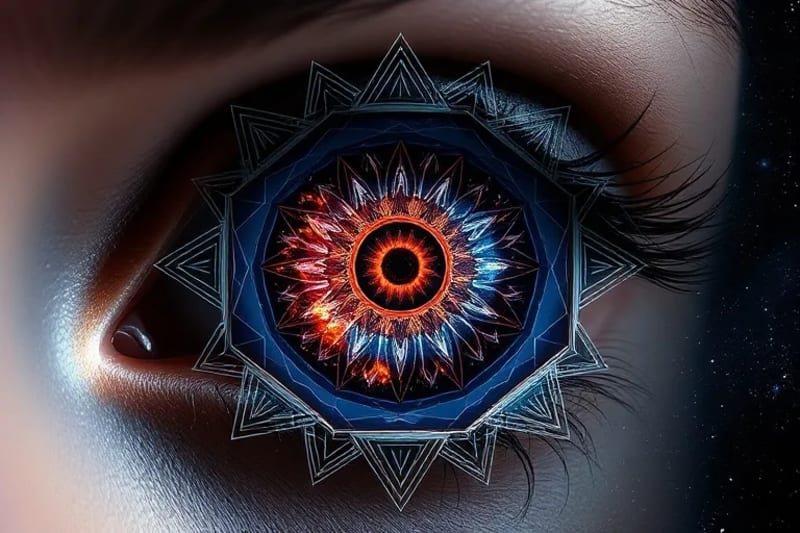
A stunning 3D render of a human eye, its iris reflecting a complex holographic universe, with subtle energy patterns emanating from the pupil, emphasizing the profound role of the observer's consciousness in shaping perceived reality.
The implications of such a model are profound. If reality is fundamentally an information-based or consciousness-based construct, then our thoughts, intentions, and perceptions might have a more direct impact on our experience than previously understood. This opens doors to exploring concepts like manifestation and the power of belief, which are central to many spiritual practices.
The shift from a purely mechanistic universe to one that is potentially holographic and consciousness-driven represents a paradigm shift. It invites us to consider that the universe is not merely a collection of inert particles but a dynamic, living system in which consciousness plays an integral and perhaps foundational role.
Implications for Personal Reality and Well-being
Understanding the potential links between quantum physics and non-dual consciousness has significant implications for our personal lives and overall well-being. If we are indeed interconnected with all things and our consciousness plays a role in shaping reality, it transforms our perception of self, responsibility, and potential.
From a non-dual perspective, realizing the illusion of separation can alleviate feelings of isolation, fear, and anxiety. When one understands that the individual self is part of a larger, unified consciousness, the pressures of ego-driven desires and fears diminish. This can lead to a profound sense of peace, contentment, and compassion for all beings. Practices like meditation and mindfulness are often employed to cultivate this direct experience of unity.
Furthermore, if consciousness influences reality, as suggested by the observer effect, it empowers individuals to recognize their active role in their experiences. This doesn't imply a simplistic "think positive and it will happen" mentality, but rather a deeper understanding of how our beliefs, intentions, and internal states can subtly shape our interactions with the world. It encourages introspection and a conscious cultivation of inner states that align with desired outcomes.
The implications extend to areas such as:
- Health and Healing: The mind-body connection, long acknowledged in holistic health, gains new scientific grounding if consciousness is fundamental. Placebo effects and the power of belief in healing could be understood through this lens.
- Interpersonal Relationships: Recognizing the interconnectedness of all beings can foster empathy, forgiveness, and a deeper sense of community, dissolving barriers built on perceived differences.
- Creativity and Innovation: Tapping into a universal field of consciousness could unlock new levels of insight and creative problem-solving, as ideas are not solely individual but emerge from a collective pool.
- Environmental Stewardship: A sense of unity with nature and the planet can inspire greater responsibility and action towards ecological sustainability.
Challenges and the Future of Integrated Understanding
While the parallels between quantum physics and non-dual consciousness are compelling, it is crucial to acknowledge the challenges and ongoing debates within both fields. The interpretations of quantum mechanics are still highly contentious among physicists, with no single, universally accepted view. Attributing the observer effect directly to human consciousness remains a speculative leap for many scientists, who often prefer more mechanistic explanations.
Similarly, non-dual concepts, while profound, are often difficult to articulate within the confines of conventional language and logic. They often point to an experience that transcends intellectual understanding, which can be challenging for a scientific framework built on empirical evidence and falsifiability. Critics argue against "quantum mysticism," cautioning against misinterpreting scientific findings to support spiritual beliefs without rigorous evidence.
Despite these challenges, the dialogue between these domains is invaluable. It pushes the boundaries of scientific inquiry, encouraging physicists to consider the role of consciousness more seriously, and prompts spiritual practitioners to engage with scientific understandings of reality. Future research may focus on:
- Neuroscience of Consciousness: Exploring how brain states correlate with non-dual experiences and how quantum processes might operate at the biological level.
- Theoretical Physics: Developing new models that explicitly integrate consciousness into the fundamental laws of the universe, moving beyond current interpretations.
- Interdisciplinary Studies: Fostering collaboration between physicists, philosophers, cognitive scientists, and spiritual scholars to create a more comprehensive framework of reality.
The journey towards a unified understanding of reality is ongoing. It requires both scientific rigor and philosophical openness, a willingness to question long-held assumptions, and to explore the profound mysteries that lie at the intersection of the physical and the metaphysical. The exploration of quantum physics and non-dual consciousness invites us to a grander, more interconnected vision of existence, one that holds immense potential for both intellectual discovery and spiritual awakening.
Frequently Asked Questions (FAQs)
Here are some common questions regarding the intersection of quantum physics and non-dual consciousness:
| Question | Answer |
|---|---|
| What is the primary connection between quantum physics and non-dual consciousness? | The primary connection lies in the quantum observer effect and the concept of entanglement, which suggest that reality is not entirely objective and that phenomena are deeply interconnected, echoing non-dual principles of unity and the mind's role in perception. |
| Does quantum physics prove non-duality? | No, quantum physics does not definitively "prove" non-duality in a scientific sense. However, its findings provide intriguing parallels and philosophical grounds for exploring non-dual concepts, challenging classical materialistic views of reality. |
| How can understanding these concepts benefit personal well-being? | Understanding these concepts can foster a deeper sense of interconnectedness, reduce feelings of isolation, and empower individuals by highlighting the active role of consciousness in shaping experience, leading to greater peace and empathy. |
Source: Hybrid content assisted by AIs and human editorial supervision.


Comments
Post a Comment