
Psycho-Astrology: Jungian Archetypes, Natal Chart Integration for Self-Discovery
Psycho-astrology represents a profound intersection between the ancient wisdom of astrology and the depths of modern psychology, particularly the analytical psychology pioneered by Carl Jung. This interdisciplinary approach offers a unique lens through which to explore the intricate landscape of the human psyche, providing a framework for deeper self-discovery and understanding of our intrinsic motivations and potentials. By integrating Jungian archetypes with the symbolic language of the natal chart, individuals can unlock hidden layers of their personality and embark on a transformative journey of individuation.
The natal chart, often referred to as a cosmic blueprint, captures the precise positions of celestial bodies at the moment of an individual's birth. Each planet, sign, house, and aspect within this chart symbolizes specific psychological energies, developmental patterns, and life experiences. When viewed through a Jungian perspective, these astrological components cease to be mere predictors of fate and instead become powerful symbols reflecting the universal archetypes that shape our collective unconscious and individual consciousness.
 Precursors intellectuales, diagramas fundamentales y representaciones conceptuales que forjaron la visión de Carl Jung sobre la psique y su conexión con el cosmos.
Fuente visual sujeta a disponibilidad del ecosistema: Wikimedia Commons bajo licencia CC BY-SA 4.0 o renderizado conceptual IA.
This article delves into the core principles of psycho-astrology, examining how Jung's concepts of archetypes, the collective unconscious, and individuation find resonant expression within astrological symbolism. We will explore how specific planetary placements, aspects, and house positions can illuminate the presence and dynamics of various archetypes within an individual's life, offering a powerful tool for self-exploration and personal growth.
Table of Contents
- Jungian Archetypes: Universal Patterns of the Psyche
- The Natal Chart as a Psychological Map
- Integrating Archetypes with Planetary Placements
- Shadow Work and the Natal Chart
- Individuation: An Astrological Journey
- Practical Applications for Self-Discovery
- Challenges and Ethical Considerations
- Conclusion: The Synergy of Cosmos and Psyche
Jungian Archetypes: Universal Patterns of the Psyche
Carl Jung posited that the human psyche is composed of both a personal unconscious, containing repressed memories and experiences, and a collective unconscious, a deeper layer shared by all humanity. This collective unconscious is populated by archetypes: universal, archaic patterns and images that derive from the collective experiences of the human race. These archetypes are not inherited ideas but rather inherited predispositions to respond to the world in certain ways, manifesting as recurring themes, symbols, and behaviors across cultures and time.
Key Jungian archetypes frequently explored in psycho-astrology include:
- The Persona: The mask we present to the world, our public image.
- The Shadow: The repressed, unconscious aspects of ourselves, both negative and potentially positive, that we deny or project onto others.
- The Anima/Animus: The unconscious feminine image in a man (Anima) and the unconscious masculine image in a woman (Animus), representing our inner opposite-sex qualities and influencing our relationships.
- The Self: The archetype of wholeness and the regulating center of the psyche, representing the totality of the conscious and unconscious mind. It is the ultimate goal of individuation.
- The Hero: The archetype of courage, transformation, and overcoming obstacles.
- The Wise Old Man/Woman: The archetype of wisdom, guidance, and spiritual insight.
- The Great Mother: The archetype of nurturing, creation, and destruction.
These archetypes manifest in our dreams, myths, fairy tales, and personal experiences, providing a rich symbolic language for understanding our inner world. Their dynamic interplay shapes our personality, relationships, and life path.
The Natal Chart as a Psychological Map
From a psycho-astrological perspective, the natal chart is not merely a predictive tool but a symbolic map of the individual psyche. Each element within the chart can be correlated with Jungian concepts, offering profound insights into an individual's psychological makeup and developmental journey. The planets represent fundamental drives and functions; the zodiac signs describe the qualitative expression of these drives; the houses indicate the life areas where these energies manifest; and the aspects reveal the dynamic relationships and tensions between them.
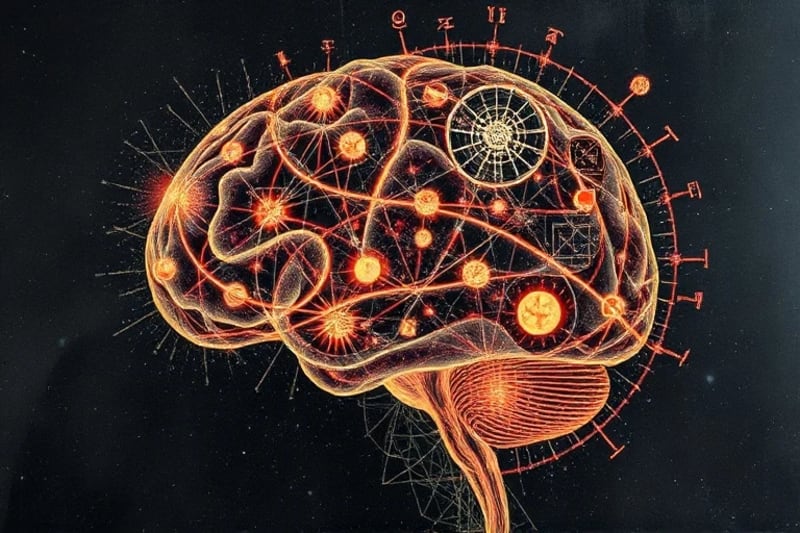 A conceptual representation of the intricate relationship between the human psyche and the celestial influences depicted in a natal chart.
For instance, the Sun in the natal chart symbolizes the ego, our conscious identity, and the drive towards self-realization. Its sign and house placement describe how this ego-identity is expressed and in what areas of life it seeks fulfillment. The Moon, conversely, represents the unconscious emotional nature, our instincts, and our deepest needs for security and belonging. Its position reveals our emotional patterns and how we seek comfort.
Planets like Mars (will, aggression, desire) and Venus (love, values, attraction) can be seen as embodying specific archetypal energies related to action and relationship. The outer planets—Uranus, Neptune, and Pluto—often correlate with transpersonal archetypes and collective unconscious forces, signifying profound shifts and transformations that transcend personal ego concerns. Understanding these planetary roles is crucial for interpreting the psychological dimensions of the chart, much like understanding the Lunar Phases Astrology: New Moon, Full Moon Cycles can reveal deeper emotional patterns.
Planets as Archetypal Embodiments
| Planet | Jungian Archetypal Correlation | Psychological Expression |
|---|---|---|
| Sun | The Self, The Hero, Ego | Core identity, conscious will, drive for self-realization, vitality. |
| Moon | The Great Mother, Child, Anima/Animus (emotional aspect) | Emotional needs, unconscious habits, security, nurturing, instinctual responses. |
| Mercury | The Trickster, The Messenger | Communication, intellect, learning, perception, rational thought. |
| Venus | The Lover, The Muse, Anima/Animus (relational aspect) | Values, aesthetics, relationships, harmony, attraction, self-worth. |
| Mars | The Warrior, The Destroyer, The Hero | Drive, aggression, assertion, courage, sexual energy, action. |
| Jupiter | The Wise Old Man, The King, The Guru | Growth, expansion, optimism, philosophy, higher learning, faith. |
| Saturn | The Father, The Senex, The Taskmaster | Structure, discipline, responsibility, limitations, karma, maturity. |
| Uranus | The Rebel, The Revolutionary, The Awakener | Innovation, disruption, freedom, individuality, sudden change. |
| Neptune | The Mystic, The Dreamer, The Savior | Spirituality, illusion, compassion, dissolution, transcendence, escapism. |
| Pluto | The Destroyer, The Transformer, The Underworld God | Power, death, rebirth, transformation, obsession, deep psychological change. |
Integrating Archetypes with Planetary Placements
The integration of Jungian archetypes with planetary placements allows for a nuanced understanding of an individual's psychological dynamics. For example, a prominent Mars in a natal chart, especially in a fiery sign like Aries or a fixed sign like Scorpio, might indicate a strong manifestation of the Hero or Warrior archetype. This individual might naturally gravitate towards challenges, assertiveness, and leadership roles. However, if Mars is afflicted by challenging aspects (e.g., square to Saturn), the individual might struggle with expressing this archetypal energy, leading to frustration, anger, or feeling blocked in their efforts.
Similarly, Venus placements can shed light on the Anima/Animus. A Venus in Pisces, for instance, might suggest a highly romanticized or idealized Anima/Animus, leading to a search for a soulmate who embodies ethereal qualities, potentially leading to disillusionment. Conversely, a Venus in Capricorn might seek a partner who embodies the Wise Old Man/Woman archetype, valuing stability, maturity, and achievement in relationships. This deep dive into relationship potentials can be further explored through concepts like Conscious Coupling: Law Attraction Soulmate Synastry Guide.
The houses in the natal chart provide the contextual stage for these archetypal dramas. The 1st House (Ascendant) often relates to the Persona, indicating how we initially present ourselves to the world. The 7th House (Descendant) can reveal the qualities of our Anima/Animus as projected onto partners. The 12th House, traditionally associated with the unconscious, can be a potent area for exploring the Shadow and other repressed archetypal material.
Shadow Work and the Natal Chart
One of the most powerful applications of psycho-astrology is in performing "shadow work." The Shadow archetype encompasses all the aspects of ourselves that we deem unacceptable and therefore repress into the unconscious. These can be negative traits like anger, jealousy, or selfishness, but also positive qualities like creativity, power, or joy that we fear to express. The natal chart offers several indicators of where the Shadow might be most active.
 A visual metaphor for the intricate and often hidden interplay of conscious and unconscious forces that shape human experience.
Planets in the 8th or 12th houses, challenging aspects (squares, oppositions, quincunxes) involving Pluto, Saturn, or the Moon, and the South Node of the Moon can all point to areas where unconscious material, including the Shadow, resides. For example, a strong Pluto in the natal chart often signifies a deep engagement with themes of power, control, and transformation, compelling the individual to confront their own Shadow aspects related to these themes. The Quincunx Aspect: Navigating Uncomfortable Growth in Your Chart, in particular, can highlight areas of psychological discomfort that demand integration.
Engaging with the Shadow through astrological interpretation involves consciously acknowledging and integrating these repressed parts of the self. This process is not about eliminating the Shadow but understanding its messages and reclaiming its energy in a constructive way. It leads to greater psychological wholeness and authenticity, reducing the tendency to project our undesirable traits onto others.
Individuation: An Astrological Journey
Jung's concept of individuation is the lifelong psychological process of differentiating the self from both the collective and personal unconscious, ultimately leading to the realization of one's unique and holistic potential (the Self). Psycho-astrology views the entire natal chart as a dynamic blueprint for this journey. Planetary transits and progressions, which mark the movement of planets through the sky relative to the natal chart, often coincide with significant archetypal activations and developmental stages in the individuation process.
For instance, a Pluto transit over a natal planet can trigger a profound confrontation with the Shadow or a deep transformative process, forcing the individual to shed old patterns and embrace new levels of power and authenticity. Saturn transits often bring challenges and responsibilities that compel the individual to build structure, develop discipline, and integrate the "Father" or "Senex" archetype. These periods are crucial for maturing and solidifying the ego's relationship with the Self.
The Midheaven (MC) and Imum Coeli (IC) axes in the chart also play a role in individuation, representing our public calling and private roots, respectively. The evolution of these points through transits and progressions can signify shifts in our life purpose and our connection to our inner foundations. The journey of individuation is not linear but cyclical, often mirroring the cyclical nature of planetary movements.
Practical Applications for Self-Discovery
The integration of Jungian archetypes and natal chart analysis offers numerous practical benefits for personal growth and self-discovery:
- Enhanced Self-Awareness: Gaining insight into unconscious motivations, fears, and desires.
- Improved Relationships: Understanding projections of the Anima/Animus onto partners and friends, leading to healthier relationship dynamics. This is especially useful when analyzing Composite Chart Dynamics: Unveiling Relationship's Soul.
- Purpose and Direction: Clarifying one's life path and vocational calling by aligning with core archetypal energies.
- Emotional Healing: Confronting and integrating the Shadow, releasing repressed emotions and patterns.
- Creative Expression: Tapping into archetypal sources of inspiration for artistic and personal endeavors.
- Spiritual Growth: Connecting with the transcendent aspects of the Self and the collective unconscious.
By consciously working with the archetypal energies revealed in the natal chart, individuals can move beyond deterministic interpretations of astrology and actively participate in their psychological and spiritual evolution. It transforms astrology from a passive prediction tool into an active guide for inner work.
Challenges and Ethical Considerations
While psycho-astrology offers profound insights, it also comes with challenges and ethical considerations. Misinterpretation of archetypes or astrological placements can lead to oversimplification or mislabeling of individuals. It is crucial for practitioners to approach this work with sensitivity, avoiding rigid interpretations and recognizing the unique expression of archetypes in each person.
The process of confronting the Shadow or integrating complex archetypal energies can be intense and requires a stable psychological foundation. Therefore, it is often best undertaken with the guidance of a trained psycho-astrologer or therapist who understands both Jungian concepts and astrological symbolism. The goal is empowerment and integration, not judgment or fear. Furthermore, understanding the broader context of esoteric symbolism, such as Black Sun Esoteric Symbolism: Shadow, Power, Transformation, can add further depth and nuance to these complex interpretations.
Conclusion: The Synergy of Cosmos and Psyche
Psycho-astrology provides a powerful and integrative framework for exploring the depths of the human psyche. By weaving together the symbolic language of the natal chart with Jungian archetypes, individuals gain access to a rich tapestry of meaning that illuminates their unconscious patterns, developmental tasks, and inherent potentials. This approach moves beyond superficial astrological readings, inviting a profound journey of self-discovery and individuation.
Through conscious engagement with the archetypal energies revealed in their birth chart, individuals can heal old wounds, integrate repressed aspects of themselves, and align more fully with their authentic Self. Psycho-astrology thus stands as a testament to the enduring connection between the cosmos and the human soul, offering a pathway to psychological wholeness and spiritual evolution in the modern world.
Source: Hybrid content assisted by AI and human editorial supervision.


Comments
Post a Comment