
Fixed Stars Midpoints Astrology: Precise Event Timing
In the intricate tapestry of astrological prognostication, the precise timing of auspicious events often hinges on methodologies extending beyond conventional planetary aspects. Advanced practitioners frequently turn to the profound influences of fixed stars and the nuanced dynamics of midpoints. These sophisticated techniques offer a granular level of analysis, enabling astrologers to pinpoint critical moments with remarkable accuracy and to unravel deeper layers of karmic and evolutionary potential within a natal chart or a predictive timeline.
The integration of fixed stars, which are distant celestial bodies whose positions remain relatively static from an Earth-centric perspective, with midpoints, the mathematical bisectors between planetary pairs, elevates astrological interpretation to an advanced scientific art. This article delves into the theoretical underpinnings and practical applications of combining fixed stars and midpoints for precise timing, offering a comprehensive guide for those seeking to master these powerful tools in their astrological practice.
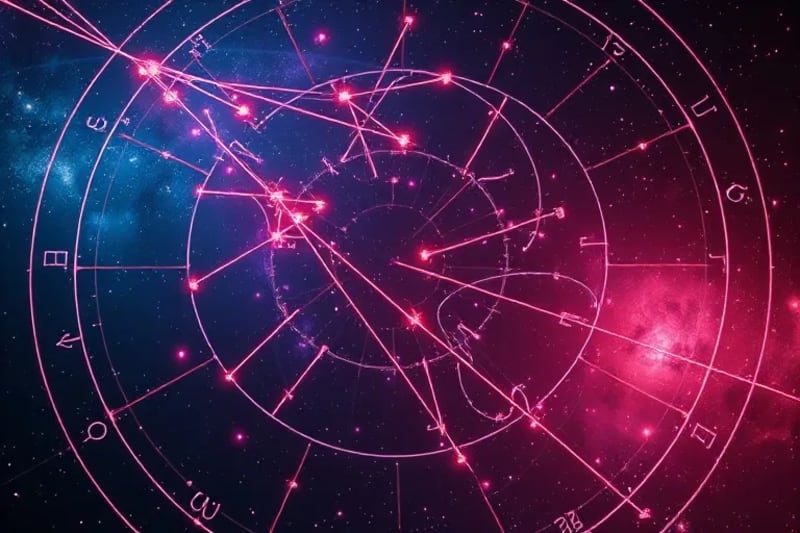
An intricate celestial map illustrating the precise alignments of fixed stars and planetary midpoints, crucial for advanced astrological timing.
Table of Contents
- Historical Context and Evolution
- Understanding Fixed Stars in Astrology
- The Power of Midpoints: Mathematical Precision
- Integrating Fixed Stars and Midpoints
- Methodology and Practical Application
- Case Studies and Illustrative Examples
- Challenges and Nuances in Interpretation
- Advanced Techniques and Modern Perspectives
Historical Context and Evolution
The study of fixed stars dates back to ancient Mesopotamian and Egyptian civilizations, where prominent stars and constellations were observed for agricultural, navigational, and divinatory purposes. Early astrologers like Ptolemy meticulously cataloged these stars, attributing specific natures and influences to them based on their perceived resemblance to planetary energies. The Almagest, for instance, provides extensive descriptions of fixed stars and their effects when conjoined with planets or sensitive points in a chart.
Midpoints, while seemingly a more modern development, have roots in the harmonic and symmetrical principles explored by ancient Greek mathematicians and philosophers. However, their systematic application in astrology gained significant traction with the Hamburg School of Astrology, pioneered by Alfred Witte and Friedrich Sieggrün in the early 20th century. This school, also known as Uranian Astrology, formalized the calculation and interpretation of midpoints, establishing a rigorous framework for their use in predictive and natal analysis.
The evolution of these techniques represents a continuous quest for precision and depth in astrological understanding. From the observational wisdom of antiquity to the mathematical rigor of modern schools, fixed stars and midpoints have consistently offered astrologers a means to transcend the generalities of planetary positions and delve into the specific, often fated, nuances of human experience.
Understanding Fixed Stars in Astrology
Unlike planets, which represent dynamic psychological functions and life areas, fixed stars are often associated with external, fated events, collective influences, and archetypal energies. Their impact is generally considered more potent when they are closely conjoined (within a 0° to 1° orb) with a planet, an angle (Ascendant, Descendant, Midheaven, Imum Coeli), or a significant midpoint in a natal or event chart.
Fixed stars are categorized by their magnitude (brightness) and their perceived planetary nature. For example, Regulus (Alpha Leonis) is often described as having a nature akin to Mars and Jupiter, associated with honor, ambition, and sudden downfall if not handled with humility. Spica (Alpha Virginis), with its Venus-Mars nature, is linked to success, talent, and good fortune. Algol (Beta Persei), a star of the nature of Saturn and Jupiter, is famously associated with violence, decapitation, and extreme situations, demanding careful interpretation.
The interpretation of fixed stars requires a deep understanding of their traditional meanings and a careful consideration of the planet or point they conjoin. A fixed star's influence can amplify, modify, or even drastically alter the expression of the astrological factor it touches. It's crucial to remember that fixed stars often manifest as external circumstances or events that are largely beyond the individual's direct control, acting as powerful cosmic signposts.

An antique astrolabe alongside an hourglass, symbolizing the ancient and precise art of celestial timing in astrology.
The Power of Midpoints: Mathematical Precision
Midpoints represent the exact halfway point between two planets or sensitive points in a chart. They are calculated by finding the arc distance between two points and dividing it by two. For example, the Sun/Moon midpoint represents the integration of conscious will (Sun) and emotional needs (Moon), often symbolizing the core of one's personality or relationship dynamics.
The significance of a midpoint arises when a third planet or sensitive point (including fixed stars) forms a hard aspect (conjunction, opposition, square, or semi-square/sesquiquadrate) to it, or when a midpoint itself is activated by a transit or progression. This creates a powerful three-point configuration, often described as a "planetary picture" in Uranian astrology, which reveals specific psychological complexes, life themes, or event patterns.
Midpoints can be analyzed in various ways:
- Direct Midpoints: The exact halfway point between two celestial bodies.
- Indirect Midpoints: Points 90° or 45° away from the direct midpoint, which are also considered significant in Uranian astrology.
- Planetary Pictures: Combinations like A + B - C, where C activates the midpoint of A and B, creating a specific interpretative phrase.
The precision of midpoints allows for extremely detailed interpretations, often revealing the "how" and "why" behind events, rather than just the "what." They are particularly useful in predictive astrology for identifying exact moments of activation for specific themes.
Integrating Fixed Stars and Midpoints
The true power of these techniques emerges when fixed stars are brought into conjunction with midpoints. This creates a highly specific and potent astrological signature, often indicating a fated event or a significant turning point that carries a strong archetypal resonance. When a fixed star aligns with a midpoint, it's as if the cosmic energy of that star is channeled directly into the thematic expression of the midpoint.
For instance, if the midpoint of Venus/Mars (representing passion, desire, or conflict in relationships) is conjoined by the fixed star Algol, it could signify intense, potentially volatile romantic encounters or even violent relationship breakdowns. Conversely, if the same midpoint is conjoined by Spica, it might indicate artistic success through collaboration or harmonious, fortunate partnerships.
This integration allows astrologers to move beyond general interpretations. Instead of merely noting a Mars transit to Venus, the addition of a fixed star to their midpoint can specify the nature, intensity, and even the external circumstances surrounding the manifestation of that energy. It provides a unique lens through which to view the interplay of individual will, emotional drives, and external destiny.
| Component | Nature | Influence | Example Combination |
|---|---|---|---|
| Fixed Star | External, fated, archetypal | Specific events, collective themes, destiny | Regulus conjunct Sun/MC midpoint |
| Midpoint | Mathematical, psychological integration | Interplay of planetary energies, specific themes | Venus/Mars midpoint |
| Integration | Fated manifestation of integrated energies | Precise timing of highly specific, often significant events | Algol conjunct Venus/Mars midpoint |
Methodology and Practical Application
Applying fixed stars to midpoints requires a systematic approach. The primary steps involve:
- Chart Calculation: Use precise ephemerides and astrological software that includes fixed star positions (tropical zodiac, usually). Ensure accuracy to the minute of arc.
- Midpoint Calculation: Calculate all significant midpoints (e.g., Sun/Moon, Asc/MC, all planetary pairs). Many software programs automate this.
- Orb Application: For fixed stars, a tight orb is crucial, typically 0° to 1° conjunction or opposition to a planet or midpoint. For midpoints, aspects to other planets or points can extend to 1.5° to 2°.
- Identification of Key Configurations: Look for fixed stars conjoining natal midpoints, or transiting/progressed planets activating natal fixed star/midpoint combinations.
- Interpretation: Synthesize the meaning of the fixed star with the theme of the midpoint. Consider the house and sign placement of the midpoint, and the nature of the planets involved.
In electional astrology, this technique is invaluable for choosing optimal times for initiating ventures. For example, selecting a moment when a beneficial fixed star (like Spica) conjoins the Jupiter/MC midpoint (representing public success and expansion) could significantly enhance the prospects of a new business launch or public appearance.
For predictive astrology, transits or progressions of planets to fixed star/midpoint combinations in the natal chart can signal highly specific events. A transit of Uranus to a natal fixed star/Mars-Pluto midpoint, for instance, might indicate a sudden, transformative, and potentially disruptive event related to power struggles or intense action.
A futuristic cosmic clock depicting nebulae and zodiac elements, highlighting precise alignments for significant life events.
Case Studies and Illustrative Examples
Consider the natal chart of a renowned public figure. Let's hypothesize that their Sun/MC midpoint (career, public image) is precisely conjoined by the fixed star Regulus. This configuration alone suggests a destiny of leadership, prominence, and potential for great honor, but also the risk of hubris. If, during a critical period of their career, a transiting Jupiter makes a hard aspect to this Regulus/Sun/MC combination, it could pinpoint a moment of immense public acclaim, a significant promotion, or a major award.
Another example might involve a relationship chart (synastry or composite). If the Venus/Mars midpoint (romantic passion) in a composite chart is conjoined by the fixed star Sirius, known for its intensity and bringing "dog days" or intense focus, it could indicate a relationship marked by profound, almost fated, attraction and a strong, perhaps obsessive, bond. A transit of Saturn to this configuration might then mark a period of serious commitment or a challenging test of the relationship's foundation.
These examples highlight how the combination of fixed stars and midpoints provides a layer of specificity that traditional planetary aspects alone might miss. They act as cosmic magnifying glasses, bringing into sharp focus the underlying archetypal forces at play in a person's life or a specific event.
Challenges and Nuances in Interpretation
While powerful, the use of fixed stars and midpoints is not without its challenges. One critical aspect is the choice of zodiac. Most fixed star interpretations are based on their tropical positions, but some astrologers prefer sidereal. Consistency is key. Furthermore, the orb of influence for fixed stars is traditionally very tight, often less than a degree, demanding extreme precision in calculations.
The sheer volume of midpoints can also be overwhelming. Astrologers typically focus on major midpoints involving the Sun, Moon, Ascendant, Midheaven, and personal planets, expanding to outer planets as needed. Prioritizing which midpoints to analyze is an art developed through experience.
Another nuance lies in the often fated or external nature of fixed star influences. While planets represent internal psychological drives and choices, fixed stars often signify events that seem to happen *to* the individual, sometimes with dramatic and unavoidable consequences. This requires a nuanced interpretative approach that balances free will with destiny.
The Hamburg School of Astrology, also known as Uranian Astrology, developed a systematic approach to midpoints, emphasizing their role in revealing precise event timing and underlying psychological dynamics. This school's methodologies have significantly influenced modern advanced astrological practice.
The interpretation of fixed stars often relies on traditional Ptolemaic classifications, which assign planetary natures to these distant celestial bodies. However, contemporary research continues to refine and expand upon these ancient understandings, integrating new astronomical data and psychological insights.
Advanced Techniques and Modern Perspectives
Beyond the fundamental conjunctions, advanced practitioners explore other aspects of fixed stars to midpoints, such as oppositions, squares, and even parallels and contra-parallels, though these are often considered secondary to the conjunction. The 90-degree dial, a staple of Uranian astrology, visually simplifies the identification of midpoint structures and their activation by fixed stars.
Modern software has made these complex calculations far more accessible, allowing astrologers to experiment with a wider range of fixed stars and midpoints. Some contemporary astrologers also integrate fixed stars with other advanced techniques, such as Arabic Parts, harmonic charts, and even asteroid influences, to create a multi-layered and deeply insightful analysis.
The ongoing research into fixed stars and their effects, combined with the mathematical elegance of midpoints, ensures that these techniques remain at the forefront of advanced astrological inquiry. They offer a pathway to understanding not just the general flow of life, but the precise, often fated, moments that shape our destinies and reveal our deepest potentials. Mastering them provides an unparalleled tool for precise timing and profound insight into the cosmic blueprint.
Fuente: Contenido híbrido asistido por IAs y supervisión editorial humana.


Comments
Post a Comment