
Psycho-Astrology Archetypal Psychology Jungian Shadow Natal Chart Wholeness
Psycho-astrology represents a profound intersection between the ancient wisdom of astrology and the intricate depths of modern psychology, particularly drawing from the seminal work of Carl Jung. This interdisciplinary approach views the natal chart not merely as a predictive tool, but as a symbolic blueprint of the psyche, offering unparalleled insights into an individual's innate psychological patterns, potentials, and challenges. By integrating astrological symbolism with Jungian archetypal psychology, individuals can embark on a transformative journey toward self-understanding and wholeness, particularly through the crucial process of shadow integration.
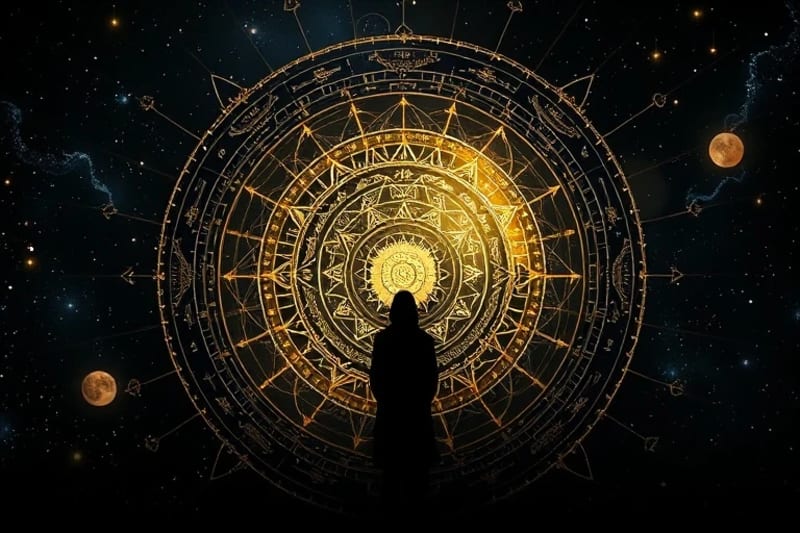 Conceptual representation of the intricate celestial map of the psyche, where hidden aspects emerge and integrate into a harmonious whole.
Fuente visual sujeta a disponibilidad del ecosistema: Wikimedia Commons bajo licencia CC BY-SA 4.0 o renderizado conceptual IA.
The ultimate goal of psycho-astrology is not to dictate destiny, but to illuminate the underlying psychological dynamics that shape our experiences and behaviors. It provides a framework for recognizing the archetypal forces at play within us, understanding their manifestations through planetary energies, and consciously working with them to foster personal growth. This holistic perspective empowers individuals to move beyond deterministic views of astrology and engage actively in their psychological evolution.
Central to this process is the concept of natal chart wholeness, which involves acknowledging and integrating all facets of one's astrological chart, including those that may initially appear challenging or undesirable. This article will delve into the theoretical underpinnings of psycho-astrology, explore the connection between Jungian archetypes and the natal chart, elucidate the significance of the astrological shadow, and outline practical techniques for its integration to achieve a more complete and authentic self.
Table of Contents
- The Foundations of Psycho-Astrology
- Jungian Archetypes and the Natal Chart
- Understanding the Shadow in Astrology
- Techniques for Shadow Integration
- Achieving Natal Chart Wholeness
- Practical Applications and Benefits
The Foundations of Psycho-Astrology
Psycho-astrology emerges from the premise that astrological symbols are not merely external influences but rather internal psychological structures. Carl Jung, a pioneering figure in analytical psychology, famously explored the concept of synchronicity—meaningful coincidences—which he believed linked inner psychological states with outer events, including celestial phenomena. He saw astrology as a symbolic language that could describe the archetypal patterns of the collective unconscious as they manifest in individual lives.
Jung's work provided a crucial bridge, allowing astrologers to move beyond purely predictive or descriptive interpretations of the natal chart towards a deeper, psychological understanding. Each planet, sign, and house in the natal chart can be understood as representing a specific psychological function, an archetypal energy, or an area of life where these energies play out. For instance, the Sun symbolizes the ego and conscious identity, while the Moon represents the emotional core and unconscious needs.
The synergy between astrological symbolism and psychological dynamics is evident in how planetary aspects reflect inner conflicts or harmonious integrations. A challenging square aspect between two planets, for example, might indicate an internal tension between two archetypal drives, which, when consciously addressed, can lead to significant personal growth and a more integrated personality. Conversely, a harmonious trine might represent an area of natural talent or effortless expression. This perspective shifts the focus from external fate to internal psychological work.
Jungian Archetypes and the Natal Chart
Jungian archetypes are universal, archaic patterns and images that derive from the collective unconscious and are the psychic counterpart of instinct. They are not inherited ideas but rather inherited predispositions to respond to the world in certain ways. In the context of the natal chart, these archetypes find their expression through the planets, zodiac signs, and houses, offering a rich tapestry of psychological understanding.
- The Persona: Represented by the Ascendant and its ruling planet, the Persona is the mask we present to the world, the social identity we adopt.
- The Anima/Animus: The inner feminine (Anima in men) and inner masculine (Animus in women) are often reflected in the Moon, Venus (Anima), Mars, and Sun (Animus) placements, and their aspects.
- The Self: The central archetype of wholeness and the regulating center of the psyche, often symbolized by the Sun and the overall integration of the chart.
- The Shadow: This crucial archetype encompasses the repressed, disowned, and unconscious aspects of the personality, which we will explore in detail.
Each planet in the natal chart embodies a specific archetypal energy. Mars, for instance, represents the Warrior archetype, governing our drive, assertion, and aggression. Venus embodies the Lover and Artist, dictating our values, relationships, and aesthetic sensibilities. Saturn, as the Wise Elder or Taskmaster, signifies structure, discipline, responsibility, and the lessons we must learn. Understanding these planetary archetypes allows for a deeper interpretation of their placement and aspects within the chart.
 Symbolic still-life illustrating the process of piecing together fragmented astrological and psychological aspects for integration.
The zodiac signs further qualify these archetypal expressions, indicating how the planetary energy is expressed. A Mars in Aries will express its warrior energy directly and impulsively, while a Mars in Libra might express it through negotiation and a desire for justice. The houses then define the areas of life where these archetypal energies are most active. For example, Mars in the 7th house (relationships) might indicate a tendency towards conflict in partnerships, or a drive to assert oneself within relationships.
The interplay of these elements creates a unique psychological profile. By identifying the dominant archetypes and their astrological expressions, individuals can gain profound insights into their core motivations, fears, and aspirations. This understanding is foundational for the process of shadow integration, as it helps to pinpoint where disowned or repressed aspects of these archetypes might reside.
| Archetype | Key Planetary Associations | Astrological Expression |
|---|---|---|
| The Self | Sun, Ascendant, Chart Ruler | Core identity, life purpose, individuation process. |
| The Persona | Ascendant, 1st House, Chart Ruler | Public image, social roles, initial impression. |
| The Shadow | Pluto, Saturn, 12th House, challenging aspects | Repressed traits, hidden fears, disowned desires. |
| The Anima/Animus | Moon, Venus (Anima); Sun, Mars (Animus) | Inner feminine/masculine, relationship projections. |
| The Hero/Warrior | Mars, Sun | Courage, assertion, drive, conflict. |
| The Lover/Artist | Venus, Moon | Affection, beauty, values, harmony, creativity. |
| The Sage/Teacher | Jupiter, Saturn, Mercury | Wisdom, knowledge, guidance, philosophy. |
Understanding the Shadow in Astrology
The Jungian Shadow is arguably the most critical archetype for psychological integration. It comprises all the parts of ourselves that we have disowned, repressed, or deemed unacceptable, often due to societal conditioning, parental disapproval, or personal trauma. These can be negative traits like anger, jealousy, or selfishness, but also positive qualities like creativity, power, or sexuality that we have been taught to suppress. The Shadow does not disappear; it operates unconsciously, often manifesting as projections onto others or as self-sabotaging behaviors.
In astrological terms, the Shadow can be identified through various indicators in the natal chart. Challenging aspects, such as squares and oppositions, especially involving outer planets like Pluto, Uranus, and Neptune, often highlight areas where unconscious material is seeking expression. Pluto, in particular, is deeply associated with the Shadow, representing transformation, power dynamics, and the hidden depths of the psyche. Its placement by house and sign can reveal where intense, often repressed, energies reside.
Other astrological indicators include retrograde planets, which suggest an internalized or delayed expression of planetary energy, often requiring conscious effort to integrate. The 12th house, traditionally associated with the unconscious, hidden enemies, and self-undoing, is another potent area for uncovering Shadow material. Planets placed here may represent energies that are difficult to access consciously or that manifest in subtle, often confusing ways. Similarly, intercepted signs within a house can point to energies that are "skipped over" or not fully expressed, contributing to the Shadow.
Recognizing the astrological expressions of the Shadow is the first step towards integration. For instance, a strong Mars-Pluto aspect might indicate repressed aggression or a fear of one's own power, leading to passive-aggressive behavior or attracting controlling relationships. Similarly, a challenging Neptune aspect could point to areas of illusion, self-deception, or a tendency to escape reality, all of which can be manifestations of an unintegrated Shadow.
The Shadow is a moral problem that challenges the whole ego-personality, for no one can become conscious of the shadow without considerable moral effort. To become conscious of it involves recognizing the dark aspects of the personality as present and real.
— Carl Jung, "Aion: Researches into the Phenomenology of the Self"
Techniques for Shadow Integration
Shadow integration is not about eliminating the Shadow, but about acknowledging, confronting, and assimilating its contents into conscious awareness. This process reduces its unconscious power and frees up energy for personal growth. Psycho-astrology offers several powerful techniques to facilitate this integration, often involving a combination of introspection, symbolic engagement, and conscious action.
- Astrological Chart Analysis: Begin by identifying the key astrological indicators of your Shadow. This includes examining challenging aspects, the 12th house, Pluto placements, and any retrograde planets. Understand the archetypal energies involved in these configurations.
- Journaling and Active Imagination: Dedicate time to journaling about the feelings, behaviors, or projections that arise from your identified Shadow areas. Use active imagination to engage with the planetary symbols or archetypes. For example, if you have a challenging Mars aspect, imagine a dialogue with the "Warrior" within you, exploring its repressed anger or unexpressed assertiveness.
- Dream Analysis: Dreams are a direct pathway to the unconscious. Pay attention to recurring themes, symbols, and figures in your dreams, especially those that evoke strong emotions. Relate these back to your natal chart, particularly to the planets and houses associated with your Shadow.
- Confronting Projections: The Shadow is often projected onto others. When you find yourself intensely disliking or admiring a trait in someone else, consider if it might be a disowned part of yourself. Use your natal chart to pinpoint which archetypal energy might be at play. For instance, strong reactions to someone's perceived arrogance might reflect your own repressed desire for recognition (Sun) or power (Pluto).
- Engaging with Challenging Planetary Energies: Consciously work with the energies of planets that form difficult aspects in your chart. For example, if Saturn is prominent in your Shadow, engage in disciplined activities, take on responsibilities, or confront your fears of limitation. This conscious engagement brings unconscious patterns into the light. The insights gained from understanding Astrology Centaurs can also be invaluable here, as they often highlight areas of deep wounding that contribute to the Shadow.
- Creative Expression: Art, music, dance, and writing can be powerful outlets for expressing and integrating Shadow material. By giving form to these unconscious energies, you can begin to understand and accept them.
 An abstract cosmic landscape symbolizing the winding path of self-discovery and integration towards wholeness.
Achieving Natal Chart Wholeness
Natal chart wholeness, in the context of psycho-astrology, is synonymous with Jung's concept of individuation—the process by which an individual becomes a whole, undivided, and unique being. It is not about perfection, but about integrating all parts of the self, including the conscious and unconscious, the light and the dark, the strengths and the vulnerabilities. The natal chart serves as a guide for this lifelong journey, revealing the inherent potential for wholeness that exists within each individual.
The "Self" archetype, often symbolized by the Sun and the overall pattern of the chart, represents this inherent drive towards wholeness. It is the organizing principle of the psyche, constantly striving for balance and integration. The process of individuation involves consciously engaging with all planetary energies, understanding their archetypal significance, and allowing them to express themselves in a balanced and authentic manner. This means not just focusing on the "easy" or "positive" placements, but actively working with the challenging ones, recognizing them as catalysts for growth.
Key to achieving this wholeness is the synthesis of all chart elements. This includes understanding the interplay between your conscious identity (Sun), emotional needs (Moon), communication style (Mercury), values (Venus), drive (Mars), growth potential (Jupiter), and life lessons (Saturn), as well as the transformative influences of the outer planets (Uranus, Neptune, Pluto). Each element contributes to the unique symphony of your being. By understanding Tarot Quantum Mechanics Intersecting Divination Reality, we can further deepen our connection to these esoteric archetypes and facilitate self-discovery.
The Midheaven (MC) and Ascendant also play crucial roles in expressing one's unique path and integrated self in the world. The MC represents our public image, career, and life direction, while the Ascendant signifies our approach to life and how we initiate experiences. When these points are aligned with an integrated understanding of the Self, an individual can manifest their true potential with greater authenticity and purpose. Wholeness is a dynamic state, continuously evolving as we encounter new experiences and integrate further aspects of our psyche.
Practical Applications and Benefits
The journey of psycho-astrological shadow integration and the pursuit of natal chart wholeness yield profound practical benefits that extend into all areas of life. These advantages are not merely theoretical but translate into tangible improvements in self-awareness, relationships, career, and overall well-being.
- Improved Self-Awareness and Self-Acceptance: By understanding the archetypal forces and Shadow aspects within your natal chart, you gain a deeper, more compassionate understanding of yourself. This leads to greater self-acceptance, reducing internal conflict and fostering a more authentic sense of identity.
- Enhanced Relationships: Recognizing your own projections and understanding the archetypal dynamics at play in your relationships can dramatically improve interpersonal connections. It allows you to take responsibility for your reactions and respond to others from a place of conscious awareness rather than unconscious reactivity. This can even extend to understanding the energetic bonds with companions, as explored in Pet Synastry, highlighting how all relationships, human or otherwise, involve energetic interplay.
- Greater Life Purpose and Direction: An integrated natal chart reveals your true potential and life path. By aligning with your innate archetypal energies and consciously integrating your Shadow, you can pursue your goals with greater clarity, purpose, and resilience.
- Overcoming Self-Sabotage: Many self-sabotaging behaviors stem from unintegrated Shadow material. By bringing these unconscious patterns to light, you can consciously choose new responses, breaking free from repetitive negative cycles and fostering healthier habits.
- Increased Creativity and Vitality: When repressed energies are integrated, they become available for conscious use. This often translates into a surge of creative energy, increased vitality, and a greater capacity to engage with life fully.
- Resilience and Emotional Regulation: Understanding the cyclical nature of planetary transits and their archetypal lessons allows for greater emotional resilience. You learn to navigate challenging periods with more awareness, seeing them as opportunities for growth rather than insurmountable obstacles.
In essence, psycho-astrology provides a roadmap for the heroic journey of self-discovery. It invites individuals to delve into the depths of their psyche, confront their inner demons, embrace their hidden strengths, and ultimately, emerge as more integrated, authentic, and whole beings. This process is continuous, offering ongoing opportunities for profound personal evolution and a deeper connection to the universal archetypal patterns that shape human experience.
Explore Further Insights
Deepen your understanding of astrological and psychological concepts with these related articles:
Source: Hybrid content assisted by AI and human editorial supervision.


Comments
Post a Comment