
astro-archeology-unveiling-ancient-celestial-wisdom
Astro-archeology stands as a fascinating interdisciplinary field, meticulously examining the profound connections between ancient civilizations and the cosmos. This discipline delves into how early human societies observed celestial phenomena, encoded astronomical knowledge into their architecture, art, and rituals, and how these ancient celestial narratives continue to resonate in modern contexts. It bridges the gap between the tangible remnants of the past and the intangible wisdom of the stars, offering a unique lens through which to understand human history and our enduring fascination with the heavens.
Far beyond mere stargazing, ancient cultures developed sophisticated systems for tracking celestial movements, which were fundamental to their agricultural cycles, religious beliefs, and societal structures. Astro-archeology seeks to uncover these intricate relationships, revealing how the sun, moon, planets, and stars were not just distant lights but active participants in the daily lives and spiritual worlds of our ancestors. This exploration helps us appreciate the intellectual prowess and observational skills of peoples long past, whose insights often rivaled, and sometimes even surpassed, later scientific developments.
Table of Contents
- Introduction to Astro-Archeology
- The Dawn of Celestial Observation
- Ancient Civilizations and Cosmic Calendars
- Decoding Celestial Narratives: Methods and Challenges
- The Modern Relevance of Ancient Wisdom
- The Esoteric and the Scientific
- Conclusion: Echoes of the Cosmos
Introduction to Astro-Archeology
Astro-archeology, a field that emerged in the mid-20th century, combines the methodologies of archeology with the principles of astronomy. Its primary goal is to investigate ancient sites and artifacts for astronomical alignments and symbolism, thereby reconstructing the cosmological beliefs and scientific knowledge of past societies. This discipline moves beyond simply identifying astronomical references; it seeks to understand the cultural, religious, and practical implications of these celestial observations.
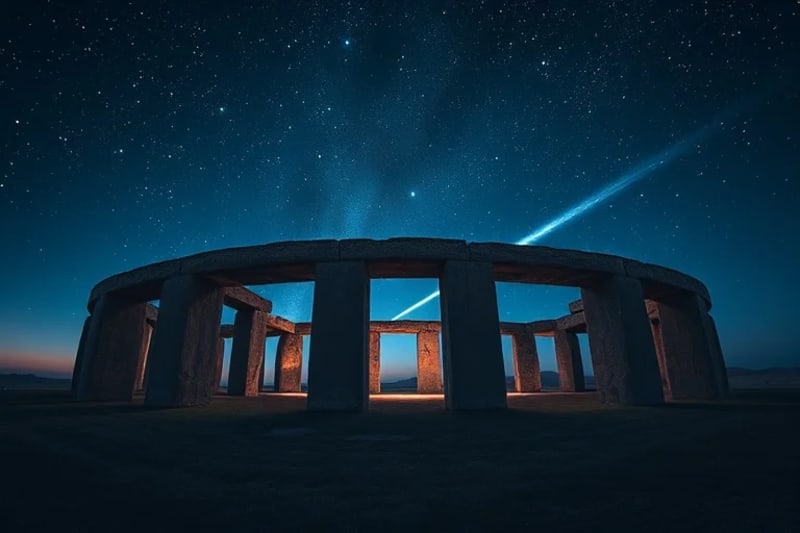 Precursors to modern scientific thought, ancient structures and their celestial alignments reflect a profound understanding of cosmic rhythms, shaping early human societies.
This conceptual image, a render by AI, captures the timeless connection between humanity and the celestial sphere, echoing ancient observations.
The practice involves meticulous surveying of ancient structures, analyzing their orientation relative to significant celestial events such as solstices, equinoxes, and the risings and settings of prominent stars or planets. It also examines ancient texts, iconography, and oral traditions for astronomical content, providing a holistic view of how the cosmos influenced human culture. The insights gained from astro-archeology challenge conventional narratives of human development, highlighting the sophisticated scientific understanding possessed by seemingly "primitive" cultures.
The Dawn of Celestial Observation
From the earliest periods of human history, the night sky served as both a clock and a calendar, guiding nomadic hunter-gatherers and later, agricultural communities. The regular cycles of the sun and moon dictated hunting seasons, planting times, and harvest periods. This practical necessity fostered a deep observational tradition, leading to the construction of structures designed to mark these celestial events with precision.
Megalithic sites across the globe, such as Stonehenge in England and Nabta Playa in Egypt, stand as monumental testaments to this early astronomical prowess. Stonehenge, for instance, is famously aligned with the summer solstice sunrise and winter solstice sunset, demonstrating a sophisticated understanding of solar cycles. Nabta Playa, predating Stonehenge by several millennia, features stone circles and alignments that correspond to the summer solstice and the heliacal rising of certain stars, indicating an even earlier development of astronomical observation in Africa.
These ancient observatories were not merely scientific instruments; they were also sacred spaces, where the celestial rhythms were interwoven with spiritual beliefs and communal rituals. The alignment of a structure with a particular star or constellation often imbued it with symbolic power, connecting the earthly realm with the divine cosmos. This integration of practical knowledge with spiritual significance is a hallmark of ancient celestial narratives.
Ancient Civilizations and Cosmic Calendars
As civilizations grew more complex, so did their astronomical systems. The Egyptians, Mayans, and Incas, among others, developed highly advanced celestial calendars and incorporated astronomical principles into their urban planning and monumental architecture. Their understanding of the cosmos was integral to their governance, religion, and daily life.
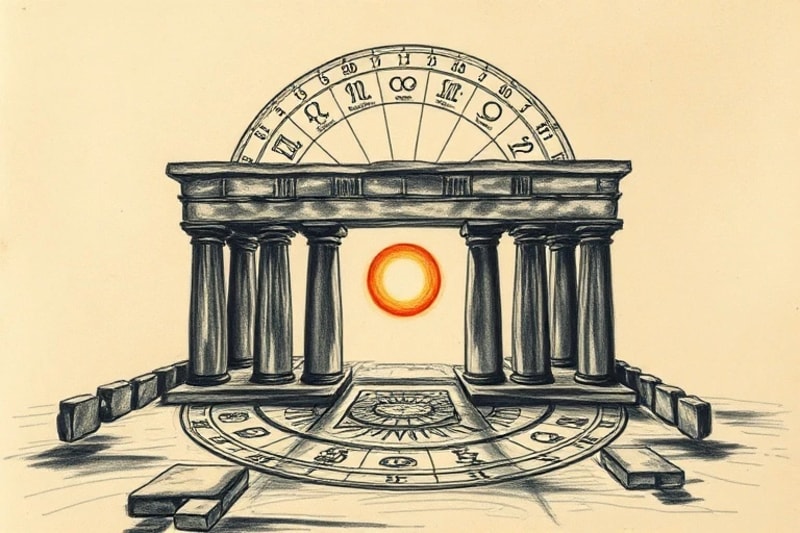 This intricate diagram reveals how ancient cultures meticulously mapped celestial movements, integrating them into their architectural designs and daily existence.
Rendered by AI, this visual interpretation highlights the precision and depth of ancient astronomical understanding.
In ancient Egypt, the orientation of temples and pyramids often aligned with the rising of the sun on specific dates, or with the heliacal rising of Sirius (Sopdet), which heralded the annual flooding of the Nile. This celestial event was crucial for agriculture and was deeply embedded in their mythology and religious practices. The precise alignment of structures like the Great Pyramid of Giza with the cardinal directions also speaks to their advanced observational skills.
The Maya civilization in Mesoamerica developed one of the most sophisticated calendar systems in human history, based on intricate observations of the sun, moon, and Venus. Sites like Chichen Itza feature structures, such as El Castillo, that exhibit dramatic light-and-shadow effects during the equinoxes, creating the illusion of a serpent descending the pyramid. These phenomena were not accidental but were deliberately engineered to mark significant cosmic events and reinforce the power of their rulers, who were often seen as intermediaries between the earthly and celestial realms. For a deeper dive into how celestial bodies influence personal destiny, consider exploring the concepts related to Sun Astrology: Ego, Purpose, Life Force Natal Chart Guide.
Similarly, the Inca Empire in the Andes incorporated astronomical alignments into their cities and ceremonial sites. The Intihuatana, or "hitching post of the sun," found at Machu Picchu, is believed to have been an astronomical clock or calendar, precisely marking the equinoxes and solstices. These structures allowed them to track agricultural cycles and perform rituals honoring their sun god, Inti. The wisdom embedded in these ancient designs reveals a profound respect for cosmic order and its influence on earthly life.
Decoding Celestial Narratives: Methods and Challenges
Astro-archeologists employ a variety of methods to uncover and interpret ancient celestial narratives. These include:
- Site Surveys and Alignments: Using modern surveying equipment and astronomical software to measure the orientation of ancient structures relative to celestial events at the time of their construction. This involves calculating the precise positions of stars and planets in the distant past.
- Epigraphy and Iconography: Analyzing ancient texts, inscriptions, and artistic representations for astronomical symbols, constellations, or references to celestial events. This can include deciphering hieroglyphs, codices, and rock art.
- Ethnoastronomy: Studying the astronomical knowledge and traditions of indigenous cultures that maintain connections to ancient practices. This provides valuable insights into the cultural context and meaning of celestial observations.
- Mathematical and Statistical Analysis: Applying statistical methods to determine the probability that observed alignments are intentional rather than coincidental, strengthening the evidence for astronomical purpose.
Despite these sophisticated methods, astro-archeology faces several challenges. The passage of time can alter landscapes, making precise measurements difficult. The interpretation of ancient beliefs can be subjective, and distinguishing between practical astronomical knowledge and symbolic or mythological interpretations requires careful scholarship. Furthermore, the destruction or degradation of ancient sites means that much evidence has been lost, making the reconstruction of complete celestial narratives a complex puzzle.
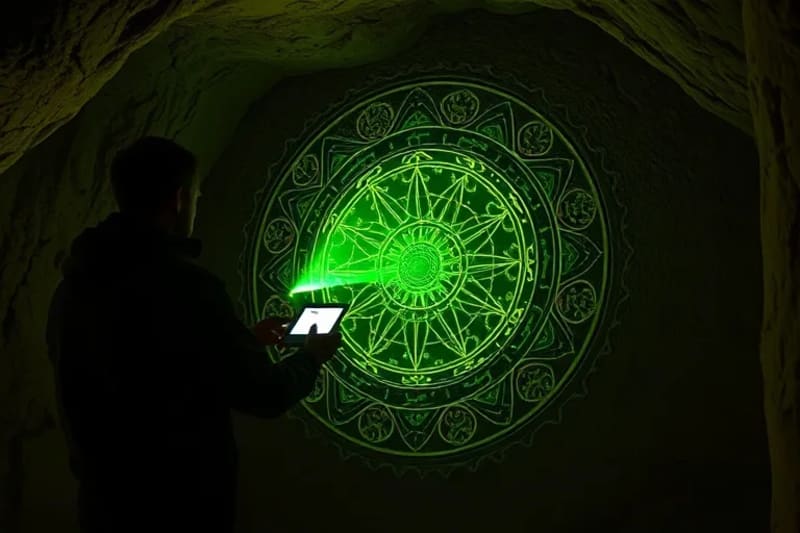 This visualization depicts contemporary scientific methods applied to ancient astronomical art, symbolizing the ongoing quest to understand historical cosmic insights.
A conceptual AI render, illustrating the technological intersection with ancient knowledge.
The Modern Relevance of Ancient Wisdom
The study of ancient celestial narratives is not merely an academic exercise; it holds significant relevance for our modern world. It offers profound insights into the origins of scientific thought, demonstrating that systematic observation and data collection are deeply ingrained in human intellectual history. By understanding how past cultures interacted with the cosmos, we gain a broader perspective on the evolution of astronomy and its cultural impact.
Moreover, these ancient narratives often contain wisdom about sustainable living, agricultural practices, and societal harmony that were directly linked to cosmic cycles. In an era of ecological concern, revisiting these integrated approaches to nature and the cosmos can provide valuable lessons. The holistic worldview of many ancient cultures, where the earth and sky were interconnected, contrasts sharply with purely mechanistic modern perspectives, encouraging a more balanced understanding of our place in the universe. Understanding the deeper layers of these cosmic influences can be akin to exploring Decans in Astrology: Deeper Layers of Your Sun Sign, revealing hidden dimensions of meaning.
Astro-archeology also enriches our appreciation for cultural diversity and the shared human experience of gazing at the stars. Despite geographical and temporal separation, many ancient societies developed similar cosmological concepts and architectural responses to celestial events. This universality speaks to a fundamental human curiosity and a desire to find meaning and order in the vastness of the universe. This search for meaning can also be found in studies of Fixed Stars Astrology Global Destiny Influence Explained.
The Esoteric and the Scientific
One of the intriguing aspects of astro-archeology is its intersection with both empirical science and esoteric traditions. While the discipline primarily relies on scientific methodologies to establish astronomical alignments, it also acknowledges that for ancient peoples, the cosmos was not merely a physical phenomenon but a realm imbued with spiritual significance. Many ancient celestial narratives are deeply intertwined with mythology, religion, and philosophical concepts that transcend purely scientific observation.
For example, the precise alignments of temples might have served not only as calendars but also as conduits for divine energy or as symbolic representations of cosmic order. The stars were often seen as deities, ancestors, or guides, and their movements were believed to influence human destiny and earthly events. Astro-archeology seeks to understand this dual nature of ancient celestial knowledge, recognizing that the scientific and the sacred were often inseparable.
This balance is crucial, as dismissing the esoteric aspects would be to ignore a significant dimension of ancient thought, while focusing solely on them without empirical evidence would undermine the scientific rigor of the field. The goal is to reconstruct the full spectrum of ancient cosmological understanding, embracing both its practical and its spiritual dimensions. This holistic approach resonates with contemporary interests in integrating different forms of knowledge, much like the principles explored in Quantum Manifestation Hermetic Alchemy Cosmic Laws Transform.
The study of ancient celestial narratives, as defined by the scholarly community, is an interdisciplinary endeavor that requires rigorous application of archaeological, astronomical, and anthropological methods. It is imperative to differentiate between scientifically verifiable alignments and speculative interpretations, maintaining a commitment to evidence-based research.
As per archaeological guidelines, all claims regarding astronomical significance must be supported by statistical analysis and contextual evidence from the cultural period under investigation. This ensures the integrity and academic validity of astro-archeological findings.
Conclusion: Echoes of the Cosmos
Astro-archeology offers a compelling journey into the minds of our ancestors, revealing a world where the cosmos was a living, breathing entity that shaped every aspect of human existence. From the megalithic circles of prehistoric Europe to the majestic temples of Mesoamerica, ancient peoples left behind an indelible record of their celestial observations and profound cosmological insights. These ancient celestial narratives, meticulously unearthed and interpreted by astro-archeologists, provide a vital link to our shared human heritage.
By studying these connections, we not only gain a deeper understanding of specific cultures but also appreciate the universal human quest for knowledge, meaning, and connection to something larger than ourselves. The wisdom embedded in these lost civilizations serves as a powerful reminder of humanity's enduring relationship with the stars, an echo of the cosmos that continues to inspire wonder and inquiry in the modern age. Astro-archeology thus stands as a testament to the timeless human endeavor to comprehend the universe and our place within it.
Explore More Cosmic Insights
- Aquarius Decans: Unveiling Water Bearer's Nuances | StarPluto
- Planetary Declinations Astrology: Parallels Contra-Parallels | StarPluto
- Quantum Cybersecurity: Post-Quantum Challenges for Critical Infrastructure
- Karmic Astrology: Soul Debts and Talents in the Natal Chart
- Astro-Botany: Celestial Influences on Plant Growth
- Forgotten Archaeological Prophecies: Sumerians, Egyptians, End Times
Source: Hybrid content assisted by AI and human editorial supervision.


Comments
Post a Comment