
Sacred Geometry Psychology: Universal Patterns Human Perception
Sacred geometry, a concept as ancient as civilization itself, delves into the fundamental patterns that underpin existence. From the spirals of galaxies to the atomic structure, these geometric forms are believed to be the blueprints of creation, manifesting in nature, art, and architecture across cultures. Beyond their aesthetic appeal, there is a profound psychological dimension to these patterns, influencing human perception, cognition, and even our capacity for manifestation.
This exploration delves into how these universal patterns resonate with the human psyche, shaping our understanding of beauty, order, and interconnectedness. We will uncover the historical roots of sacred geometry, its presence in various spiritual traditions, and the emerging scientific perspectives that shed light on its psychological impact. Understanding these principles can offer new insights into well-being, creativity, and the subtle ways our environment affects us.
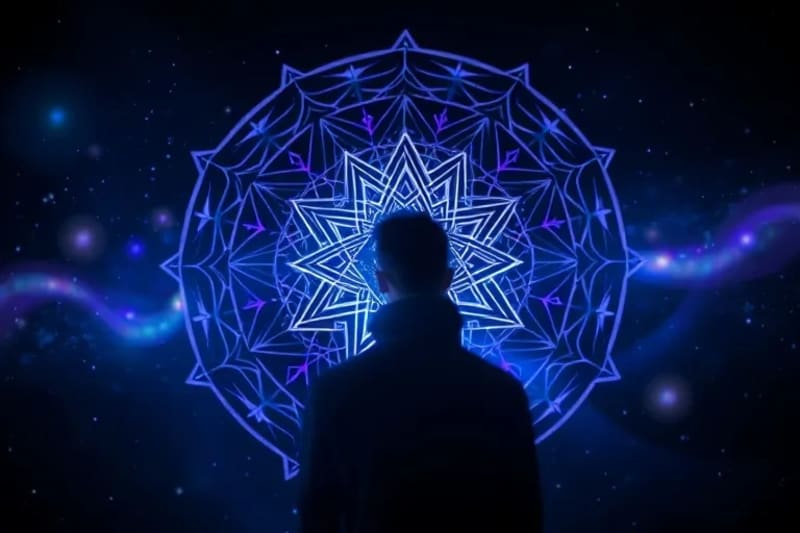 Exploring the subtle interplay between ancient geometric principles, their historical precursors, and the conceptual frameworks that define human perception and consciousness.
This conceptual visualization, a rendering by advanced AI, captures the essence of universal patterns influencing our cognitive landscape, drawing from a rich tapestry of historical and philosophical insights.
Table of Contents
- What is Sacred Geometry?
- Historical and Cultural Significance
- The Psychology of Form and Pattern
- Sacred Geometry and Human Cognition
- Emotional and Spiritual Well-being
- Sacred Geometry in Manifestation
- Practical Applications in Modern Life
- Conclusion: Harmonizing with Universal Design
What is Sacred Geometry?
Sacred geometry refers to the geometric patterns, shapes, and proportions found in nature and art that are believed to hold symbolic and spiritual significance. These patterns are often considered to be the fundamental building blocks of the universe, reflecting divine order and harmony. From the microscopic to the macroscopic, these geometric principles are ubiquitous, appearing in everything from snowflakes and seashells to planetary orbits and galactic structures.
Key examples include the Flower of Life, the Seed of Life, the Vesica Piscis, the Platonic Solids (tetrahedron, hexahedron, octahedron, dodecahedron, icosahedron), and the Fibonacci sequence/Golden Ratio. Each of these forms carries specific symbolic meanings and mathematical properties that have fascinated philosophers, scientists, and mystics for millennia. They are not merely abstract designs but are seen as living expressions of cosmic intelligence.
Historical and Cultural Significance
The presence of sacred geometry can be traced back to ancient civilizations across the globe. Egyptians incorporated the Golden Ratio into the construction of the Great Pyramids and their temples. The Greeks, particularly Pythagoras and Plato, extensively studied these forms, believing they held the secrets to the universe. Plato, in his work "Timaeus," associated the Platonic Solids with the classical elements: fire, earth, air, water, and the cosmos itself.
In Eastern traditions, mandalas and yantras, intricate geometric designs, are used as tools for meditation and spiritual transformation. Islamic art is renowned for its complex geometric patterns, which reflect the belief in the infinite nature of God and the rejection of figurative representation. Gothic cathedrals, with their rose windows and architectural proportions, also embody principles of sacred geometry, designed to uplift the spirit and connect worshippers to the divine.
The Psychology of Form and Pattern
From a psychological perspective, sacred geometry taps into our innate human preference for order, symmetry, and harmony. Research in cognitive psychology suggests that the human brain is wired to recognize and respond to patterns. Symmetrical and balanced forms are often perceived as more aesthetically pleasing and evoke feelings of calm and stability. This preference is not merely cultural; it appears to be deeply embedded in our cognitive architecture.
The Golden Ratio, for instance, has been shown to appear in objects and faces that humans find most attractive. This suggests that certain geometric proportions resonate with a fundamental sense of beauty and balance within us. Exposure to these patterns can reduce cognitive load, making information processing more efficient and leading to a sense of ease and satisfaction.
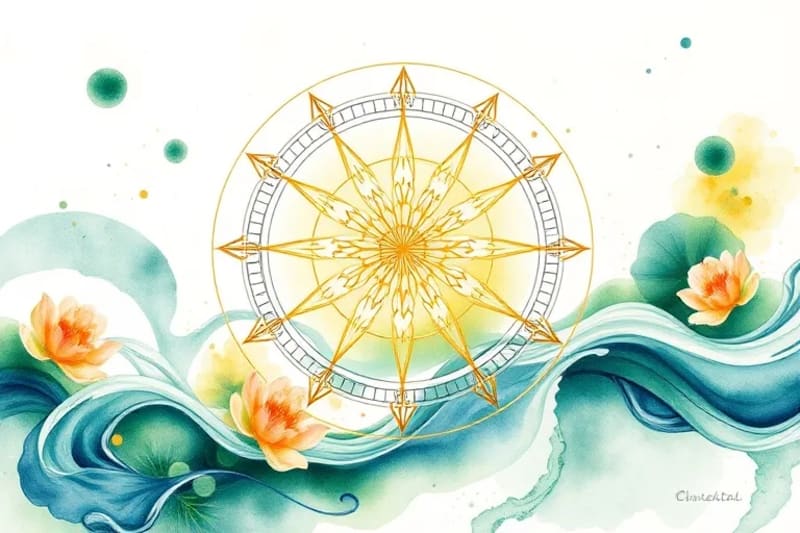 A conceptual artwork depicting the transformation of geometric patterns into tangible natural elements, symbolizing the process of manifestation.
This artistic interpretation, generated by AI, illustrates the dynamic interplay between abstract design and the materialization of ideas, echoing ancient beliefs in the power of intention and form.
Sacred Geometry and Human Cognition
The influence of sacred geometry extends beyond mere aesthetics to impact our cognitive functions. Engaging with these complex yet orderly patterns can stimulate both hemispheres of the brain, fostering a sense of holistic thinking. The left brain, typically associated with logic and analysis, appreciates the mathematical precision, while the right brain, linked to intuition and creativity, responds to the beauty and symbolic depth.
Studies have indicated that visual exposure to geometric patterns can enhance focus and concentration, making them valuable tools in practices like meditation and mindfulness. The repetitive and intricate nature of these designs can help quiet the "mental chatter," leading to a state of relaxed awareness. This cognitive engagement can improve problem-solving skills and foster innovative thought, as the mind is trained to perceive underlying structures and connections.
For those interested in deeper cognitive exploration, understanding esoteric symbolism in various media can further illuminate these connections. Explore Esoteric Symbolism in Modern Art to see how these patterns are integrated into contemporary visual culture.
Emotional and Spiritual Well-being
The psychological benefits of sacred geometry also encompass emotional and spiritual well-being. Many individuals report feeling a sense of peace, harmony, and connection when interacting with these patterns. This is often attributed to the inherent order and balance they represent, which can act as a calming influence on the nervous system.
In spiritual contexts, sacred geometry is seen as a doorway to higher consciousness, helping individuals connect with a sense of universal unity. The contemplation of these forms can evoke feelings of awe and wonder, fostering a deeper appreciation for the intricate design of existence. This can lead to a reduction in stress and anxiety, promoting a more centered and grounded state of being. The integration of such patterns into personal spaces or meditation practices can create environments conducive to spiritual growth and emotional balance.
Sacred Geometry in Manifestation
Beyond perception and well-being, sacred geometry is often linked to the principles of manifestation. The belief is that these patterns are the energetic templates through which reality is formed. By focusing on or working with specific geometric forms, individuals aim to align their intentions with these universal creative forces, thereby facilitating the manifestation of their desires.
Practices such as creating crystal grids often utilize sacred geometry to amplify intentions. The arrangement of crystals in geometric patterns is believed to create a more potent energetic field, directing energy towards a specific goal. This approach aligns with the hermetic principle of "as above, so below," suggesting that by understanding and applying universal patterns, we can influence our personal reality. For advanced insights into this, consider exploring Quantum Manifestation and Hermetic Reality Shaping.
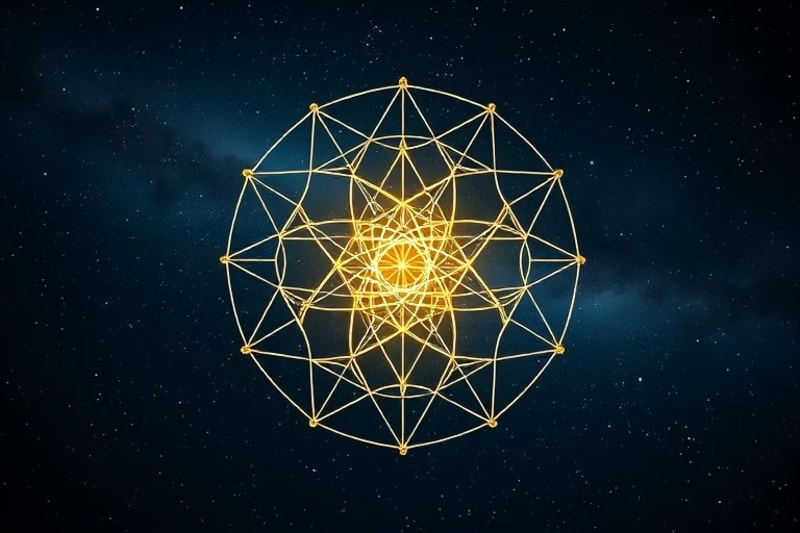 A 3D render illustrating Platonic solids and the Flower of Life suspended in a cosmic environment, representing the universal patterns of creation.
This AI-generated image provides a visual metaphor for the foundational geometric structures believed to govern the cosmos, inviting contemplation on the interconnectedness of all things.
The concept of "morphogenetic fields," proposed by Rupert Sheldrake, suggests that form and pattern are not merely physical but also energetic, influencing the development and behavior of systems. Sacred geometry can be seen as a representation of these fields, providing a visual language for the underlying structure of reality. By consciously engaging with these patterns, individuals may tap into these fields to shape their experiences.
Practical Applications in Modern Life
Integrating sacred geometry into daily life does not require deep mystical practice; it can be as simple as appreciating the patterns around us or consciously incorporating them into our environment. Here are a few practical applications:
- Meditation and Mindfulness: Use mandalas or images of sacred geometry as focal points during meditation to enhance concentration and achieve deeper states of relaxation.
- Art and Design: Incorporate geometric patterns into home decor, clothing, or personal art. This can create a harmonious and aesthetically pleasing environment that subtly influences mood and perception.
- Personal Growth: Study and draw sacred geometric forms to improve focus, develop artistic skills, and gain a deeper understanding of universal principles. This can be a form of active meditation.
- Energy Work: For those interested in energy practices, utilize crystal grids based on sacred geometric layouts to amplify intentions for healing, protection, or manifestation. Learn more about Advanced Crystal Grids.
- Architectural Spaces: Architects and designers can consciously apply principles of sacred geometry to create spaces that evoke specific emotional and cognitive responses, promoting well-being and productivity.
Even simple awareness of these patterns in nature, from the spiral of a sunflower to the branching of a tree, can foster a sense of connection and wonder. This heightened awareness can contribute to a more mindful and appreciative approach to life.
Conclusion: Harmonizing with Universal Design
The psychology of sacred geometry offers a fascinating lens through which to view our world and our place within it. These universal patterns are not just abstract concepts but powerful influences on human perception, cognition, and our ability to shape our reality. By understanding and consciously engaging with sacred geometry, we can cultivate a deeper sense of harmony, beauty, and purpose in our lives.
Whether through artistic appreciation, meditative practice, or simply observing the natural world, recognizing these fundamental designs can unlock new pathways to personal growth and a profound connection to the cosmos. As we continue to explore the intricate dance between consciousness and creation, sacred geometry remains a timeless guide, reminding us of the underlying order and interconnectedness that binds all things.
Explore More Insights
- AI Dream Interpretation: Algorithmic Decoding Subconscious Symbolism
- Scrying Reflective Surfaces Divination Future Insights
- Quantum Manifestation Hermetic Reality Shaping Advanced
- Astrology Social Justice Collective Cycles: Understanding Planetary Influence
- Dragon Destiny Strategies: Element & Ascendant Insights
- Esoteric Symbolism Modern Art Decoding Meanings Visual Media
- Advanced Numerology: Master Numbers, Karmic Debts
- Chiron Houses Healing Wounds Evolutionary Growth Natal Chart
- Crystal Grids Advanced: Programming Specific Intentions
- Herbal Magic: Plants for Spells, Healing, Protection
- Astro-Linguistics Sigil Magic: Unlocking Words for Manifestation
- Planetary Aspects Inner Child Healing Jungian Archetypes
- Karmic Astrology: Retrograde Planets & Past Life Lessons
- Shadow Work: Integrating Darker Aspects for Wholeness
- Horary Astrology: Answering Specific Questions
Source: Hybrid content assisted by AI and human editorial supervision.


Comments
Post a Comment