
Decoding Lunar Mansions: Advanced Timing & Life Events
In the intricate tapestry of astrological wisdom, the concept of Lunar Mansions stands as a profound yet often overlooked system for advanced timing and understanding the subtle energies that shape life events. Far beyond the familiar twelve zodiac signs, Lunar Mansions divide the celestial sphere into smaller, more precise segments, tracking the Moon's daily journey across the heavens. These divisions, rooted in ancient astronomical observations and spiritual traditions, offer unparalleled depth in predictive astrology, revealing nuanced influences on personality, destiny, and the unfolding of life's most significant moments.
This advanced exploration delves into the historical origins, cultural variations, and practical applications of Lunar Mansions, providing a framework for astrologers and enthusiasts to unlock a more granular understanding of cosmic timing. From the Vedic Nakshatras to the Arabic Manazil al-Qamar and the Chinese Xiù, each system offers a unique lens through which to interpret the Moon's potent influence, transforming birth chart analysis into a dynamic tool for forecasting and self-discovery.
Table of Contents
Quick Navigation:
- Historical Roots and Cross-Cultural Perspectives
- Vedic Nakshatras: The Lunar Constellations of India
- Arabic Manazil al-Qamar: Mansions of the Moon in Esoteric Traditions
- Chinese Xiù: The Twenty-Eight Mansions of the Celestial Sphere
- Interpreting Lunar Mansions in a Birth Chart
- Advanced Predictive Techniques with Lunar Mansions
- Integrating Lunar Mansions with Modern Astrology
Historical Roots and Cross-Cultural Perspectives
The concept of dividing the ecliptic into smaller segments based on the Moon's daily movement is an ancient practice, predating the familiar solar zodiac in many cultures. The Moon, being the fastest-moving celestial body visible to the naked eye, completes its cycle around the Earth in approximately 27.3 days. This natural rhythm formed the basis for these lunar divisions, each representing roughly one day's journey of the Moon.
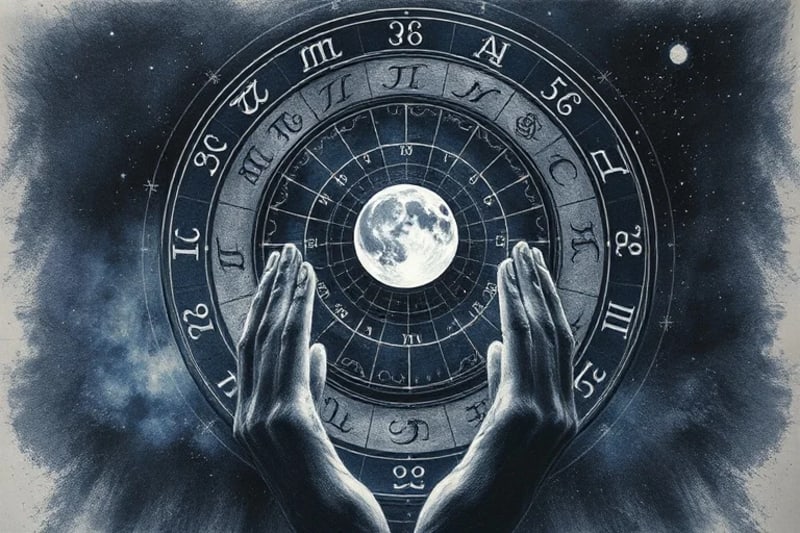
Exploring the profound historical and conceptual frameworks that underpin the understanding of lunar cycles and their influence on human experience across diverse ancient civilizations.
Conceptual AI render, inspired by historical astronomical charts and cross-cultural symbolism, illustrating the universal pursuit of celestial understanding.While the number of mansions typically hovers around 27 or 28, their specific boundaries, interpretations, and applications vary significantly across different traditions. This cross-cultural consistency points to a shared ancient observation of the cosmos and an intuitive understanding of the Moon's profound influence on earthly life, tides, emotions, and growth cycles. These systems provided not only calendrical functions but also powerful tools for divination, electional astrology, and understanding individual destinies.
Vedic Nakshatras: The Lunar Constellations of India
In Vedic astrology (Jyotish), the Nakshatras are arguably the most detailed and influential system of Lunar Mansions. There are 27 Nakshatras, each spanning 13 degrees and 20 minutes of the zodiac, covering the entire 360-degree circle. Each Nakshatra is associated with a specific star or asterism, a ruling planet, a deity, and a unique set of characteristics that profoundly influence its nature.
The Nakshatras are not merely divisions of space; they are considered cosmic powerhouses, each carrying distinct energetic imprints. The Moon's position in a particular Nakshatra at the time of birth is paramount in Vedic astrology, revealing deep insights into an individual's psychological makeup, inherent talents, challenges, and life path. This lunar mansion forms the basis for the Vimshottari Dasha system, a primary predictive tool in Jyotish that maps out planetary periods and their influence throughout a person's life.
Symbolic representation of how celestial mechanics, particularly lunar cycles, intricately govern the flow of time and influence earthly events.
Digital art, conceptualizing the precise and cyclical nature of astrological timing, inspired by ancient mechanisms.Key attributes associated with each Nakshatra include:
- Ruling Planet (Dasha Lord): Determines the planetary period sequence in Vimshottari Dasha.
- Deity: Represents the divine energy and archetypal qualities associated with the Nakshatra.
- Symbol: A visual representation that encapsulates its essence.
- Guna (Quality): Sattva (purity), Rajas (activity), or Tamas (inertia), indicating its fundamental nature.
- Yoni (Animal Symbol): Relates to sexual compatibility and instinctual nature.
- Nadi (Pulse): Indicates physiological and genetic predispositions, crucial for marital compatibility.
- Varna (Caste/Class): Relates to an individual's social and professional inclination.
The detailed analysis of Nakshatras extends to their padas (quarters), each spanning 3 degrees and 20 minutes, falling within a specific Navamsha (D9 chart) sign. This further refines the interpretation, adding layers of nuance to planetary placements. For a deeper dive into foundational astrological principles, consider exploring the Hermetic Principles: Seven Universal Laws Explained, which often underpin ancient cosmic understandings.
Arabic Manazil al-Qamar: Mansions of the Moon in Esoteric Traditions
The Arabic system of Lunar Mansions, known as Manazil al-Qamar, consists of 28 divisions, each roughly 12 degrees and 51 minutes of the zodiac. These mansions were integral to medieval Islamic astrology, astronomy, and magical practices. Each Manzil is associated with specific properties, influences, and often, particular talismans or rituals.
Unlike the Vedic system, which focuses heavily on natal chart interpretation and predictive dashas, the Arabic Mansions found significant application in electional astrology (Muhurta) and astrological magic. Practitioners would observe which Manzil the Moon was transiting to determine auspicious times for specific actions, spellcasting, or the creation of talismans for health, prosperity, protection, or love. Each Manzil had a specific "nature" – for example, some were considered favorable for travel, others for starting new ventures, and some for destructive purposes.
| System | Number of Mansions | Angular Span (Approx.) | Primary Application |
|---|---|---|---|
| Vedic Nakshatras | 27 | 13° 20' | Natal Chart Analysis, Predictive Dashas, Compatibility |
| Arabic Manazil al-Qamar | 28 | 12° 51' | Electional Astrology, Astrological Magic, Talismanic Work |
| Chinese Xiù | 28 | Variable (Unequal Divisions) | Astronomical Observation, Feng Shui, Destiny Analysis |
Chinese Xiù: The Twenty-Eight Mansions of the Celestial Sphere
In Chinese astronomy and astrology, the celestial sphere is divided into 28 Xiù (宿), or "mansions" or "lodges." These are primarily equatorial divisions, unlike the ecliptic divisions of the Vedic and Arabic systems. Each Xiù is associated with a specific constellation and often linked to one of the Four Symbols of the Chinese constellations: the Azure Dragon of the East, the Vermilion Bird of the South, the White Tiger of the West, and the Black Tortoise of the North.
The Chinese Xiù were crucial for tracking the Moon's position and were fundamental to their calendar system, agricultural cycles, and navigation. In Chinese astrology, particularly in systems like Zi Wei Dou Shu (Purple Star Astrology) and Bazi (Four Pillars of Destiny), the Xiù provide additional layers of interpretation regarding an individual's destiny, character, and the timing of events. The unequal sizes of the Xiù reflect their origin in observing actual star groupings rather than abstract mathematical divisions.
Interpreting Lunar Mansions in a Birth Chart
To effectively decode Lunar Mansions in a birth chart, one must look beyond the Sun and Moon signs and delve into the specific mansion occupied by key planetary placements. This adds immense detail and specificity to traditional interpretations.
A visual metaphor for the intricate process of astrological prediction, where ancient tools illuminate the subtle threads of fate and future possibilities.
3D conceptual render, blending historical artifacts with futuristic elements to represent the timeless nature of astrological inquiry.- The Moon's Mansion: This is arguably the most crucial placement. It reveals the core emotional nature, subconscious patterns, instinctive reactions, and the general tenor of one's destiny. In Vedic astrology, the Moon's Nakshatra is the foundation of the entire predictive system.
- The Ascendant's Mansion: The Nakshatra of the Ascendant (Lagna) describes the individual's life path, physical appearance, temperament, and how they project themselves to the world. It colors the entire chart and indicates the primary lessons to be learned.
- Planets in Mansions: Each planet placed in a specific Lunar Mansion will express its energy through the filter of that mansion's qualities. For example, Mars in a Nakshatra known for its aggressive nature will manifest its drive differently than Mars in a peaceful, nurturing Nakshatra. This adds significant detail to planetary significations.
- Planetary Rulerships: In Vedic astrology, the planetary ruler of the Nakshatra where a planet is placed can also modify its expression. This concept is vital for understanding the subtle interplay of energies.
Understanding these placements requires a deep study of each mansion's specific characteristics, deities, symbols, and planetary associations. It moves beyond generic sign interpretations to a more personalized and precise understanding of astrological influences. For example, exploring the Decans of the Zodiac can offer a similar layer of detailed interpretation within the solar sign system.
Advanced Predictive Techniques with Lunar Mansions
The true power of Lunar Mansions shines in predictive astrology, offering tools for exceptionally precise timing of life events and understanding karmic unfolding.
- Vimshottari Dasha System (Vedic): This is the cornerstone of Vedic predictive astrology. Based on the Moon's Nakshatra at birth, it assigns specific planetary periods (Dashas) that govern different phases of life. Each Dasha brings forth the themes and energies of its ruling planet, filtered through the natal chart's planetary placements and their Nakshatras. Understanding the current Dasha and its sub-periods (Bhuktis) provides a detailed roadmap of life's unfolding events and challenges.
- Transits through Natal Mansions: Observing transiting planets, especially the Moon, through the natal Nakshatras of significant planets or the Ascendant can trigger events related to those natal placements. For instance, a challenging planet transiting over one's natal Moon Nakshatra might indicate emotional turmoil or significant life changes.
- Muhurta (Electional Astrology): This ancient technique involves selecting the most auspicious time to begin an activity, based on planetary positions, particularly the Moon's Nakshatra. Each Nakshatra has specific qualities that make it favorable or unfavorable for certain actions (e.g., starting a business, getting married, traveling). This is where the Arabic Manazil also find strong application.
- Compatibility (Kuta Matching): In Vedic astrology, Nakshatra compatibility (Kuta matching) is a crucial aspect of relationship analysis. By comparing the Nakshatras of two individuals, astrologers can assess their inherent compatibility on various levels – emotional, physical, mental, and spiritual.
- Lunar Return Charts: While less common than Solar Returns, analyzing the Lunar Return chart (when the transiting Moon returns to its natal position) and noting its Nakshatra can provide insights into the emotional themes and events of the upcoming lunar month.
These techniques, when mastered, allow for an incredibly precise and nuanced understanding of life's timing. For those interested in deeper astrological aspects, the concept of the Yod Aspect in Astrology offers another layer of complex karmic patterning.
Integrating Lunar Mansions with Modern Astrology
While Lunar Mansions are deeply rooted in ancient traditions, their integration into a modern astrological practice can significantly enhance the depth and accuracy of readings. Western astrologers can benefit from understanding the Nakshatra or Manzil placement of key planets, adding a layer of detail that traditional sign and house interpretations might miss.
For instance, knowing that a natal Venus in Libra falls within the Chitra Nakshatra (ruled by Mars, deity Tvashtar, associated with craftsmanship and beauty) provides a much richer understanding than just "Venus in Libra." It suggests a Venusian expression that is highly artistic, possibly precise, and driven by a desire for perfection, with a subtle Martian undercurrent. This synthesis allows for a more holistic and comprehensive astrological profile.
The study of Lunar Mansions requires dedication and an open mind, but the rewards are immense. It unlocks a profound understanding of cosmic rhythms, personal destiny, and the precise timing of life's unfolding events, moving beyond broad strokes to reveal the intricate brushwork of the celestial artist.
Explore More Insights
- Runes Ancient Divination: Self-Discovery Tool
- Psycho-Astrology: Jungian Archetypes & Shadow Wholeness Guide
- Tarot Numerology Fusion: Life Path Predictive Insights
- Synastry Davison Charts: Shared Soul Purpose in Relationships
- Jungian Archetypes in Astrology: Shadow, Anima, Hero's Journey
- Neptune in Houses: Decoding Dreams, Spirituality, Illusions
Source: Hybrid content assisted by AI and human editorial supervision.


Comments
Post a Comment