
AI Tarot Reading: Predictive Insights, Ethical AI Divination
The ancient art of Tarot reading, a practice steeped in mysticism and introspection, is undergoing a profound transformation with the advent of artificial intelligence. This convergence of traditional divination and cutting-edge technology introduces a fascinating new frontier: AI-assisted Tarot reading. Far from replacing human intuition, AI is emerging as a powerful tool to augment, analyze, and offer novel perspectives on the complex symbolism inherent in Tarot cards, opening doors to predictive insights and deeper self-understanding.
This exploration delves into how AI interprets these symbolic cards, the capabilities and limitations of its predictive insights, and the critical ethical considerations that arise when algorithms venture into the realm of spiritual guidance. As we navigate this evolving landscape, understanding the mechanics and implications of algorithmic divination becomes paramount for both practitioners and seekers alike.
Table of Contents
- How AI Interprets Tarot: The Algorithmic Approach
- Predictive Insights: Capabilities and Limitations of AI Tarot
- Ethical Considerations in Algorithmic Divination
- The Indispensable Role of the Human User
- The Future of AI in Spiritual Practices
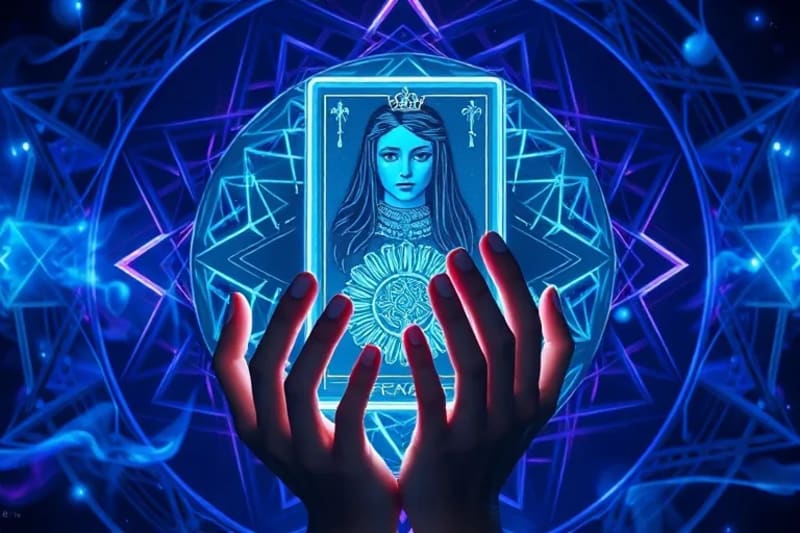
The fusion of digital projections and esoteric symbols represents the evolving landscape of AI-assisted divination.
Conceptual rendering by AI, exploring the dynamic interplay between advanced technology and traditional spiritual practices.How AI Interprets Tarot: The Algorithmic Approach
At its core, AI-assisted Tarot reading leverages sophisticated computational methods to process and interpret the vast symbolic language of the cards. This process typically involves several key AI technologies, primarily machine learning and natural language processing (NLP). Machine learning algorithms are trained on extensive datasets that include traditional Tarot card meanings, historical interpretations, and even user feedback from millions of readings.
These algorithms learn to recognize patterns, correlations, and nuances that might be subtle to the human eye. For instance, they can identify how specific cards interact with each other in various positions within a spread, drawing connections that might indicate particular outcomes or psychological states. NLP comes into play when translating the symbolic meanings into coherent, human-readable interpretations, often generating detailed narratives that resonate with the querent's questions.
The AI doesn't "feel" or "intuit" in the human sense; instead, it operates on statistical probabilities and learned associations. It can analyze the Rider-Waite-Smith deck, Thoth Tarot, or other systems by breaking down their visual elements, associated keywords, astrological correspondences, and numerological significance. This allows for a multi-layered analysis that can be both comprehensive and remarkably fast, providing insights that might take a human reader considerable time and research to compile.
- Data Ingestion: AI systems ingest vast libraries of Tarot lore, including card meanings, astrological associations, numerology, and historical interpretations.
- Pattern Recognition: Machine learning identifies recurring patterns and relationships between cards in different spreads and contexts.
- Natural Language Generation: NLP models translate complex symbolic data into coherent, personalized narrative interpretations.
- Contextual Analysis: Some advanced AIs can consider user input (questions, personal details) to tailor interpretations, enhancing relevance.
Predictive Insights: Capabilities and Limitations of AI Tarot
The allure of AI-assisted Tarot often lies in its promise of predictive insights. By analyzing historical data and patterns, AI can project potential outcomes based on current energies and trends represented by the cards. This can manifest as identifying probable challenges, opportunities, or psychological shifts. For example, if a common pattern of cards historically leads to a specific type of career change, the AI can highlight this as a strong possibility for the querent.
The intricate dance between human curiosity and algorithmic intelligence.
However, it is crucial to understand the limitations. AI predictions are based on statistical likelihoods and learned patterns, not on genuine foresight or intuition. They reflect what has been, not necessarily what must be. The future is inherently fluid, influenced by countless variables, including free will and unforeseen circumstances. AI cannot account for the subtle energies, personal nuances, or the querent's own evolving consciousness in the same way a deeply empathetic human reader might.
Therefore, AI-generated predictions should be viewed as probabilities and guidance, rather than definitive prophecies. They offer a data-driven perspective on potential paths, serving as a powerful tool for self-reflection and decision-making, but always within the context of human agency. For those interested in other AI-driven interpretive methods, exploring AI-Assisted Dream Interpretation: Algorithmic Approaches can provide further insight into how technology deciphers subconscious symbolism.
| Aspect | Capabilities (Strengths) | Limitations (Weaknesses) |
|---|---|---|
| Analysis Depth | Processes vast data, identifies complex patterns and correlations across multiple card meanings and systems. | Lacks intuitive depth, cannot grasp subtle energetic shifts or unspoken emotional nuances. |
| Speed & Accessibility | Instantaneous readings, available 24/7, democratizes access to Tarot for a global audience. | May lead to superficial engagement due to instant gratification, potential for over-reliance. |
| Objectivity | Provides interpretations free from human biases, personal beliefs, or emotional states of a reader. | Can perpetuate biases present in its training data, lacks empathy and human connection. |
| Predictive Scope | Highlights statistical probabilities and likely outcomes based on historical patterns. | Cannot account for free will, unforeseen events, or the dynamic nature of the future; offers probabilities, not certainties. |
Ethical Considerations in Algorithmic Divination
The integration of AI into practices as personal and sensitive as divination raises significant ethical questions. One primary concern is the potential for bias. If the training data for an AI Tarot system reflects historical or societal biases (e.g., gender stereotypes, cultural assumptions), these biases can be perpetuated and amplified in its interpretations. This could lead to skewed advice or misinterpretations that are not truly neutral or universally applicable.
Another critical aspect is the issue of privacy and data security. Users often share personal questions and sensitive information during a reading. How is this data stored, used, and protected? The potential for misuse or breaches of such intimate data is a serious concern that developers must address with robust security measures and transparent data policies. The very nature of AI in spiritual contexts also brings up discussions around AI Esoteric Symbolism: Decoding Digital Consciousness, where the implications of digital interpretation extend beyond mere data.
A symbolic representation of ancient wisdom meeting the digital age.
Furthermore, there's the risk of over-reliance. If individuals begin to solely depend on AI for life decisions or spiritual guidance, they might lose touch with their own inner wisdom, intuition, and critical thinking skills. The human element of self-reflection, personal responsibility, and the nuanced understanding of one's own life context could diminish. Ethical AI development in this space requires a commitment to transparency, fairness, and user empowerment, ensuring that the technology serves as an aid, not a replacement for personal agency.
- Algorithmic Bias: Ensuring training data is diverse and free from societal prejudices to prevent skewed interpretations.
- Data Privacy: Protecting sensitive user information shared during readings through robust encryption and clear policies.
- Over-Reliance: Designing AI tools that encourage self-reflection and critical thinking rather than fostering dependency.
- Transparency: Clearly communicating the AI's capabilities and limitations to users, managing expectations about its "predictive" nature.
- Authenticity: Addressing the philosophical question of whether algorithmic insights can truly be considered "spiritual" guidance.
The Indispensable Role of the Human User
Despite the sophistication of AI, the human element remains indispensable in Tarot reading. AI can provide a comprehensive analysis of card meanings and their interactions, but it cannot fully replicate the depth of human intuition, empathy, and the ability to connect with a querent on an emotional level. A human reader brings a unique blend of life experience, spiritual wisdom, and the capacity to ask clarifying questions that can unlock deeper insights. The process of Biometric Divination Biofeedback Intuition Self-Discovery highlights the persistent need for human engagement with self-discovery tools.
The AI's interpretation serves as a powerful starting point, a detailed map. However, it is the human user who must navigate this map, applying the insights to their unique life circumstances, values, and aspirations. The AI might point out a potential challenge, but it is the individual who must decide how to confront it, drawing upon their inner resources and free will. The human user provides the context, the personal narrative, and the ultimate meaning-making process that transforms raw data into profound personal guidance.
Therefore, AI-assisted Tarot is best viewed as a collaborative tool. It can offer a second opinion, highlight overlooked aspects, or provide a quick, objective reading. However, the final interpretation, the integration of insights, and the actionable steps always rest with the individual, making the experience a blend of technological assistance and personal empowerment.
The Future of AI in Spiritual Practices
The trajectory of AI in spiritual practices, including Tarot, points towards increased integration and augmentation rather than replacement. We can anticipate more sophisticated AI models capable of understanding nuanced human language, emotional states (through sentiment analysis), and even integrating biofeedback data to provide highly personalized readings. Imagine an AI that not only interprets cards but also suggests mindfulness exercises or journaling prompts tailored to your current emotional state and the reading's themes.
The future may also see AI acting as a research assistant for human Tarot readers, quickly cross-referencing interpretations, historical contexts, and astrological correspondences, allowing the human reader to focus more on intuitive connection and client interaction. This synergy could elevate the practice of Tarot, making it more accessible, deeply informed, and dynamically responsive to individual needs.
Ultimately, AI in spiritual practices is poised to become a bridge between ancient wisdom and future possibilities, offering new avenues for self-exploration, guidance, and understanding in an increasingly complex world. The key will be to develop these technologies responsibly, ensuring they enhance human experience without diminishing the profound spiritual connection that lies at the heart of practices like Tarot.
Explore More Insights
- Dream Incubation AI: Subconscious Symbolism Decoding
- Celestial Mechanics Global Consciousness Cosmic Sociology
- Urban Geomancy: Ley Lines & Spirit Allies in Cityscapes
- Planetary Rulerships Beyond Dignities: Accidental Strength
- Ética IA Generativa Arte: Autoría, Propiedad Intelectual, Debate
Source: Hybrid content assisted by AI and human editorial supervision.


Comments
Post a Comment