
Vedic Astrology vs Western Natal Charts Comparative Guide
Navigating the vast landscape of celestial interpretation often brings practitioners to a fascinating fork in the road: the choice between Vedic astrology, known as Jyotish, and Western tropical astrology. While both systems map the positions of the planets at the exact moment of birth to decode human psychology and destiny, their underlying mathematical frameworks, philosophical foundations, and predictive techniques diverge significantly. Understanding these systemic differences allows seekers to choose the right lens for personal evolution and deep psychological inquiry.
Table of Contents (Jump Menu)
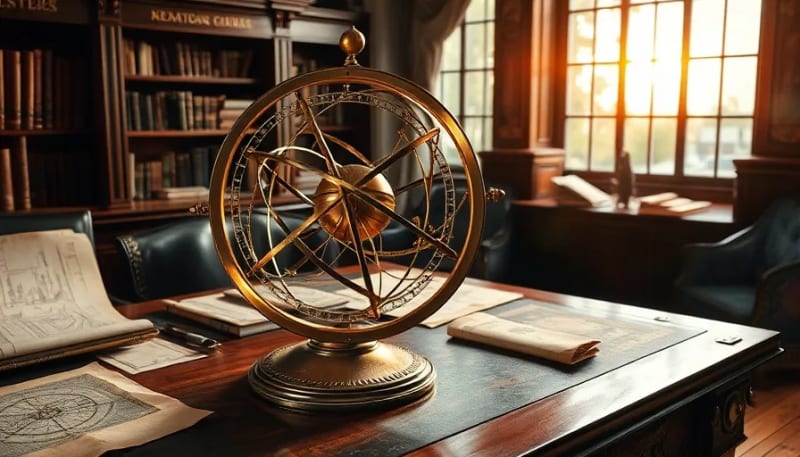
Intricate historical instruments, celestial maps, and esoteric geometric tools that illustrate humanity's enduring quest to measure time and decode cosmic cycles. Image: AI conceptual render based on public domain astronomical artifacts and Wikimedia Commons historical references.
Foundational Divergence: Sidereal vs. Tropical Zodiacs
The most critical mechanical difference between Vedic astrology and Western astrology lies in how they measure the zodiac wheel. Western astrology utilizes the tropical zodiac, which is anchored to the vernal equinox. In this system, zero degrees of Aries always aligns with the Northern Hemisphere's spring equinox, regardless of the physical constellations in the background sky. This approach aligns the chart with seasonal changes and psychological archetypes tied to Earth's orbit around the Sun.

Abstract artistic rendering of stellar constellations and zodiacal paths mapped across ancient parchment.
Conversely, Vedic astrology employs the sidereal zodiac, which accounts for the Earth's axial precession—a gradual shift in the orientation of our planet's rotational axis. Because of this astronomical wobble, the sidereal zodiac calculates planetary positions based on the actual fixed stars in the night sky. This creates an offset between the two systems known as the Ayanamsa, currently spanning approximately 24 degrees. As a result, a person's Sun sign in Western astrology often shifts backward into the previous sign when calculated in the Vedic system.
For those exploring deeper layers of psyche and destiny, examining how these frameworks interact can be illuminating. Many practitioners find that comparing these charts mirrors the deep self-inquiry found in Natal Chart Self-Discovery: Deeper Insights, where reconciling conflicting personality traits leads to profound breakthroughs. Understanding the sidereal framework also connects closely with studies in Neuro-Astrología Sideral: Conexión Cerebral Ancestral, bridging ancient celestial observation with modern cognitive patterns.
House Systems and Chart Layout Mechanics
Beyond the zodiac calculation, the visual and structural layout of the chart differs dramatically. Western astrology typically uses circular wheels divided into various house systems such as Placidus, Koch, or Whole Sign, accommodating planets across dynamic geometric aspects. The focus tends to lean heavily toward psychological profiling, relational dynamics, and inner potentials.
In contrast, Vedic astrology traditionally utilizes a square or diamond-shaped grid known as the South Indian or North Indian chart style. More importantly, Vedic astrology strictly adheres to the Whole Sign house system, where each house corresponds to an entire 30-degree zodiac sign. The Ascendant (Lagna) dictates the first house entirely, and every subsequent house occupies a full sign. This structural clarity eliminates house size distortion and places immense emphasis on planetary rulerships and conjunctions, which are analyzed through sophisticated predictive timing models.
Clean geometric lines and intersecting orbital pathways illustrating structural alignment in predictive charting.
When analyzing complex chart geometries, practitioners often encounter rigid configurations that mirror psychological tensions. Navigating these configurations is similar to interpreting challenging aspects discussed in Fixed Cross and T-Square: Navigating Dynamic Chart Patterns, where structural friction drives personal transformation and resilience.
Predictive Tools: Dashas vs. Transits and Progressions
Another major distinction lies in forecasting methods. While Western astrology relies heavily on planetary transits, secondary progressions, and solar returns to anticipate life cycles, Vedic astrology utilizes a highly precise, mathematically driven planetary period system known as Vimshottari Dashas.
The Dasha system maps out a sequence of planetary time lords based on the exact degree of the Moon at birth. Each human life is divided into distinct planetary epochs ranging from several years to decades. These periods dictate which psychological themes, career milestones, or karmic lessons will take center stage. To master these temporal cycles and align personal timing with cosmic rhythms, many advanced students integrate principles from Chrono-Astrology Techniques Navigating Personal Time Cycles.
| Feature | Vedic Astrology (Jyotish) | Western Tropical Astrology |
|---|---|---|
| Zodiac Calculation | Sidereal (Fixed Stars, Accounts for Precession) | Tropical (Anchored to Vernal Equinox) |
| Primary Focus | Karmic blueprint, destiny, and predictive timing | Psychological profiling, free will, and inner growth |
| House System | Whole Sign Houses (Strict sign-to-house boundaries) | Placidus, Koch, Equal, or Whole Sign |
| Forecasting Method | Vimshottari Dashas (Planetary Time Lords) | Transits, Secondary Progressions, Solar Returns |
Integrating Both Systems for Holistic Self-Discovery
Rather than viewing Vedic and Western astrology as opposing rivals, modern esoteric practitioners increasingly treat them as complementary languages. Western charts excel at mapping psychological nuance, emotional landscapes, and conscious self-awareness. Meanwhile, Vedic charts provide an extraordinary roadmap for understanding life timing, karmic obligations, and structural destiny.
Synthesizing both approaches bridges the gap between psychological autonomy and celestial determinism. By exploring the unique strengths of each tradition, seekers can construct a comprehensive framework for personal growth, emotional healing, and spiritual mastery.
Explore Our Content Ecosystem
- Solar Return Cycles: Annual Predictions Self-Knowledge Personal Growth
- Lunar Mansions Esoteric Symbolism Predictive Astrology Wisdom
- Cosmic Omens: Synchronicities, Esoteric Symbols, Horoscopes Interpretation
- Entanglement Synastry: Non-Local Soul Connections & Fate
Source: Hybrid content assisted by AI and human editorial supervision.


Comments
Post a Comment