
Sacred Geometry Biophilic Urban Design: Harmonious Spaces
In an increasingly urbanized world, the quest for spaces that foster well-being, connection, and harmony has become paramount. Traditional urban planning often prioritizes functionality and economic efficiency, sometimes at the expense of human experience and ecological balance. However, a transformative paradigm is emerging, one that weaves together ancient wisdom with contemporary design principles: the integration of sacred geometry into biophilic urban design. This approach seeks to create environments that are not only aesthetically pleasing and ecologically sound but also energetically resonant, promoting a profound sense of peace and vitality for inhabitants.
This article delves into the synergistic potential of these two powerful concepts, exploring how the universal patterns of sacred geometry can amplify the inherent benefits of biophilic design to craft truly harmonious urban spaces. We will uncover the foundational principles of each discipline and illustrate how their convergence can lead to cities that nurture the human spirit and foster a deeper connection to the natural world.
Table of Contents
- The Essence of Sacred Geometry: Universal Blueprints
- Biophilic Urban Design: Reconnecting with Nature
- The Convergence: Sacred Geometry as Biophilic Amplifier
- Practical Applications in Urban Planning and Architecture
- Energetic Harmony and Human Well-being
- Challenges, Innovation, and the Future of Urban Harmony
The Essence of Sacred Geometry: Universal Blueprints
Sacred geometry is the ancient science and philosophy that explores the fundamental patterns and proportions found throughout nature and the cosmos. It posits that certain geometric shapes and ratios are not merely arbitrary but are the underlying blueprints of creation, reflecting the divine order and interconnectedness of all things. From the spiral of a galaxy to the arrangement of seeds in a sunflower, these patterns appear universally, suggesting a common language of existence.
Key elements of sacred geometry include the Golden Ratio (Phi, approximately 1.618), the Fibonacci sequence, and the Platonic Solids (tetrahedron, hexahedron/cube, octahedron, dodecahedron, icosahedron). These forms and ratios are believed to carry specific energetic qualities and to evoke a sense of beauty, balance, and harmony within the human psyche. Ancient civilizations, from the Egyptians to the Greeks, intuitively understood and applied these principles in their art, architecture, and spiritual practices, believing they could align human creations with cosmic energies.
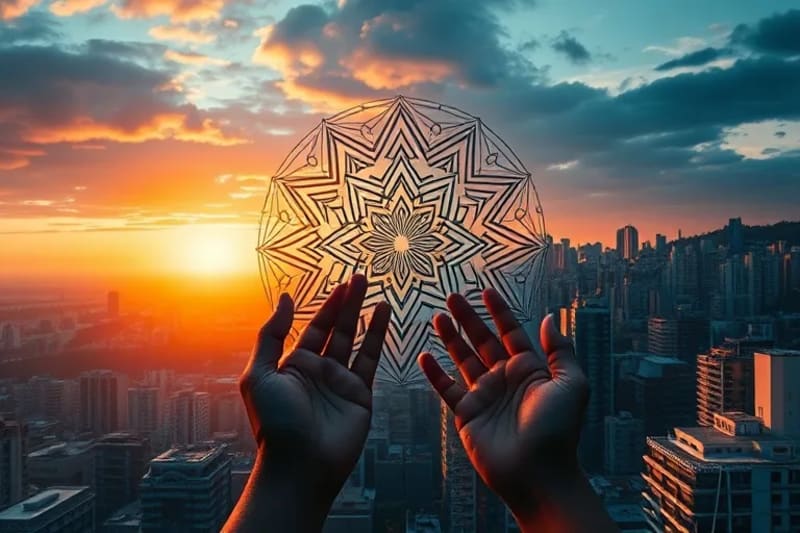 The intricate dance between universal geometric principles and the organic flow of nature, as envisioned in contemporary urban design.
This conceptual visualization, a product of advanced AI rendering, illustrates the potential for urban environments to embody both ancient wisdom and ecological consciousness, reflecting patterns found in nature and the cosmos.
The energetic implications of sacred geometry are profound. It is believed that spaces designed with these proportions can facilitate a more balanced flow of energy, promoting healing, creativity, and spiritual awareness. When we encounter these forms, whether consciously or subconsciously, our brains tend to process them as inherently pleasing and orderly, contributing to a sense of calm and well-being. This innate human response forms a crucial bridge to the principles of biophilic design.
Biophilic Urban Design: Reconnecting with Nature
Biophilia, a term popularized by E.O. Wilson, describes the innate human tendency to connect with nature and other living systems. Biophilic design translates this innate affinity into the built environment, aiming to integrate natural elements and processes into architecture and urban planning. The core idea is that by bringing nature into our daily lives, we can improve our physical health, mental well-being, and overall quality of life.
The principles of biophilic design extend beyond simply adding plants to a building. They encompass a broader spectrum of natural elements and experiences, including:
- Direct Connection to Nature: Incorporating natural light, fresh air, water features, living walls, and natural landscapes.
- Indirect Connection to Nature: Using natural materials, colors, textures, and patterns that mimic those found in nature.
- Spatial and Place-Based Qualities: Designing spaces that offer prospects (unimpeded views), refuges (places of retreat), and complexity (rich sensory information).
- Human-Nature Relationship: Fostering emotional attachments to natural elements and encouraging interaction with ecological systems.
The benefits of biophilic design are well-documented. Studies have shown that access to nature in urban settings can reduce stress, lower blood pressure, improve cognitive function, enhance creativity, and accelerate healing. In an urban context, biophilic design translates into green infrastructure, urban farms, accessible parks, tree-lined streets, and buildings that breathe with natural light and ventilation. It transforms concrete jungles into vibrant, living ecosystems that support both human and ecological health. To learn more about how urban planning can integrate natural cycles, consider exploring Eco-Astrology Planetary Cycles Environmental Restoration.
The Convergence: Sacred Geometry as Biophilic Amplifier
The true innovation lies in understanding how sacred geometry can act as a powerful amplifier for biophilic design. Nature itself is replete with sacred geometric patterns. The branching of trees, the spiral of a fern, the hexagonal structure of a honeycomb, and the fractal patterns of coastlines all embody these universal principles. When biophilic design consciously integrates these geometric blueprints, it moves beyond mere aesthetics to create spaces that resonate at a deeper, energetic level.
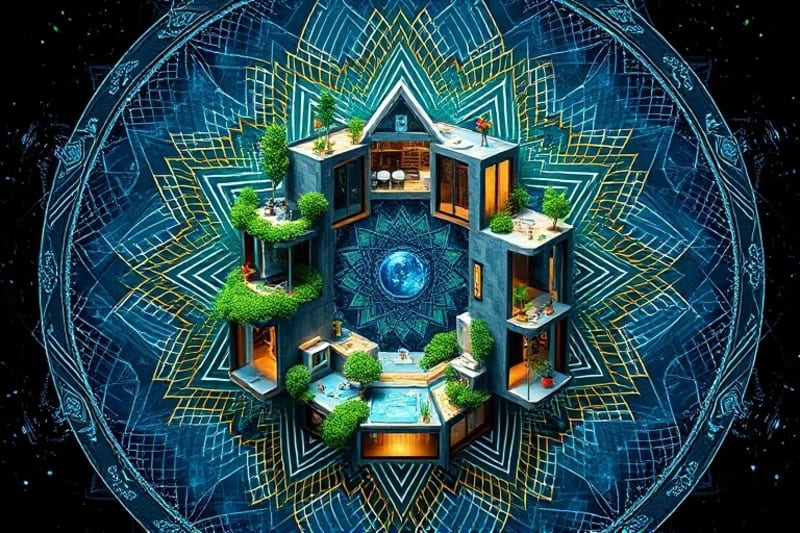 A detailed architectural rendering showcasing the seamless integration of natural elements and precise geometric proportions within a sustainable urban dwelling.
Consider the Golden Ratio. When applied to the proportions of a building's facade, the layout of a park, or even the spacing of trees along a boulevard, it creates a visual harmony that is instinctively perceived as beautiful and balanced. This is because our brains are wired to recognize these patterns, which are ubiquitous in healthy natural systems. By consciously incorporating them, designers can create environments that feel inherently "right" and conducive to well-being.
Fractal geometry, another key aspect, is particularly relevant. Fractals are patterns that repeat at different scales, creating complexity and detail. Nature is fractal: a tree branch looks similar to the entire tree, and a fern frond resembles the whole plant. Integrating fractal patterns into urban green spaces, building textures, or even street networks can mimic the visual richness of natural environments, reducing visual monotony and fostering a sense of engagement and exploration. This deep integration of natural and mathematical principles can elevate urban spaces into realms of profound energetic resonance.
Practical Applications in Urban Planning and Architecture
The application of sacred geometry in biophilic urban design is not merely theoretical; it offers tangible strategies for creating more harmonious cities:
- Urban Layouts and Master Planning:
- Golden Ratio in Zoning: Applying Golden Ratio proportions to define the relative sizes of different urban zones (residential, commercial, green spaces) can create a sense of balanced distribution.
- Fibonacci Spirals in Pathways: Designing pedestrian pathways and bike routes that follow natural curves inspired by Fibonacci spirals can create more organic, enjoyable, and intuitively navigable routes.
- Platonic Solids for Public Spaces: The underlying geometry of public squares or plazas can be inspired by Platonic Solids, influencing their overall shape and the arrangement of elements within them to foster specific energetic qualities (e.g., a central gathering point).
- Architectural Design:
- Proportional Facades: Using the Golden Ratio for window placement, building height-to-width ratios, and facade divisions can create visually appealing and energetically balanced structures.
- Fractal Building Skins: Designing building exteriors with fractal patterns, perhaps through modular green walls or intricate shading devices, mimics natural complexity and integrates nature visually.
- Internal Flow: Applying sacred geometry to the layout of interior spaces can optimize natural light penetration, air circulation, and the flow of human movement, enhancing comfort and well-being.
- Landscape Architecture and Green Infrastructure:
- Fractal Green Spaces: Designing parks and gardens with fractal branching patterns for paths, water features, and planting arrangements creates visually rich and ecologically diverse environments.
- Geometric Planting Beds: Arranging planting beds or urban farms in patterns derived from sacred geometry can enhance visual appeal and potentially optimize plant growth through energetic alignment.
- Water Features: Incorporating water elements whose flow patterns or basin shapes reflect sacred geometry can create calming, resonant focal points in urban landscapes.
These applications move beyond superficial greening, embedding a deeper, structural harmony into the very fabric of the city. This approach can be particularly powerful when considering concepts like Algorithmic Enchantment AI-Generated Sigils Sacred Art, where technology can assist in generating and visualizing these complex patterns for urban integration.
Energetic Harmony and Human Well-being
The ultimate goal of integrating sacred geometry into biophilic urban design is to foster a profound sense of energetic harmony and enhance human well-being. When we inhabit spaces that are aligned with these universal patterns, we experience a subtle yet powerful shift in our state of being. This goes beyond mere comfort or aesthetic pleasure; it taps into our innate connection to the underlying order of the universe.
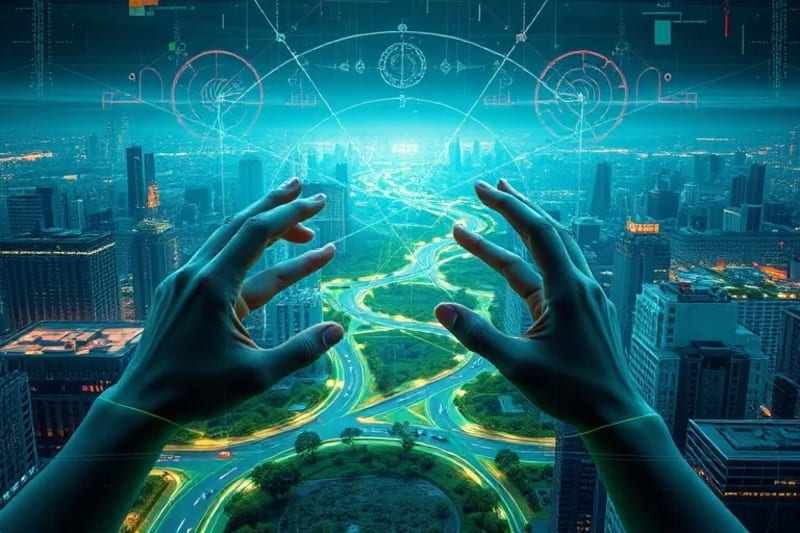 An abstract representation of how invisible energetic currents can be guided and amplified by the intentional application of sacred geometric principles within urban frameworks.
The benefits are multi-faceted:
- Reduced Stress and Anxiety: Environments designed with natural patterns and harmonious proportions can induce a state of calm, reducing physiological markers of stress.
- Enhanced Cognitive Function: Exposure to natural and geometrically ordered environments has been linked to improved focus, creativity, and problem-solving abilities.
- Increased Sense of Belonging: Spaces that feel inherently balanced and beautiful can foster a stronger sense of community and connection among residents.
- Improved Physical Health: By encouraging outdoor activity, providing clean air, and reducing psychological stress, these designs indirectly contribute to better physical health outcomes.
- Spiritual Connection: For many, experiencing these universal patterns can evoke a sense of wonder, awe, and connection to something larger than themselves, fostering spiritual well-being.
These harmonious spaces become more than just places to live or work; they become sanctuaries that nourish the soul and support holistic human development. The subtle energetic shifts they facilitate contribute to a more positive and uplifting collective consciousness within the urban fabric, aligning with broader concepts of Cosmic Sociology AI Ethics Global Consciousness Digital Age.
Challenges, Innovation, and the Future of Urban Harmony
While the vision of cities built upon sacred geometry and biophilic principles is compelling, its widespread implementation faces several challenges. These include the initial costs associated with innovative design, the need for interdisciplinary collaboration between urban planners, architects, landscape designers, and spiritual practitioners, and overcoming conventional planning paradigms that often prioritize efficiency over experiential quality. Educating policymakers and the public about the profound benefits of such designs is also crucial.
However, the future is bright with innovation. Advancements in computational design, parametric modeling, and artificial intelligence are making it easier to generate and analyze complex geometric patterns and integrate them seamlessly into urban plans. Digital tools can simulate the energetic flow and human experience within proposed designs, allowing for optimization before construction. Furthermore, a growing global awareness of environmental sustainability and mental health is creating a fertile ground for these holistic design philosophies to take root.
The integration of sacred geometry into biophilic urban design represents a profound shift in how we conceive and construct our cities. It moves us towards creating urban environments that are not just functional or green, but truly harmonious, energetically balanced, and deeply nurturing to the human spirit. By honoring the universal blueprints of creation and our innate connection to nature, we can build cities that are not just places to exist, but vibrant ecosystems where life flourishes in all its beauty and potential.
Explore More Insights
- Esoteric Symbolism AI Art: Digital Consciousness
- Sacred Movement Esoteric Breathwork: Activating Pranic Energy
- Hellenistic Astrology Bridging Ancient Predictive Modern Spirituality
- Dream Interpretation: Decoding Common Symbols A-Z
- Electional Astrology Timing Life Events Success Guide
- Astrología Cósmica: Lenguajes Luz y Potencial Álmico
Source: Hybrid content assisted by AI and human editorial supervision.


Comments
Post a Comment