
Sacred Geometry Psychology: Universal Patterns Perception
The universe, in its grand design, often reveals itself through patterns. From the spiral of a galaxy to the branching of a tree, certain fundamental forms and ratios appear consistently across scales and disciplines. Sacred geometry is the study of these universal patterns, believed to be the blueprint of creation, while psychology explores the intricacies of the human mind, perception, and behavior. The intersection of these two fields offers a fascinating lens through which to understand how humans perceive, interpret, and are influenced by the inherent order of the cosmos.
This exploration delves into how the principles of sacred geometry resonate within the human psyche, influencing our aesthetic preferences, cognitive processes, and even our sense of spiritual connection. By examining the universal patterns that underpin both the physical world and our mental constructs, we can uncover profound insights into the nature of reality and our place within it. This article aims to bridge the gap between ancient wisdom and modern psychological understanding, offering a diversified perspective on how fundamental geometric forms shape our inner and outer worlds.
Table of Contents
- Foundations of Sacred Geometry: The Universal Blueprint
- Psychological Dimensions of Pattern Recognition and Perception
- The Golden Ratio (Phi) and Its Impact on Aesthetic Appeal
- Platonic Solids: Archetypal Forms and Cognitive Resonance
- Fractals and Self-Similarity: Reflecting Mind and Nature
- Symmetry and Balance: Psychological Comfort and Order
- Applications and Modern Interpretations in Psychology and Design
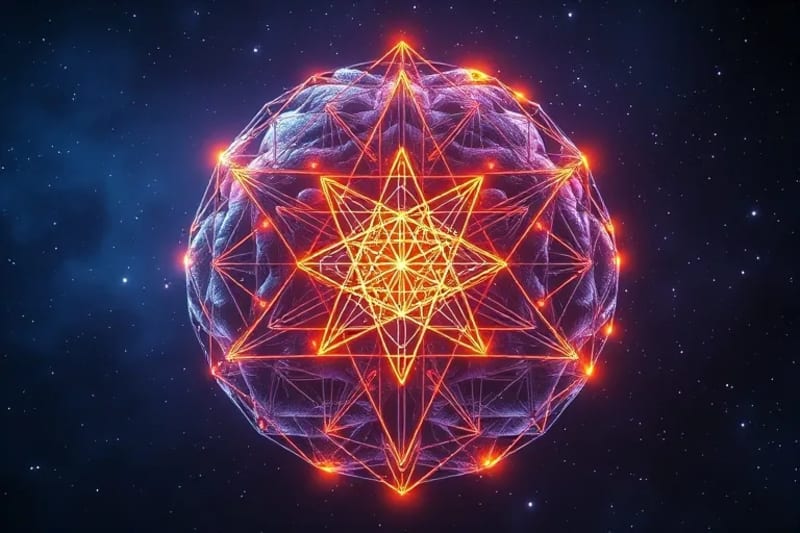
Exploring the intricate dance between universal geometric forms and the complex structures of human thought, perception, and consciousness.
Conceptual AI rendering exploring the deep resonance between the mathematical elegance of the cosmos and the inner workings of the human psyche, crafted under a free-use license.Foundations of Sacred Geometry: The Universal Blueprint
Sacred geometry is an ancient metaphysical concept that explores the fundamental patterns and forms believed to underlie all creation. It posits that certain geometric shapes and proportions are not arbitrary but are intrinsic to the fabric of existence, from the microscopic to the macroscopic. These patterns are found in nature, art, architecture, and even the human body, suggesting a universal language of form that transcends cultural and temporal boundaries.
Key principles of sacred geometry include the Golden Ratio (Phi), the Fibonacci sequence, Platonic Solids, and the Flower of Life. These elements are not merely mathematical curiosities; they are seen as symbols of cosmic order, harmony, and interconnectedness. Understanding these foundational concepts is crucial for appreciating their psychological impact, as they represent an underlying structure that the human mind instinctively recognizes and responds to.
Historically, civilizations across the globe, from ancient Egypt and Greece to indigenous cultures, incorporated sacred geometry into their spiritual practices, art, and architecture. They believed these forms held inherent power and could facilitate a deeper connection to the divine or universal consciousness. This historical reverence highlights a long-standing human intuition about the significance of these patterns.
Psychological Dimensions of Pattern Recognition and Perception
The human brain is fundamentally a pattern-seeking organ. From birth, we are wired to detect regularities, make predictions, and construct meaning from the sensory information we receive. This innate ability to recognize patterns is critical for survival, learning, and navigating the complex world around us. When we encounter geometric patterns, especially those considered "sacred," our brains engage in a sophisticated process of interpretation.
Psychologically, exposure to ordered and harmonious patterns can evoke feelings of calm, balance, and well-being. Conversely, chaotic or unpredictable patterns can lead to feelings of unease or stress. This response is not solely cultural; it appears to be deeply rooted in our cognitive architecture. The Gestalt principles of perception, such as proximity, similarity, continuity, and closure, illustrate how our minds naturally organize visual information into coherent wholes, often favoring simpler, more symmetrical, and complete forms.
The universality of sacred geometric patterns suggests that they tap into these fundamental cognitive mechanisms. Our brains may be predisposed to find these structures aesthetically pleasing or meaningful because they reflect the underlying order of the natural world, which our perceptual systems have evolved to process efficiently. This connection can be further explored through concepts like Psycho-Astrology Jungian Archetypes, which also touch upon universal symbols and patterns in the human psyche.
The Golden Ratio (Phi) and Its Impact on Aesthetic Appeal
Perhaps the most celebrated of all sacred geometric principles is the Golden Ratio, approximately 1.618, often denoted by the Greek letter Phi (Φ). This irrational number appears when the ratio of two quantities is the same as the ratio of their sum to the larger of the two quantities. It manifests in countless natural phenomena, from the spiral arrangement of seeds in a sunflower to the proportions of a nautilus shell, and even in the branching patterns of trees.
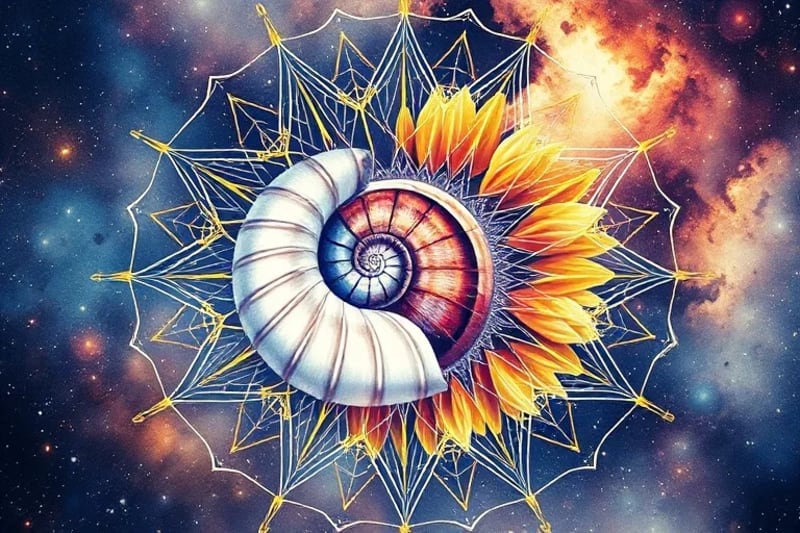
The ubiquitous presence of the Golden Ratio across natural forms and human creations, reflecting universal principles of harmony and proportion.
Artistic interpretation generated by AI, showcasing the Golden Ratio's influence on aesthetics and natural design, available for use under a general license.Psychologically, the Golden Ratio has been linked to human perceptions of beauty and harmony. Studies suggest that objects, faces, and compositions that adhere to these proportions are often rated as more aesthetically pleasing. This preference is evident in art history, where artists like Leonardo da Vinci and architects throughout various eras consciously or unconsciously incorporated Phi into their works. The Parthenon in Greece is a classic example of architecture designed with these harmonious proportions.
The psychological explanation for this preference is multifaceted. It may relate to our innate ability to process information efficiently; patterns adhering to the Golden Ratio might be perceived as naturally balanced and less demanding for cognitive processing. Alternatively, it could stem from our evolutionary exposure to these proportions in nature, leading to an inherent preference for forms that signal health, vitality, and optimal growth. This concept ties into broader ideas of Elemental Balance Birth Chart, where harmony and proportion are also key to understanding personal dynamics.
Platonic Solids: Archetypal Forms and Cognitive Resonance
Platonic Solids are a set of five convex regular polyhedra: the tetrahedron, cube (hexahedron), octahedron, dodecahedron, and icosahedron. Each face is a regular polygon of the same size and shape, and the same number of faces meet at each vertex. These geometric forms were extensively studied by ancient Greek philosophers, most notably Plato, who associated each solid with a classical element or a cosmic concept:
- Tetrahedron: Fire (sharp, energetic)
- Cube: Earth (stable, grounded)
- Octahedron: Air (light, fluid)
- Icosahedron: Water (flowing, adaptable)
- Dodecahedron: Aether/Universe (encompassing, celestial)
From a psychological perspective, these perfect forms hold a unique resonance. Their inherent symmetry and regularity make them visually stable and harmonious. They represent fundamental building blocks of three-dimensional space, and our minds may instinctively recognize their structural integrity and balance. This recognition can evoke a sense of order and foundational truth.
The association of these solids with elements and cosmic principles also taps into archetypal thinking, as described by Carl Jung. These shapes can function as universal symbols that resonate with deeper layers of the unconscious mind, representing fundamental aspects of existence. Encountering these forms, whether in art, meditation, or natural crystalline structures, can therefore have a profound, often subconscious, psychological impact, fostering a sense of connection to universal order.
Fractals and Self-Similarity: Reflecting Mind and Nature
Fractals are complex geometric shapes that exhibit self-similarity at different scales; that is, they look roughly the same no matter how much you zoom in or out. They are found abundantly in nature, from coastlines and snowflakes to river networks, lightning bolts, and the branching patterns of trees and blood vessels. The concept of fractals, popularized by Benoît Mandelbrot, provides a mathematical framework for understanding the irregular yet ordered complexity of the natural world.
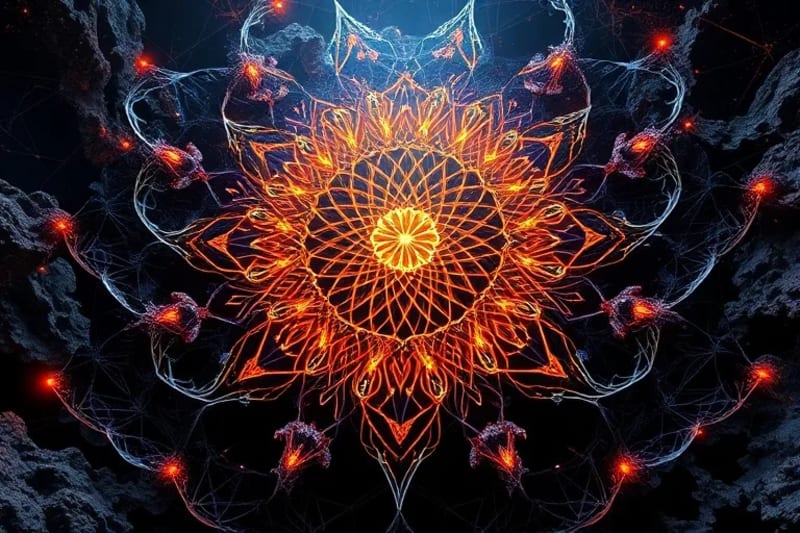
The intricate beauty of fractal geometry, mirroring the complex, self-similar structures found in both natural phenomena and the human brain's neural pathways.
Digitally rendered conceptual art, illustrating the fractal nature of reality and thought, sourced from a public domain generative art project.Psychologically, fractals can have a unique effect on the human mind. Research suggests that viewing natural fractal patterns can reduce stress and promote relaxation. This might be due to our evolutionary adaptation to natural environments, which are rich in fractal geometry. Our visual system is highly attuned to processing these patterns, and their inherent complexity, combined with underlying order, may provide a form of "restful stimulation" that is both engaging and calming.
Furthermore, the human brain itself exhibits fractal-like structures, particularly in its neural networks. This self-similarity in our cognitive architecture might explain why we find fractals so compelling and why they can evoke a sense of deep connection or understanding. The recursive nature of fractals can also be seen as a metaphor for thought processes, where ideas branch out and repeat in complex, interconnected ways. This mirrors the intricate web of connections explored in Astrology Mindfulness Integration, which seeks inner harmony through understanding complex systems.
Symmetry and Balance: Psychological Comfort and Order
Symmetry is a fundamental aspect of sacred geometry and a powerful psychological principle. Bilateral symmetry, where one half of an object or image is a mirror image of the other, is ubiquitous in nature, from human faces and animal bodies to the structure of leaves. Radial symmetry, where parts are arranged around a central point, is also common in flowers and certain organisms.
Psychologically, symmetry is strongly associated with order, balance, and harmony. Our brains are highly efficient at detecting symmetry, and there is an inherent preference for symmetrical forms. This preference is deeply ingrained, partly due to evolutionary reasons: symmetry in living organisms often signals health, genetic fitness, and lack of disease or injury. Thus, symmetrical faces are generally perceived as more attractive.
Beyond attractiveness, symmetry provides a sense of stability and predictability. In design and architecture, symmetrical compositions tend to feel more formal, grand, and reassuring. This psychological comfort derived from symmetry contributes to the overall sense of well-being and order that sacred geometric patterns often evoke. It reduces cognitive load, as symmetrical patterns are easier to process and understand, leading to a feeling of clarity and ease.
Applications and Modern Interpretations in Psychology and Design
The interplay of sacred geometry and psychology has practical applications in various modern fields. In architecture and interior design, understanding these principles can create spaces that promote well-being, productivity, and aesthetic pleasure. Designers often incorporate elements like the Golden Ratio, symmetrical layouts, and natural fractal patterns to create environments that feel inherently balanced and harmonious.
In therapeutic contexts, visual stimuli featuring sacred geometric patterns are sometimes used in mindfulness practices, meditation, and art therapy. The repetitive and ordered nature of these patterns can help calm the mind, focus attention, and induce states of relaxation or altered consciousness. This aligns with practices that seek to integrate spiritual and psychological well-being, fostering inner harmony and balance.
Furthermore, in fields like user interface (UI) and user experience (UX) design, principles of visual hierarchy, balance, and proportion, often rooted in geometric understanding, are crucial for creating intuitive and aesthetically pleasing digital interfaces. Even in branding and marketing, logos and visual identities frequently leverage geometric principles to convey stability, innovation, or elegance, subtly influencing consumer perception and trust.
The study of sacred geometry and its psychological impact continues to evolve, bridging ancient wisdom with contemporary scientific inquiry. It reminds us that the quest for order, meaning, and beauty is deeply embedded in the human experience, and that universal patterns offer a profound language through which we can understand ourselves and the cosmos.
Explore Our Content Ecosystem
Dive deeper into the fascinating connections between ancient wisdom, modern psychology, and cosmic influences. Our curated articles offer diverse perspectives to enrich your understanding of the universe and your place within it.
- Astro-Genomics Epigenetics: Decoding Inherited Health Patterns: Uncover the celestial influences on your genetic blueprint.
- Guided Meditation Emotional Well-being Moon Phases: Harmonize your inner self with lunar cycles.
- Techno-Shamanism Digital Tools Bridging Ancient Modern Spirituality: Explore the fusion of technology and ancient spiritual practices.
- Grand Trines Astrology: Harmonious Flow, Creative Potential: Understand the powerful positive aspects in your birth chart.
- Fixed Cross and T-Square: Navigating Dynamic Chart Patterns: Learn to master challenging astrological configurations.
- Oráculos Arcaicos: Desenterrando Prácticas Esotéricas Civilizaciones Perdidas: Journey into the ancient world of divination.
- Liturgia Sacramentos Sanación Protección: Guía Tiempos Inciertos: Find spiritual guidance and protection in challenging times.
Source: Hybrid content assisted by AI and human editorial supervision.


Comments
Post a Comment