
Psyche Celestial Mechanics: Planetary Orbits Archetypes
The intricate relationship between the human psyche and celestial mechanics has captivated thinkers for millennia. Far from being a mere superstition, the concept that planetary orbits influence archetypal patterns within our consciousness represents a profound intersection of ancient wisdom and modern scientific inquiry. This exploration delves into how the predictable, yet complex, movements of celestial bodies resonate with universal psychological structures, shaping our individual and collective experiences.
Understanding this connection requires a multidisciplinary approach, bridging the gap between astrophysics, depth psychology, and esoteric traditions. The premise is not that planets directly "cause" events, but rather that their orbital patterns serve as a cosmic clock, mirroring and synchronizing with intrinsic patterns of development and expression within the human soul.
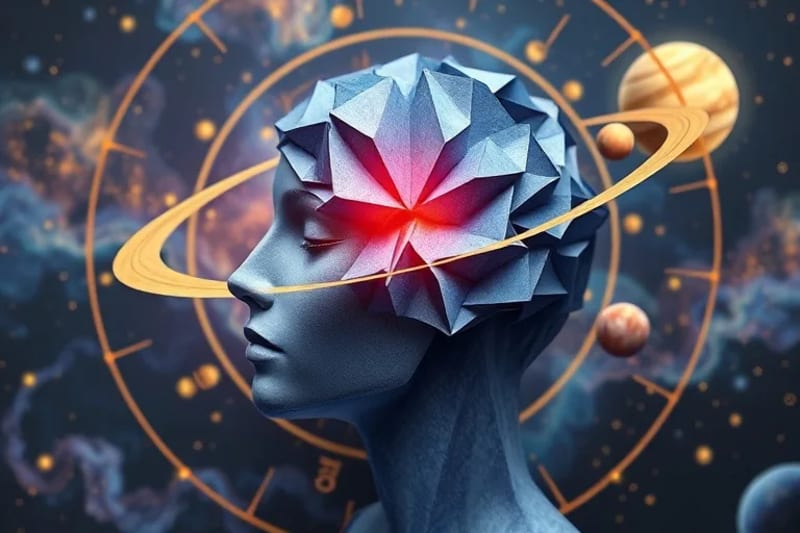
Conceptual illustration depicting the subtle yet profound influence of celestial mechanics on the intricate tapestry of human archetypal patterns.
This visual interpretation, a render assisted by advanced AI, captures the essence of cosmic synchronicity and its resonance with the human spirit, reflecting the timeless interplay between the macrocosm and microcosm.
Table of Contents
- The Foundation: Celestial Mechanics and Archetypal Psychology
- Planetary Orbits as Cosmic Rhythms
- Jungian Archetypes and Astrological Correspondences
- Transits and Progressions: Dynamic Archetypal Activation
- The Holographic Universe and Synchronicity
- Implications for Self-Understanding and Evolution
The Foundation: Celestial Mechanics and Archetypal Psychology
Celestial mechanics, a branch of astronomy, describes the motions of celestial bodies under the influence of gravity. It provides the mathematical framework for predicting planetary positions, conjunctions, oppositions, and other significant alignments. These precise, cyclical patterns have been observed and recorded for millennia, forming the bedrock of astrological systems worldwide.
Archetypal psychology, notably influenced by Carl Jung, posits the existence of universal, archaic patterns and images that derive from the collective unconscious. These archetypes, such as the Hero, the Mother, the Shadow, or the Wise Old Man, are not inherited ideas but rather inherited predispositions to respond to the world in certain ways. They manifest in myths, dreams, art, and human behavior across cultures and throughout history.
The convergence of these two fields suggests that the archetypes are not merely abstract psychological constructs but may be deeply entangled with the fundamental rhythms of the cosmos. The planetary orbits, with their distinct periods and relationships, could be seen as the physical manifestation of these archetypal principles, acting as a dynamic blueprint for the unfolding of consciousness.
Planetary Orbits as Cosmic Rhythms
Each planet in our solar system possesses a unique orbital period and trajectory, contributing to a complex symphony of cosmic rhythms. These rhythms are not static; they create constantly shifting angular relationships (aspects) between planets from our geocentric perspective. Astrologers interpret these aspects as indicators of psychological dynamics and life events.
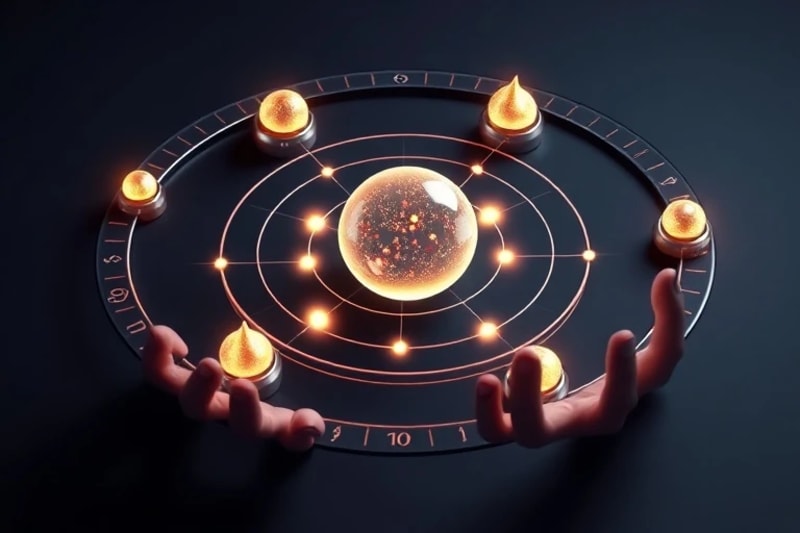
A sophisticated 3D rendering of planetary orbits, emphasizing the intricate gravitational dynamics that orchestrate cosmic rhythms.
This visual representation, generated by AI, highlights the elegance and precision of celestial mechanics, illustrating how these forces might underpin the archetypal unfolding of consciousness.
Consider the distinct characteristics associated with each planet in astrological symbolism, which remarkably align with archetypal qualities:
- Sun: Corresponds to the Ego, the Self, conscious identity, vitality, and purpose. Its daily and annual cycle defines our fundamental rhythm of existence.
- Moon: Linked to the Anima/Animus, the Mother archetype, emotions, instincts, and the unconscious. Its rapid lunar cycles influence our emotional tides and subconscious patterns.
- Mercury: Represents the Trickster, the Messenger, communication, intellect, and rational thought. Its swift orbit and retrogrades symbolize periods of introspection and re-evaluation.
- Venus: Associated with the Lover, the Goddess, values, aesthetics, relationships, and harmony. Its graceful orbit reflects cycles of attraction and union.
- Mars: Embodies the Warrior, the Hero, drive, aggression, courage, and assertion. Its direct movement signifies action and impulse.
- Jupiter: Corresponds to the Wise Old Man, the Benefactor, expansion, growth, wisdom, and optimism. Its longer orbital period marks cycles of opportunity and philosophical development.
- Saturn: Linked to the Father, the Senex, structure, discipline, limitation, and responsibility. Its significant orbital period defines major life stages and lessons.
The outer planets—Uranus, Neptune, and Pluto—with their even longer and more distant orbits, are often associated with collective, transpersonal archetypes and generational shifts. For instance, Neptune in Houses is often linked to dreams, illusions, and spiritual journeys, reflecting its archetypal influence on our collective unconscious and spiritual aspirations.
Jungian Archetypes and Astrological Correspondences
Carl Jung himself explored the parallels between astrology and his concept of archetypes, seeing astrology as a symbolic representation of the collective unconscious. He noted that the astrological chart, or birth chart, acts as a "map of the psyche," reflecting the archetypal patterns active within an individual at the moment of their birth.
The positions of planets within specific zodiac signs and houses, and the angular relationships between them, are believed to indicate the specific configuration and interplay of archetypal energies within an individual's psychological makeup. For example, a prominent Mars might suggest a strong Warrior archetype, while a dominant Venus could indicate a powerful Lover archetype.
This isn't a deterministic view but rather an acknowledgment of a symbolic correspondence. The celestial patterns don't dictate fate but rather illuminate the inherent psychological potentials and challenges. The individual's free will and conscious choices determine how these archetypal energies are expressed and integrated.
Transits and Progressions: Dynamic Archetypal Activation
Beyond the static birth chart, astrology utilizes dynamic techniques like transits and progressions to understand the ongoing activation of archetypal patterns throughout life. Transits involve the current positions of planets relative to the birth chart, indicating periods when specific archetypal energies are highlighted or challenged.
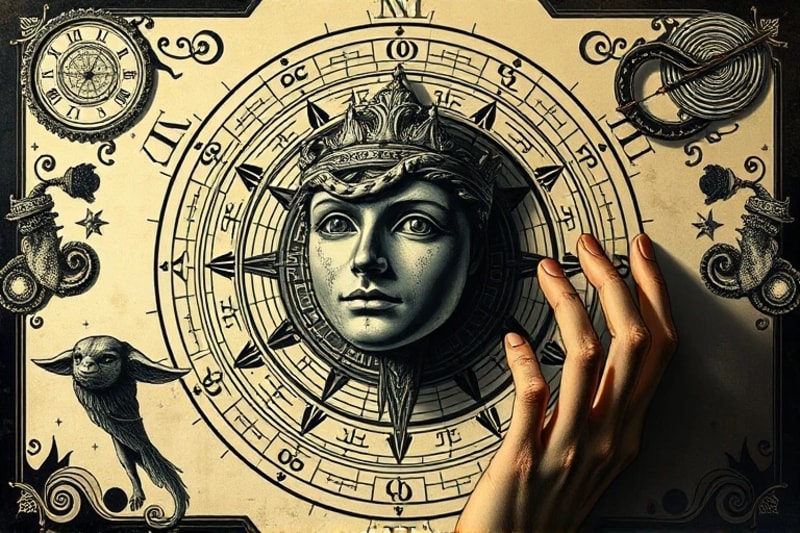
A richly detailed oil painting capturing a conceptual still-life of ancient astrological tools juxtaposed with symbolic representations of Jungian archetypes.
This AI-generated artwork evokes the profound historical and psychological connections between celestial observation and the universal patterns of the human soul.
For instance, a transit of Saturn over a natal planet might activate the Father/Senex archetype, bringing themes of responsibility, structure, and maturation to the forefront. Conversely, a transit of Uranus could activate the Rebel/Innovator archetype, prompting sudden changes and a desire for liberation. These periods are often experienced as significant psychological shifts, challenges, or opportunities for growth.
Progressions, another dynamic technique, symbolize the internal unfolding of the psyche over time, often reflecting a slower, more deliberate evolution of archetypal themes. Together, transits and progressions offer a framework for understanding the ebb and flow of archetypal activation, providing insight into periods of profound personal transformation and development. This dynamic interplay can be seen as a form of "cosmic timing" for our psychological evolution.
The Holographic Universe and Synchronicity
The concept of a holographic universe, where every part contains information about the whole, offers a compelling metaphor for the connection between celestial mechanics and the psyche. In this view, the microcosm (human psyche) reflects the macrocosm (celestial movements), not through direct causal influence, but through a principle of interconnectedness and resonance.
Jung's concept of synchronicity—meaningful coincidences that appear to be causally unrelated but are deeply connected on a symbolic level—provides another lens. The alignment of planetary orbits with significant psychological events or archetypal activations could be seen as a form of synchronicity, where the outer cosmic pattern mirrors an inner psychological state. This suggests a non-local connection, where information or patterns are shared across different levels of reality without a conventional causal chain.
Modern theories like Quantum Synastry further explore these non-local connections, proposing that relationships and psychological interactions might be entangled on a quantum level, mirroring the intricate interdependencies observed in celestial mechanics. This perspective moves beyond a simple cause-and-effect model to embrace a more holistic, interconnected understanding of reality.
Implications for Self-Understanding and Evolution
Embracing the idea that celestial mechanics influence archetypal patterns offers profound implications for self-understanding and personal evolution. By recognizing the cosmic rhythms at play, individuals can gain deeper insight into their inherent psychological predispositions, their life cycles, and the universal themes that shape their journey.
This understanding fosters a sense of being part of a larger, meaningful cosmic order. It encourages individuals to engage consciously with their archetypal energies, rather than being unconsciously driven by them. For example, understanding a challenging Saturn transit might lead to a conscious effort to build structure and responsibility, rather than succumbing to feelings of limitation.
Furthermore, this perspective can enhance our appreciation for the interconnectedness of all things, from the smallest quantum particle to the grandest galactic movements. It invites us to see our lives not as isolated events but as integral components of a vast, evolving cosmic narrative. Exploring topics such as Astro-Genomics suggests even deeper, inherent blueprints that might be influenced by these celestial patterns.
The study of planetary dignities and electional astrology, as discussed in Planetary Dignities Electional Astrology Rulerships Beyond, further illustrates how specific celestial configurations are chosen for optimal outcomes, reflecting a conscious engagement with these archetypal forces. This holistic approach empowers individuals to navigate their psychological landscape with greater awareness, purpose, and alignment with the cosmic dance.
Explore More Cosmic Insights
- Advanced Zodiac Compatibility: Decanate & Duad Influences
- Quantum Mechanics Manifestation: Cosmic Laws Transformation
- Astrological Aspects: Harmony and Tension in the Natal Chart
Source: Hybrid content assisted by AI and human editorial supervision.


Comments
Post a Comment