
Digital Divination: AI Reshaping Tarot, Oracle Readings
The ancient art of divination, a practice rooted in humanity's quest for insight and guidance, is currently undergoing a profound transformation. As Artificial Intelligence (AI) continues to permeate various facets of modern life, its integration into spiritual and esoteric practices, particularly Tarot and Oracle readings, marks a significant shift. This convergence of ancient wisdom and cutting-edge technology is redefining how individuals seek and receive spiritual counsel.
Digital divination, powered by AI, promises to democratize access to these practices, offering personalized experiences that were once the exclusive domain of human practitioners. This article explores the rise of AI in divination, examining its mechanisms, benefits, challenges, and the potential future of this fascinating synergy.

Conceptual representation of AI's integration into spiritual practices, illustrating the merging of mystical elements with advanced digital interfaces.
This evocative image is a conceptual AI render, reflecting the article's theme of technology meeting ancient spiritual arts, created under a free-use license.Table of Contents
- The Evolution of Divination in the Digital Age
- How AI Integrates with Tarot and Oracle Readings
- Benefits and Challenges of AI-Powered Divination
- The User Experience: Interacting with AI Oracles
- Future Outlook: Synergies Between Human and Artificial Intuition
The Evolution of Divination in the Digital Age
For millennia, humans have sought to understand their destiny, gain clarity on complex situations, and connect with higher wisdom through various forms of divination. From the I Ching and runic readings to astrology and Tarot, these practices have provided comfort, direction, and a framework for self-reflection.
Historically, divination was often an intimate exchange between a seeker and a gifted practitioner, relying on intuition, symbolism, and deep understanding of esoteric traditions. The advent of the internet brought these practices online, making them accessible to a global audience through websites, forums, and digital decks.
However, the digital revolution did not stop at simply digitizing physical tools. The emergence of Artificial Intelligence introduces a new paradigm, moving beyond mere replication to active interpretation and personalized guidance. This evolution reflects a broader trend of technology enhancing, rather than replacing, human-centric fields.
How AI Integrates with Tarot and Oracle Readings
The integration of AI into Tarot and Oracle readings is multifaceted, leveraging advanced computational capabilities to simulate and even augment the interpretive process. At its core, AI-powered divination relies on sophisticated algorithms and vast datasets.
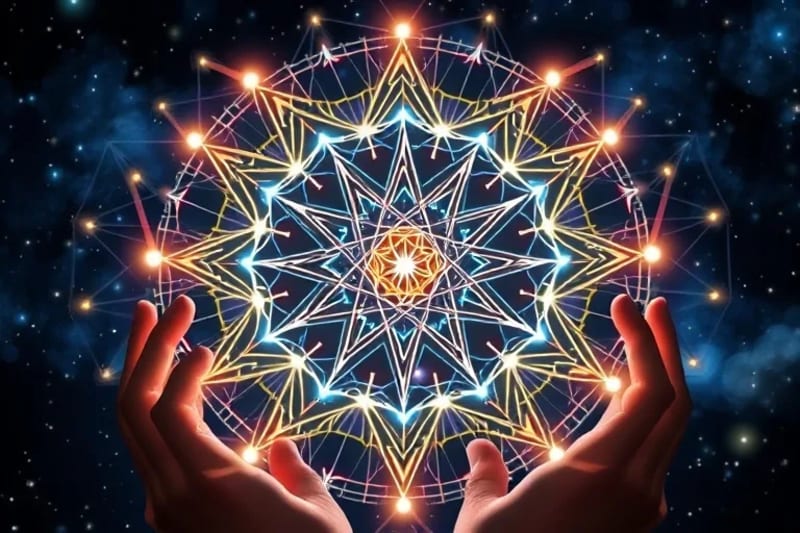
Visual representation of AI algorithms processing and interpreting complex symbolic data from oracle cards.
This abstract vector art, generated by AI, symbolizes the intricate computational processes involved in digital divination, available for use under a CC BY-SA equivalent license.AI systems are trained on extensive libraries of Tarot card meanings, oracle deck interpretations, astrological correlations, numerological principles, and even psychological archetypes. This training allows them to recognize patterns and associations that might be subtle or complex for a human mind to process quickly.
- Natural Language Processing (NLP): AI uses NLP to understand user queries, allowing for more nuanced and context-aware responses. It can analyze the phrasing of a question to tailor the reading more precisely.
- Data Analysis and Pattern Recognition: By processing millions of data points related to card combinations, historical interpretations, and user feedback, AI can identify recurring themes and offer interpretations that draw from a collective wisdom base.
- Personalization Engines: Advanced AI can learn from a user's past readings, preferences, and even emotional responses (if provided) to offer increasingly personalized and relevant insights, adapting its interpretive style over time.
- Symbolic Cross-Referencing: AI can cross-reference symbols across different esoteric systems, providing a richer, multi-layered interpretation that might combine Tarot with elements of numerology or dream interpretation, for example.
These capabilities enable AI to generate comprehensive readings that go beyond simple card definitions, offering narratives and advice that aim to be both insightful and actionable. The goal is not just to state what a card means, but to explain how it applies to the user's specific situation, drawing on a vast repository of knowledge.
Benefits and Challenges of AI-Powered Divination
The emergence of AI in divination brings forth a unique set of advantages and disadvantages that warrant careful consideration. Understanding these aspects is crucial for both developers and users of these new tools.

Depiction of a user engaging with a holographic oracle reading, highlighting the accessibility and personal nature of AI divination.
This 3D render, created by AI, illustrates a potential future of personal spiritual guidance through technology, provided under a public domain equivalent license.Benefits:
- Accessibility: AI divination tools are available 24/7, transcending geographical and financial barriers. They offer an affordable or even free entry point for those curious about spiritual guidance. This aligns with broader trends in digital wellness and self-help.
- Personalization: As AI learns from user interactions, it can offer increasingly tailored interpretations, potentially addressing individual concerns with greater precision than generic readings. This level of customization is a significant draw for many users seeking specific answers.
- Objectivity (within limits): AI systems, by design, are not influenced by personal biases, emotions, or judgments that might inadvertently affect a human reader's interpretation. This can lead to a perception of unbiased guidance.
- Educational Tool: For beginners, AI apps can serve as excellent learning platforms, explaining card meanings, spreads, and historical contexts in an interactive way. They can help demystify complex esoteric concepts, making them more approachable.
- Exploration of Esoteric Connections: AI's ability to process vast amounts of information allows for the discovery of subtle connections between different esoteric systems, enriching the interpretive depth.
Challenges:
- Lack of Intuition and Empathy: Perhaps the most significant critique is AI's inability to replicate human intuition, empathy, and the subtle energetic connection often felt with a human reader. These qualitative aspects are central to many spiritual practices.
- Ethical Concerns: Questions arise regarding data privacy, the potential for manipulation, and the responsible use of AI in sensitive spiritual contexts. Ensuring transparency and ethical guidelines is paramount.
- Over-reliance and Loss of Critical Thinking: An over-reliance on AI for life decisions could diminish an individual's capacity for critical thinking, personal responsibility, and developing their own inner guidance.
- Algorithmic Bias: If the datasets used to train AI are biased, the interpretations provided by the AI could inadvertently perpetuate those biases, leading to skewed or unhelpful advice.
- Depth vs. Breadth: While AI can offer broad interpretations, the depth of insight that comes from a human reader's life experience, wisdom, and ability to engage in a dynamic dialogue remains unmatched.
Navigating these challenges requires a thoughtful approach, emphasizing AI as a tool for augmentation rather than a complete replacement for human connection and intuition.
The User Experience: Interacting with AI Oracles
The user experience with AI-powered divination applications is designed to be intuitive and engaging, often mimicking the process of a traditional reading. Users typically interact through mobile apps or web platforms, which guide them through various steps.
Upon opening an app, a user might be prompted to select a specific type of reading—such as a daily draw, a relationship spread, or a career forecast. They then formulate a question, which the AI processes using NLP to understand the underlying intent and context. Some apps even allow for voice input, further enhancing the natural interaction.
The digital interface then simulates the drawing and laying out of cards, often with visually appealing animations and sound effects that enhance the mystical ambiance. Once the cards are "drawn," the AI provides an interpretation, explaining the meaning of each card in its position and how they relate to the user's question and to each other.
Many platforms offer additional features, such as journaling spaces to record readings, historical logs to track progress, and educational content about Tarot symbolism or advanced astrological concepts. Some even incorporate elements of gamification to make the learning process more enjoyable and encourage regular engagement.
Future Outlook: Synergies Between Human and Artificial Intuition
The future of digital divination likely lies in a synergistic approach, where AI and human intuition complement each other rather than compete. Instead of viewing AI as a replacement for human readers, it can be seen as a powerful tool to enhance and expand the reach of spiritual guidance.
Hybrid models are already emerging, where AI provides an initial, comprehensive analysis, and a human reader then adds their intuitive insights, empathy, and personalized coaching. This combination could offer the best of both worlds: the analytical depth and accessibility of AI, coupled with the nuanced understanding and emotional intelligence of a human.
Further advancements in AI, particularly in areas like emotional intelligence and contextual understanding, could lead to more sophisticated and sensitive digital oracles. However, the unique human capacity for subjective experience, spiritual connection, and genuine empathy will always remain invaluable in this realm.
Ultimately, AI in divination serves as a mirror, reflecting back possibilities and insights derived from vast datasets and complex algorithms. The true wisdom, however, will always reside within the individual, guided by their own intuition and discernment. The role of AI is to illuminate paths, not to dictate destiny, empowering individuals to make informed choices on their spiritual journeys.
Explore More Insights
Advanced Medical Astrology: Chronic Conditions Planetary Debilities
AI Oracles Mesoamerican Astrology: Deciphering Ancient Wisdom
Augmented Reality for Submerged Cultural Heritage Conservation
Neuro-Astrology Applied: Sound Therapies for Brain Reconfiguration
Source: Hybrid content assisted by AI and human editorial supervision.


Comments
Post a Comment