
Astrology Sacred Geometry Art Cosmic Patterns Inspiration
The intersection of astrology and sacred geometry art offers a profound pathway to creative inspiration and a deeper understanding of the cosmos. These ancient disciplines, often perceived as distinct, share fundamental principles rooted in universal patterns and divine order. By exploring their synergy, artists and enthusiasts alike can unlock new dimensions of expression, translating celestial influences into tangible, aesthetically pleasing forms.
This article delves into how astrological insights, combined with the timeless principles of sacred geometry, can serve as a powerful catalyst for artistic creation. We will explore the historical connections, foundational concepts, and practical applications that bridge these two fascinating fields, providing a comprehensive guide for those seeking to chart cosmic patterns for their creative endeavors.
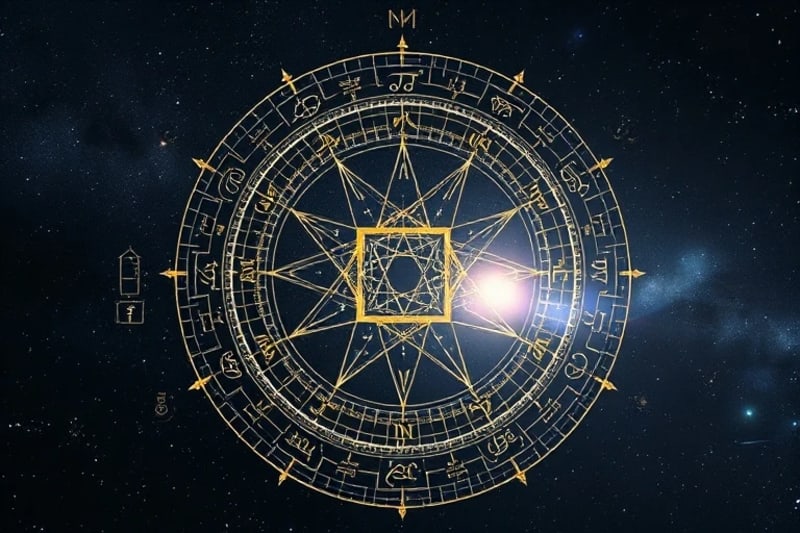
An intricate astrological chart seamlessly integrated with sacred geometric patterns, revealing the underlying cosmic order.
Table of Contents
- Historical Foundations: Ancient Wisdom & Cosmic Order
- Astrology: Charting the Celestial Blueprint
- Sacred Geometry: The Universal Language of Form
- The Intersection: Where Astrology Meets Sacred Geometry
- Artistic Application: Creating Cosmic-Inspired Art
- Benefits of Integrating Astrology & Sacred Geometry in Art
- Practical Exercises for Creative Exploration
Historical Foundations: Ancient Wisdom & Cosmic Order
Both astrology and sacred geometry trace their origins to ancient civilizations, where the observation of celestial bodies and the recognition of recurring patterns in nature were deeply intertwined. Cultures from Egypt and Mesopotamia to Greece and India understood the universe as a harmonious system governed by precise laws.
Ancient astronomers and philosophers often served as both scientists and spiritual guides, deciphering the messages of the stars and the hidden structures of existence. They believed that the macrocosm (the universe) was reflected in the microcosm (humanity and nature), and that understanding these universal principles could lead to profound insights into life, destiny, and the divine.
The construction of megalithic structures, temples, and pyramids often incorporated both astrological alignments and geometric ratios, demonstrating a sophisticated understanding of these concepts. These ancient practices laid the groundwork for the modern exploration of how cosmic patterns influence our lives and how they can be expressed through art.
Astrology: Charting the Celestial Blueprint
Astrology is the study of the correlations between celestial events and earthly affairs. It posits that the positions and movements of planets, stars, and other celestial bodies at the moment of an individual's birth (or an event's inception) influence personality, destiny, and life experiences. A birth chart, also known as a natal chart, is a map of the heavens at a specific time and location.
Key components of an astrological chart include:
- Planets: Representing different psychological functions and drives (e.g., Sun for ego, Moon for emotions, Mercury for communication).
- Zodiac Signs: Twelve archetypal energies that color how the planets express themselves (e.g., Aries for initiation, Taurus for stability).
- Houses: Twelve areas of life where planetary energies manifest (e.g., 1st House for self, 7th House for relationships).
- Aspects: The angular relationships between planets, indicating harmonious or challenging dynamics.
Understanding these elements provides a rich symbolic language that can be translated into visual art. The interplay of planets and signs, the geometry of aspects, and the overall structure of the chart itself are fertile ground for creative interpretation. For instance, the placement of Venus in Signs can reveal an individual's aesthetic preferences and artistic expression.
Sacred Geometry: The Universal Language of Form
Sacred geometry is the study of universal patterns found in nature, art, and architecture, believed to reveal the underlying structure of creation. These patterns are not merely aesthetic but are considered blueprints of the cosmos, reflecting divine order and harmony. From the microscopic to the macroscopic, these geometric forms are present everywhere.
Key concepts in sacred geometry include:
- The Golden Ratio (Phi, φ): Approximately 1.618, this ratio appears in spirals, human proportions, and natural growth patterns.
- Fibonacci Sequence: A series of numbers where each number is the sum of the two preceding ones (0, 1, 1, 2, 3, 5, 8...), closely related to the Golden Ratio and spirals in nature.
- Vesica Piscis: Formed by the intersection of two circles, it symbolizes creation and the union of opposites.
- Flower of Life: A complex geometric pattern composed of multiple overlapping circles, considered a blueprint of the universe.
- Platonic Solids: Five regular convex polyhedra (tetrahedron, cube, octahedron, dodecahedron, icosahedron) that are the only three-dimensional shapes whose faces are all identical regular polygons.
A stylized representation of the Golden Ratio spiral overlaid onto a celestial sphere, symbolizing universal order.
These geometric forms are not just abstract shapes; they are seen as energetic templates that structure reality. By incorporating them into art, creators can infuse their work with universal harmony and resonance, tapping into a deeper, more profound aesthetic. They represent the visible manifestation of cosmic laws, offering a visual vocabulary for the unseen.
The Intersection: Where Astrology Meets Sacred Geometry
The profound connection between astrology and sacred geometry lies in their shared emphasis on patterns, cycles, and relationships. An astrological chart is inherently a geometric diagram, mapping the angular relationships (aspects) between celestial bodies. These aspects form specific geometric shapes within the zodiac wheel, such as trines (120 degrees), squares (90 degrees), and oppositions (180 degrees).
Consider the zodiac wheel itself, a perfect circle divided into twelve sections, each representing a sign. This division is a fundamental geometric act. The relationships between planets within this circle create a complex web of lines and angles that resonate with the principles of sacred geometry. For example, a Grand Trine forms an equilateral triangle, a symbol of stability and harmony, while a Grand Cross forms a square, representing tension and dynamic energy.
Furthermore, the cycles of planets, such as the Uranus Astrology cycle of innovation and rebellion, can be visualized as spirals or waves, mirroring the Fibonacci sequence and the Golden Ratio found in natural growth. This cosmic dance of celestial bodies is a living, breathing example of sacred geometry in motion, constantly creating and recreating universal patterns.
Artistic Application: Creating Cosmic-Inspired Art
For artists, integrating astrology and sacred geometry opens up a vast realm of creative possibilities. It's not just about drawing stars and planets; it's about embodying the energetic principles and structural integrity of the cosmos in visual form. Here are some approaches:
- Natal Chart Mandalas: Transform a personal birth chart into a mandala, using colors, symbols, and geometric patterns to represent planets, signs, and aspects. Each element of the chart can be assigned a specific geometric form or color.
- Planetary Sigils and Glyphs: Incorporate astrological glyphs for planets and signs into geometric compositions. These ancient symbols carry deep meaning and can be stylized within sacred geometric frameworks.
- Cosmic Landscapes: Create abstract or representational art that depicts celestial phenomena (nebulae, galaxies) using sacred geometric principles for composition and flow. The Golden Ratio can guide the placement of key elements.
- Elemental Art: Focus on the four elements (Fire, Earth, Air, Water) associated with zodiac signs, and represent them through geometric patterns. For example, a tetrahedron for Fire, a cube for Earth.
- Aspect Geometry: Visually represent the geometric shapes formed by planetary aspects in a birth chart. A square aspect could be depicted as a challenging, angular form, while a trine could be a flowing, harmonious curve.

An abstract watercolor composition featuring overlapping Platonic solids, subtly integrated with astrological glyphs.
Artists can use various mediums, from digital art and painting to sculpture and textile design, to bring these cosmic patterns to life. The goal is to create art that not only appeals visually but also resonates energetically and spiritually with the viewer, reflecting the universal order it embodies.
Benefits of Integrating Astrology & Sacred Geometry in Art
The practice of combining astrological insights with sacred geometry in art offers numerous benefits, extending beyond mere aesthetic appeal. This approach can be deeply transformative for both the creator and the observer.
Firstly, it fosters a deeper connection to the universal order. By consciously working with these cosmic patterns, artists become conduits for universal energies, translating complex celestial information into accessible visual forms. This process can lead to a heightened sense of purpose and spiritual alignment.
Secondly, it enhances creative inspiration and problem-solving. When artists understand the underlying geometric structures of the cosmos, they gain a new framework for composition, balance, and harmony in their work. This can help overcome creative blocks and lead to innovative artistic solutions. It's a way of manifesting abundance in creative output.
Thirdly, the resulting art can have a therapeutic and meditative quality. The inherent harmony and balance of sacred geometry, combined with the symbolic depth of astrology, can create pieces that promote peace, introspection, and healing. Such art can serve as a focal point for meditation or a tool for personal reflection, helping individuals to understand their own cosmic blueprint.
Finally, it provides a unique way to explore personal identity and destiny. Creating art based on one's own birth chart, or the charts of loved ones, becomes an act of self-discovery. It allows for a visual exploration of individual strengths, challenges, and life paths, offering a new perspective on personal narratives.
Practical Exercises for Creative Exploration
To begin your journey into astrological and sacred geometric art, consider these practical exercises:
- Chart Deconstruction: Obtain your natal chart. Identify the most prominent aspects (squares, trines, oppositions) and the geometric shapes they form. Sketch these shapes, experimenting with different colors and textures to represent the energies involved.
- Planetary Symbolism: Choose one planet (e.g., Mars for action, Jupiter for expansion) and research its associated colors, metals, and geometric forms. Create a piece of art that embodies these attributes within a sacred geometric framework like the Flower of Life or a Vesica Piscis.
- Zodiacal Patterns: Select a zodiac sign and explore its elemental and modality associations. Design a geometric pattern that visually represents these qualities. For instance, a fiery sign might be represented by sharp, dynamic angles, while a watery sign by flowing, curvilinear forms.
- Golden Ratio Composition: When planning any artwork, consciously apply the Golden Ratio or Fibonacci sequence to your composition. Use these principles to guide the placement of your astrological symbols or geometric elements, ensuring inherent balance.
- Meditative Drawing: Practice drawing sacred geometric patterns like the Seed of Life or Metatron's Cube while focusing on a specific astrological influence (e.g., a current planetary transit). This can be a meditative practice that enhances both artistic skill and spiritual awareness.
These exercises are designed to help you intuitively connect with the cosmic patterns and translate them into your unique artistic vision. The journey is one of discovery, blending ancient wisdom with contemporary creativity.
Source: Hybrid content assisted by AI and human editorial supervision.


Comments
Post a Comment