
Mesoamerican Lunar Oracles: Ancient Predictive Astrology
The celestial dance of the Moon has captivated humanity across millennia, serving as a primal clock, a beacon of mystery, and a profound source of spiritual insight. Among the most sophisticated interpreters of lunar rhythms were the ancient Mesoamerican civilizations, including the Maya, Aztec, and Zapotec. Their intricate calendrical systems and cosmological beliefs reveal a deep understanding of the Moon's influence, not merely as a timekeeper but as a powerful oracle for prediction, agricultural planning, and spiritual guidance. This exploration delves into the heart of Mesoamerican lunar wisdom, uncovering how these ancient insights can enrich and deepen modern predictive astrology.
The precision with which these cultures tracked celestial movements, particularly those of the Moon, was astonishing. Their observatories, often integrated into ceremonial centers, allowed for meticulous long-term observations that informed their complex understanding of time and destiny. Far from being simple agrarian societies, the Mesoamericans developed a profound philosophical framework where the cosmos directly influenced earthly affairs and human fate, with the Moon playing a central, dynamic role in this intricate cosmic tapestry.
Table of Contents
- The Cosmic Tapestry: Lunar Significance in Mesoamerican Cultures
- Calendrical Mastery: Tzolkin, Haab', and the Lunar Dance
- Deities and Divination: The Moon's Prophetic Voice
- Bridging Eras: Mesoamerican Lunar Wisdom in Modern Astrology
- Practical Applications: Integrating Ancient Lunar Insights
- The Enduring Legacy: Reclaiming Celestial Rhythms
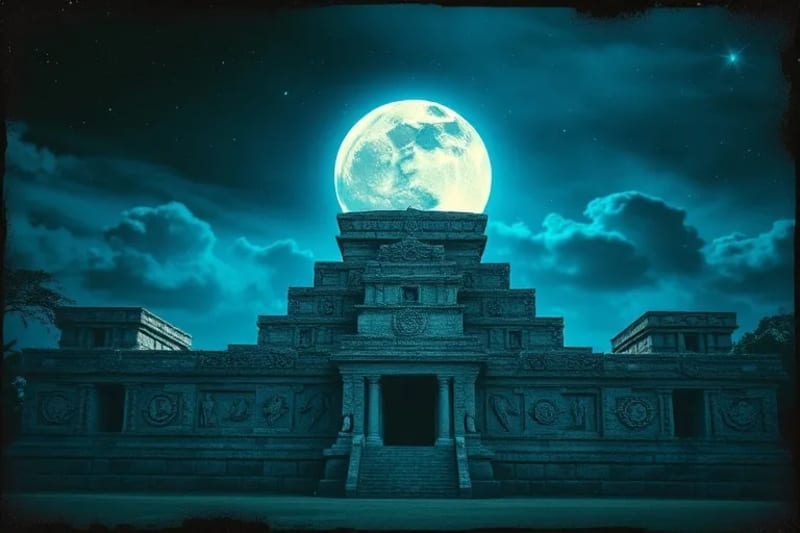
Ancient Mesoamerican architectural marvels served as profound observatories, aligning with celestial bodies to decode the Moon's prophetic messages and integrate them into daily life and spiritual practices.
Conceptual AI rendering, exploring the historical interplay of architecture, astronomy, and spiritual cosmology in ancient Mesoamerica.The Cosmic Tapestry: Lunar Significance in Mesoamerican Cultures
For Mesoamerican civilizations, the Moon was far more than a nocturnal light source; it was a living entity, a deity, and a fundamental component of the cosmic order. Its phases dictated agricultural cycles, influencing planting and harvesting, and its movements were intricately linked to human fertility, emotional states, and the ebb and flow of life itself. The Maya, for instance, held the Moon in high regard, often associating it with feminine deities, water, and the underworld.
The Moon's cyclical nature mirrored the Mesoamerican worldview of creation, destruction, and rebirth. This cyclical perception permeated their understanding of time, history, and prophecy. Lunar eclipses, in particular, were moments of intense spiritual significance, often viewed as portents of change, danger, or divine intervention. Rituals and ceremonies were conducted to appease lunar deities and interpret these celestial messages, underscoring the Moon's active role in shaping destiny.
Unlike Western astrology, which often emphasizes solar-centric individuality, Mesoamerican cosmology presented a more integrated view of humanity within the larger cosmic framework. The Moon's influence was collective as much as individual, affecting communities, crops, and the very fabric of society. This holistic perspective offers a rich counterpoint to modern astrological interpretations, encouraging a broader understanding of lunar energies.
Calendrical Mastery: Tzolkin, Haab', and the Lunar Dance
The calendrical systems of Mesoamerica are renowned for their complexity and accuracy, reflecting an advanced astronomical knowledge. While the Tzolkin (sacred 260-day calendar) and the Haab' (365-day civil calendar) are well-known, the underlying lunar cycles were crucial for their calibration and predictive power. The Maya, for example, accurately calculated the synodic month (the time from one new moon to the next) to an astonishing degree of precision.
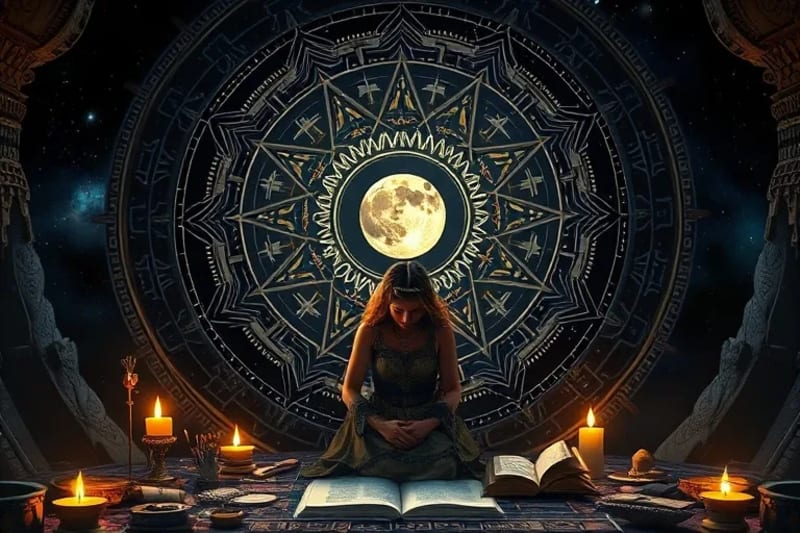
Ancient priests and priestesses meticulously tracked lunar movements, integrating these observations into complex calendrical systems for divination and societal planning.
Digital artwork inspired by the historical practices of Mayan celestial observers and their profound wisdom.The Maya developed specific lunar series within their Long Count calendar, tracking the age of the Moon at the start of each month. This allowed them to predict lunar eclipses with remarkable accuracy, a feat that required centuries of continuous observation and sophisticated mathematical understanding. These predictions were not merely academic; they were vital for ritual timing and understanding the unfolding of cosmic events.
Consider the relationship between the Tzolkin and the lunar cycle. While not directly lunar, the Tzolkin's 260-day cycle resonates with human gestation and other natural rhythms. The interplay between this sacred cycle and the more observable 29.5-day lunar cycle created a multi-layered system for understanding auspicious times, personal destinies, and collective energies. This intricate calendrical framework provided a precise language for interpreting the Moon's influence, offering a blueprint for life's unfolding events.
For those interested in deeper astrological insights, understanding how different celestial bodies interact is key. The article on Inter-Elemental Relationships Astrology: Compatibility Harmony Strategies offers a complementary perspective on how various cosmic forces combine to shape experiences.
Key Mesoamerican Calendrical Systems and Lunar Connections
| Calendar System | Description | Lunar Connection |
|---|---|---|
| Tzolkin (Sacred Calendar) | A 260-day cycle formed by the permutation of 20 day names and 13 numbers. Used for divination, naming, and ritual timing. | While not directly lunar, its cycles align with various natural rhythms, and its interaction with the Haab' and lunar cycles creates complex predictive patterns. |
| Haab' (Civil Calendar) | A 365-day cycle composed of 18 months of 20 days each, plus a 5-day period (Uayeb). Governed agricultural and civic life. | Used in conjunction with lunar tables to predict agricultural cycles and align ceremonies with specific lunar phases for optimal outcomes. |
| Long Count Calendar | A continuous count of days from a mythological starting point (3114 BCE), used for monumental inscriptions and historical dating. | Incorporated detailed lunar series (e.g., Lunar Table at Palenque) to track lunar phases and predict eclipses over vast spans of time, demonstrating advanced astronomical knowledge. |
Deities and Divination: The Moon's Prophetic Voice
The Moon was often personified as powerful deities in Mesoamerican pantheons, reflecting its diverse influences. For the Maya, Ixchel was a prominent Moon goddess, associated with fertility, childbirth, weaving, medicine, and destruction. Her dual nature — nurturing and fierce — mirrored the Moon's own phases and its capacity for both creation and dissolution. Understanding the characteristics of such deities provides insight into the symbolic meaning of lunar phenomena.
Divination practices were deeply interwoven with lunar observations. Priests and shamans would interpret the Moon's phase, position, and any unusual phenomena (like eclipses or halos) to provide guidance on warfare, political decisions, marriage, and personal well-being. The interpretation was not static; it was dynamic, considering the Moon's current state within the broader calendrical cycles and the specific context of the question being asked.
The concept of "lunar oracles" in Mesoamerica extended beyond simple observation. It involved a deep spiritual connection, where the Moon was seen as a direct communicator of divine will and cosmic energies. This spiritual dimension is often overlooked in purely astronomical analyses but is crucial for grasping the full scope of their predictive astrology. The Moon was not just an object to be measured; it was a sacred messenger.
Bridging Eras: Mesoamerican Lunar Wisdom in Modern Astrology
Modern predictive astrology often focuses on transits, progressions, and solar returns, with the Moon's role primarily linked to emotions, habits, and the subconscious. However, integrating Mesoamerican lunar wisdom can significantly broaden this perspective. By understanding the Moon as a collective oracle, we can gain insights into broader societal trends, environmental shifts, and the underlying energetic currents affecting communities.
The emphasis on cyclical time in Mesoamerican thought can inform our interpretation of lunar cycles. Instead of viewing a New Moon or Full Moon as isolated events, we can see them as part of a larger, ongoing narrative, influenced by historical patterns and future potentials. This perspective encourages a more holistic and long-term view of lunar influences, moving beyond immediate emotional responses to deeper, unfolding processes.
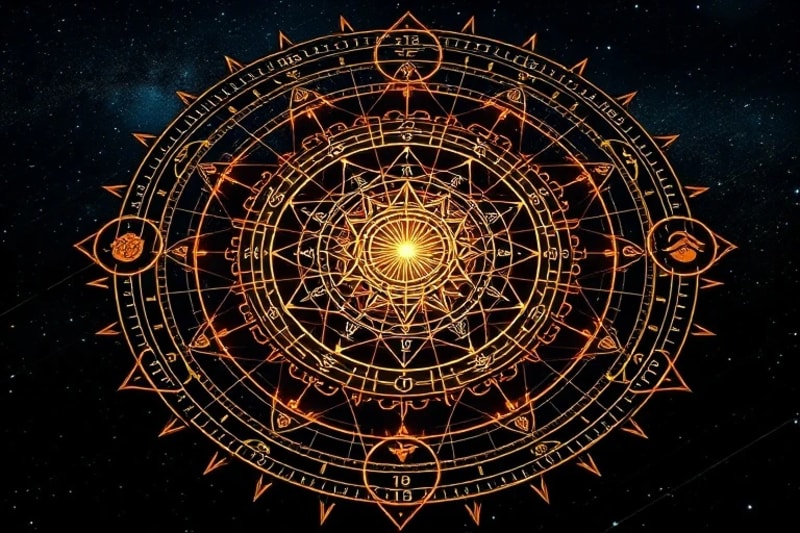
The synthesis of ancient Mesoamerican calendrical wisdom with contemporary astrological charts reveals a deeper, more interconnected understanding of cosmic influences.
Abstract 3D rendering illustrating the conceptual integration of historical and modern celestial knowledge.For instance, when analyzing significant astrological cycles, such as those discussed in Astrological Cycles: Major Transits Global Events Impact, incorporating the Mesoamerican understanding of lunar eclipses as profound turning points can add another layer of predictive depth. These eclipses, viewed not just as personal challenges but as collective omens, can highlight periods of significant societal transformation or upheaval.
Comparative Lunar Interpretations: Mesoamerican vs. Modern Astrology
| Aspect | Mesoamerican Lunar Oracle | Modern Predictive Astrology (General) |
|---|---|---|
| Primary Focus | Collective well-being, agricultural cycles, societal fate, divine messages. | Individual emotions, subconscious, habits, personal growth, relationship dynamics. |
| Eclipses | Profound omens, portents of significant societal change, danger, or divine intervention. Required extensive rituals. | Periods of accelerated change, fated events, emotional upheaval, revelation, often with a personal focus. |
| Calendrical Integration | Deeply integrated into complex, multi-layered calendars (Tzolkin, Haab', Long Count) for precise timing and long-term prophecy. | Lunar phases are tracked, but often as a separate cycle within the broader tropical zodiac framework. |
| Deification | Moon often personified as powerful deities (e.g., Ixchel) with complex attributes, directly influencing earthly affairs. | Moon is an astrological planet/luminary, representing archetypal energies rather than a direct deity. |
Practical Applications: Integrating Ancient Lunar Insights
How can a modern astrologer practically apply Mesoamerican lunar wisdom? One approach is to pay closer attention to the collective impact of lunar phases and eclipses. Instead of solely focusing on personal charts, consider how these celestial events might be influencing global events, social moods, and environmental patterns. This broader perspective can offer more nuanced predictive insights.
Another application involves studying the interplay between lunar cycles and other planetary transits with a Mesoamerican cyclical mindset. For example, a significant planetary transit occurring during a particular lunar phase might be interpreted not just for its immediate impact but for its role in a larger, unfolding cosmic narrative. This requires a shift from linear to cyclical thinking about time and destiny.
Furthermore, exploring the symbolism of Mesoamerican lunar deities can enrich our understanding of the Moon's archetypal energies. Ixchel's association with both creation and destruction, healing and storms, provides a more complex framework for interpreting lunar influences than a singular focus on nurturing or emotion. This can help astrologers offer more comprehensive guidance.
For those exploring deeper psychological dimensions in astrology, the principles of Psycho-Astrology: Jungian Archetypes Shadow Wholeness Integration can provide a framework to connect the ancient, archetypal energies of lunar deities with modern psychological understanding of the self.
The Enduring Legacy: Reclaiming Celestial Rhythms
The wisdom of Mesoamerican lunar oracles is a testament to humanity's enduring quest to understand its place in the cosmos. By meticulously observing the Moon and integrating its rhythms into their complex calendrical and spiritual systems, these ancient civilizations developed a sophisticated predictive astrology that was deeply connected to the cycles of nature and the divine. Their legacy offers a profound opportunity for modern astrologers to expand their interpretative horizons, moving beyond individualistic perspectives to embrace a more collective, cyclical, and spiritually integrated understanding of lunar influence.
Reclaiming these ancient celestial rhythms is not about abandoning modern techniques but about enriching them. It's about recognizing the universal patterns that connect us to our ancestors and to the cosmos itself. The Moon, in its perpetual dance, continues to whisper its ancient secrets, inviting us to listen more deeply and to integrate its profound wisdom into our contemporary understanding of destiny and time.
Explore More Cosmic Insights
- MC Ruler Aspects: Public Persona, Career Path Guide
- Scorpio Horoscope 2024: Love, Career, Wellness
- Ceres Astrology: Nurturing, Loss, Self-Care
- Chinese Zodiac 2025: Wood Snake Forecast & Predictions
- Quantum Alchemy: Transmuting Lead Experiences into Gold Opportunities
- Techno-Shamanism Digital Healing Modern Spiritual Practices
- Emerald Tablet Quantum Manifestation Hermetic Principles
- Energetic Protection: Shielding Your Aura
- Collective Consciousness Zodiacal Eras Societal Shifts
- Candle Magic Complex Intentions Timing Sigils Color Lore
- Automatic Writing for Shadow Work: Accessing Subconscious Insights
- Decans Zodiac: Deeper Layers Sign Interpretation
- Astrodynamics: Interplanetary Travel Routes in the Solar System
- Future Astrology: AI, Big Data, Cosmic Interpretation
- Composite Synastry: The Relationship as a Unique Entity
Source: Hybrid content assisted by AI and human editorial supervision.


Comments
Post a Comment